OET Reading Final Mastery System Complete Strategy for Parts A, B & C Success
Introduction
OET Reading success is not achieved by mastering Parts A, B, and C separately. Real exam success comes when you can combine all three sections into one smooth performance system.
Most candidates know strategies but still struggle in the exam because they fail to connect:
- Speed (Part A)
- Meaning (Part B)
- Inference (Part C)
- Time management across the full test
This final lesson brings everything together into a complete Reading Mastery System that prepares you for real exam execution. The OET Reading Final Mastery System combines strategies from all three parts of the exam, but these techniques are only effective if you first build strong skimming and scanning skills. You can learn these essential reading foundations in OET Reading Mastery 2026 Complete Guide to Skimming & Scanning High Score Strategy.
Learning Objectives
By the end of this lesson, you will be able to:
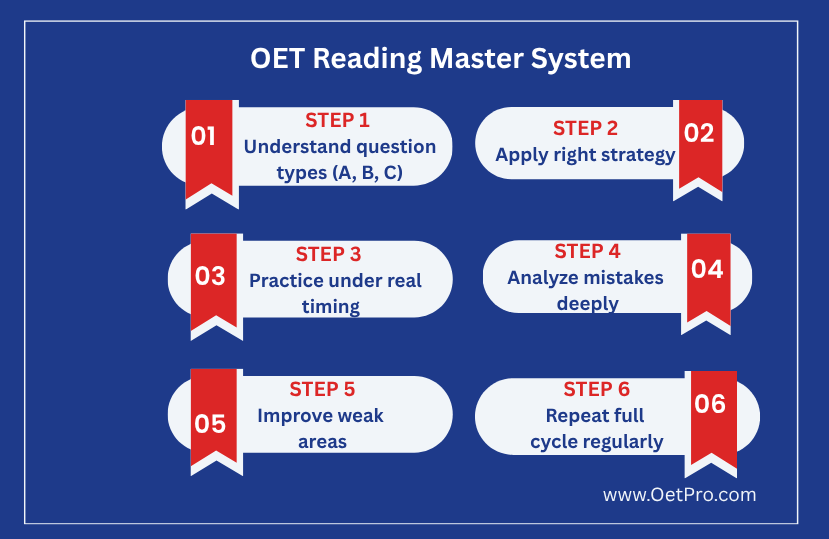
- Combine strategies for Parts A, B, and C
- Manage time across the full Reading test
- Apply correct thinking for each section automatically
- Reduce exam stress and confusion
- Improve overall accuracy under pressure
- Build a final revision system before exam day
- Develop full Reading exam readiness
Overview of OET Reading Final Mastery System
This system is designed to simulate real exam performance conditions, not just practice.
It focuses on four core areas:
1. Section Mastery
Each part has a different focus:
- Part A -> Speed + scanning
- Part B -> Meaning + MCQs
- Part C -> Inference + deep comprehension
2. Integration System
You must switch thinking styles quickly:
- Fast scanning (A)
- Controlled reasoning (B)
- Deep analysis (C)
3. Time Control Strategy
- Manage total exam time
- Avoid spending too long on any section
- Balance accuracy with speed
4. Exam Simulation Mindset
- Practice under real exam conditions
- No interruptions
- No overthinking
This creates real exam confidence
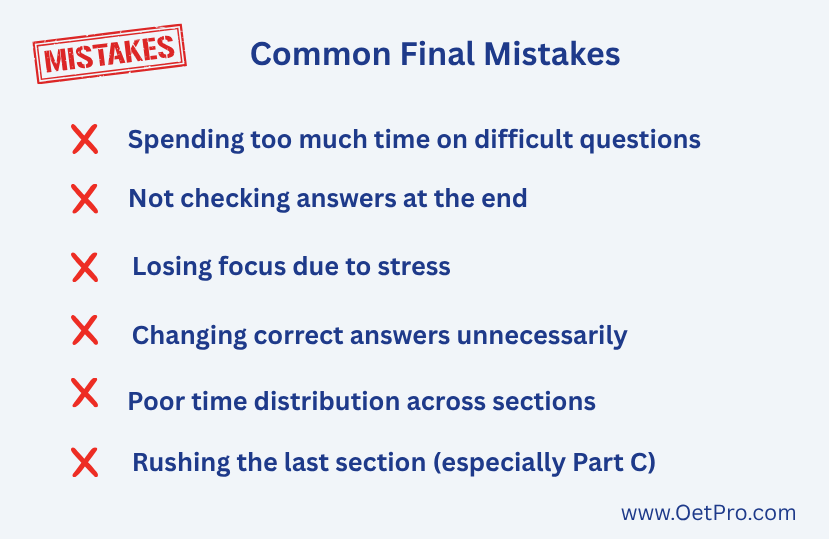
Common Mistakes in Final Preparation
Most students fail at this stage due to poor integration of skills.
Treating each part separately
Students prepare A, B, and C independently but fail to connect them during the exam.
Ignoring time distribution
Spending too long in one section reduces performance in others.
Overthinking MCQs
Changing correct answers due to doubt leads to loss of marks.
Not simulating full tests
Without full mock tests, exam pressure feels overwhelming.
Weak revision system
Students repeat practice but do not refine mistakes.
Full Integration Strategy Framework (OET Reading)
Now we move into the real exam execution system. This is where you learn how to handle OET Reading as one continuous performance task, not three separate sections.
The goal is simple:
- Switch thinking modes quickly
- Maintain accuracy under pressure
- Manage time across all sections
To succeed in Parts A, B, and C, you must be able to quickly locate key information without reading every word. This efficiency comes from strong scanning and structured reading habits. These core skills are explained in the OET Reading Mastery Skimming and Scanning Framework.
The OET Reading Flow System (Real Exam Strategy)
Step 1 — Part A (Speed Mode)
Start with Part A, but think differently from normal reading.
Your mindset:
- Scan, don’t read
- Locate answers, don’t understand everything
- Focus on keywords and structure
Execution rules:
- Move quickly through headings and tables
- Answer direct questions first
- Do not get stuck on one item
Part A = Speed + precision
Step 2 — Part B (Meaning Mode)
Now shift your thinking style completely.
Your mindset:
- Understand purpose of text
- Focus on meaning, not keywords
- Think like a healthcare professional
Execution rules:
- Read question first
- Skim workplace text
- Eliminate wrong MCQs logically
Part B = Meaning + decision-making
Step 3 — Part C (Inference Mode)
Now move into deep comprehension mode.
Your mindset:
- Think beyond the text
- Understand writer intention
- Identify hidden meaning
Execution rules:
- Read questions first
- Skim passage structure
- Read only relevant sections deeply
- Use elimination method
Part C = Inference + logic. The Final Mastery System is built on a step-by-step reading approach where skimming, scanning, and comprehension work together. Without mastering the basics, the full system becomes difficult to apply. You can build this foundation in the OET Reading Mastery Complete Guide 2026.
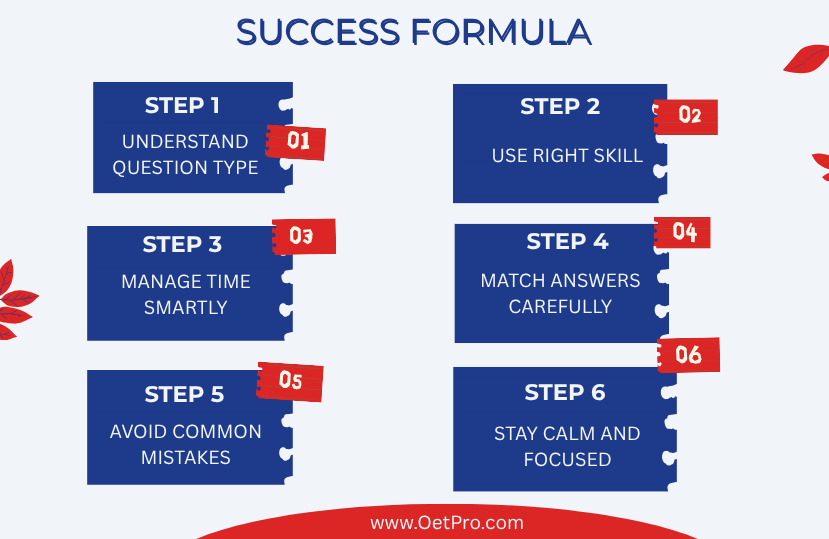
The Switching Technique (Most Important Skill)
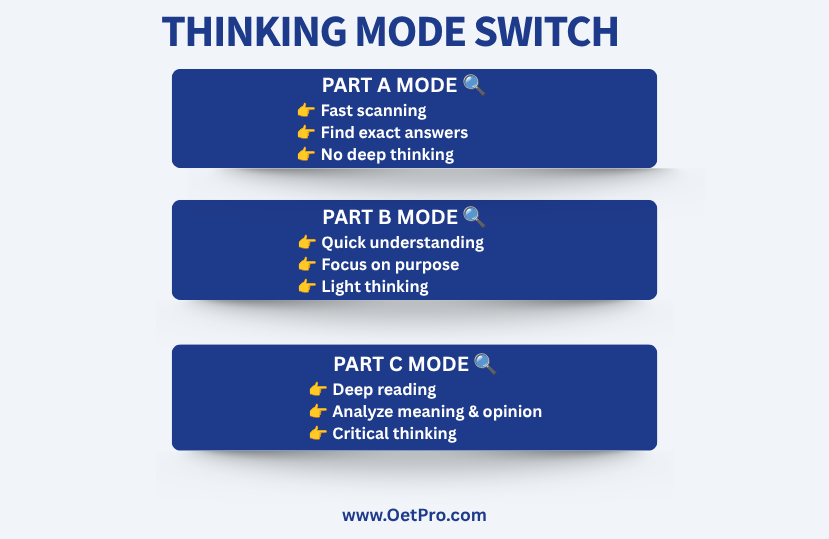
The biggest challenge is not difficulty it is switching thinking modes quickly.
Mode Switching Flow:
- A -> Fast scanning brain
- B -> Meaning interpretation brain
- C -> Analytical inference brain
How to train switching:
- Practice full sections in different order
- Do not always follow A ? B ? C
- Randomize practice sessions
This builds real exam flexibility
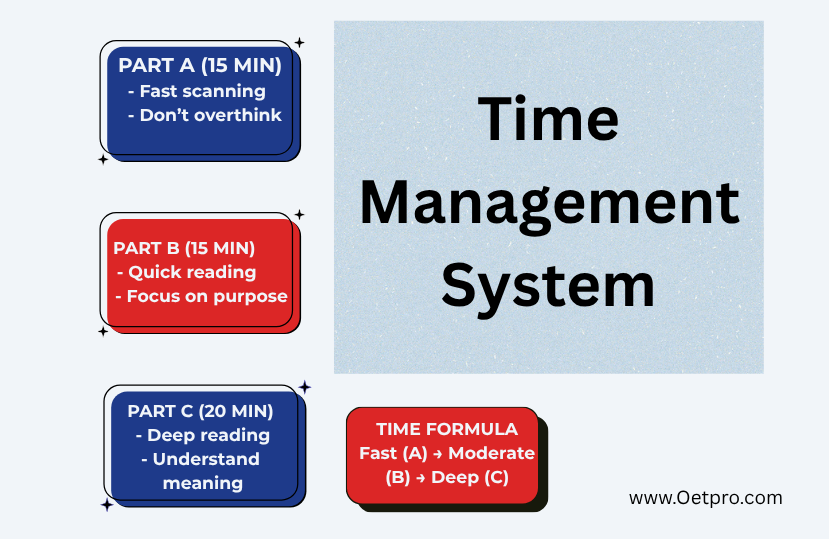
Time Distribution Strategy
Proper time control is critical for final success.
Recommended Timing:
- Part A -> Fast completion (strict time control)
- Part B -> Moderate time (accuracy focus)
- Part C -> Controlled deep reading
Key rule:
Never sacrifice Part C completely for Part A or B
Full Exam Flow Strategy
Before starting:
- Calm mindset
- No panic reading
- Clear time awareness
During exam:
- Do not pause between sections mentally
- Switch modes instantly
- Do not carry confusion from one part to another
After exam:
- Do not second-guess answers
- Trust your strategy execution
Common Integration Mistakes
Mixing strategies between parts
Example: using scanning method in Part C ? wrong approach
Losing time in Part A
Affects entire exam balance
Overthinking Part B MCQs
Leads to confusion and wrong changes
Reading Part C line-by-line
Causes time failure
Panic switching between sections
Breaks focus and accuracy
Examiner-Level Execution Techniques & High-Score Habits
At this stage, we move beyond strategy into exam performance behavior. This is what separates average candidates from high scorers.
OET Reading is not only about understanding texts it is about how you behave under exam pressure.
Examiner-Level Technique 1 — Controlled Confidence
High scorers do not hesitate repeatedly. They make decisions based on logic and move forward.
What this looks like:
- Choose answer and trust reasoning
- Do not change answers without strong reason
- Avoid second-guessing simple questions
Confidence increases speed and accuracy
Examiner-Level Technique 2 — Time Awareness Thinking
You should always know where you are in the exam.
Training method:
- Check time only at section transitions
- Do not check repeatedly during questions
- Mentally track progress per section
This prevents panic and time loss
Examiner-Level Technique 3 — Strategic Skipping
High scorers do NOT get stuck.
How to apply:
- Skip difficult questions immediately
- Mark and return later if time allows
- Prioritize easy marks first
This protects your overall score
Examiner-Level Technique 4 — Emotional Neutrality
OET Reading is designed to confuse candidates with similar options.
You must train:
- Do not get frustrated on difficult MCQs
- Stay calm after wrong answers
- Treat each question independently
Emotional control improves accuracy
Examiner-Level Technique 5 — Pattern Recognition
Over time, OET Reading repeats question styles.
Common patterns:
- Paraphrased meaning questions
- Purpose-based questions in Part B
- Inference-based answers in Part C
Training method:
- After each mock test, identify patterns
- Group similar question types
- Practice targeted improvement
This builds exam familiarity
High-Score Behavior System
Top scorers follow consistent habits:
- Before Exam
- Calm mindset
- No last-minute confusion
- Light revision only
- During Exam
- Follow strategy automatically
- Avoid overthinking
- Trust first logical answer
- After Exam
- No answer checking stress
- Focus on next section only
- Maintain mental stability
Common Final Stage Mistakes
Over-practicing without review
Leads to repeated errors
Changing answers frequently
Reduces accuracy
Panic when time is low
Breaks focus completely
Comparing difficulty between sections
Creates unnecessary stress
Losing confidence after one bad section
Affects entire performance
Final Checklist, Revision Plan & Complete Master Blueprint
This is your final consolidation stage. At this point, you are not learning new strategies—you are building exam-day consistency and execution control.
The goal of OET Reading mastery is simple:
Apply the right strategy automatically under pressure
Final OET Reading Master Checklist
Before entering the exam hall, you should be confident in all three sections and your overall system.
- Part A Mastery Checklist (Speed System)
Make sure you can:
- Scan tables and texts quickly
- Locate answers without reading everything
- Identify keywords instantly
- Avoid wasting time on details
Part A = Speed + precision
- Part B Mastery Checklist (Meaning System)
You should be able to:
- Identify purpose of workplace texts
- Understand MCQs based on meaning
- Avoid keyword traps
- Use elimination confidently
Part B = Meaning + logic
- Part C Mastery Checklist (Inference System)
You must be able to:
- Understand paragraph structure
- Identify implied meaning
- Locate relevant sections quickly
- Solve inference-based MCQs
Part C = Deep comprehension + reasoning
Final Exam Execution Plan
Before Exam
- Stay calm and focused
- Do light revision only
- Avoid overloading your mind
During Exam
- Switch thinking modes (A -> B -> C) smoothly
- Do not panic if one section feels difficult
- Trust your first logical answer
- Skip and return if necessary
After Exam
- Do not recheck answers mentally
- Move on confidently
- Avoid overthinking results
7-Day Final Revision Plan
This is your last preparation system before exam day.
Days 1–2: Skill Refresh
- Part A scanning practice
- Part B MCQ meaning practice
- Part C paragraph understanding
Days 3–4: Timed Practice
- Full section timing drills
- Focus on speed + accuracy balance
Day 5: Full Mock Test
- Complete OET Reading simulation
- Real exam timing
- No interruptions
Day 6: Error Fixing
- Analyze mistakes
- Identify weak areas
- Re-practice problem questions
Day 7: Light Revision
- Review strategies only
- No heavy practice
- Build confidence
Final Master Blueprint (Complete System)
OET Reading success is built on four pillars:
1. Strategy
- Part A -> scanning
- Part B -> meaning
- Part C -> inference
2. Execution
- Follow structured approach
- Avoid random reading
- Use elimination method
3. Time Management
- Do not overspend time on any section
- Balance speed and accuracy
4. Mindset
- Stay calm under pressure
- Trust your preparation
- Avoid overthinking
Many students struggle in the Final Mastery System because they cannot maintain speed and accuracy across different question types. This is directly improved through skimming and scanning practice. These techniques are covered in the OET Reading Mastery High Score Strategy Guide.
Final Key Insight
OET Reading is not a test of intelligence.
It is a test of:
System-based thinking + calm execution + structured practice