OET Listening Foundations: Complete Guide to Part A, B & C Structure for Healthcare Professionals
Introduction
OET Listening is often underestimated by healthcare professionals because it sounds familiar. Candidates assume that because they work in medical environments, they will naturally understand the audio.
However, this assumption leads to one of the most common problems in the exam: false confidence.
OET Listening is not just about understanding English. It is about understanding structured medical communication under exam pressure. The audio is carefully designed to test how quickly you can process clinical information, workplace discussions, and academic explanations in real time.
The exam does not test general listening ability. It tests:
- Attention to detail
- Medical reasoning
- Understanding implied meaning
- Ability to process information once only
Many candidates lose marks not because they do not understand English, but because they misunderstand the system of the exam itself.
This lesson will build your foundation by helping you clearly understand how Part A, Part B, and Part C actually work and what each section is designed to test.
Learning Objectives
By the end of this lesson, you will be able to:
- Understand the structure of OET Listening (Part A, B, C)
- Identify what each part is designed to test
- Recognize common traps in each section
- Build correct expectations for exam difficulty
- Avoid beginner-level mistakes that reduce scores
Overview: OET Listening Exam Structure
OET Listening is divided into three sections, each testing a different skill.
Part A — Consultation Extracts (Clinical Listening)
This section is the most detail-focused.
You will hear:
- Doctor–patient conversations
- Nurse–patient discussions
- Clinical interviews
You must listen for:
- Symptoms
- Medical history
- Treatments
- Dates, numbers, instructions
Key requirement: fast and accurate note-taking
Part B — Workplace Communication
This section focuses on professional context.
You will hear:
- Hospital meetings
- Workplace discussions
- Short announcements or decisions
You must identify:
- Purpose of communication
- Opinion or suggestion
- Decision or action
Key requirement: understanding intent, not just words
Part C — Academic / Professional Discussion
This is the most concept-based section.
You will hear:
- Interviews with healthcare experts
- Professional presentations
- Research-based discussions
You must understand:
- Attitude of speaker
- Implied meaning
- Opinion vs fact
Key requirement: inference and deep understanding
Common Mistakes (Beginner Level Errors)
Most candidates lose marks due to misunderstanding the system, not the English.
Mistake 1: Treating Listening as One Skill
Students think:
- “If I understand English, I will do well in all parts”
Reality:
Each part tests a different skill:
- Part A = detail accuracy
- Part B = purpose recognition
- Part C = inference
Mistake 2: Ignoring Exam Design
Candidates often believe:
- Audio is random conversation
Reality:
Every audio is carefully structured with traps, distractors, and paraphrasing.
Mistake 3: Expecting Word-by-Word Understanding
Students try to understand every word.
Result:
- They lose focus on key information
- Miss answers due to overload
Mistake 4: No Awareness of Time Pressure
Many candidates:
- Think they can pause mentally
- Try to translate while listening
Reality:
OET Listening is real-time processing only.
Core Teaching Framework: How OET Listening Actually Works
To perform well in OET Listening, you must stop treating it as “listening practice” and start treating it as a structured decision-making system.
The exam is designed around one core principle:
You are not tested on how much you hear
You are tested on how accurately you interpret meaning in real time
Each part of the exam trains a different cognitive skill, and understanding this is essential for scoring well.
Skill Breakdown by Section
Part A — Clinical Detail Processing System
Part A is not general listening. It is a medical information extraction task.
You are expected to:
- Capture specific clinical details quickly
- Identify symptoms, duration, and history
- Track numbers, timings, and treatment instructions
This section tests your ability to convert spoken medical language into accurate written notes in real time.
Core skill: Detail Accuracy + Fast Note Conversion
Part B — Purpose Recognition System
Part B is designed to test how well you understand intent behind communication.
You are not just listening to what is said you must understand why it is being said.
You will often hear:
- Suggestions
- Decisions
- Requests
- Workplace updates
Core skill: Identifying purpose and function of speech
Part C — Inference & Attitude System
Part C is the most advanced section because it removes direct answers.
You must understand:
- Opinion of the speaker
- Attitude (positive, negative, uncertain)
- Implied meaning (not directly stated information)
Core skill: Inference-based listening and emotional interpretation
Core Listening System: The 3-Layer Model
To master OET Listening, you must train your brain using a structured model:
Layer 1: Surface Listening (Words)
- Understanding basic vocabulary
- Recognizing medical terms
- Following sentence flow
This is beginner level only
Layer 2: Meaning Processing (Context)
- Understanding what the sentence means
- Connecting information across sentences
- Recognizing paraphrasing
This is intermediate level skill
Layer 3: Exam Interpretation (Intent)
- Identifying what the question is really asking
- Understanding implied meaning
- Detecting traps and distractors
This is high-score level skill
Core Strategy: How High Scorers Listen
Top candidates do NOT listen word-by-word.
They use a structured mental approach:
Before Listening
- Predict question type (detail / purpose / opinion)
- Identify expected answer format
During Listening
- Focus only on relevant information
- Ignore filler language
- Track meaning, not words
After Listening
- Confirm answer using context, not keywords
Common Strategic Mistakes
Most candidates fail because they misuse their listening approach:
Mistake 1: Word-Focused Listening
- Trying to understand every word
- Losing track of question focus
Mistake 2: No Skill Separation
- Treating Part A, B, C as same difficulty
- Using same strategy for all sections
Mistake 3: Passive Listening Habit
- Waiting for answers instead of predicting them
- No active engagement with audio
Mistake 4: Ignoring Question Intent
- Focusing on keywords instead of meaning
- Missing paraphrased answers
Advanced Listening Technique: From Hearing to Interpreting
At the advanced level of OET Listening, success is no longer about “understanding English.” It becomes about controlling attention during fast medical communication.
Most candidates still try to follow every word, but high scorers shift their focus. They listen selectively, meaning they actively decide what to ignore and what to capture. This controlled attention is what allows them to stay accurate under pressure.
A key upgrade at this stage is moving from word recognition to meaning tracking. Instead of translating sentences in your mind, you train yourself to recognize patterns such as symptoms, decisions, or opinions instantly.
Examiner Insights: Why Candidates Lose Marks
From an examiner’s design perspective, OET Listening is built to test precision under confusion.
Most wrong answers come from predictable patterns:
- Candidates focus on familiar keywords instead of full meaning
- They get distracted by similar-sounding options
- They miss small but critical changes in tone or detail
- They assume information instead of confirming it
Examiners deliberately design answers so that more than one option feels correct. However, only one option matches the exact intent and context of the audio.
This is why “almost correct” answers are a major trap in all three parts of the test.
Vocabulary Mapping System (High-Score Skill)
OET Listening vocabulary is not about memorizing lists. It is about building a mental mapping system between ideas and expressions.
In real exams, medical information is rarely repeated in the same form. Instead, it is paraphrased:
- “Chest pain” may be expressed as “tightness in the chest”
- “Medication change” may appear as “adjusting the treatment plan”
- “Improvement” may be described as “symptoms getting better”
- “Worsening condition” may be expressed as “deterioration of health”
High scorers automatically recognize these equivalences without stopping to translate. This reduces hesitation and improves speed.
Another important mapping skill is recognizing signal words that change meaning direction. Words like but, however, although, on the other hand often reverse or modify the meaning of the sentence. Ignoring them leads to incorrect answers even when vocabulary is understood.
Structured Practice System (Mock Test Upgrade Method)
Mock tests should never be used randomly. At this stage, they must become part of a structured improvement cycle.
A strong system involves three levels of training.
First, you complete the mock test under strict exam conditions. No pauses, no repetition, and full time control. This builds real exam pressure handling.
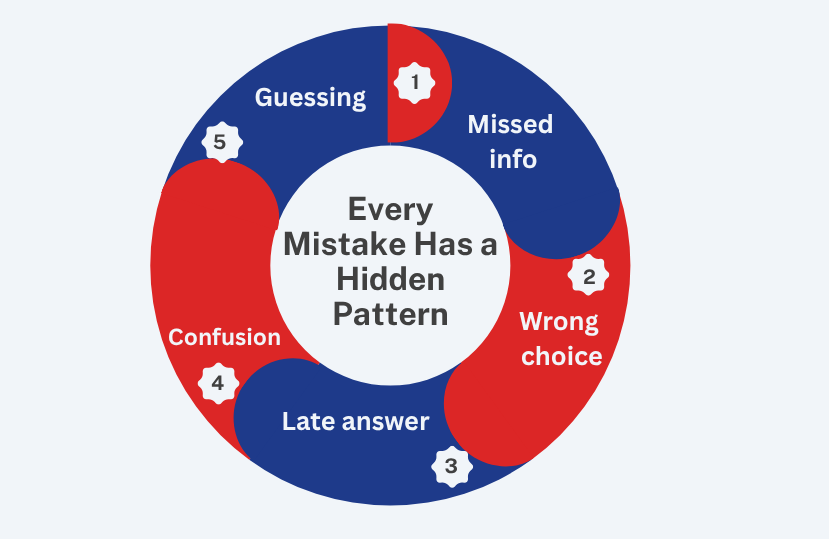
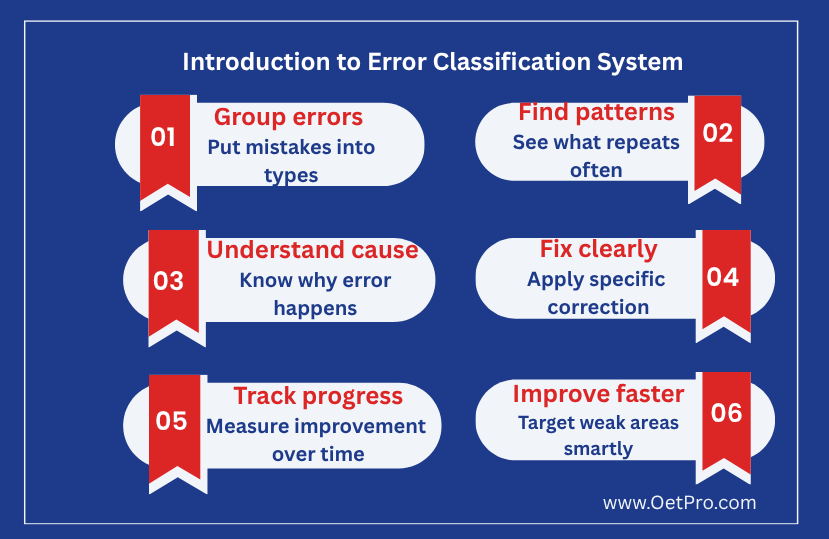
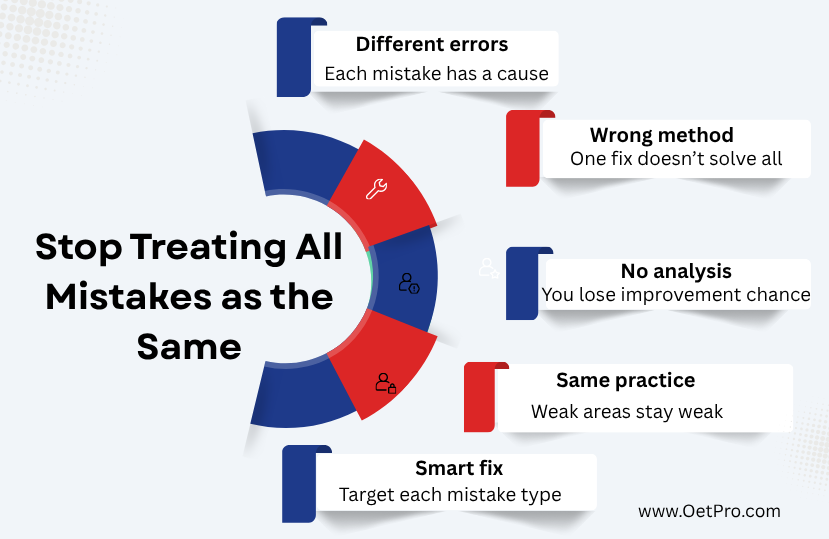
Second, you perform a detailed breakdown of your mistakes. Instead of just checking answers, you classify errors into categories such as listening failure, misunderstanding, distraction, or timing pressure. This step is where real learning happens.
Third, you focus only on weak areas instead of repeating the entire test. For example, if you struggle with inference questions in Part C, you isolate that skill and practice short targeted audio exercises instead of full exams.
This targeted correction approach ensures that every mock test improves a specific weakness rather than repeating the same performance pattern.
Summary (Core Lesson Takeaways)
OET Listening is not a simple comprehension test. It is a structured exam system designed to evaluate how accurately healthcare professionals process spoken medical communication under pressure.
Each section has a different purpose:
- Part A tests clinical detail extraction and note accuracy
- Part B tests understanding of workplace purpose and intention
- Part C tests inference, attitude, and implied meaning
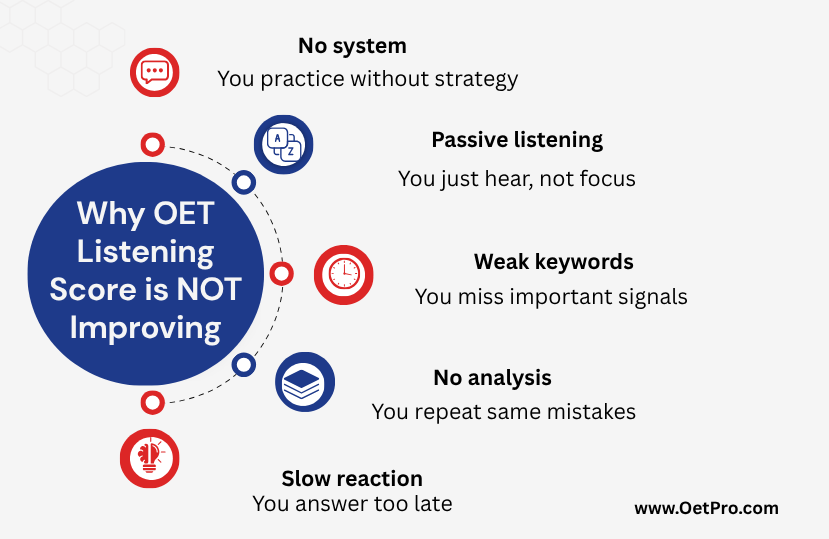
Most candidates fail not because of weak English, but because they use the same listening approach for all three sections. High scorers succeed because they adapt their strategy based on the skill being tested.
The key transformation is simple:
Move from passive listening to structured interpretation
Final Checklist (Before and During Exam)
Before the Exam
- Understand the purpose of each part (A, B, C)
- Practice active prediction of question types
- Train with exam-like conditions (no pauses or repetition)
- Focus on medical vocabulary patterns and paraphrasing
During the Exam
- Listen for meaning, not every word
- Focus only on relevant information for the question
- Identify signal words like “however,” “but,” “although”
- Avoid overthinking or translating mentally
- Stay calm under time pressure
After Practice Tests
- Do not just check answers
- Classify mistakes clearly:
- Listening error
- Meaning misunderstanding
- Distractor trap
- Timing pressure
- Revisit only weak sections instead of repeating full test
FAQs
1. Is OET Listening difficult for healthcare professionals?
Not if you understand the system. The difficulty comes from exam design, not language complexity.
2. How is Part A different from Parts B and C?
Part A focuses on clinical details, while Part B focuses on purpose and Part C focuses on inference and attitude.
3. Why do I keep losing marks even after practice?
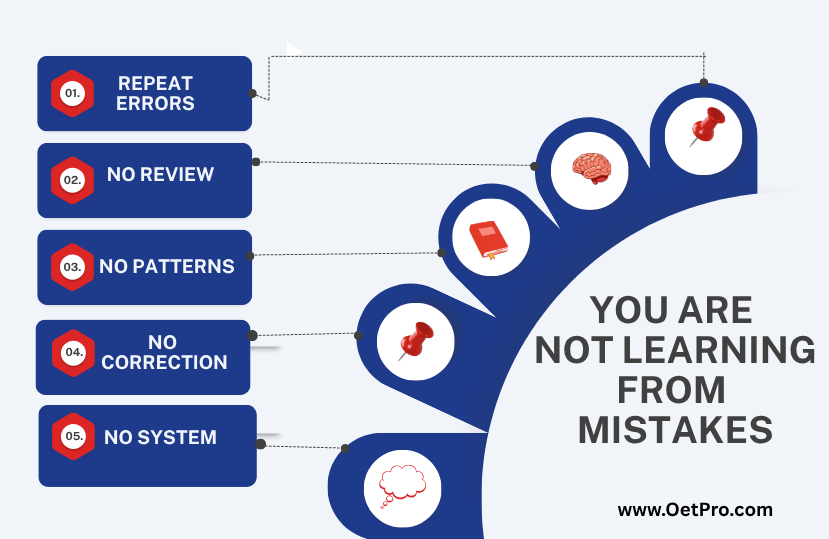
Because most candidates repeat tests without analyzing mistakes or changing strategy.
4. What is the best way to improve OET Listening quickly?
Use structured mock test cycles: simulate -> analyze -> correct -> retrain weak areas.
5. Should I focus on vocabulary or listening practice?
Both matter, but understanding paraphrasing patterns is more important than memorizing vocabulary lists.
Practice Plan (7-Day Skill Building System)
Day 1–2: Simulation Phase
- Take one full mock test under strict conditions
- No pauses or repetition
- Focus on exam discipline
Day 3: Analysis Phase
- Review all answers carefully
- Categorize every mistake
- Identify weak skill areas
Day 4–5: Targeted Training
- Practice only weak question types
- Focus on Part-specific skills (A, B, or C)
- Work on short focused audio segments
Day 6: Reinforcement
- Reattempt selected sections
- Compare improvement with Day 1 test
Day 7: Full Simulation
- Take another full mock test
- Evaluate progress and remaining gaps
Conclusion
OET Listening success is not achieved by doing more tests. It is achieved by building a system of understanding, analyzing, and correcting performance.
Once you stop treating mock tests as practice and start using them as structured training tools, your score begins to improve consistently.
The real difference between average and high scorers is simple:
- Average candidates listen repeatedly
- High scorers listen strategically