The 12 OET Professions: Which Version of the Test to Take
OET has 12 versions, one for each healthcare profession. See what changes between them, which regulators accept each one, and how to pick the right version before you book.
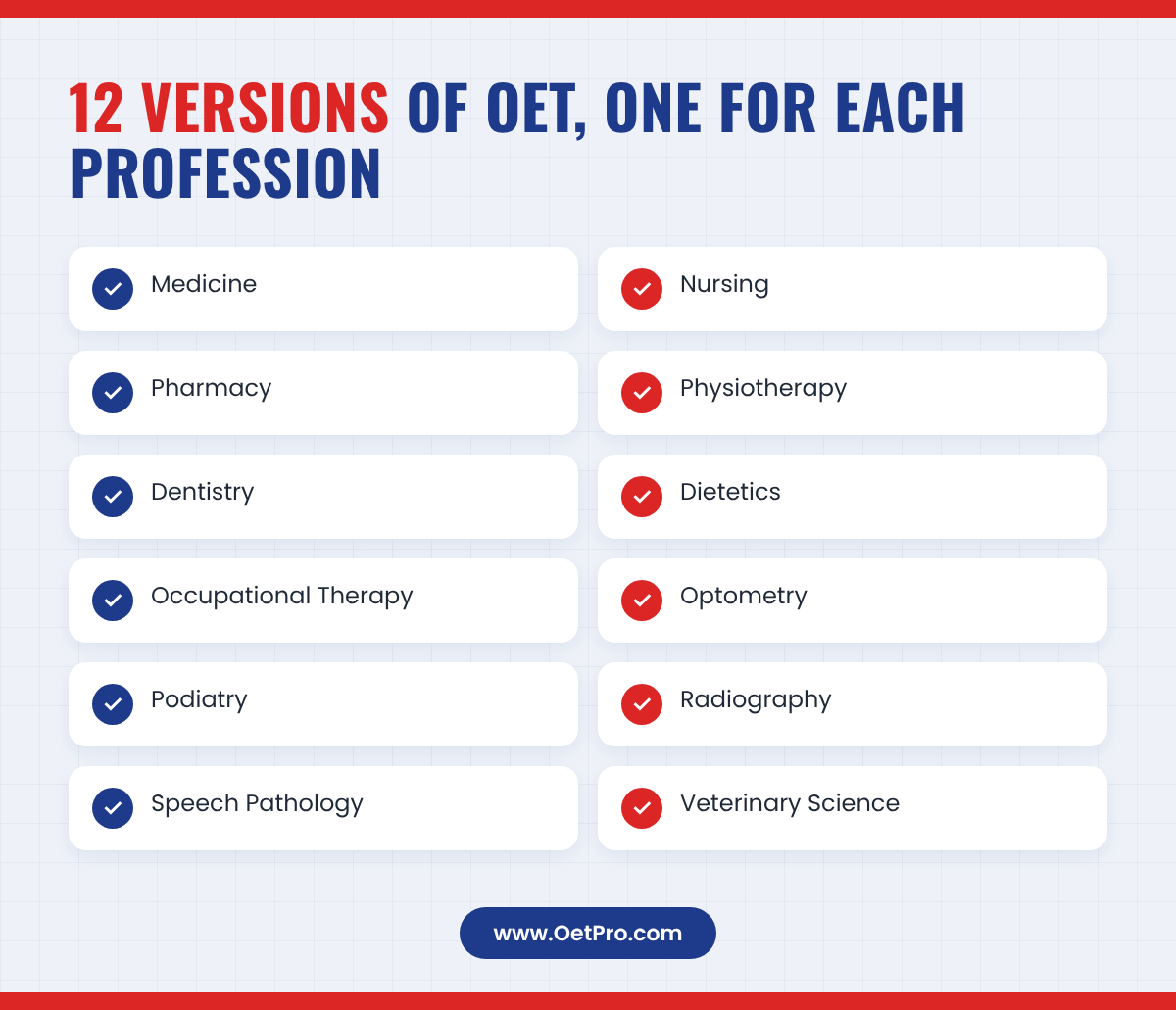
OET comes in 12 versions, one for each healthcare profession it serves: Dentistry, Dietetics, Medicine, Nursing, Occupational Therapy, Optometry, Pharmacy, Physiotherapy, Podiatry, Radiography, Speech Pathology and Veterinary Science. You take the version for the profession you are registering in, and only two of the four sub-tests change from one version to another: Writing and Speaking.
Choosing the right version sounds simple, and for most people it is. But the details matter. Some regulators accept only the paper test, OET@Home is offered for just four professions, and a few professions, such as midwifery and paramedicine, do not have a version of their own. This guide explains every version, what is the same for everyone, what changes, who accepts which version, and how to choose before you pay for a booking.
The 12 OET professions
OET is built for healthcare workers only. Every candidate sits the same kind of test, but the Writing and Speaking tasks are written around one profession's daily work. These are the 12 versions you can book:
| OET version | Usually taken by | OET@Home offered? |
|---|---|---|
| Medicine | Doctors | Yes |
| Nursing | Nurses | Yes |
| Pharmacy | Pharmacists | Yes |
| Physiotherapy | Physiotherapists | Yes |
| Dentistry | Dentists | No |
| Dietetics | Dietitians | No |
| Occupational Therapy | Occupational therapists | No |
| Optometry | Optometrists | No |
| Podiatry | Podiatrists | No |
| Radiography | Radiographers | No |
| Speech Pathology | Speech pathologists (speech and language therapists) | No |
| Veterinary Science | Veterinarians | No |
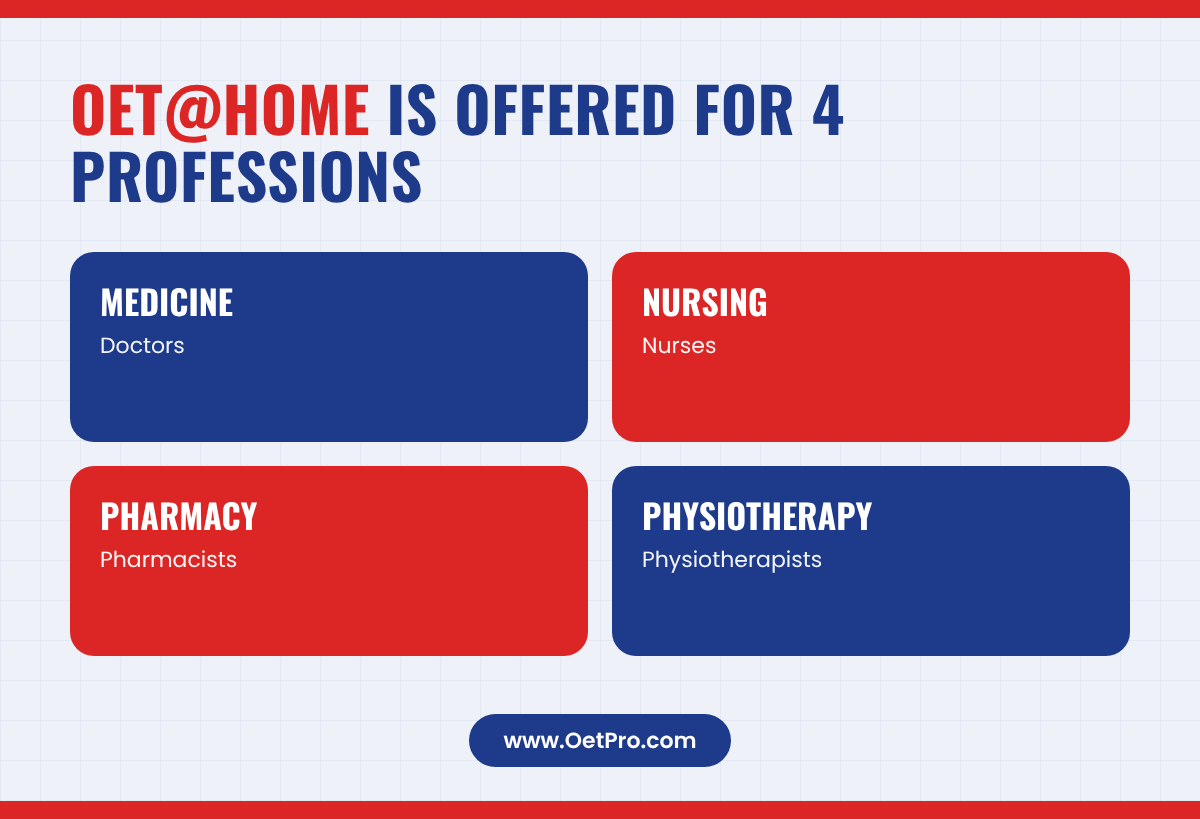
All 12 versions can be taken on paper or on computer at a test venue. OET@Home, the version you take on your own computer with a remote supervisor, is offered only for Medicine, Nursing, Pharmacy and Physiotherapy.
What is the same in every version
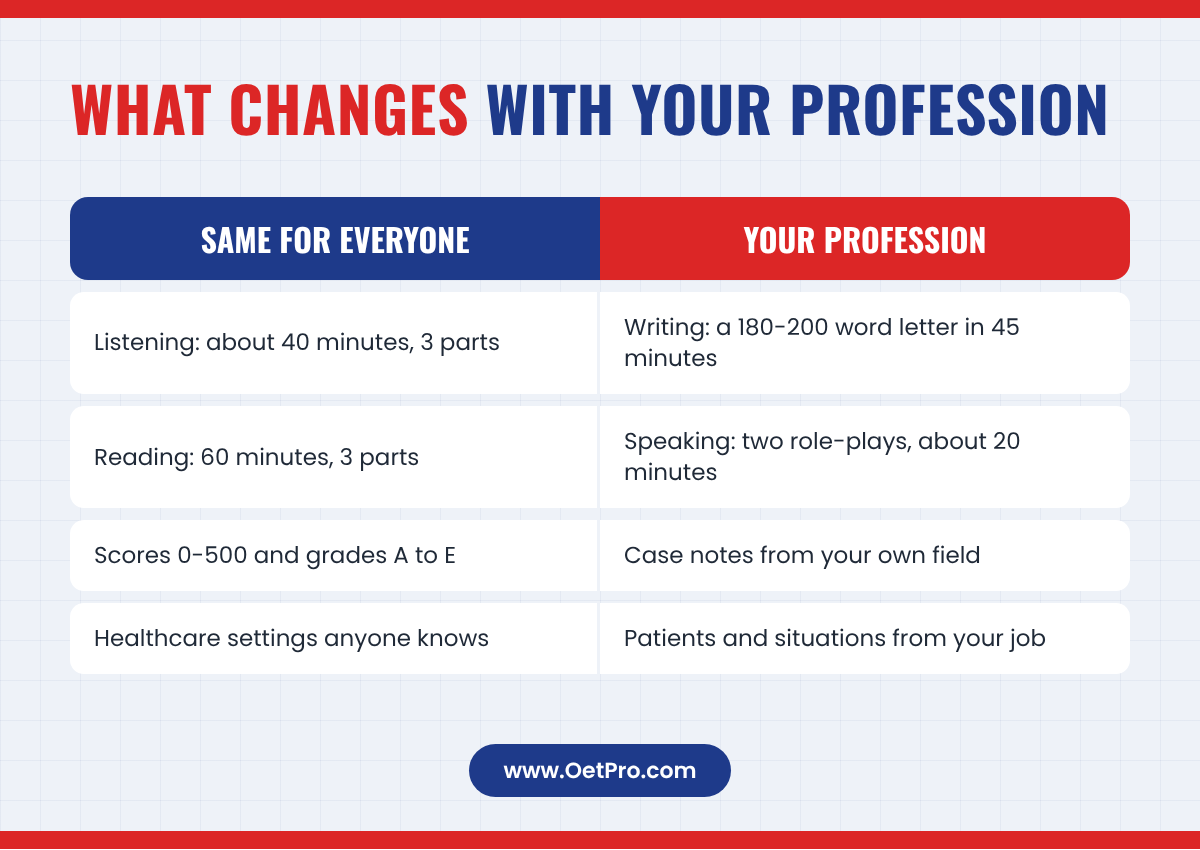
Half of the test is shared. The Listening and Reading sub-tests are common to all candidates, so a nurse, a dentist and a vet answer the same questions. The recordings and texts come from healthcare settings, so they feel familiar whatever your profession.
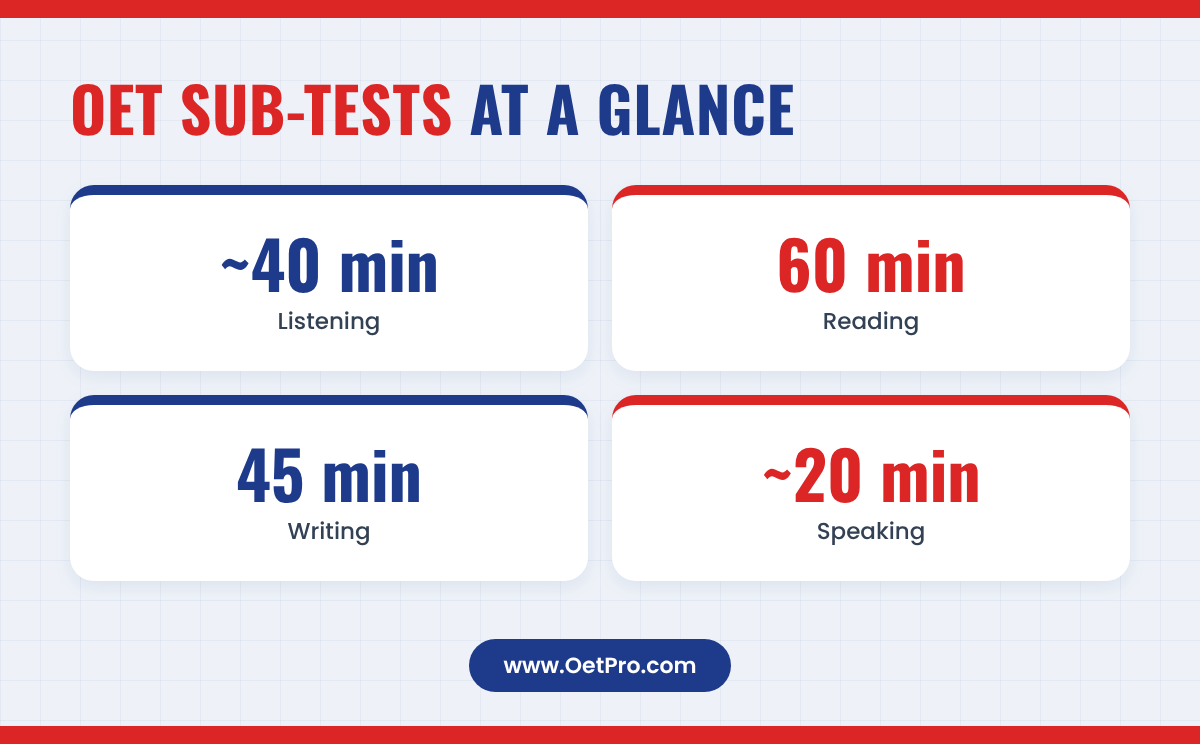
- Listening takes about 40 minutes and has three parts: notes from consultations, short workplace extracts, and longer talks or interviews.
- Reading takes 60 minutes and also has three parts, from quick scanning of short texts to careful reading of longer articles.
Scoring is the same for everyone too. Each sub-test gets its own score from 0 to 500 and a letter grade from A to E. There is no overall score, which is why regulators ask for a minimum in each sub-test. Our OET scoring system guide explains the grades in detail.
What changes: the Writing sub-test
The Writing sub-test takes 45 minutes and is specific to your profession. You read case notes about a patient and write a formal letter of 180 to 200 words, usually to another healthcare professional. Depending on the task, it may be a referral letter, a transfer or discharge letter, or a letter giving advice or information.
The case notes reflect the work of your own profession, so the same skill looks different in each version:
- A doctor might refer a patient to a specialist after a consultation, summarising the history and the reason for referral.
- A nurse might write a discharge letter to a community nurse who will continue care at home.
- A pharmacist might write to a doctor about a patient's medicines and a concern about side effects.
- A physiotherapist might update another therapist on a patient's progress after a course of treatment.
- A dentist, optometrist or podiatrist might refer a patient on to a doctor when something outside their own field needs attention.
What every version tests is the same: choosing the information the reader needs, organising it clearly, and writing in a professional tone. That is why practising with your own profession's case notes matters more than practising with whatever samples are easiest to find. You can see tasks for each profession on our free writing sample pages, for example OET Writing samples for nursing and OET Writing samples for medicine.
What changes: the Speaking sub-test
The Speaking sub-test takes about 20 minutes and is also profession-specific. You complete two role-plays. You play yourself, the healthcare professional, and the interlocutor plays a patient, or a patient's relative or carer. Each role-play is based on a card that tells you the setting and what you need to do.
The situations come from your own workplace:
- A nurse may explain how to care for a wound at home, or reassure a worried relative.
- A doctor may explain a diagnosis, a test result or a treatment plan.
- A pharmacist may explain how and when to take a new medicine.
- A dietitian may discuss changes to a patient's diet after a diagnosis.
- A veterinarian talks to the owner of an animal rather than to the patient.
Our complete OET Speaking guide explains the role-play format and how it is marked.
How Writing and Speaking are marked in every version
Even though the tasks change with your profession, the marking criteria do not. Every candidate is assessed against the same criteria, which is why no version is easier than another.
Writing criteria
Your letter is assessed on six criteria:
- Purpose: does the reader understand quickly why you are writing?
- Content: have you included the information the reader needs, and only that?
- Conciseness and clarity: is the information summarised clearly, without unnecessary detail?
- Genre and style: is the tone right for a professional letter to this reader?
- Organisation and layout: is the letter logically ordered and easy to follow?
- Language: are grammar, vocabulary, spelling and punctuation accurate?
Speaking criteria
Speaking is assessed on two groups of criteria. The linguistic criteria cover intelligibility, fluency, appropriateness of language, and resources of grammar and expression. The clinical communication criteria cover relationship building, understanding and including the patient's perspective, providing structure, gathering information and giving information.
The clinical communication criteria are the same whether you are a nurse talking to a patient or a vet talking to a pet owner. What changes is the situation, not the standard.
Profession-by-profession quick guide
Here is a short note on each version, with examples of regulators that appear on OET's recognition list for that profession.
- OET Medicine: for doctors. Recognised by the GMC (UK), the Medical Council of Ireland, the Medical Board of Australia, the Medical Council of New Zealand, ECFMG (USA) and most Canadian colleges of physicians and surgeons.
- OET Nursing: for nurses. Recognised by the NMC (UK), NMBI (Ireland), the Nursing and Midwifery Board of Australia, the Nursing Council of New Zealand and CGFNS (USA), among others.
- OET Pharmacy: for pharmacists. Recognised by the GPhC (UK), the Pharmaceutical Society of Ireland, the Pharmacy Board of Australia and the Singapore Pharmacy Council.
- OET Physiotherapy: for physiotherapists. Recognised by CORU (Ireland), the Physiotherapy Board of Australia and the Physiotherapy Board of New Zealand.
- OET Dentistry: for dentists. Recognised by the Dental Council of Ireland, the Dental Board of Australia and the Singapore Dental Council.
- OET Dietetics: for dietitians. Recognised by CORU (Ireland), the Dietitians Board of New Zealand and the College of Dietitians of Ontario.
- OET Occupational Therapy: for occupational therapists. Recognised by CORU (Ireland), the Occupational Therapy Board of Australia and the Occupational Therapy Board of New Zealand.
- OET Optometry: for optometrists. Recognised by CORU (Ireland), the Optometry Board of Australia and the Optometrists and Dispensing Opticians Board of New Zealand.
- OET Podiatry: for podiatrists. Recognised by the Podiatry Board of Australia and the Podiatrists Board of New Zealand.
- OET Radiography: for radiographers. Recognised by CORU (Ireland), the Medical Radiation Practice Board of Australia and the Medical Radiation Technologists Board in New Zealand.
- OET Speech Pathology: for speech pathologists and speech and language therapists. Recognised by CORU (Ireland) and Speech Pathology Australia.
- OET Veterinary Science: for veterinarians. Recognised by the RCVS (UK), the Veterinary Council of Ireland and the Veterinary Council of New Zealand.
Recognition does not mean every format is accepted, and grade requirements differ. Use this list as a starting point, then confirm with your regulator.
The main regulators at a glance
Your OET version should match the register you are joining. OET publishes a list of the organisations that recognise the test. Here are the main regulators on that list for the most popular destinations, and the professions they register:
| Country | Regulator | Registers |
|---|---|---|
| United Kingdom | Nursing and Midwifery Council (NMC) | Nurses and midwives |
| United Kingdom | General Medical Council (GMC) | Doctors |
| United Kingdom | General Pharmaceutical Council (GPhC) | Pharmacists |
| United Kingdom | Royal College of Veterinary Surgeons (RCVS) | Veterinarians |
| Ireland | Nursing and Midwifery Board of Ireland (NMBI) | Nurses and midwives |
| Ireland | Medical Council of Ireland | Doctors |
| Ireland | CORU | Dietitians, occupational therapists, physiotherapists, radiographers, speech therapists, optometrists |
| Australia | AHPRA and the National Boards | Doctors, nurses and midwives, dentists, pharmacists, physiotherapists, occupational therapists, optometrists, podiatrists and others |
| New Zealand | Nursing Council and Medical Council of New Zealand | Nurses; doctors |
| United States | ECFMG | International medical graduates (doctors) |
| United States | CGFNS International | Nurses |
| Singapore | Singapore Medical, Dental and Pharmacy Councils | Doctors, dentists, pharmacists |
In Canada, OET is accepted by many provincial colleges, including the colleges of physicians and surgeons in most provinces, several nursing colleges and some pharmacy and dietetics colleges. Because each province is different, check the college for your profession and province directly.
The list changes, and each regulator sets its own grade requirements. Always read the English language page of your regulator before you book. Our guide to OET accepted countries and registration covers the wider picture.
Paper, computer or OET@Home: check the format too
Choosing the right profession is only half of the decision. The format you take the test in can also decide whether your result is accepted.
- OET@Home is offered only for Medicine, Nursing, Pharmacy and Physiotherapy. Even for these professions, not every organisation accepts it. OET's own list says CGFNS and Josef Silny in the United States do not accept OET@Home results.
- Some organisations accept the paper test only. On OET's recognition list, examples include the Medical Council of New Zealand, the Pharmaceutical Society of Ireland, CORU in Ireland and several Australian councils. In Singapore and the UAE, the paper test is the default.
- New Zealand immigration no longer accepts tests taken from home. From 13 July 2026, Immigration New Zealand requires all parts of OET to be taken in person at a test centre.
If you are unsure, book the paper or computer test at a venue. It is the format the largest number of organisations accept.
What if your profession is not one of the 12?
Some health professions do not have their own OET version. Midwives, paramedics and Chinese medicine practitioners, for example, appear on registers that accept OET, but there is no OET Midwifery, OET Paramedicine or OET Chinese Medicine test.
If this applies to you, do not guess. Contact the regulator you are registering with and ask which OET version it accepts for your profession, and get the answer in writing if you can. A result in a version your regulator does not accept may mean taking the test again.
How to choose the right version
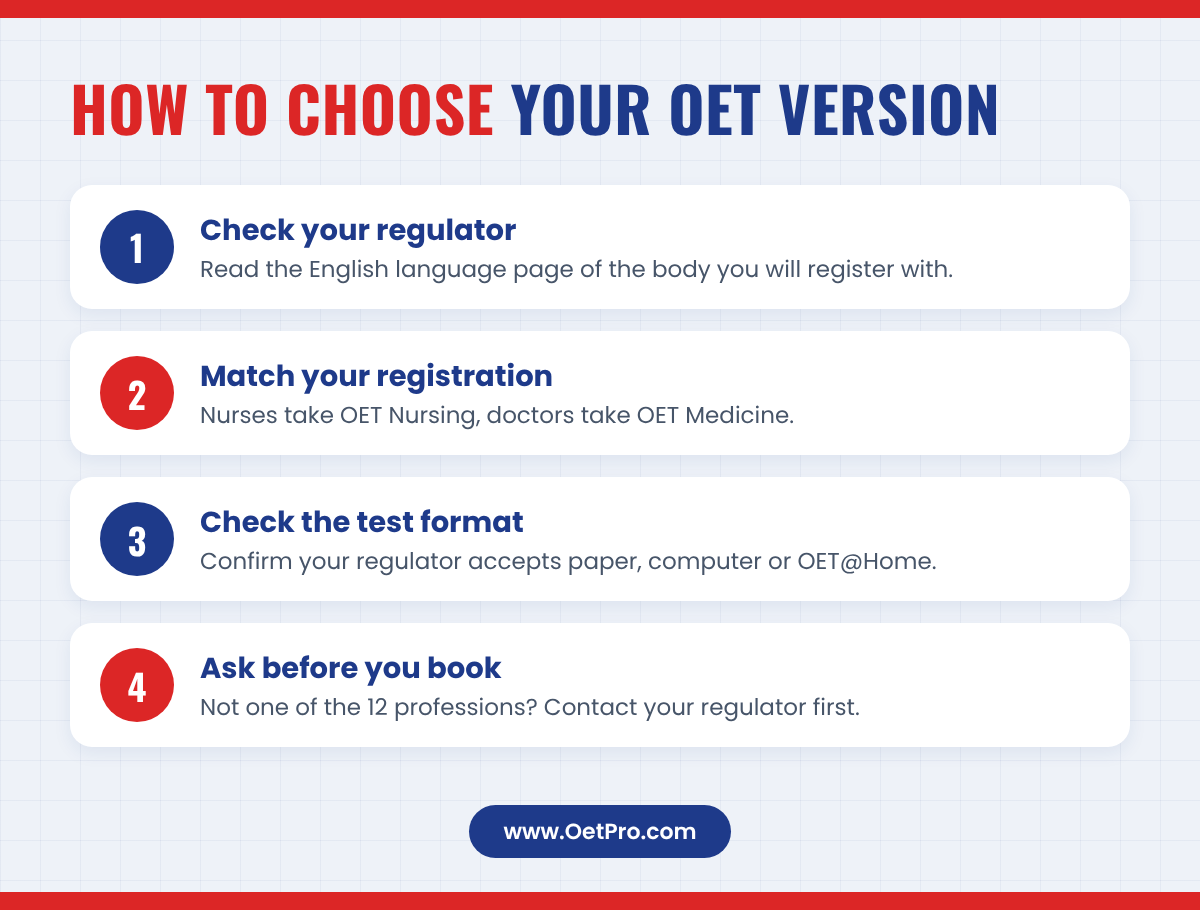
For almost everyone, the choice comes down to four checks:
- Start with your regulator. Find the English language page of the body you will register with, such as the nursing council or medical council in your target country. It tells you which tests, formats and grades it accepts.
- Match the version to your registration. A nurse registering as a nurse takes OET Nursing. A doctor registering as a doctor takes OET Medicine.
- Check the format. Make sure your regulator accepts the format you plan to book: paper, computer at a venue, or OET@Home.
- Ask before you book if anything is unclear. This is especially important if your profession is not one of the 12, or if you hold qualifications in two fields.
Preparing for your version
Because two sub-tests are shared and two are specific to you, it helps to split your preparation the same way.
Listening and Reading: practise like everyone else
Any good Listening and Reading practice works for every profession. Focus on speed and accuracy. In Reading Part A you scan several short texts quickly, and in Listening you write short answers while the recording keeps playing. Our OET study plans show how to divide your weekly study time between the four sub-tests.
Writing: practise with your own profession's case notes
Do not practise Writing with another profession's tasks just because more samples exist. A nurse's discharge letter and a doctor's referral letter need different details from the case notes, and the reader of each letter needs different things. Practise with tasks from your own version, and always write within the 45 minutes.
Speaking: rehearse the conversations you already have at work
Think of the explanations you give patients every day: a new medicine, a test, a change in diet, an exercise plan. Practise saying them in simple, friendly English. Check that the patient understands, ask about their worries, and keep the conversation two-way. These are the same kinds of conversations the role-plays are built on.
Common questions
Is one version easier than another?
No. Listening and Reading are identical for everyone, and Writing and Speaking are marked against the same criteria in every version. The version that feels easiest is the one that matches your daily work, because the vocabulary and situations are familiar.
Can I take OET Nursing if I am a doctor?
You can book any version, but a regulator registering you as a doctor will expect a result for your profession. Always check what your regulator asks for before you book.
Do I need to know about other professions?
No. Writing and Speaking use situations from your own profession only. Listening and Reading are shared by everyone and are set in general healthcare settings.
Can I take OET@Home for Dentistry or Optometry?
No. OET@Home is offered only for Medicine, Nursing, Pharmacy and Physiotherapy. Candidates in the other eight professions take the test on paper or on computer at a venue.
Next steps
Once you know your version, the next step is to understand the whole exam. Our complete guide to OET covers everything from booking to results, and the OET exam format guide explains each part in detail. To see where you stand today, try a free OET practice test on OETPRO, or create a free account to save your progress.
Sources
Practise with real OET-style tests
Free sample tests for all four sub-tests, with answers.