
OET Preparation Strategy (2026): 4-Week & 8-Week Study Plan for High Scores
Introduction
Many healthcare professionals start preparing for OET with one simple question:
“How should I study and how long will it take?”
Without a clear plan, preparation often becomes inconsistent. You may practise randomly, focus too much on one skill, or feel overwhelmed by the amount of material.
That’s why a structured preparation strategy is essential. In this lesson, you’ll learn exactly how to prepare for OET using proven 4-week and 8-week study plans, along with daily routines and skill-based strategies. This is the strongest B ? A link because it sends readers from a specific preparation topic to the broader OET resource.
Why You Need a Study Plan
Preparing for OET is not just about studying harder it’s about studying smarter.
A clear study plan helps you:
- Stay consistent
- Cover all four skills (Listening, Reading, Writing, Speaking)
- Track your progress
- Reduce stress and confusion
- Improve your score efficiently
Without a plan, many candidates:
- Spend too much time on easier skills
- Ignore weaker areas
- Practise without feedback
- Take mock tests too late
A structured approach ensures balanced and focused preparation.
How Long Should You Prepare?
There is no one-size-fits-all answer.
Your preparation time depends on:
- Your current English level
- Your familiarity with medical communication
- Your target score (Grade B, C+, etc.)
- Your daily study availability
General Recommendation
4-Week Plan
Best for:
- Candidates with a strong English background
- Healthcare professionals already familiar with OET format
- Those needing quick preparation
8-Week Plan
Best for:
- Candidates needing more practice
- Those aiming for higher scores
- Candidates balancing work and study
Key Insight
The quality of your study matters more than the number of weeks.
Consistent, focused preparation is more effective than long, unfocused study hours.
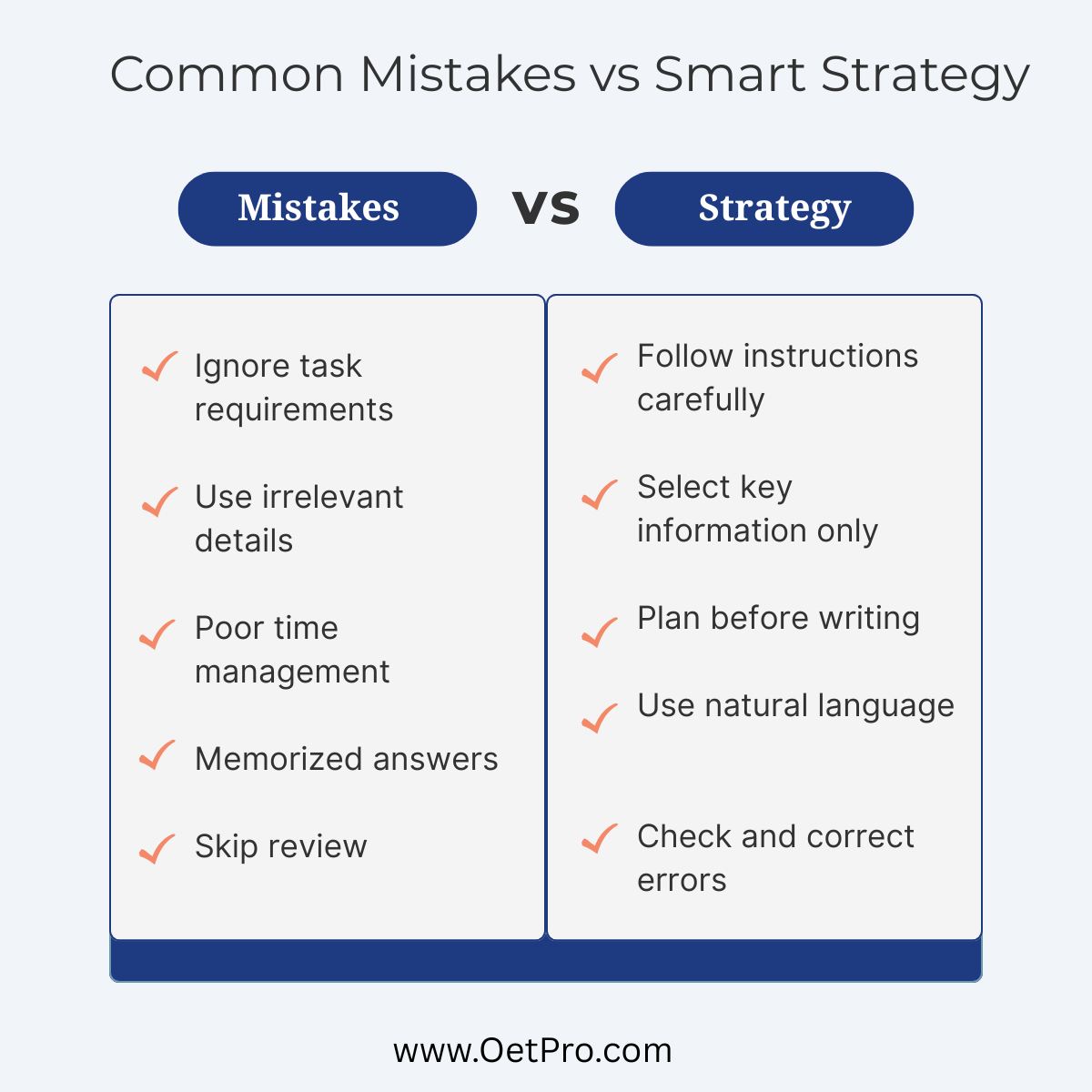
Common Preparation Mistakes
Avoid these mistakes to improve your chances of success.
Studying Without a Plan
Random practice leads to slow progress and confusion.
Ignoring Weak Skills
Many candidates avoid Writing or Speaking because they feel difficult.
This is one of the biggest reasons for low scores.
Practising Without Feedback
Without feedback, mistakes become habits.
Over-Reliance on Passive Learning
Watching videos or reading tips is not enough.
You must actively practise.
Skipping Mock Tests
Mock tests help you:
- Build exam confidence
- Manage time effectively
- Identify real weaknesses
Avoiding preparation mistakes is easier when you understand the exam as a whole. Our complete OET guide explains the exam structure, section-wise strategies, scoring, common beginner mistakes, and practice techniques.
4-Week & 8-Week Study Plans
Now that you understand the importance of a structured approach, let’s move to the most practical part:
Your step-by-step OET study plan.
These plans are designed specifically for healthcare professionals, focusing on efficiency, consistency, and skill improvement.
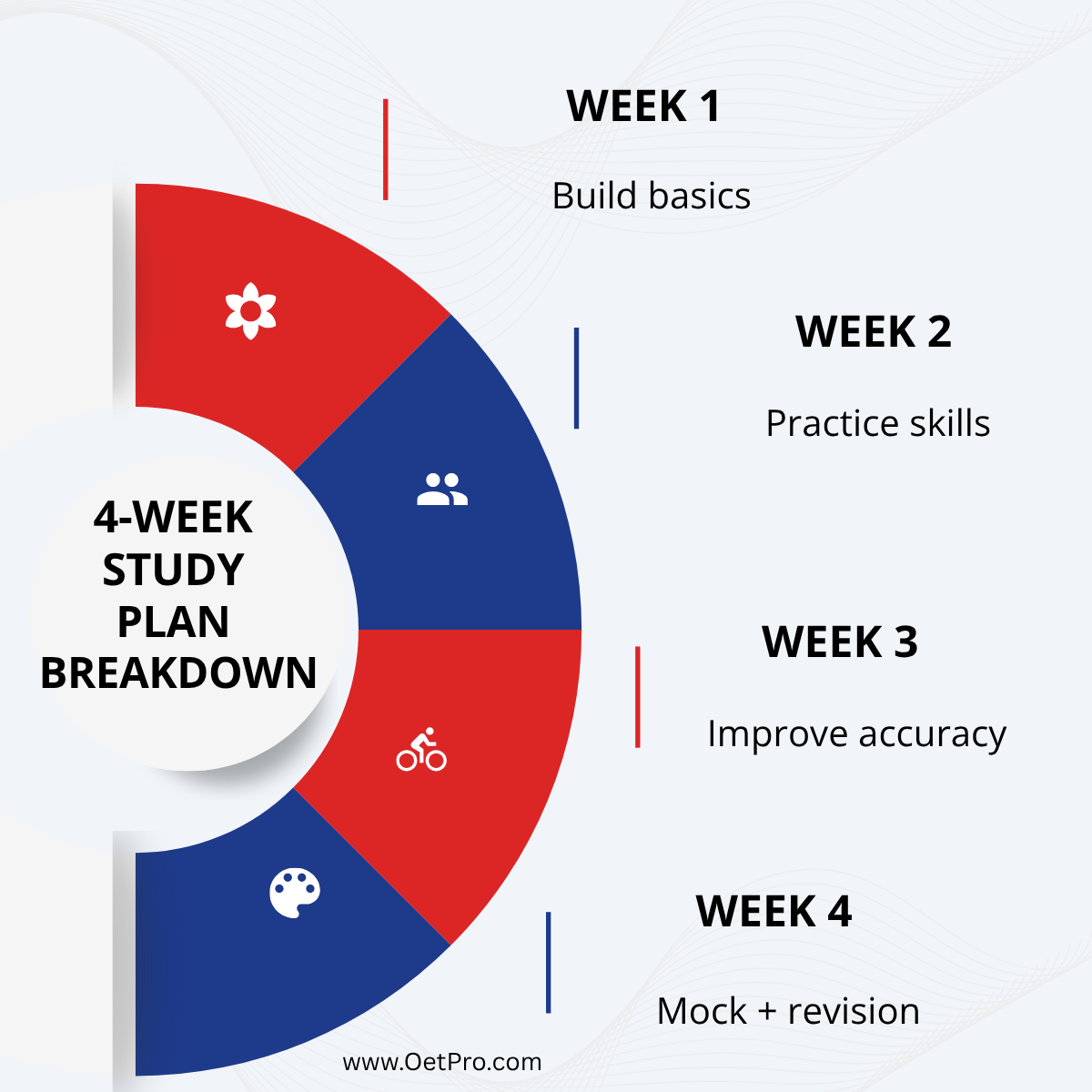
4-Week OET Study Plan (Fast-Track)
Best For
- Strong English foundation
- Familiarity with healthcare communication
- Limited preparation time
Week 1 — Foundation & Assessment
Focus
- Understand exam format and scoring
- Identify strengths and weaknesses
Tasks
- Review OET test structure
- Take a diagnostic test
- Analyse performance
- Start basic practice for all four skills
Week 2 — Skill Building
Focus
- Improve core skills
Tasks
- Listening: Practice Part A & B daily
- Reading: Timed reading exercises
- Writing: 2–3 letters (feedback required)
- Speaking: Role-play practice
Week 3 — Intensive Practice
Focus
- Apply strategies under exam conditions
Tasks
- Full practice tests (2–3)
- Timed writing tasks
- Speaking mock sessions
- Error analysis
Week 4 — Final Preparation
Focus
- Improve weak areas
- Build confidence
Tasks
- 2 full mock tests
- Review mistakes
- Practice high-yield topics
- Light revision before exam
This study plan works best when combined with a clear understanding of the OET exam, its four sections, scoring criteria, and common mistakes. For a complete overview, explore our Complete Guide to OET 2026.
Key Strategy
Focus on accuracy and time management.
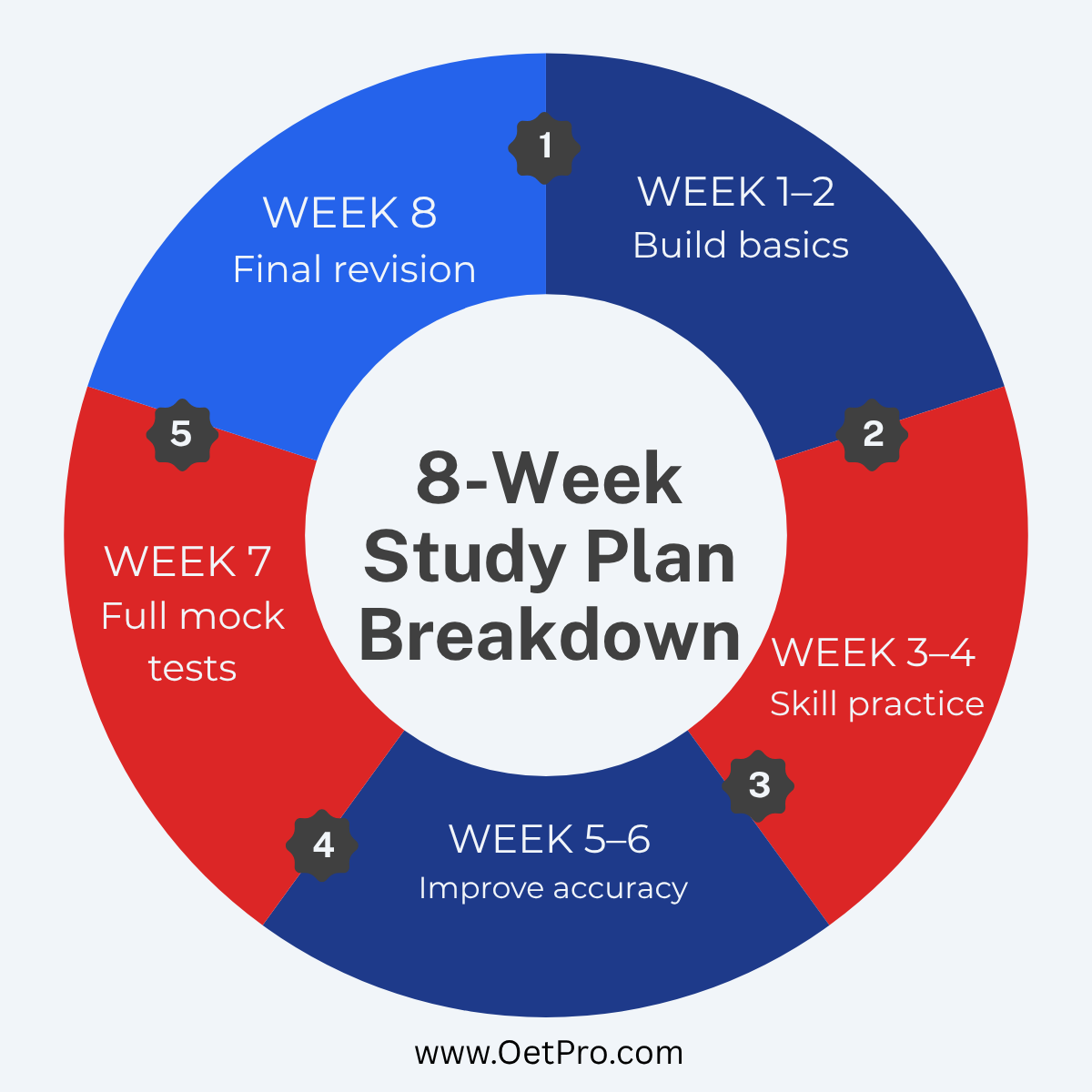
8-Week OET Study Plan (Comprehensive)
Best For
- Intermediate learners
- Candidates targeting Grade B or higher
- Working professionals
Week 1–2 — Foundation
Focus
- Understand exam format
- Build basic skills
Tasks
- Diagnostic test
- Vocabulary building
- Introductory practice for all skills
Week 3–4 — Skill Development
Focus
- Strengthen individual skills
Tasks
- Listening drills
- Reading speed practice
- Writing structure training
- Speaking role-plays
Week 5–6 — Advanced Practice
Focus
- Apply strategies in exam-like conditions
Tasks
- Timed exercises
- Full writing tasks
- Speaking mock tests
- Detailed feedback
Week 7 — Mock Testing
Focus
- Simulate real exam
Tasks
- 2–3 full mock tests
- Time management practice
- Performance analysis
Week 8 — Final Revision
Focus
- Polish performance
Tasks
- Review weak areas
- Practice high-frequency tasks
- Light revision
- Confidence building
Key Strategy
Consistency over intensity.
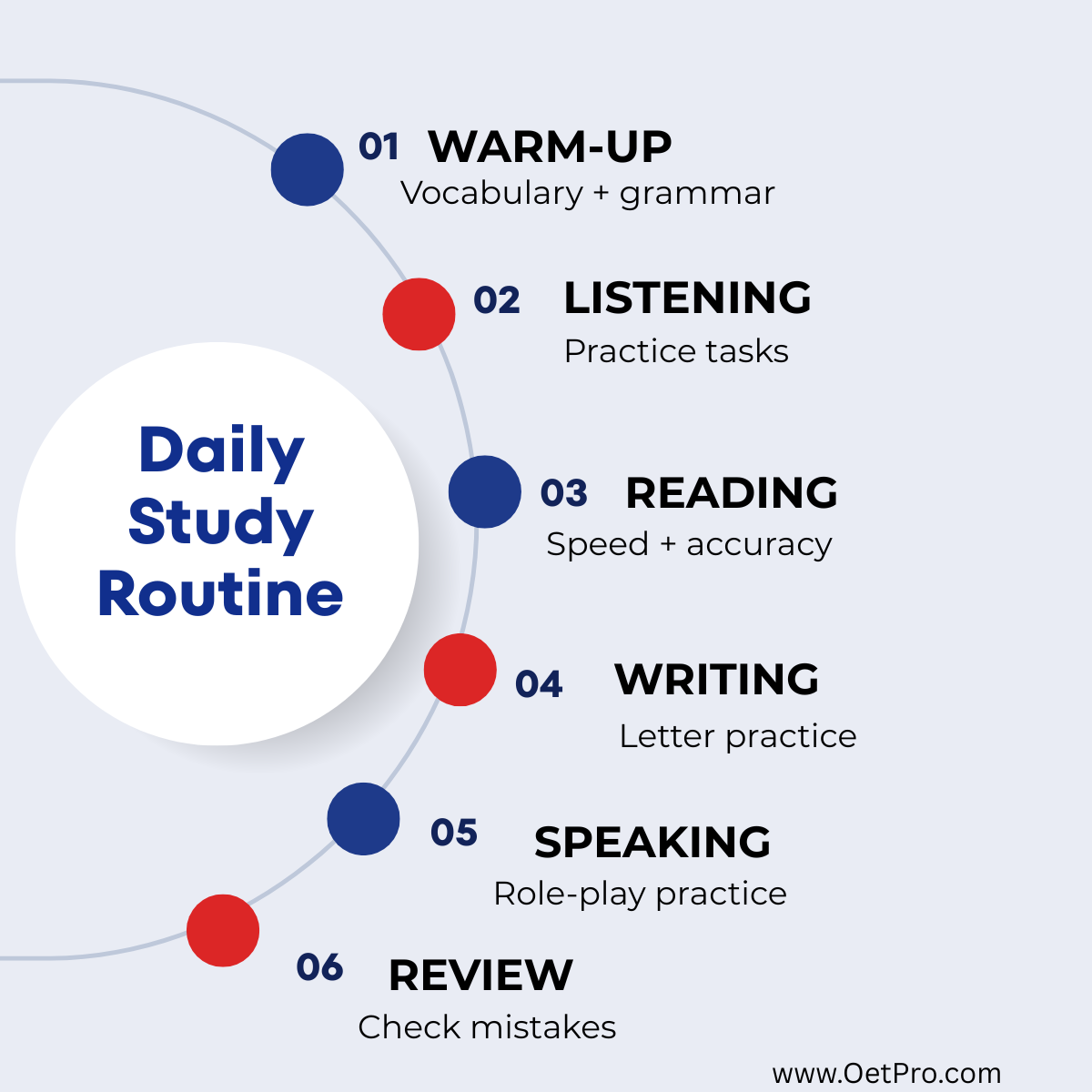
Daily Study Routine
Recommended Study Time
- 2–3 hours per day (minimum)
- Divide time across all skills
Sample Daily Plan
Listening (30–40 min)
- Practice audio tasks
- Focus on note-taking
Reading (30–40 min)
- Timed reading
- Skimming and scanning practice
Writing (30–45 min)
- Practice letters
- Focus on structure and clarity
Speaking (30–45 min)
- Role-play with partner or AI
- Record and review
Weekly Structure
| Day | Focus |
|---|---|
| Monday | Listening + Reading |
| Tuesday | Writing |
| Wednesday | Speaking |
| Thursday | Listening + Reading |
| Friday | Writing |
| Saturday | Full/mini mock test |
| Sunday | Review + weak areas |
Skill-Wise Strategy Overview
Listening
- Focus on Part A accuracy
- Practise note completion
- Improve attention to detail
Reading
- Develop speed
- Practise scanning techniques
- Manage time carefully
Writing
- Master letter structure
- Use clear, concise language
- Practise regularly with feedback
Speaking
- Practise role-plays
- Focus on empathy and clarity
- Improve fluency and confidence
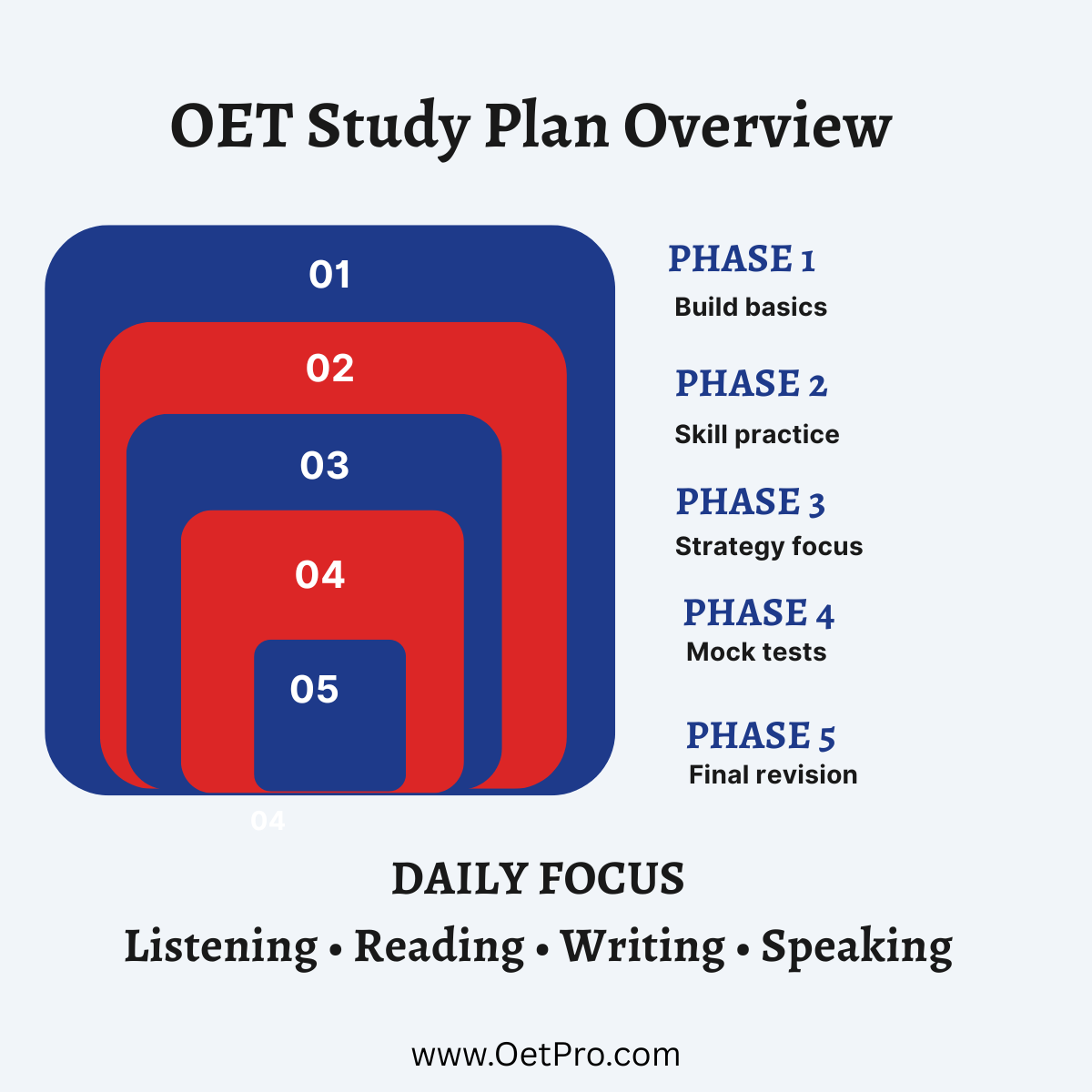
Advanced Preparation Strategies
Once you have a study plan in place, the next step is to prepare smarter, not just harder.
High-scoring candidates follow specific strategies that help them improve faster and avoid common traps.
1. Focus on High-Impact Skills
Not all skills improve at the same speed.
Priority Order for Most Candidates
- Writing
- Speaking
- Reading
- Listening
Why?
- Writing and Speaking require active production
- They are harder to improve without guidance
- They often determine your final grade
2. Use Active Practice, Not Passive Learning
Many candidates spend too much time:
- Watching videos
- Reading tips
- Highlighting notes
Better Approach
- Write full letters
- Perform real role-plays
- Complete timed tests
Practice like you are in the exam.
3. Get Feedback Early
This is one of the biggest success factors.
Without Feedback
- Mistakes repeat
- Progress slows
With Feedback
- You correct errors quickly
- You improve structure and accuracy
- You gain confidence
4. Track Your Progress
Use a simple tracking system:
- Mock test scores
- Writing corrections
- Speaking feedback
- Weak areas
Goal
Measure improvement every week.
5. Practise Under Time Pressure
OET is a timed exam.
Train Yourself To
- Write within 45 minutes
- Read quickly and accurately
- Listen carefully without replay
Examiner Insights
Understanding how examiners assess your performance gives you a major advantage.
Writing (What Examiners Look For)
- Relevant information only
- Clear structure
- Appropriate tone
- Accuracy and grammar
Speaking
- Clear communication
- Empathy and patient care
- Fluency
- Professional language
Reading & Listening
- Accuracy
- Attention to detail
- Time management
Key Insight
Examiners reward clarity, not complexity.
High-Value Vocabulary (Medical English)
Using the right vocabulary improves both Writing and Speaking scores.
Common Clinical Phrases
- "The patient presents with…"
- "He reports a history of…"
- "She is currently experiencing…"
- "I recommend further investigation…"
- "Please monitor the patient for…"
Communication Phrases (Speaking)
- "How are you feeling today?"
- "Let me explain your condition."
- "There’s no need to worry."
- "I understand your concern."
- "We will take good care of you."
Tip
Focus on clarity and appropriateness, not complicated vocabulary.
Practice Activities
Activity 1 — Writing Task
Write a referral letter based on a patient case.
Focus
- Structure
- Clarity
- Relevant details
Activity 2 — Speaking Role-Play
Scenario:
You are a nurse explaining medication to a patient.
Focus
- Clear instructions
- Reassurance
- Professional tone
Activity 3 — Reading Drill
- Complete a timed reading task
- Focus on scanning and locating answers
Activity 4 — Listening Practice
- Listen to a clinical conversation
- Complete note-taking exercise
Weekly Progress Tracker
| Week | Focus | Improvement Goal |
|---|---|---|
| Week 1 | Foundation | Understand format |
| Week 2 | Skills | Improve accuracy |
| Week 3 | Practice | Build confidence |
| Week 4 | Mock Tests | Improve timing |
Summary
A successful OET preparation journey is not about studying more it’s about studying with a clear strategy.
In this lesson, you learned how to:
- Choose between a 4-week or 8-week study plan
- Structure your daily and weekly routine
- Apply skill-wise preparation strategies
- Use advanced techniques to improve faster
- Avoid common preparation mistakes
With the right plan and consistent effort, achieving your target score becomes much more realistic.
Final Preparation Checklist
Before your exam, make sure:
Study Plan
- I have chosen a 4-week or 8-week plan
- I follow a daily study routine
Skill Coverage
- I practise Listening, Reading, Writing, and Speaking regularly
- I focus on my weaker skills
Practice & Feedback
- I complete writing tasks with feedback
- I practise speaking role-plays
- I take regular mock tests
Exam Readiness
- I can manage time in each section
- I understand exam format and scoring
- I feel confident in my preparation
Common Questions (FAQs)
How many weeks do I need to prepare for OET?
It depends on your current level. Strong candidates may succeed with 4 weeks, while others may benefit from an 8-week plan.
Is 4 weeks enough for OET?
Yes, if you already have a strong English foundation and can study consistently every day.
How many hours should I study daily?
At least 2–3 hours per day, focusing on all four skills.
Can I prepare for OET at home?
Yes. With the right resources, structured plan, and feedback, self-study can be very effective.
Should I take mock tests?
Yes. Mock tests are essential for:
- Time management
- Confidence building
- Identifying weak areas
7-Day Final Practice Plan (Before Exam)
Day 1
- Full mock test
- Analyse performance
Day 2
- Focus on weak skills
- Writing + Speaking practice
Day 3
- Listening + Reading drills
- Timed exercises
Day 4
- Writing practice (1–2 letters)
- Feedback review
Day 5
- Speaking role-play sessions
- Fluency improvement
Day 6
- Light revision
- Review notes and vocabulary
Day 7
- Rest and mental preparation
- Stay confident
Conclusion
OET success is not about talent it’s about strategy, consistency, and smart practice.
Whether you choose a 4-week or 8-week plan, what truly matters is:
- Daily effort
- Focused improvement
- Real exam practice
Stay consistent, trust your plan, and keep improving step by step.