How Long Are OET Results Valid? Rules for Each Regulator
OET results have no fixed expiry date: each regulator decides. Most accept them for two years, but the date they count to differs. Here are the rules for the UK, Ireland, Australia, New Zealand and the USA.
OET results do not have a fixed expiry date of their own: each regulator, visa authority or employer decides how long it will accept them. For most health regulators the answer is two years, but the exact rule differs – some count back from the day you apply, some from the day your application is assessed or approved, and a few allow three years or more in special cases.
This guide explains who sets the time limit, gives the rule for each major regulator in the UK, Ireland, Australia, New Zealand and the USA, shows which date each one counts from, and explains how combining two sittings and the test format (paper, computer or OET@Home) affect validity. It ends with a simple plan so your results are still valid when they are checked.
Do OET results expire?
Your OET Statement of Results does not carry an expiry date. Cambridge English, which runs OET together with Box Hill Institute through their joint company CBLA, says it plainly: the length of time the results are recognised as valid is decided by the authorities that recognise the OET Test. It adds that you should always check with your authority to make sure you know their requirements.
So the real question is not "how long is OET valid?" but "how long will my regulator accept it?". The answer depends on:
- the organisation you are applying to (a nursing council, a medical council, a visa authority or an employer);
- the date that organisation measures from (test date to application date, assessment date or approval date);
- whether you are using one sitting or combining two;
- whether you took the test on paper, on computer at a venue, or as OET@Home.
If you are new to the test and its owners, our guide Who runs OET? CBLA, the official website and sources to trust explains who is behind the exam.
Why most regulators use a two-year limit
Regulators want to know that your English is at the required level now, when you start working with patients, not several years ago. Language skills can change over time, so most bodies set a window. Two years is the most common window used by health regulators in the UK, Ireland, Australia and New Zealand.
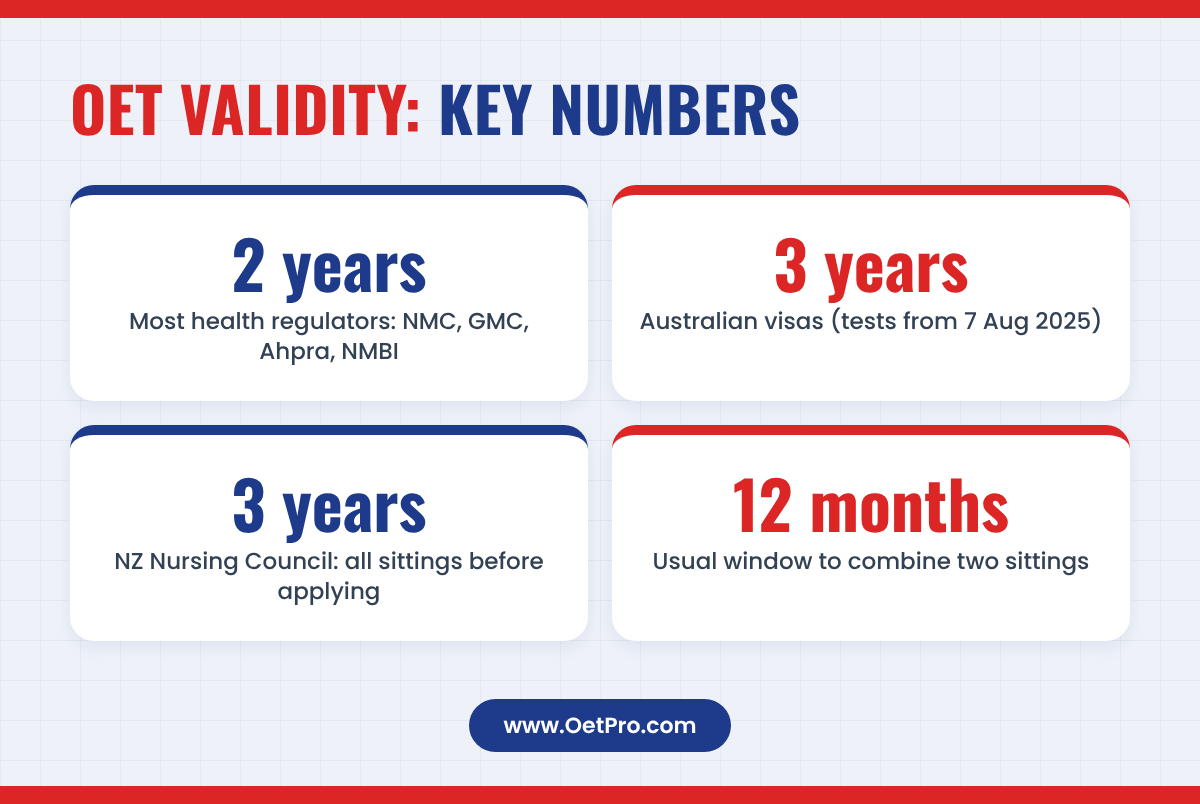
A small number of organisations use a longer window or a fixed start date instead:
- The Australian Department of Home Affairs (for visas) generally uses three years.
- The Nursing Council of New Zealand asks that all sittings fall within the three years before you apply.
- ECFMG in the USA uses a fixed cut-off date for each certification year rather than a rolling window.
Some regulators also allow an older result in special cases, such as continuous work in an English-speaking setting. These exceptions are narrow, so plan on the standard rule unless you are sure you qualify.
OET validity by regulator: quick table
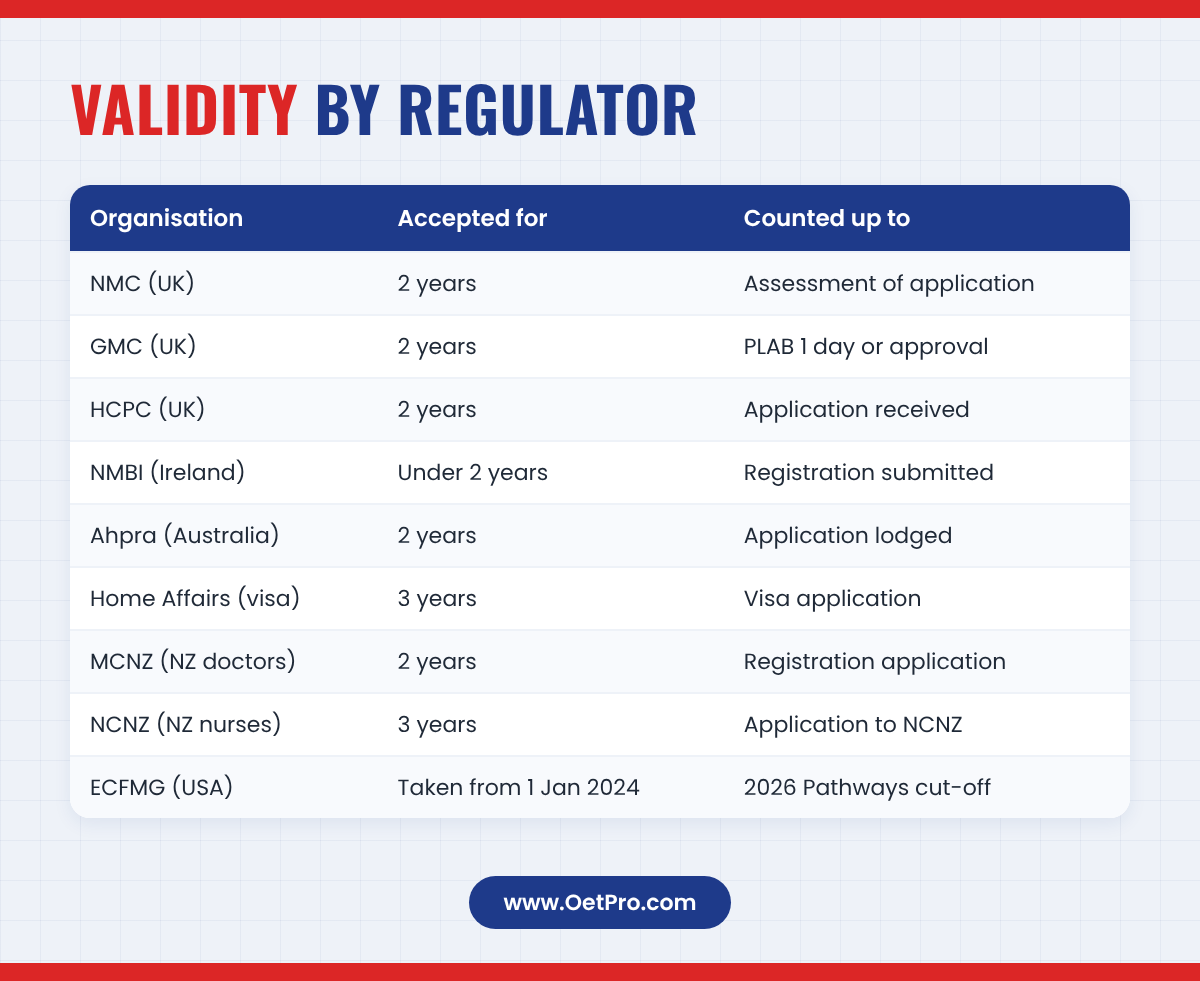
The table below summarises the rule for the regulators most OETPRO readers apply to. Details and exceptions follow in the country sections. Rules change, so always confirm on the official page (listed in Sources at the end) before you book.
| Organisation | How long results are accepted | Measured up to |
|---|---|---|
| NMC (UK nurses and midwives) | 2 years | The date the NMC assesses your complete application |
| GMC (UK doctors) | 2 years | The day you sit PLAB 1, or the date the GMC approves your registration |
| HCPC (UK allied health) | 2 years | The date the HCPC receives your application |
| NMBI (Irish nurses and midwives) | Under 2 years old | The date you submit your registration application |
| Ahpra and National Boards (Australia) | 2 years | The date you lodge your registration application |
| Home Affairs (Australian visas) | 3 years (tests from 7 August 2025) | The date of your visa application |
| Medical Council of New Zealand | 2 years | The date of your registration application |
| Nursing Council of New Zealand | All sittings within 3 years | The date of your application to NCNZ |
| ECFMG (USA, 2026 Pathways) | Test taken on or after 1 January 2024 | Fixed cut-off date, not a rolling window |
United Kingdom: NMC, GMC and HCPC
NMC – nurses, midwives and nursing associates
The Nursing and Midwifery Council says your language test scores are valid for two years. Your test must be taken within the two years before the NMC assesses your complete application. This matters: it is the assessment date that counts, not the day you first open your application. If you collect your documents slowly, your result can run out before the NMC looks at the full file.
For OET the NMC needs grade B (350 or more) in Listening, Reading and Speaking, and C+ (300 or more) in Writing.
GMC – doctors
The General Medical Council states that OET certificates are valid for two years. The GMC checks validity at two points:
- If you are taking PLAB, your certificate must be valid on the day you sit PLAB part 1.
- When you apply for registration with a licence to practise, it must be valid when the GMC approves your application.
There is one extension. If your certificate is over two years old, the GMC may still accept it if it was under three years old on the date your registration application was received and you passed PLAB 2 less than three months before that. You need at least grade B in each sub-test of the Medicine version, achieved in the same test and in your most recent sitting.
HCPC – allied health professions
The Health and Care Professions Council (for professions such as physiotherapy, occupational therapy, radiography, dietetics and speech and language therapy) says any test certificate you submit must be no more than two years old when it receives your application. Minimum scores are listed in a separate HCPC document, so check it for your profession.
The Health and Care Worker visa
For the UK visa itself, GOV.UK says doctors, dentists, nurses and midwives do not need to prove their knowledge of English again if they have already passed an English language assessment accepted by the relevant regulated professional body. In practice, the regulator's time limit is the one that matters most for these professions.
Ireland: NMBI rules for nurses and midwives
The Nursing and Midwifery Board of Ireland only accepts IELTS or OET results that are less than two years old. If your result is out of date, you must sit the test again.
- Online applications: the result must be valid when you submit your registration application – not when you apply for qualification recognition, which comes earlier.
- Paper applications: the test must be completed within two years of the date you submit the application.
The NMBI accepts only one test result and does not accept combined results. It also does not accept OET@Home. The minimums are B in Listening, Reading and Speaking and C+ in Writing.
In October 2023 the NMBI announced a three-month extension, but only for a small group of applicants whose test expired while visa problems delayed them and who had completed a compensation measure in 2023. The standard two-year rule did not change for everyone else.
Australia: Ahpra boards and Home Affairs
Registration with Ahpra and the National Boards
Ahpra says English language test results are valid for two years before the date you lodge your application for registration. A result older than two years may still be accepted if, since the test, you have:
- worked continuously in a relevant role, or
- been continuously enrolled in a Board-approved programme,
and you lodge your application within 12 months of finishing that work or study. Check the exact conditions with your Board before relying on this.
Australia also changed its minimum OET scores. For tests taken on or after 23 April 2026, you need 350 in Listening, 360 in Reading, 350 in Writing and 360 in Speaking. Tests taken on or before 22 April 2026 are judged on the old minimums (B in Listening, Reading and Speaking, C+ in Writing). Ahpra does not accept at-home versions of English tests. OET on computer is accepted when taken at a test centre.
Visas with the Department of Home Affairs
The visa authority uses a different window. For tests taken on or after 7 August 2025, the test must be taken within the three years before your visa application, depending on the visa subclass. Tests taken on or before 6 August 2025 may be used until 6 August 2028, again depending on the visa.
For "competent English", tests from 7 August 2025 need at least 290 in Listening, 310 in Reading, 290 in Writing and 330 in Speaking. Home Affairs lists OET@Home as an at-home test it does not accept.
New Zealand: Medical Council and Nursing Council
Medical Council of New Zealand (MCNZ)
The MCNZ English language policy says doctors' results must be no more than two years old when they apply for registration. For NZREX Clinical, results are valid for two years from the test date for new candidates. Repeat NZREX candidates may use results up to five years old if, since their last sitting, they have lived continuously in one of the listed English-speaking countries (New Zealand, Australia, the UK, Ireland, the USA, English-speaking Canada or South Africa).
The MCNZ requires 350 in Speaking, Listening and Reading and 300 in Writing on the Medicine version.
Nursing Council of New Zealand (NCNZ)
The NCNZ uses a different rule. You may reach the required scores over more than one sitting, but the required scores must be achieved within 12 months of first sitting the test, and all sittings must be completed within the three years before your application to the NCNZ. The minimums are 350 in Reading, Listening and Speaking and 300 in Writing.
The NCNZ says it does not currently accept online computer-based tests. It accepts OET on computer taken at an approved venue, including when the Speaking sub-test is hosted online.
United States: ECFMG for doctors
ECFMG (part of Intealth) accepts OET Medicine for the English communication part of its certification Pathways. It does not use a rolling two-year window. Instead, for the 2026 Pathways, your OET Medicine test must be taken on or after 1 January 2024. ECFMG says this cut-off ensures your communication skills assessment is current when you would enter graduate medical education.
You need at least 350 in Listening, Reading and Speaking and at least 300 in Writing, all in one test administration. OET@Home is accepted only for applicants who do not have a physical test venue in their country.
For US nursing (VisaScreen and state boards), English test rules are set by TruMerit (formerly CGFNS) and each state board. TruMerit does not accept at-home versions of English tests. Check its current score table and any date rules before booking.
Which date counts? Test date, application, assessment or approval
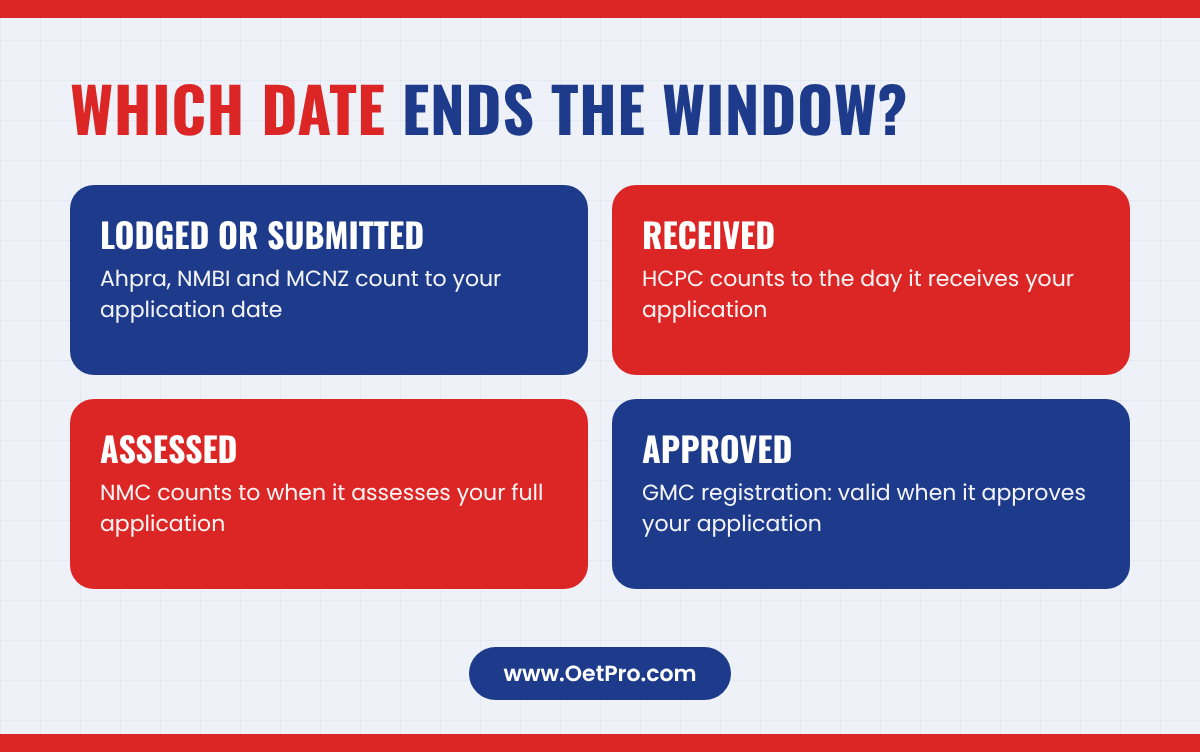
Two regulators can both say "two years" and still mean different things. The start of the window is always your test date. The end of the window is where the rules differ:
- Date you lodge or submit: Ahpra, NMBI (registration application), MCNZ. Once you apply in time, the clock is less of a worry.
- Date the regulator receives it: HCPC.
- Date the regulator assesses it: NMC. Delays in getting other documents can push you past two years.
- Date the regulator approves it: GMC (for registration). This is the strictest point, because approval comes last.
- Date of another exam: GMC also checks validity on the day you sit PLAB part 1.
If the rule is measured to assessment or approval, leave yourself extra time. A result that is 22 months old when you apply may be more than 24 months old by the time a decision is made.
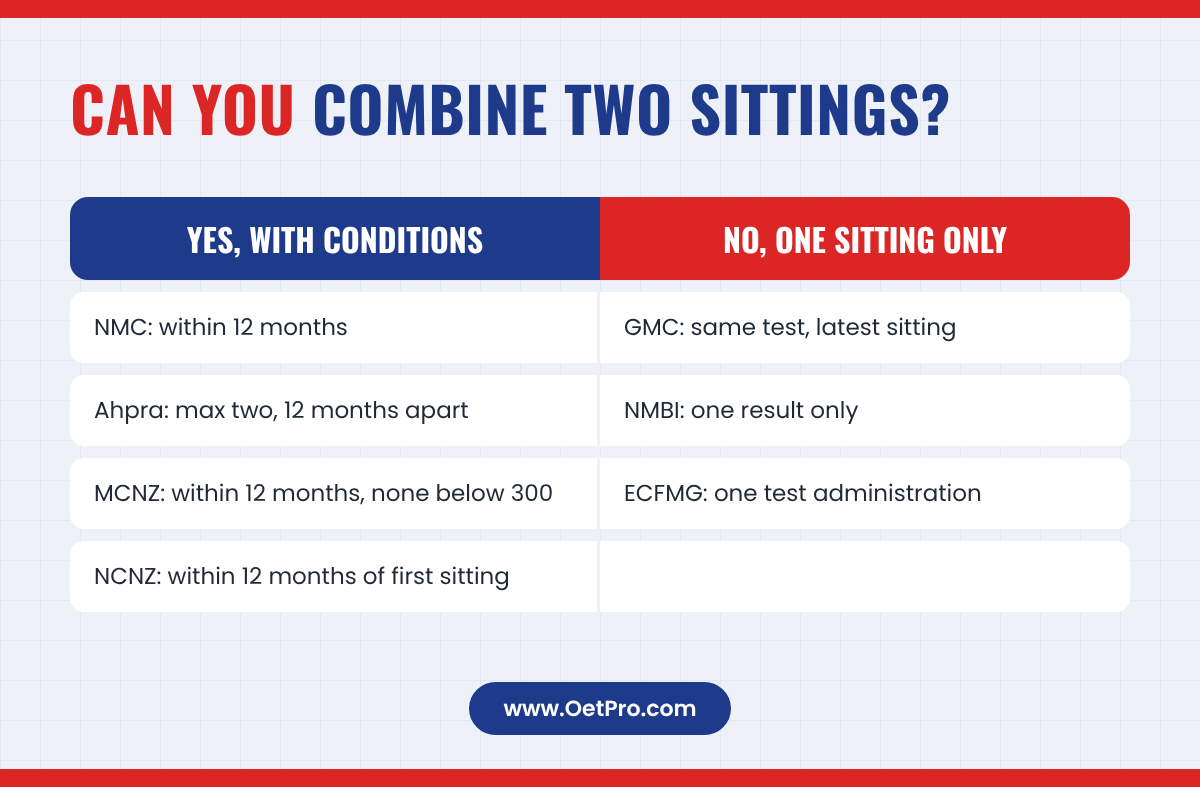
Combining two sittings and how it affects validity
Some regulators let you use your best scores from two sittings. When they do, each sitting usually has its own time limit too.
| Organisation | Combine two sittings? | Main conditions |
|---|---|---|
| NMC | Yes | Sittings within 12 months of each other; both no more than 2 years old at assessment; all four sub-tests in each sitting; same test type |
| Ahpra | Yes | Maximum two sittings, no more than 12 months apart; both must meet minimums; no mixing test providers |
| MCNZ | Yes | Within 12 months; all four sub-tests each time; no score below 300 in either sitting |
| NCNZ | Yes | Scores reached within 12 months of first sitting; all sittings within 3 years before applying |
| GMC | No | Grades from the same test and your most recent sitting |
| NMBI | No | One test result only |
| ECFMG | No | All minimum scores in a single test administration |
A practical point for the NMC: because both sittings must be under two years old when your application is assessed, the older sitting sets your real deadline. The same idea applies elsewhere – plan around your first sitting, not your best one. Our guide to the OET scoring system explains grades and scores in more detail.
Does the test format affect whether your result is accepted?
A valid date is not enough if the format is not accepted. From the official pages used for this guide:
- GMC: accepts OET on paper, on computer and OET@Home (Medicine version).
- NMBI: does not accept OET at home.
- Ahpra: does not accept at-home versions; accepts OET on computer at a test centre.
- Home Affairs: does not accept OET@Home for visas.
- NCNZ: accepts OET on computer at an approved venue; does not currently accept online computer-based tests.
- ECFMG: OET@Home only if there is no physical test venue in your country.
- TruMerit (US nursing): does not accept at-home English tests.
If you may apply to more than one country, a venue-based test (paper or computer) keeps the most doors open. Our comparison OET on paper, computer or OET@Home covers the differences in full.
How to plan your test date so your result stays valid
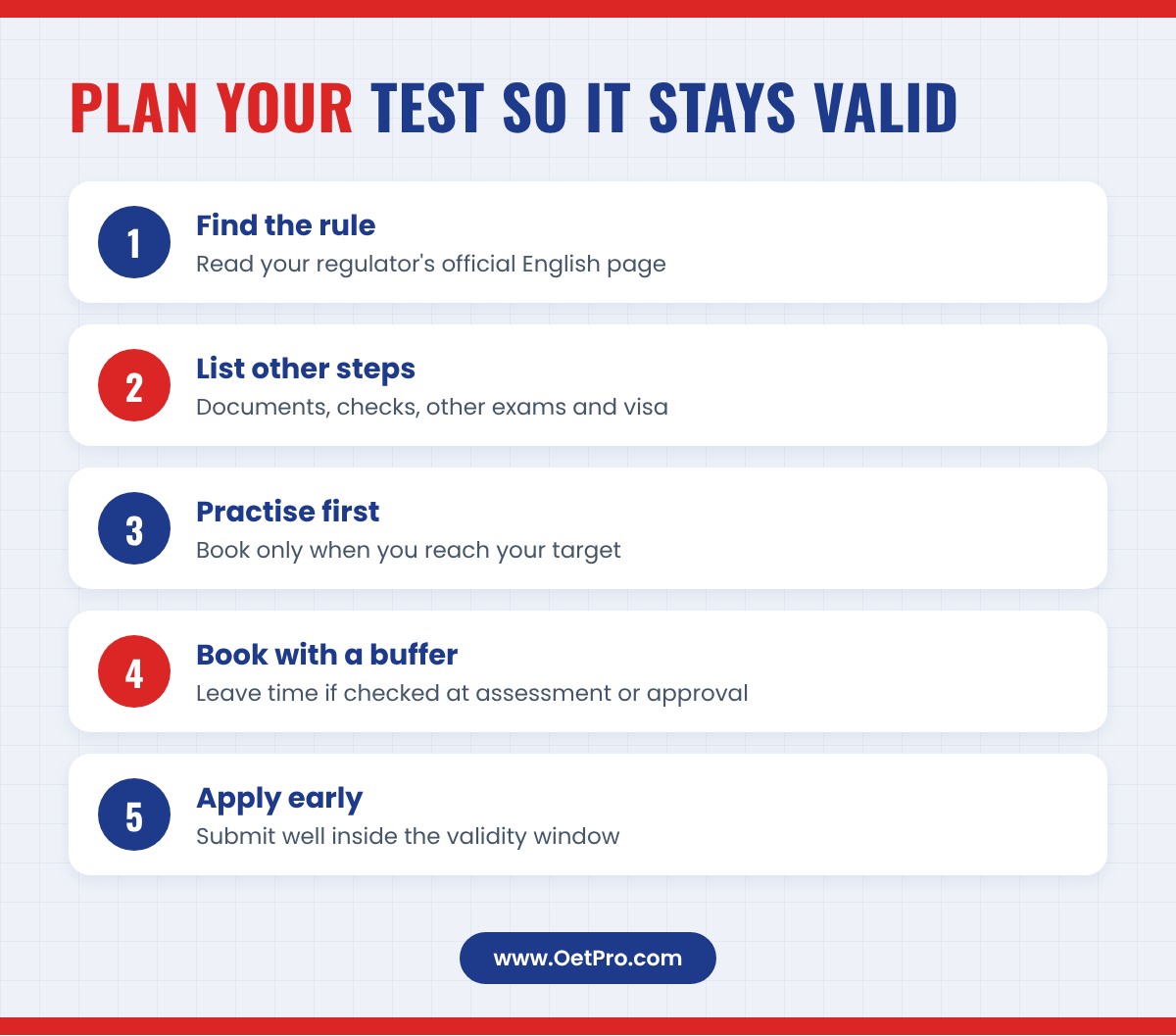
Most problems with expired results come from booking too early or applying too slowly. Work backwards from the date your regulator will check your result.
- Find your regulator's rule. Read its official English page and note the window and the end point (application, assessment or approval).
- List your other steps. Degree and licence documents, good standing certificates, verification checks, other exams (such as PLAB, the NMC CBT or the NCLEX) and visa steps all take time.
- Prepare before you book. Take practice tests and book only when you are scoring at or above the target. This avoids paying for a sitting that fails or that expires while you finish other steps.
- Book with a buffer. Aim to submit well inside the window, especially if validity is checked at assessment or approval.
- Apply as soon as you can. For regulators that count to the application date, submitting early protects your result.
- Keep your account details ready. Regulators verify results online, so you will need to give them permission through your OET account.
If you want a structured route to exam readiness, see our 4-week and 8-week OET study plans, and test your level with a free OET practice test before you book. You can create a free OETPRO account to save your progress.
What to do if your OET result is about to expire
If your result is close to the end of its window, act quickly:
- Check the exact end point. If your regulator counts to the date you submit or lodge, submitting a complete application now may be enough.
- Look for a written exception. The GMC (PLAB 2 within three months), Ahpra (continuous work or study) and the MCNZ (repeat NZREX candidates) have narrow exceptions. Read the conditions on the official page; do not assume they apply.
- Ask the regulator directly. Only the regulator can confirm whether your result will be accepted. Recruiters and forums may be out of date.
- Book a new sitting early. If you must retake, find a test date with enough time for results to arrive before your old result expires. See our guide to OET accepted countries and booking.
When results are shared, recognising organisations check them through OET's online verification portal. A candidate must give the organisation permission through their OET account, so keep your login details safe.
Common questions
Is OET valid for two years?
For most health regulators, yes – the NMC, GMC, HCPC, NMBI, Ahpra and the MCNZ all use two years. But OET itself does not set an expiry date; each organisation decides, and some use three years (Home Affairs visas, the NCNZ) or a fixed date (ECFMG).
Can I use one OET result for both registration and my visa?
Often, yes, but each body checks its own rule. In Australia, Ahpra uses two years and different score minimums from Home Affairs, which generally uses three years. In the UK, doctors, nurses, midwives and dentists can rely on an assessment accepted by their regulator for the Health and Care Worker visa.
Does my result need to be valid when I apply or when I am approved?
It depends on the regulator. The GMC checks at approval, the NMC at assessment, the HCPC when it receives your application, and Ahpra and the NMBI at the date you lodge or submit. See the "Which date counts?" section above.
If I combine two sittings, which date counts?
Usually both sittings must be inside the window. For the NMC, both must be no more than two years old when your application is assessed, so your older sitting sets the deadline.
Can a regulator extend my expired OET result?
Only where its official rules allow it, such as the GMC's PLAB 2 extension or Ahpra's continuous work or study rule. Otherwise you will need to sit the test again.
Sources
- Cambridge English – OET results
- OET – Who recognises OET
- OET – Recognising OET (results verification)
- NMC – Accepted English language tests
- NMC – Language requirements (two years at assessment)
- GMC – Using your OET certificate
- HCPC – English language proficiency
- GOV.UK – Health and Care Worker visa: knowledge of English
- NMBI – English language requirements
- NMBI – Extension of validity for English language tests (2023)
- Ahpra – Accepted English language tests
- Department of Home Affairs – Competent English
- Medical Council of New Zealand – English language policy
- Nursing Council of New Zealand – English language requirements
- ECFMG – Certification Pathways FAQs
- TruMerit – VisaScreen
Practise with real OET-style tests
Free sample tests for all four sub-tests, with answers.