Who Runs OET? CBLA, the Official Website and Sources to Trust
OET is owned by CBLA, a venture between Cambridge English (Aus) and Box Hill Institute. Learn which OET websites and contacts are official, where to find trusted answers, and how to avoid leaked material and fake results.
OET is owned and run by Cambridge Boxhill Language Assessment (CBLA), a joint venture between Cambridge English (Aus) and Box Hill Institute in Australia, which has owned the test since 2013. The only official home of the test is oet.com and the booking and support sites linked from it, so fees, dates, rules and results should always be checked there and with your regulator, not on social media, agents' posters or unofficial blogs.
This guide explains who CBLA is and what it does, lists the official OET web addresses and contact points, shows which free preparation comes from OET itself, and explains how results really reach a regulator. It also covers the warning signs of leaked material and fake results, and how to tell an official source from an unofficial one, including sites like ours.
The short answer: CBLA owns OET
OET's own "About" page says: since 2013, OET has been owned by Cambridge Boxhill Language Assessment Unit Trust (CBLA). The OET Test Regulations describe CBLA as "the entity that owns the OET". In legal terms, the company is Cambridge Boxhill Language Assessment Pty Ltd, acting as trustee for a unit trust.
You will see the owner named in slightly different ways:
- CBLA – the short name used in the test regulations and on results pages.
- Cambridge Boxhill Language Assessment – the trading name.
- Cambridge Boxhill Language Assessment Unit Trust – the full name of the trust that owns the test.
All three mean the same organisation. When a document, email or website talks about "OET" in an official way, CBLA is the body behind it.
OET itself is the Occupational English Test: an English test made for health professionals. It has versions for 12 healthcare professions, four sub-tests (Listening, Reading, Writing and Speaking) and three ways to take it: on paper at a venue, on computer at a venue, and OET@Home. If you are not sure which version is yours, read our guide to the 12 OET professions.
The two partners behind CBLA
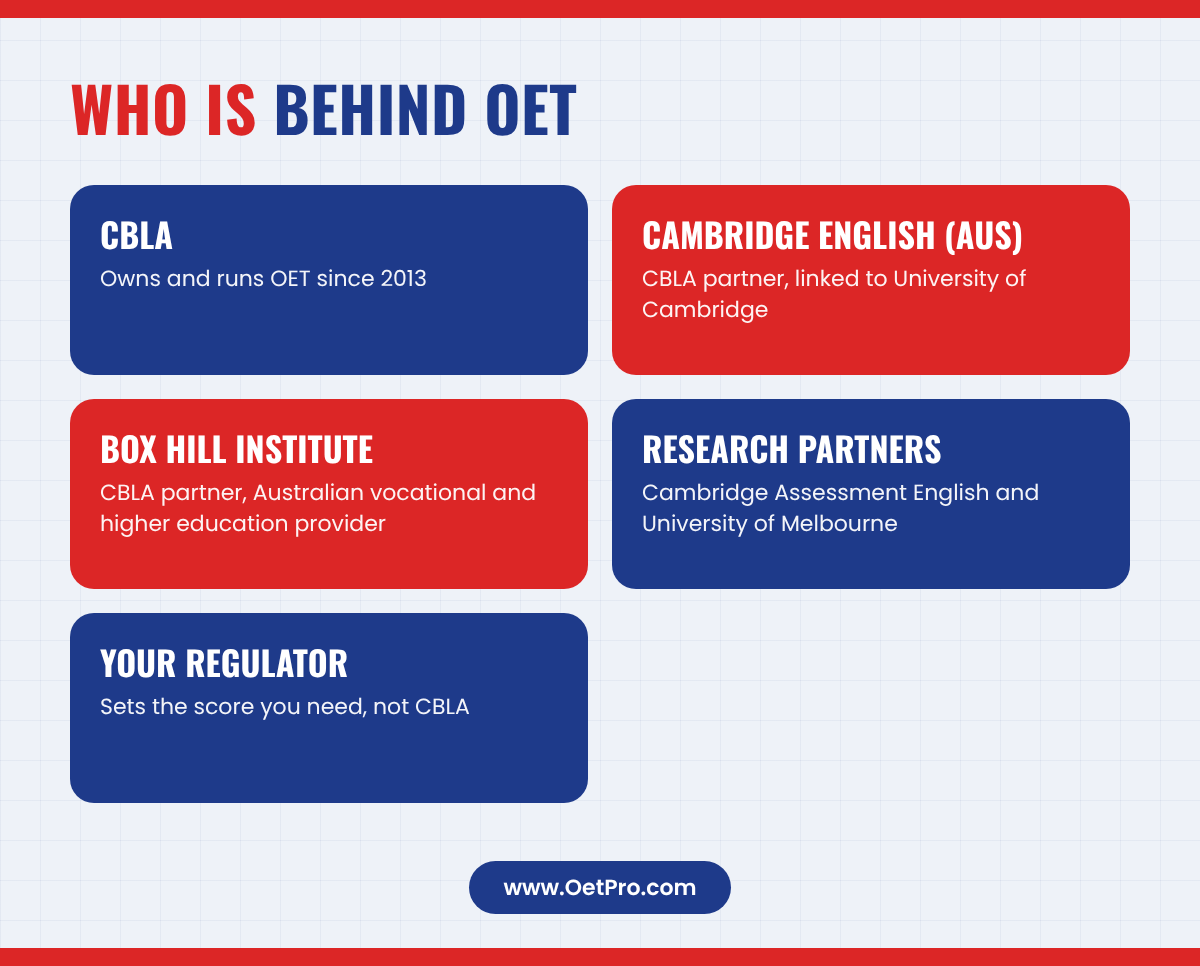
CBLA is described by OET and by Cambridge English as "a venture between Cambridge English (Aus) and Box Hill Institute". Each partner brings something different.
Cambridge English
OET's About page describes Cambridge English as "a not-for-profit department of the University of Cambridge" with more than 100 years of experience in assessing English. Cambridge English also lists OET among its own products on cambridgeenglish.org, and its page says OET is tailored to 12 healthcare professions and taken by healthcare workers from over 100 countries each month.
Box Hill Institute
Box Hill Institute is described as "a leading Australian vocational and higher education provider", working in Australia and overseas. This Australian link is one reason many official OET email addresses end in oet.com.au.
Research partners
The official "The OET Test" page says the test is supported by ongoing research from leading academic institutions, naming Cambridge Assessment English and the University of Melbourne. Research is not something candidates need to follow, but it explains why regulators trust the test: it is designed and checked by language-testing specialists, not by a private coaching company.
What CBLA does as the test owner
Because CBLA owns OET, it controls every official part of the test. From the OET Test Regulations and results pages, CBLA:
- Writes the rules. When you book, you accept the Terms and Conditions, the Test Regulations and the Privacy Policy.
- Sets the scoring. Each sub-test gets a score from 0 to 500 in ten-point steps and a grade from A to E. There is no overall grade.
- Releases results. Results appear in your online OET account, and you download your Statement of Results there.
- Controls verification. Access to the online results verification system is controlled by OET, and only organisations that recognise OET can use it.
- Handles malpractice. CBLA can withhold results during an investigation, disqualify results, and ban a candidate from taking the test for up to two years.
- Runs re-marks, complaints and appeals. A re-mark must be requested within 72 hours of results being released and costs AU$120 per sub-test under the current regulations.
CBLA does not decide what score you need. That is set by each regulator, employer or visa authority. CBLA only reports your scores; the NMC, GMC, AHPRA and others decide whether those scores are enough.
The official OET websites and addresses
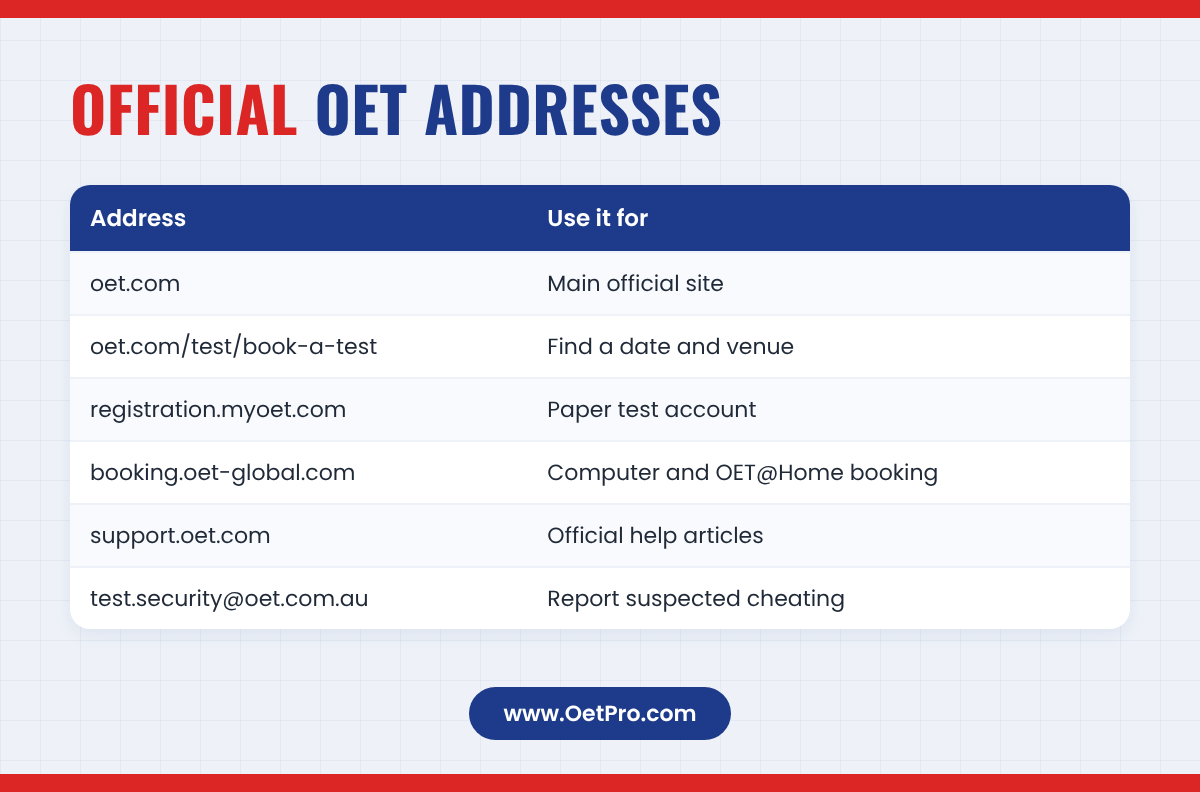
Scam websites often copy the OET name and colours. The safest habit is to start from oet.com and follow its links, rather than clicking links in messages or adverts. These are the official addresses named on OET's own pages:
| Address | What it is for |
|---|---|
| oet.com | Main official site: the test, recognition, preparation, results information |
| oet.com/test/book-a-test | Find a test date and venue, then click "Book now" |
| registration.myoet.com | Your OET account for OET on Paper bookings |
| booking.oet-global.com and oet-global.com | Booking for OET on Computer and OET@Home |
| support.oet.com | OET Support: official help articles (booking, payment, ID and more) |
| applications@oet.com.au | Applications and cancellations for paper tests |
| groupbooking@oet.com.au | Group bookings by institutions |
| test.security@oet.com.au | Reporting suspected cheating (put "allegation" in the subject line) |
A few simple checks help:
- Look carefully at the web address before you type a password or card number. A site with "oet" somewhere in its name is not automatically official.
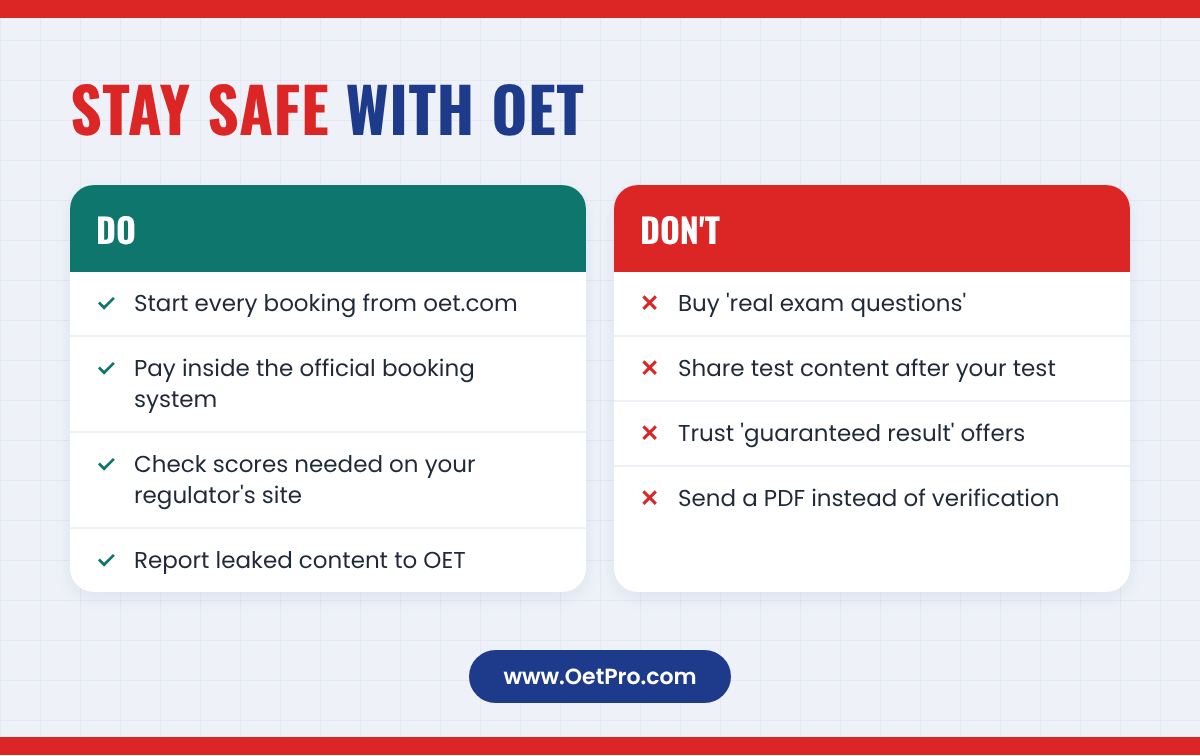
- OET Support says to have a Visa or MasterCard ready and to finish payment inside the booking system. A request to pay an individual, or to pay by bank transfer to a private account "to secure a seat", should make you stop and check.
- Booking confirmation comes by email. If it does not arrive, OET Support suggests checking your junk or spam folder before assuming anything has gone wrong.
Where to find official answers
When you have a question about OET, there are three official places to look, in this order.
1. OET Support (support.oet.com)
OET Support is the official knowledge base. For example, its article "How do I book the OET Test?" explains the steps: search for a test at oet.com/test/book-a-test, filter by test mode or distance, click "Book now", then complete the booking. It also warns that you have 15 minutes to complete payment details for a paper booking, or to finish a computer or OET@Home booking after choosing your date. For the full process, read our guide to booking OET and accepted countries.
2. The OET Test Regulations
The Test Regulations are the rulebook you agree to when you book. They cover prohibited items (phones, smartwatches, notes and recording devices), ID, malpractice, results being withheld, re-marks, complaints and appeals. Some key time limits from the current regulations:
- Test-day complaints: within 3 calendar days of the test, using the OET Complaints Form.
- Other complaints: within 30 calendar days of the incident.
- Re-mark requests: within 72 hours of results being released.
- Appeals: within 5 calendar days of receiving the outcome, using the OET Appeal Request Form. Each of the two appeal stages costs AU$120, refunded if the appeal is upheld.
- Documents requested by OET: usually 5 calendar days to supply them, or results may be withheld.
The regulations also say appeals must come from the candidate personally; requests from relatives, friends or colleagues are not accepted. Fees and time limits can change, so check the current regulations before you act.
3. Official OET pages on oet.com
For the test format, scoring and results, use the pages on oet.com itself, such as "The OET Test", "Results and scoring" and "Who recognises OET". Our own summaries of these topics are in the complete guide to OET and the guide to the OET scoring system, but the official pages always come first if anything differs.
Free official preparation from OET
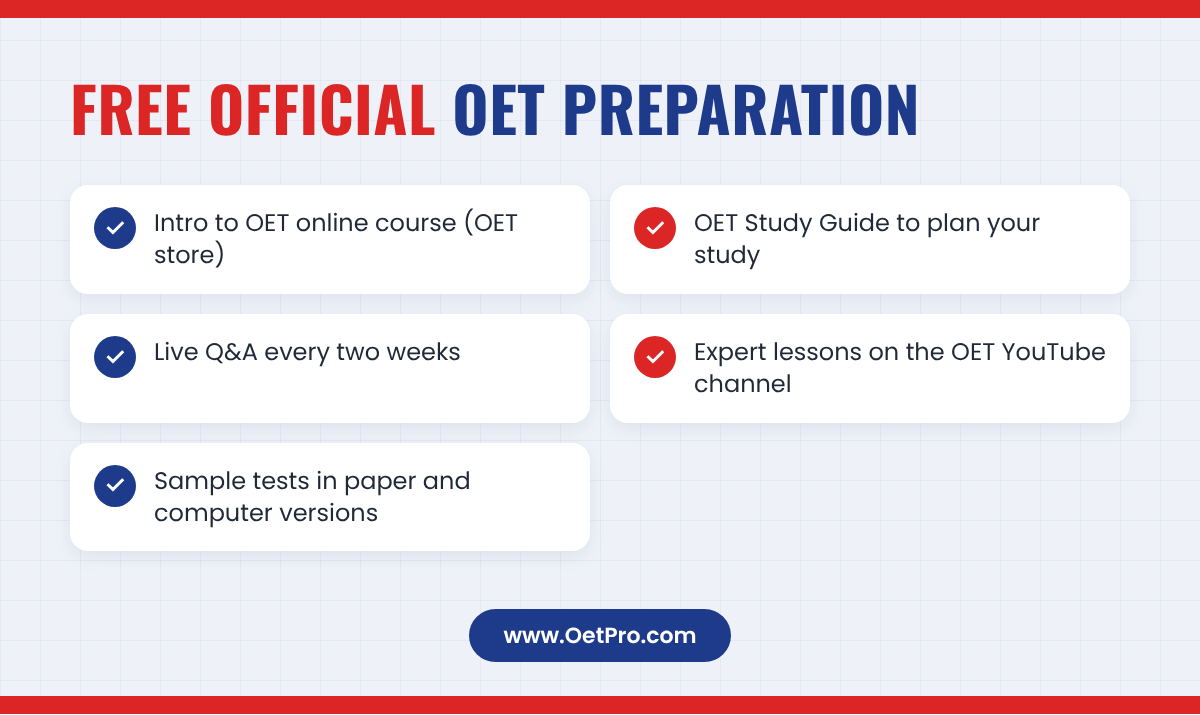
OET publishes a good amount of free preparation material. Its own article on free study resources lists five:
- Intro to OET online course – a free course introducing each part of the test, taken through the OET store.
- OET Study Guide – a free downloadable guide to plan your study time.
- Q&A sessions – live sessions every two weeks, streamed on Facebook or YouTube, where OET experts answer questions.
- On-demand lessons – videos from OET experts on the official YouTube channel, covering each part of the test.
- Sample tests – free practice tests on oet.com, in both paper and computer versions.
The official "Preparation information" page also lists introductory courses for nursing, medicine and allied health, OET Pulse (which assesses your current English level and gives feedback on how to prepare), a Language Handbook, sub-test guides, and a tool to find a preparation provider. The page does not state the cost of every item, so check before you buy.
Official samples are the best way to see what the real test looks like. Once you have used them, you will need more practice at the right level, which is where independent practice tests help. You can try our free OET practice tests with answers, and follow one of our 4-week and 8-week study plans.
Preparation providers: Premium and Non-premium partners
OET runs a network of preparation partners, listed on its "Study with a teacher" page. There are two levels:
- Premium Preparation Partners are, in OET's words, "recognised by OET as highly qualified teachers" with experience developing and delivering OET courses. Their courses have set entry requirements and course lengths.
- Non-premium Preparation Partners have completed a preliminary OET training programme only. They may display the digital "OET Knowledge" badge.
Being a partner means a provider has a relationship with OET and has done its training. It does not mean the provider can promise you a grade, change your score, or get you a test date others cannot get. Any provider that claims it can is not describing how OET works.
Most coaching centres and websites, including OETPRO, are independent. That is normal and fine, as long as the provider is honest about it and its materials are its own work rather than copied test content.
How OET results reach a regulator
This is the area where knowing the official route matters most. Your results are not "real" because you have a PDF or a printout; they are real because they sit in OET's system and the regulator checks them there.
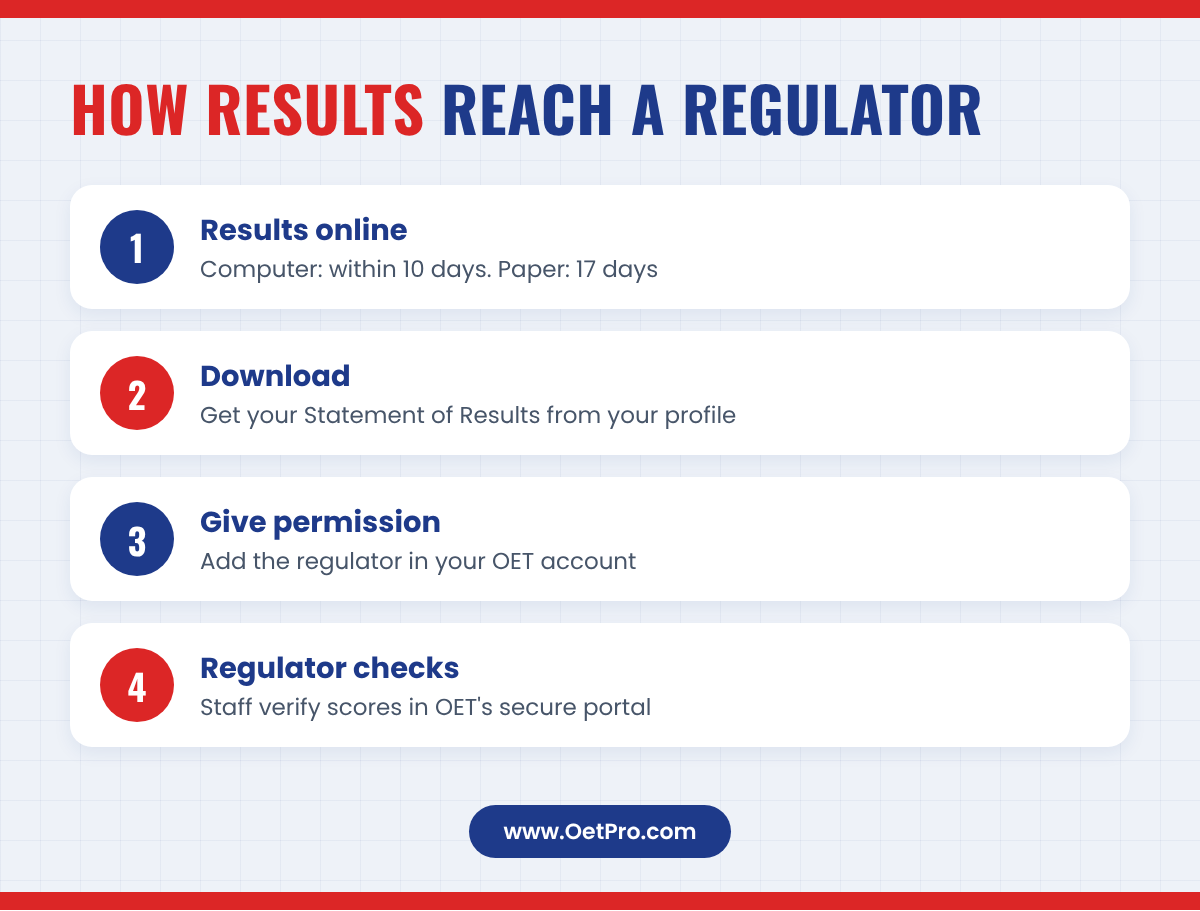
The official process works like this:
- Results are released online. Computer-based results (at a venue or OET@Home) are usually available within 10 days of the test date, and paper-based results 17 days after the test date. Public holidays, especially near the end of the year, can affect timing.
- You download your Statement of Results from your online profile, choosing the test you want.
- You give the organisation permission. In your OET account, you add the regulator or employer as a verification institution.
- The organisation checks online. Authorised staff at organisations that recognise OET log into the secure verification portal. OET says they can only view your results if you have given them permission.
OET's results page advises recognising organisations to only accept the Statement of Results shared directly within the candidate's profile, and not to accept a PDF or paper copy as the official record. The UK's Nursing and Midwifery Council (NMC), for example, asks for your OET certificate and candidate number, and says you must give it permission to verify your OET results through your OET account before you submit your application, or your application may be delayed.
So if anyone offers to "send your results to the council" for a fee, or to deliver a certificate without you sitting the test, remember: the regulator checks your scores directly in OET's system. A document that is not in that system will not pass.
Leaked material, fake results and other risks
Because OET opens the door to registration abroad, it attracts people selling shortcuts. OET's own guidance is clear about what counts as cheating.
What OET counts as malpractice
The Test Regulations define malpractice as "any action which seeks an unfair advantage in relation to the OET Test". Examples include cheating, copying or colluding, impersonation, using unauthorised items, and altering a results document. You must not record or reproduce any part of the test, and sharing test content can lead to civil or criminal charges.
OET's article "3 things you didn't know were cheating" adds points many candidates do not realise:
- Memorising test content and sharing it with others is malpractice. You may talk about how you felt, but not about detailed content or your answers.
- Using or sharing leaked material counts as cheating, even if someone else leaked it first.
- OET says it legally monitors social media and messenger groups for shared content.
- If you receive test content, you should report it through OET's suspicious reporting form. Reports can be anonymous.
What can happen
Under the regulations, results can be withheld or disqualified, a candidate can be banned from the test for up to two years, and CBLA may share details of an investigation with regulators and law enforcement. This is not a theory. The NMC has published a page for applicants affected by "suspected malpractice with some OET results": OET withdrew those results, the NMC stopped accepting them, and the issue affected 68 people who were still applying to join the register. Affected applicants had to provide new evidence of their English, their applications were referred to an Assistant Registrar for extra checks, and the NMC says registration may be refused where there is evidence of fraud or dishonest conduct.
The lesson is simple: buying "real exam questions" or a "guaranteed result" can cost far more than a failed test. It can put your registration, and your career, at risk.
Your regulator: the other source you must trust
OET tells you what you scored. Your regulator tells you whether that score is enough, which formats it accepts, and whether you may combine results from two sittings. These rules belong to the regulator, so always read its own page.
Some examples from official pages:
- The NMC asks for at least grade B (350 or above) in Reading, Listening and Speaking and at least C+ (300 or above) in Writing, and accepts OET on Paper, OET on Computer and OET@Home, provided you take the Nursing version.
- OET's "Who recognises OET" page says that for most countries organisations are marked as accepting "all test types", "Paper only" or "Paper and Computer at a venue", so the format you choose matters.
- The same page notes that CGFNS and Josef Silny do not accept OET@Home results for US nursing purposes.
- OET's results page notes that most boards and councils require at least 350 in each of the four sub-tests, but each board sets its own rule.
Requirements change, sometimes with little notice. Before you book, open your regulator's current English language page, and use OET's recognition list only as a starting point. Our guide to choosing paper, computer or OET@Home explains how format rules affect your booking.
Official, partner or independent: how to judge a source
You will read about OET in many places. A simple way to decide how much to trust each one:
| Source | Use it for | Do not rely on it for |
|---|---|---|
| oet.com, OET Support, Test Regulations | Format, rules, booking, fees, results, re-marks | Which score your regulator needs |
| Your regulator (NMC, GMC, AHPRA, NMBI and others) | Required grades, accepted formats, combining sittings | Booking or test-day rules |
| Government visa sites | English rules for visas | Professional registration rules |
| OET preparation partners | Teaching, feedback, courses | Promises of grades or dates |
| Independent sites and blogs (including OETPRO) | Explanations, practice, study plans | Final word on fees or rules |
| Social media groups and agents' posters | Sharing experiences | Fees, rules, "real questions" or results |
Where OETPRO fits
OETPRO is an independent practice site. We are not part of OET or CBLA, we do not run the test, and we cannot see, change or send your results. What we do is write original practice tests modelled on the official format, explain the rules in plain English, and link every fact in our guides to the official page it comes from, as in the Sources list below. If you would like to track your practice scores, you can create a free OETPRO account.
Common questions
Is OET run by the University of Cambridge?
Not directly. OET is owned by CBLA, a venture between Cambridge English (Aus) and Box Hill Institute. Cambridge English is a not-for-profit department of the University of Cambridge, so the university is connected through that partnership.
Is OET an Australian test?
The owner, CBLA, has strong Australian roots: Box Hill Institute is Australian, the partner is Cambridge English (Aus), and official emails end in oet.com.au. But the test is international. Cambridge English says OET supports careers in the UK, Ireland, Australia, Canada, the US, New Zealand and Singapore, and is taken by healthcare workers from over 100 countries each month.
Can an agent or coaching centre book my test for me?
Booking is done through OET's own systems: registration.myoet.com for paper tests, and booking.oet-global.com or your oet-global.com account for computer and OET@Home tests. Institutions can make group bookings through OET. Whoever helps you, make sure the booking and payment happen inside the official system, in your own name, and that the confirmation email comes to you.
How do I report leaked material or cheating?
Use OET's suspicious reporting form on the website (reports can be anonymous), or email test.security@oet.com.au with "allegation" in the subject line, as the Test Regulations explain.
Is OETPRO an official OET website?
No. OETPRO is independent and not connected to OET or CBLA. Our practice tests are our own work. For official rules, fees and results, always use oet.com and your regulator.
Sources
- OET – About OET (ownership by CBLA)
- OET – The OET Test
- OET – Test Regulations
- OET – Results and scoring
- OET – Who recognises OET
- OET – Recognising OET
- OET – Verify OET Test results
- OET Support – How do I book the OET Test?
- OET – Preparation information
- OET – Free study resources for OET preparation
- OET – Study with a teacher
- OET – 3 things you didn't know were cheating
- Cambridge English – Occupational English Test
- NMC – OET requirements
- NMC – Information for applicants affected by the OET issue
Practise with real OET-style tests
Free sample tests for all four sub-tests, with answers.