.png)
Complete Guide to the Occupational English Test (OET) 2026: Format, Scores, Fees & Preparation
Introduction
If you are a healthcare professional planning to work or study abroad, English proficiency is not just a requirement it is a clinical responsibility.
You must communicate clearly with patients, understand medical instructions, and write accurate clinical documents. This is exactly where the Occupational English Test (OET) becomes different from general English exams.
OET is not about academic essays or random topics.
It is about real healthcare communication.
In this complete guide, you will learn:
- What OET really tests
- How the exam is structured
- What scores you need
- And how to prepare strategically
This lesson is your foundation chapter in the OETPro curriculum.
Learning Objectives
By the end of this lesson, you will be able to:
- Understand the purpose and structure of the OET exam
- Identify the four key language skills in a medical context
- Recognize how OET is different from other English tests
- Avoid common beginner mistakes
- Build a clear preparation direction
Overview of the OET Exam
What is OET?
The Occupational English Test is an English language test designed specifically for healthcare professionals. To understand how OET scores are calculated, converted into grades, and interpreted across the four sections, read our detailed guide to the OET scoring system.
Unlike general English exams, OET uses:
- Patient case notes
- Doctor–patient conversations
- Referral letters
- Clinical scenarios
This makes it highly relevant for real-world practice.
Who is OET for?
OET is designed for:
- Doctors
- Nurses
- Dentists
- Pharmacists
- Physiotherapists
- Occupational Therapists
- Radiographers
- Veterinary Professionals
If your career involves patient communication, OET is built for you.
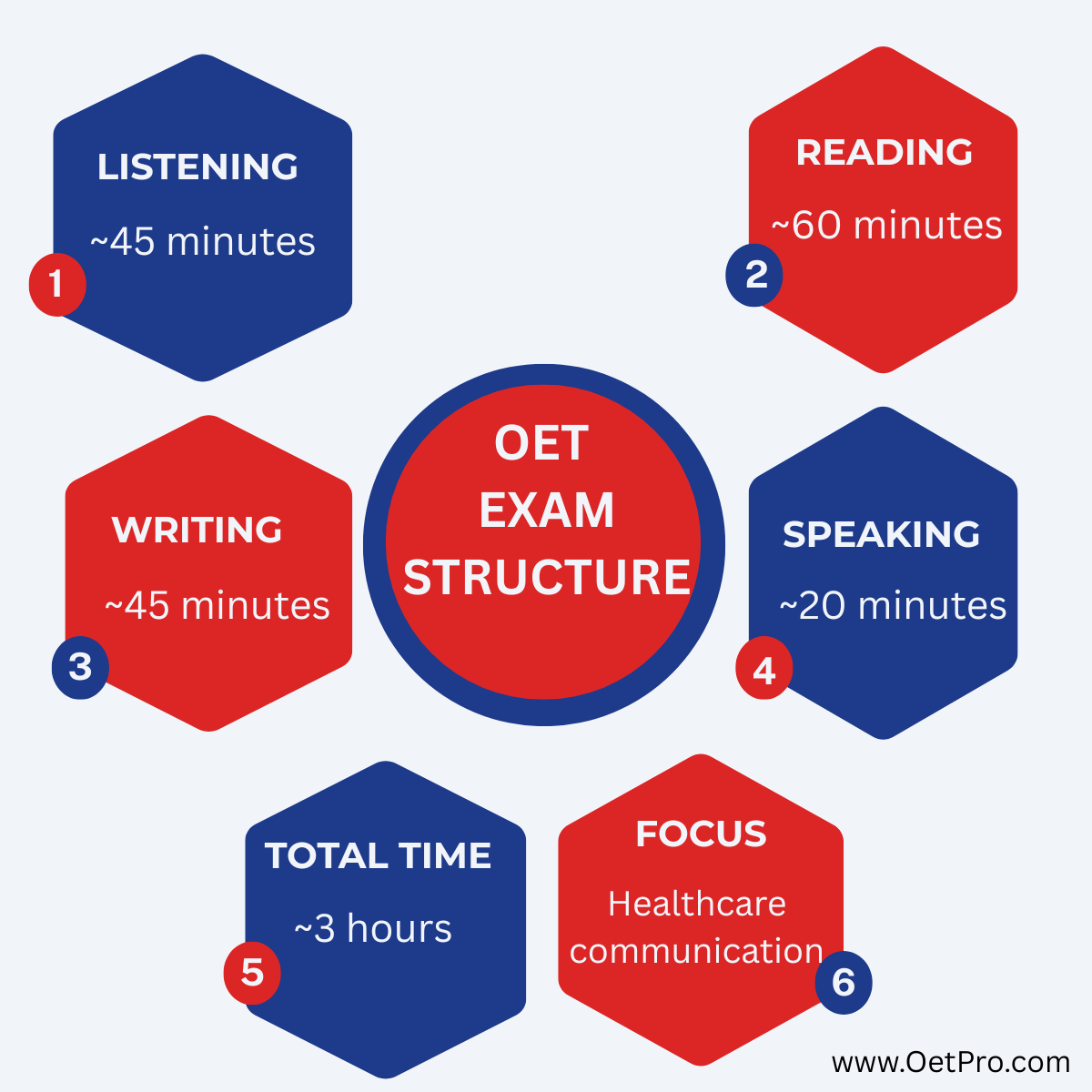
The OET exam tests four core skills:
1. Listening (45 minutes)
- Understand consultations and lectures
- Identify key medical information
2. Reading (60 minutes)
- Read medical texts
- Locate and interpret information quickly
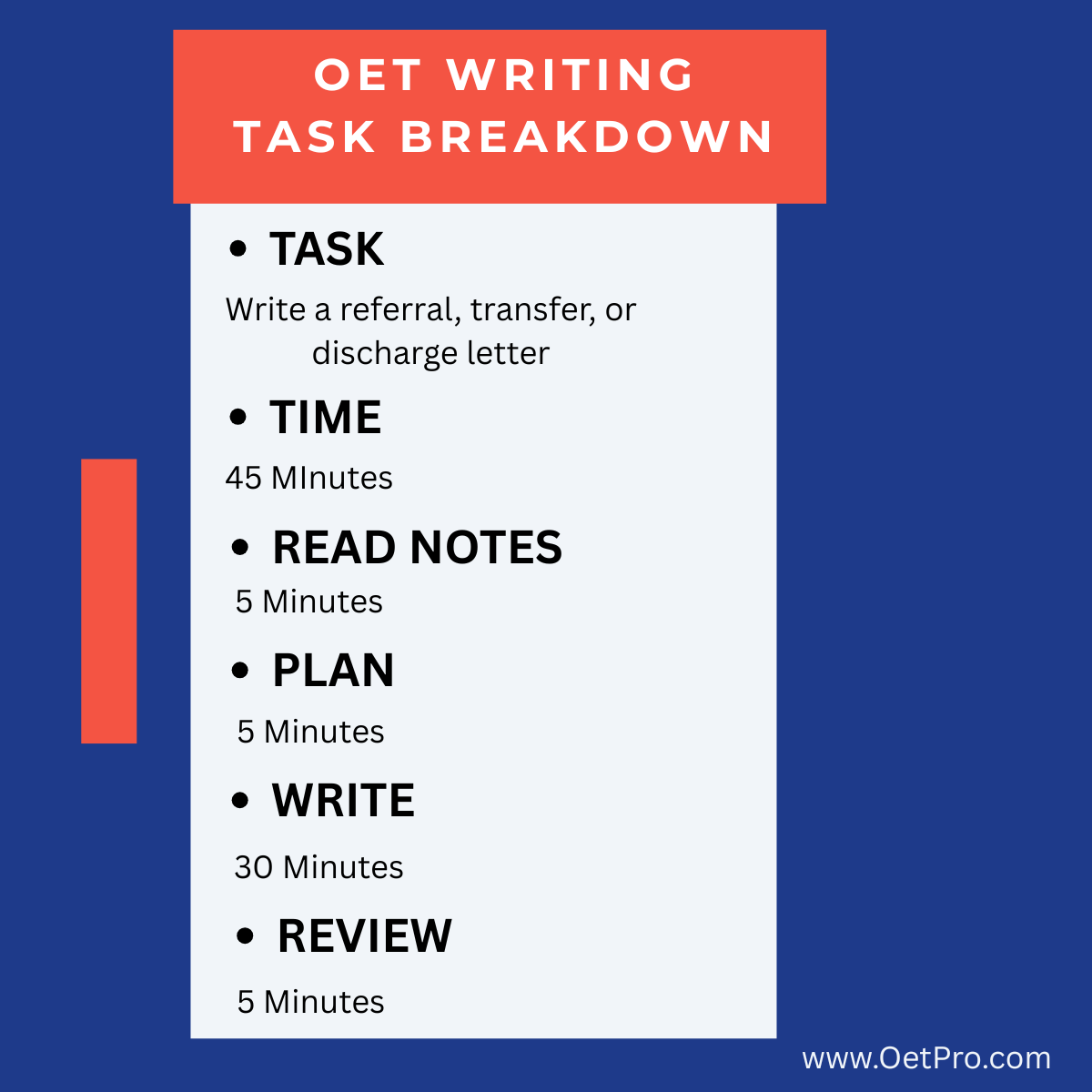
3. Writing (45 minutes)
- Write a professional letter (e.g., referral, discharge)
- Based on real patient case notes
4. Speaking (20 minutes)
- Role-play with an interlocutor
- Simulate doctor–patient or nurse–patient interaction
Want to understand what happens inside each section and how the OET test is structured? Read our detailed guide to the OET exam format guide.
Where is OET Accepted?
OET is accepted in major healthcare destinations, including:
- United Kingdom
- Australia
- New Zealand
- Ireland
- Canada (select pathways)
- United States (for specific professions)
Acceptance requirements can vary by country, profession, and purpose. For a detailed list of OET accepted countries and the registration process, see our complete guide.
Why Choose OET?
Many healthcare professionals prefer OET because:
- It uses familiar medical scenarios
- It feels more practical than academic tests
- It directly improves clinical communication skills
If you are deciding between OET and IELTS, our detailed OET vs IELTS comparison explains the differences in content, format, scoring, difficulty, and career use. If you are planning to use OET for professional registration, employment, or working abroad, check which countries accept OET and how the registration process works.
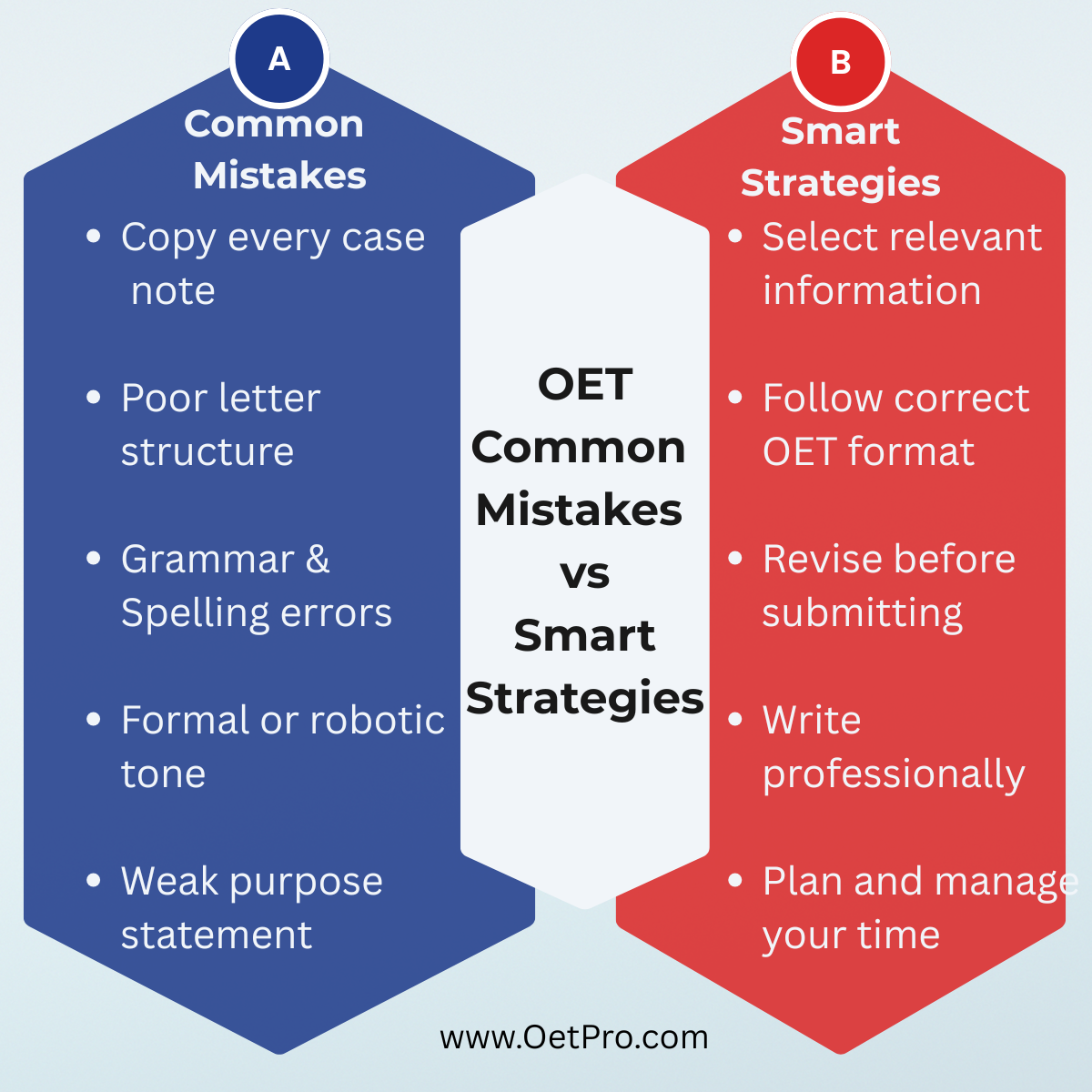
Common Beginner Mistakes
Starting OET preparation without the right strategy can lead to wasted time and low scores.
Here are the most common mistakes:
Mistake 1: Treating OET Like IELTS
OET is not a general English exam.
- IELTS ? general topics
- OET ? clinical communication
If you use IELTS strategies, you may struggle especially in Writing and Speaking.
Mistake 2: Ignoring Medical Context
Many candidates focus only on grammar and vocabulary.
But OET requires:
- Understanding patient needs
- Using appropriate tone
- Writing purpose-driven letters
Mistake 3: Memorizing Templates
Templates can help but overusing them can reduce your score.
Examiners look for:
- Personalization
- Accuracy
- Relevance
Mistake 4: Weak Writing Practice
Writing is one of the most challenging sections.
Common issues:
- Poor structure
- Missing key information
- Incorrect tone
Mistake 5: No Speaking Practice
Speaking is not just about English it is about:
- Empathy
- Clarity
- Patient interaction
Practicing alone without feedback is a major limitation.
Mistake 6: No Clear Study Plan
Random practice leads to slow progress.
You need:
- A structured roadmap
- Skill-wise improvement
- Regular evaluation
If you are unsure how OET differs from IELTS, see our detailed OET vs IELTS guide before choosing your exam preparation strategy. A structured study plan can make your preparation more focused and measurable. For a detailed OET preparation strategy, including 4-week and 8-week study plans, see our complete guide.
How OET Actually Tests You
To score well in the Occupational English Test, you must understand one key idea:
OET does not test English knowledge. It tests clinical communication.
This means:
- You are not rewarded for complex vocabulary alone
- You are evaluated on clarity, relevance, and purpose
Every task in OET reflects a real healthcare situation.
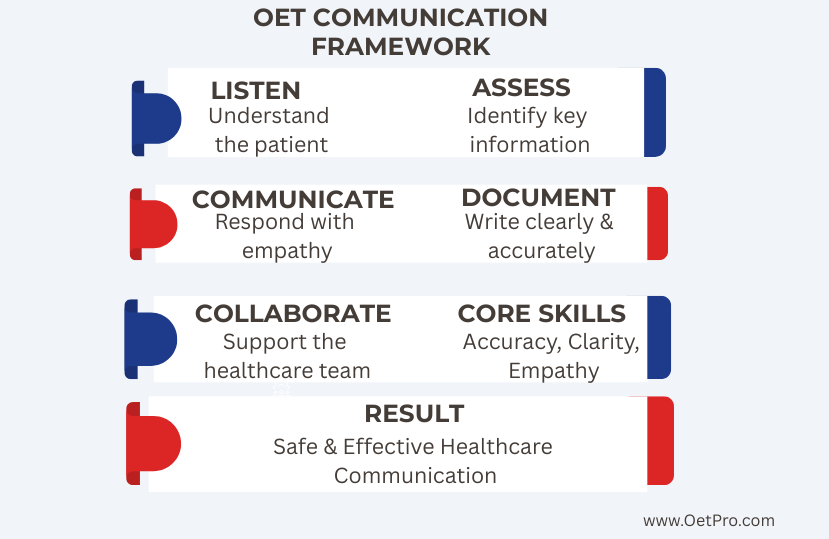
To master OET, you should follow this 4-part communication framework:
1. Clarity
Can the reader or listener understand you easily?
In OET:
- Use simple, direct sentences
- Avoid unnecessary complexity
- Focus on meaning, not decoration
Example:
The patient was experiencing a multitude of symptoms of considerable severity.
The patient had severe chest pain and shortness of breath.
2. Accuracy
Are your details correct and relevant?
In OET:
- Select the right information from case notes
- Avoid adding incorrect assumptions
- Use correct medical terminology
3. Appropriateness
Is your tone suitable for the situation?
This is critical in:
- Writing letters
- Speaking with patients
Example:
You must stop smoking immediately.
It would be beneficial for you to reduce smoking gradually.
4. Effectiveness
Did you achieve your purpose?
Every task has a goal:
- Inform
- Refer
- Reassure
- Advise
If your message does not achieve the goal, your score drops. Understanding the assessment criteria is only one part of your result. For a complete explanation of OET grades, score ranges, and how scores are interpreted, see our OET scoring system explained guide.
Section-Wise Strategy
Now let’s break down how to approach each section of the exam.
Listening Strategy
In Listening, you must:
- Capture key details
- Follow conversations in real time
Strategy:
- Focus on keywords, not full sentences
- Predict information before listening
- Stay calm if you miss one answer
Mini Example:
Audio: “The patient has been experiencing headaches for three days.”
Answer: Headaches – 3 days
Reading Strategy
Reading is about speed + accuracy.
Strategy:
- Skim first: understand the topic
- Scan: find specific answers
- Don’t read everything in detail
Key Tip:
Time management is everything in Reading Part B & C.
Writing Strategy
Writing is the most profession-specific section.
You will:
- Read case notes
- Write one formal letter
Framework:
- Introduction: Why you are writing
- Body: Relevant patient details
- Conclusion: Action required
Golden Rule:
Do not copy all case notes. Select only relevant information.
Speaking Strategy
Speaking is about human connection.
You will:
- Perform role-plays
- Interact with a simulated patient
Strategy:
- Start with empathy
- Ask open-ended questions
- Respond naturally
Mini Example:
Patient: “I’m worried about my surgery.”
You: “I understand your concern. Let me explain the procedure to you.”
Integrated Skill Strategy
Top scorers do not study skills separately.
They:
- Combine Listening + Speaking
- Combine Reading + Writing
Example:
- Read a case ? explain it aloud
- Listen to a consultation ? write a summary
This builds real clinical communication ability.
Real-World Example
Let’s connect everything.
Scenario:
A patient with diabetes needs referral to a specialist.
What OET expects:
- Listening: understand patient history
- Reading: interpret reports
- Writing: refer clearly
- Speaking: explain condition empathetically
This is why OET feels like real hospital work.
Advanced Tips to Reach a High Score
At this stage, basic understanding is not enough.
To score Grade B or above in the Occupational English Test, you must think like an examiner.
1. Write Less, But Write Better
Many candidates try to include everything from the case notes.
This reduces clarity.
High scorers:
- Select only relevant details
- Group information logically
- Avoid repetition
Example:
Includes full medical history unnecessarily
Focuses only on current issue and referral reason
2. Control Your Tone
Tone is a scoring factor especially in Writing and Speaking.
You must:
- Be professional
- Be polite
- Show empathy
Example (Speaking):
“You are overweight. You must lose weight.”
“Maintaining a healthy weight can improve your condition. Let’s discuss some options.”
3. Use Functional Language
Examiners look for purpose-based language, not just vocabulary.
You should be able to:
- Reassure
- Advise
- Explain
- Recommend
Examples:
- “I would recommend further investigation…”
- “It is important to monitor…”
- “You may benefit from…”
4. Avoid Over-Complex Grammar
Complex sentences are not always better.
Clarity > Complexity
Example:
Long, confusing sentence with multiple clauses
Two short, clear sentences
5. Practice Under Real Exam Conditions
Many students practice casually.
This creates a gap between practice and exam performance. If your target is Grade B or higher, it is important to understand exactly how OET scores and grades are determined. See our guide to OET score and grade conversion.
You must:
- Use a timer
- Practice full tests
- Simulate exam pressure
Examiner Insights: How You Are Scored
Understanding the marking system gives you a huge advantage.
Writing Assessment Criteria
In Writing, examiners evaluate:
- Purpose (Is your goal clear?)
- Content (Relevant information only?)
- Conciseness & Clarity
- Genre & Style (Professional tone)
- Organisation & Layout
- Language (Grammar & vocabulary)
Speaking Assessment Criteria
In Speaking, you are assessed on:
- Intelligibility (Clear pronunciation)
- Fluency (Smooth communication)
- Appropriateness of language
- Relationship building (Empathy)
- Information gathering
- Information giving
High-Scoring Vocabulary
Instead of memorizing difficult words, focus on useful phrases.
For Writing
- “I am writing to refer…”
- “The patient presented with…”
- “It would be appreciated if…”
- “Please do not hesitate to contact me…”
For Speaking
- “I understand how you feel…”
- “Let me explain this clearly…”
- “What concerns you the most?”
- “That’s completely understandable…”
For Explaining Conditions
- “This condition occurs when…”
- “The main cause is…”
- “Treatment usually involves…”
Practice Section
Now it’s time to apply what you’ve learned.
Practice Task 1: Writing
You are a nurse.
Task:
Write the opening sentence of a referral letter.
Case:
Patient with severe asthma requiring specialist care.
Target Answer:
“I am writing to refer Mr. John Smith, a 45-year-old patient with severe asthma, for further specialist management.”
Practice Task 2: Speaking
Scenario:
Patient is anxious about a new diagnosis.
Your Goal:
- Show empathy
- Provide reassurance
Sample Response:
“I understand this can feel overwhelming. Let me explain your condition step by step so you feel more confident.”
Practice Task 3: Reading
Task:
Find the key message in a short paragraph.
Tip:
Focus on:
- First sentence
- Topic words
- Repeated ideas
Practice Task 4: Listening
Task:
Listen and note:
- Symptom
- Duration
- Severity
This builds real exam skills.
Pro-Level Strategy
Top OET performers follow this cycle:
- Learn the concept
- Practice with guidance
- Get feedback
- Improve weak areas
- Repeat
This is the exact system used inside OETPro training programs. For a more detailed preparation roadmap, including how to organize your study time and progress through different stages, explore our OET preparation strategy guide.
OET Success Checklist
Before you take the exam, make sure you can confidently do the following:
Understanding the Exam
- I know the format of all 4 sections
- I understand what each section tests
Writing Skills
- I can write a clear referral/discharge letter
- I select only relevant case notes
- I use professional tone consistently
Speaking Skills
- I can handle role-plays naturally
- I show empathy and build rapport
- I explain medical conditions clearly
Reading Skills
- I can skim and scan quickly
- I can locate answers under time pressure
Listening Skills
- I can identify key details from conversations
- I can follow different accents
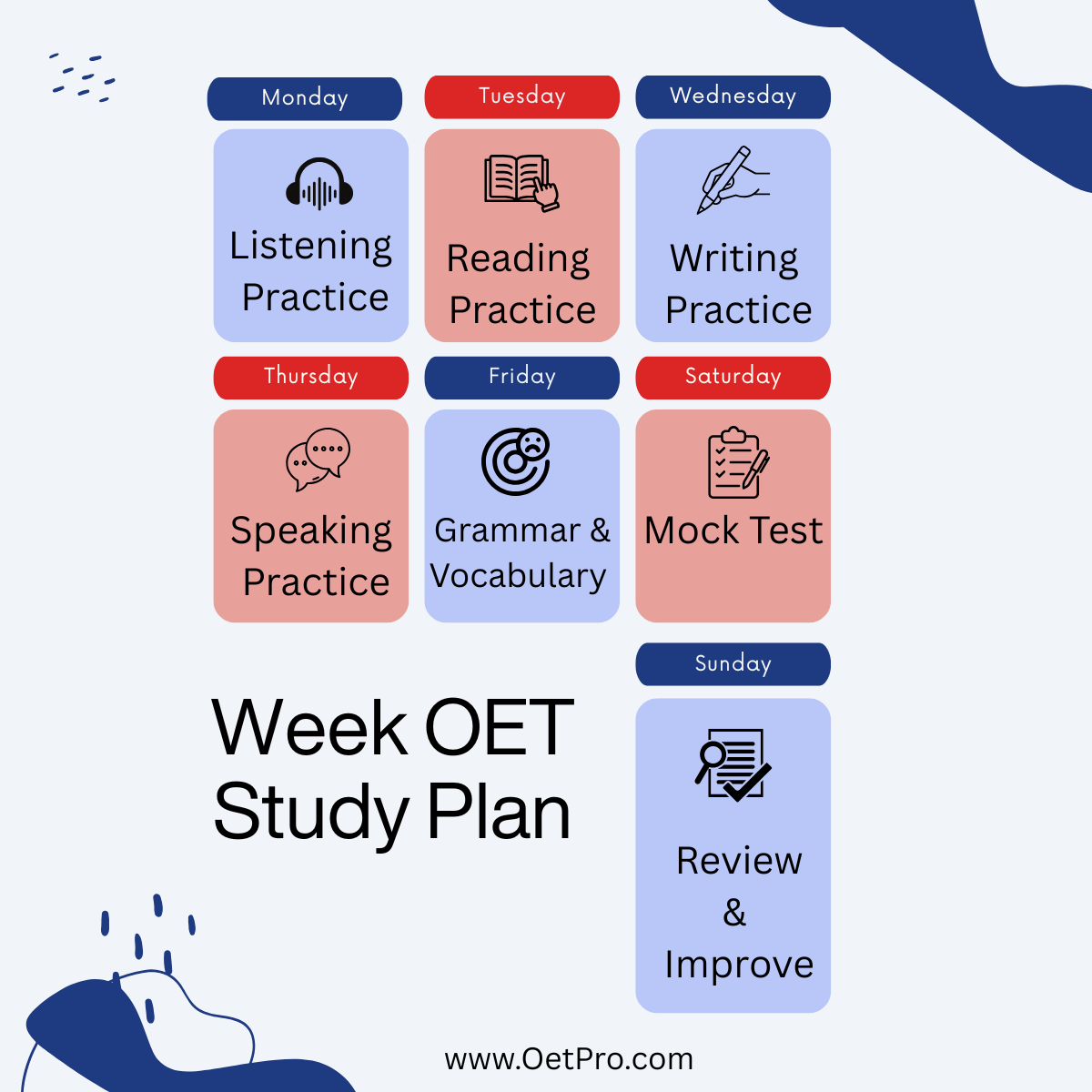
4-Week Starter Practice Plan
This is a beginner-friendly plan to help you start effectively.
Week 1: Foundation
- Understand the OET exam format
- Learn basic writing structure
- Practice simple listening tasks
Week 2: Skill Building
- Practice Reading daily
- Write 2–3 letters
- Start speaking role-plays
Week 3: Integration
- Combine skills (read + write, listen + speak)
- Practice under time conditions
- Identify weak areas
Week 4: Exam Readiness
- Take full mock tests
- Focus on mistakes
- Improve speed and confidence
This is a beginner-friendly plan to help you start effectively. For a more detailed study roadmap, including 4-week and 8-week OET preparation plans, see our preparation strategy guide.
Frequently Asked Questions (FAQs)
What is the Occupational English Test?
The Occupational English Test is an English exam designed for healthcare professionals. It evaluates your ability to communicate effectively in clinical settings.
What score do I need to pass OET?
Most healthcare boards require a Grade B (350+) in each section.
However, requirements may vary by country and profession.
Is OET than IELTS?
For healthcare professionals, OET is often easier because:
- It uses medical scenarios
- It focuses on practical communication
For healthcare professionals, OET may feel easier because it uses medical scenarios and focuses on practical communication. For a detailed comparison of difficulty, content, scoring, and exam experience, read our OET vs IELTS guide.
How long is the OET score valid?
OET scores are usually valid for 2 years, depending on the regulatory body.
Can I retake OET?
Yes. You can retake the exam as many times as needed.
How should beginners start OET preparation?
Start by:
- Understanding the format
- Learning writing structure
- Practicing daily with a plan
Once you are ready to take the test, you should also check OET registration requirements and accepted countries before booking.
Final Advice
Do not treat OET as just another English test.
Treat it as:
- A professional skill
- A career requirement
- A communication system for patient care
If you build the right habits, your score will follow.
Conclusion
The Occupational English Test is your gateway to an international healthcare career.
With the right strategy, structured practice, and consistent effort, you can:
- Achieve your target score
- Improve real communication skills
- Build confidence in clinical environments
This guide is your starting point.
Summary
You now understand the full structure and strategy behind the Occupational English Test.
Let’s quickly recap the most important points:
- OET is a healthcare-specific English exam
- It tests Listening, Reading, Writing, and Speaking
- The focus is on real clinical communication
- Success depends on:
- Clarity
- Relevance
- Professional tone
- Purpose-driven communication
This is not just an exam.
It is preparation for real patient interaction.