OET Speaking Error Correction & Recovery System Band A Fluency Strategy for Mistake Control
INTRODUCTION
In OET Speaking, mistakes are NOT what reduce your score.
What reduces your score is:
Not recovering from mistakes smoothly
Even Band A candidates make errors but they recover instantly and naturally.
This lesson teaches a complete Error Correction & Recovery System used in high-scoring OET Speaking performance.
LEARNING OBJECTIVES
By the end of this lesson, you will be able to:
- Recover smoothly from grammar and vocabulary mistakes
- Correct yourself without breaking fluency
- Maintain confidence after errors
- Avoid panic or freezing during role play
- Turn mistakes into natural communication flow
OVERVIEW: WHAT ERROR CORRECTION REALLY MEANS
Error correction is NOT:
- Stopping completely
- Restarting the sentence fully
- Apologizing repeatedly
- Getting nervous after mistakes
Error correction IS:
- Quick self-adjustment
- Natural continuation
- Silent or smooth correction
- Maintaining communication flow
CORE PRINCIPLE
In OET Speaking, recovery matters more than perfection
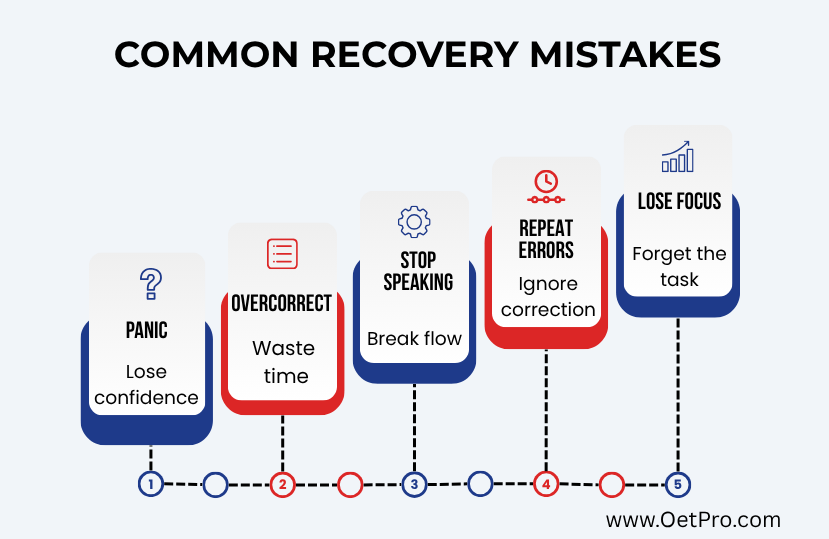
COMMON MISTAKES (ERROR BREAKDOWN PATTERNS)
Mistake 1: Full Stop After Error
Candidate stops completely after mistake.
Result:
- Loss of fluency
- Examiner notices hesitation
- Broken communication flow
Mistake 2: Repeated Apology
“I’m sorry… I mean… sorry…”
Result:
- Nervous impression
- Reduced confidence score
Mistake 3: Restarting Entire Sentence
Restarting from beginning after small error.
Result:
- Wasted time
- Loss of structure
Mistake 4: Freezing Under Pressure
Candidate stops speaking after mistake.
Result:
- Severe fluency drop
- Communication breakdown
CORE TEACHING FRAMEWORK
OET ERROR CORRECTION & RECOVERY SYSTEM
1. CONTINUATION CORRECTION METHOD
Instead of stopping, continue and fix naturally.
Example:
Wrong:
“I will give you med… sorry… medication… I mean…”
Correct:
“I will give you medication specifically antibiotics for your condition.”
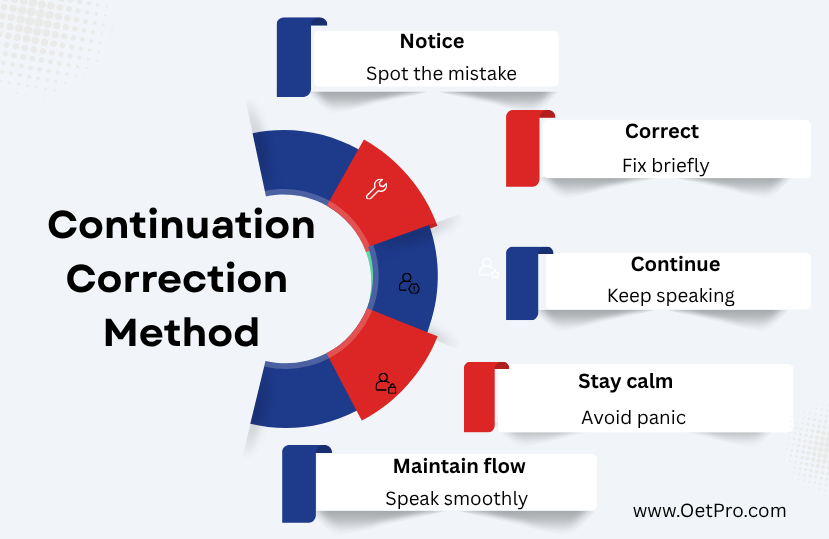
Fix + continue flow
2. SELF-REPHRASING SYSTEM
If sentence feels wrong, rephrase smoothly.
Example:
Wrong:
“You should take this tablet two times… no… one time…”
Correct:
“You should take this tablet once daily in the morning.”
No stopping, just restructuring
3. KEYWORD RECOVERY TECHNIQUE
If you forget a word, replace it immediately.
Example:
Wrong:
“This will help your… um… problem.”
Correct:
“This will help your symptoms improve quickly.”
Use simple replacement words
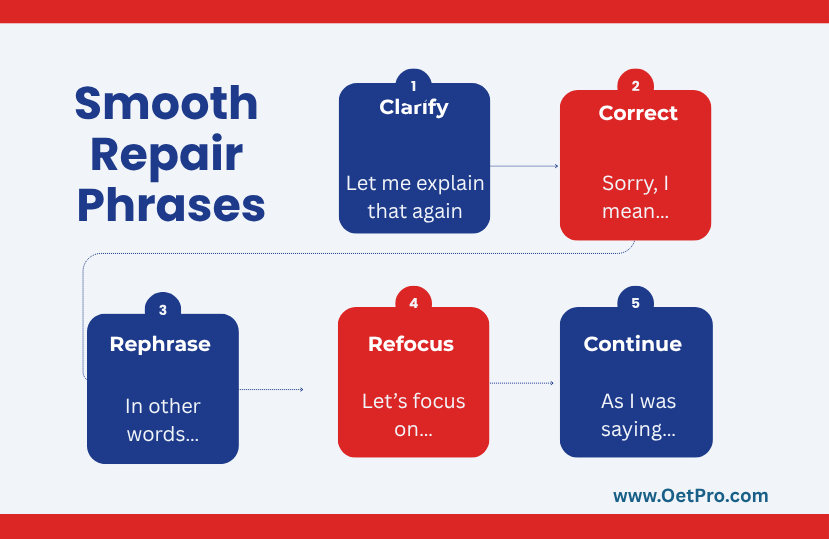
4. SMOOTH REPAIR PHRASES
Use natural correction phrases:
- “Let me rephrase that…”
- “What I mean is…”
- “To put it simply…”
- “I mean…” (used lightly)
Keeps flow natural and professional
5. FLOW PRESERVATION RULE
Never break communication for correction.
Golden Rule:
Correction should be inside speech, not outside speech
6. EMOTIONAL CONTROL SYSTEM
Mistakes create panic only if you allow it.
DO:
- Stay calm
- Continue speaking
- Adjust naturally
DON’T:
- Freeze
- Overthink grammar
- Show frustration
EXAMINER INSIGHT
Examiners do NOT expect perfect English.
They evaluate:
- Communication recovery ability
- Fluency consistency
- Confidence after mistakes
- Natural conversation flow
Strong recovery = high fluency score
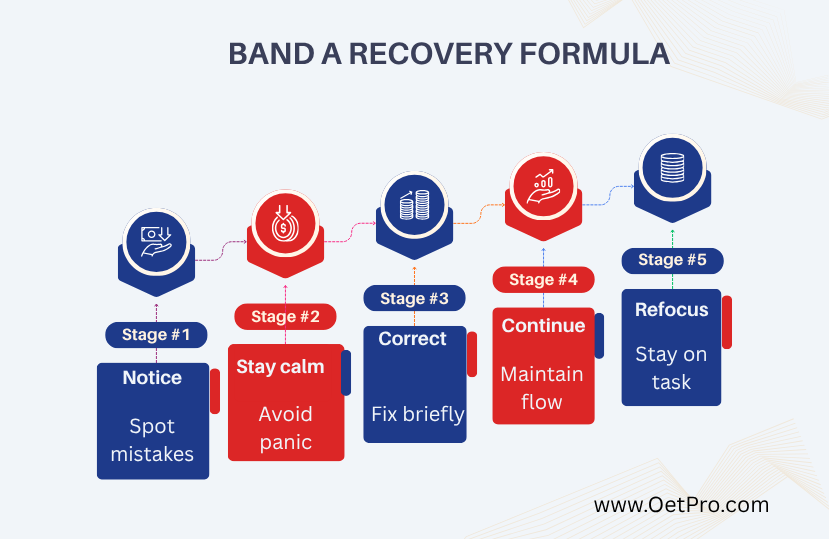
HIGH SCORER PROFILE (BAND A RECOVERY BEHAVIOR)
Band A candidates:
- Correct themselves instantly
- Do not stop speaking
- Use natural rephrasing
- Maintain confidence
- Keep communication smooth
They NEVER:
- Panic after mistakes
- Repeat apologies
- Lose structure completely
CORE INSIGHT
You are NOT scored on mistakes you are scored on how you recover from them
SUMMARY
OET Speaking Error Recovery depends on:
- Quick self-correction
- Smooth rephrasing
- Continuous speaking flow
- Calm emotional control
- Structured communication mindset
FINAL CHECKLIST
Before exam, ensure:
- I can correct mistakes without stopping
- I use natural rephrasing techniques
- I stay calm after errors
- I maintain speaking flow
- I avoid panic or repetition