OET Speaking Complete Guide: Format, Scoring, Role Play & Band A Strategy
INTRODUCTION
OET Speaking is one of the most important modules for healthcare professionals aiming for international registration and workplace communication readiness. Unlike general English tests, OET Speaking is not about memorized answers or academic vocabulary. It is about how effectively you communicate in a real clinical environment simulation.
In this test, you are assessed while interacting with a patient (role play scenario). Your ability to explain, reassure, gather information, and respond professionally determines your final score.
Many candidates lose marks not because of poor English, but because they do not understand how communication is structured in healthcare settings.
This guide will build that structure step by step.
LEARNING OBJECTIVES
By the end of this pillar lesson, you will be able to:
- Understand the complete OET Speaking test format
- Learn how role plays are conducted in the exam
- Understand the official scoring criteria
- Identify what examiners expect for Band A performance
- Build a clear clinical communication structure
- Avoid the most common mistakes made by candidates
OVERVIEW OF OET SPEAKING TEST
OET Speaking is designed to test your ability to communicate in a healthcare environment.
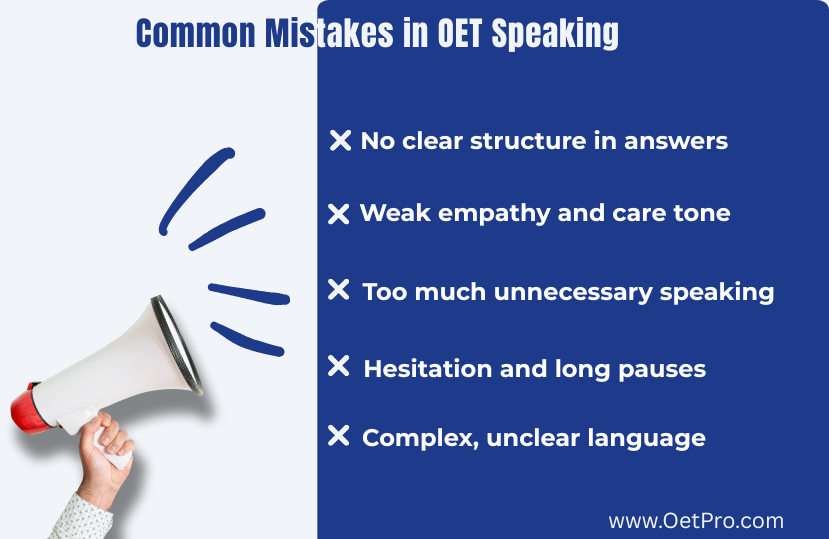
Test Structure
- 2 role-play tasks
- Each role play is based on a healthcare situation
- You play the healthcare professional (nurse/doctor/pharmacist, etc.)
- The interlocutor plays the patient or caregiver
- Preparation time is given before each role play
Key Focus Areas
- Communication clarity
- Patient interaction
- Professional tone
- Empathy and reassurance
- Clinical explanation skills
COMMON MISTAKES CANDIDATES MAKE
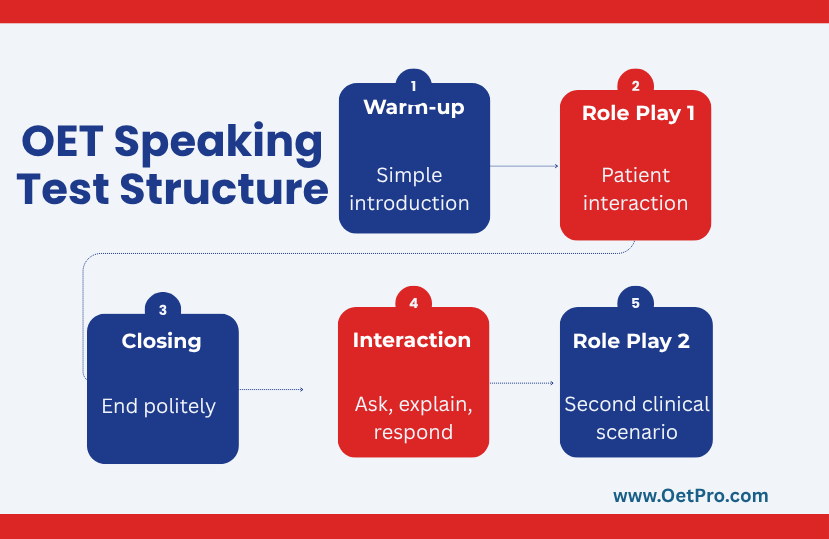
Most candidates struggle not because of English level, but because of wrong communication approach.
Mistake 1: Treating it like a speaking interview
Candidates try to “answer questions” instead of guiding a patient conversation.
Mistake 2: Overusing complex vocabulary
Using difficult words reduces clarity and sounds unnatural in clinical settings.
Mistake 3: Ignoring structure
Many candidates speak randomly without:
- Introduction
- Explanation flow
- Closure
Mistake 4: No empathy signals
Failing to show reassurance like:
- “I understand your concern…”
- “That must be worrying for you…”
Mistake 5: One-way speaking
Candidates talk too much instead of:
- Asking questions
- Confirming understanding
- Engaging the patient
CORE INSIGHT
OET Speaking is NOT tested as “English speaking ability only”.
It is tested as:
Clinical communication + patient safety + professional interaction
If your communication feels like a real healthcare interaction, your score naturally increases toward Band A.
TEACHING FRAMEWORK (CORE SYSTEM)
To succeed in OET Speaking, you must stop thinking in “answers” and start thinking in a clinical communication flow system.
Every high-scoring candidate follows a predictable structure. This is what examiners expect subconsciously.
THE OET SPEAKING COMMUNICATION FLOW
1. Introduction Phase
This is where you set the tone of the consultation.
Goal:
- Build trust
- Create comfort
- Establish professional presence
Example phrases:
- “Good morning, I’m your nurse today.”
- “How are you feeling at the moment?”
2. Information Gathering Phase
This is where you collect clinical details.
Goal:
- Ask relevant questions
- Identify patient concerns
- Clarify symptoms or situation
Strategy:
Use open + closed questions combination
Examples:
- “Can you tell me more about your symptoms?”
- “When did this start?”
- “Have you experienced this before?”
3. Explanation Phase
This is where many candidates lose marks.
Goal:
- Explain condition or procedure clearly
- Avoid medical jargon overload
- Keep language patient-friendly
High-scoring technique: “Simple translation method”
Instead of:
“You have hypertension”
Say:
“Your blood pressure is higher than normal.”
4. Empathy & Reassurance Phase
This is a Band A differentiator.
Goal:
- Show understanding
- Reduce patient anxiety
- Build trust
Examples:
- “I understand this might be worrying for you.”
- “That sounds uncomfortable, but we will manage it together.”
- “You are in safe hands.”
5. Closing Phase
End the conversation professionally.
Goal:
- Summarize key points
- Confirm understanding
- Provide next steps
Examples:
- “Just to summarize…”
- “Do you have any questions?”
- “We will monitor your condition closely.”
STRATEGY 1: ROLE PLAY CONTROL SYSTEM
Most candidates lose control of role plays.
High Score Approach:
You must act like a conversation leader, not a responder.
Golden Rule:
You guide the patient, you don’t wait for instructions.
STRATEGY 2: QUESTION FLOW BALANCE
A strong OET candidate uses:
- 40% questions
- 40% explanations
- 20% empathy + transitions
This balance creates natural clinical flow.
STRATEGY 3: SIMPLIFICATION TECHNIQUE
Never translate directly from complex medical knowledge.
Instead use:
- Simple words
- Short sentences
- Everyday comparisons
Example:
Instead of “cardiac condition” -> “heart problem”
STRATEGY 4: NATURAL TRANSITIONS
Examiners notice how smoothly you move between ideas.
Transition phrases:
- “Let me explain this to you…”
- “Now, I would like to ask you…”
- “This means that…”
EXAMPLE MINI ROLE PLAY FLOW
Scenario: Chest pain patient
- Greeting
- Ask symptoms
- Gather timing + severity
- Explain possible causes simply
- Reassure patient
- Suggest next step (doctor review)
- Close politely
EXAMINER EXPECTATION INSIGHT
Examiners are NOT checking:
- Fancy vocabulary
- Fast speaking
- Complex grammar
They ARE checking:
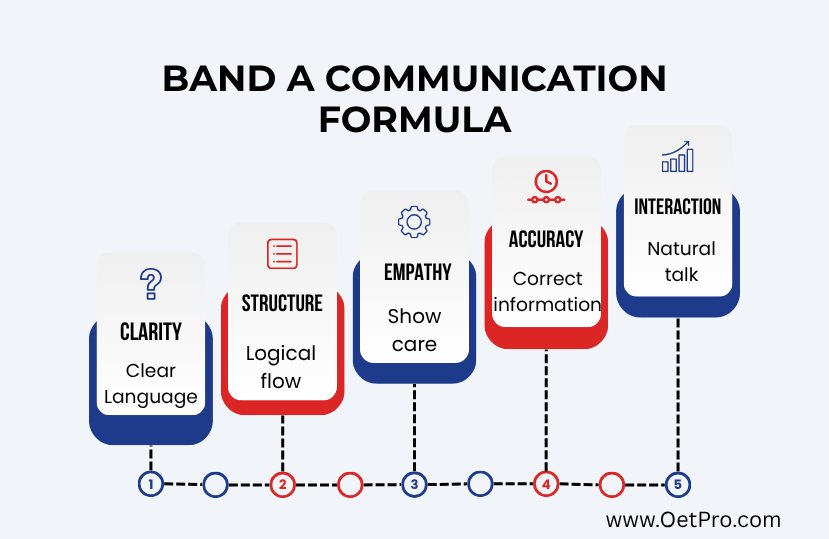
- Clarity
- Structure
- Empathy
- Clinical logic
ADVANCED TIPS FOR BAND A PERFORMANCE
At this stage, you already understand the structure and flow. Now we refine your performance to Band A level consistency, where communication sounds natural, confident, and clinically appropriate.
1. EXAMINER THINKING PATTERN (VERY IMPORTANT)
OET examiners do NOT look for perfection.
They look for:
- Can the patient understand you easily?
- Do you sound like a healthcare professional?
- Are you controlling the conversation naturally?
- Do you reduce patient anxiety?
- Do you maintain a clear structure?
Band A is awarded when communication feels safe, clear, and professional.
2. BAND A DIFFERENTIATION FACTOR
Most candidates score Band B because they:
- Speak correctly but sound robotic
- Forget empathy signals
- Lack smooth transitions
Band A candidates do this differently:
- Speak naturally, not memorized
- Guide conversation smoothly
- Balance structure + empathy
- Adjust language based on patient emotions
3. HIGH-SCORING VOCABULARY SYSTEM
You don’t need difficult vocabulary you need clinical clarity vocabulary.
Replace complex -> simple professional terms:
- “Hypertension” -> “High blood pressure”
- “Myocardial infarction” -> “Heart attack”
- “Medication adherence” -> “Taking your medicine regularly”
- “Respiratory distress” -> “Breathing difficulty”
4. EMPATHY POWER PHRASES (BAND A BOOSTER)
These phrases directly influence scoring perception:
Acknowledge emotion:
- “I can understand how uncomfortable this must feel.”
- “That sounds quite worrying.”
Normalize concern:
- “Many patients experience this, so you are not alone.”
- “This is quite common, and we can manage it.”
Reassure:
- “We will take care of this step by step.”
- “There is nothing to worry about at this stage.”
5. CLINICAL LANGUAGE FLOW MODEL
High performers follow this sequence naturally:
- Ask -> Understand
- Explain -> Simplify
- Reassure -> Reduce anxiety
- Guide -> Next step
This flow creates trust-based communication, which is exactly what OET tests.
6. COMMON EXAMINER-APPROVED STRUCTURES
STRUCTURE A: PROBLEM -> EXPLANATION -> ACTION
- What is happening?
- Why it is happening?
- What we will do next?
STRUCTURE B: FEELING -> INFORMATION -> SUPPORT
- Patient emotion
- Medical explanation
- Emotional reassurance
7. REALISTIC EXAM EXAMPLE (ADVANCED LEVEL)
Scenario: Patient worried about test results
Response flow:
- “I understand that waiting for results can be stressful.”
- “The test is checking your blood sugar levels.”
- “We will review the results together and decide the next steps.”
- “There is no immediate danger, so please don’t worry.”
This is Band A style communication.
8. EXAMINER INSIGHT (HIDDEN SCORING FACTOR)
Examiners give higher scores when they observe:
- Calm tone
- Controlled pacing
- Patient-centered communication
- Natural empathy delivery
Even with minor grammar errors, clear communication wins.
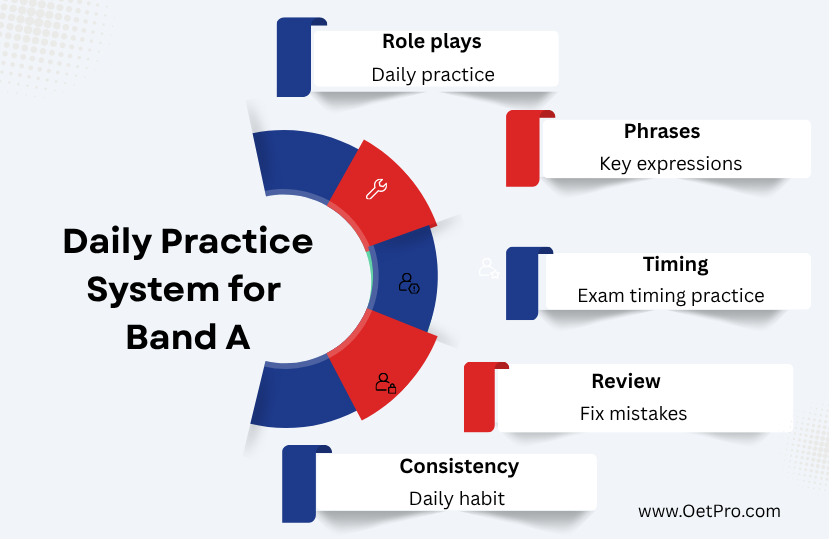
9. PRACTICE METHOD (HIGH IMPACT)
To improve quickly:
Daily practice system:
- 1 role play scenario
- 5 empathy phrases practice
- 3 explanation rewrites (medical -> simple)
- 1 timed mock conversation
SUMMARY
OET Speaking is not a language test alone it is a clinical communication test designed to assess how effectively you interact with patients in real healthcare situations.
Success depends on three core pillars:
- Clear structure
- Patient-centered communication
- Consistent empathy and professionalism
When you combine these elements, you naturally move toward Band A performance.
FINAL CORE FRAMEWORK (REMEMBER THIS)
OET Speaking Success Formula
Structure + Simplicity + Empathy + Control = Band A
FINAL CHECKLIST (BEFORE EXAM)
1. Structure Control
- I introduce myself clearly
- I follow a logical conversation flow
- I close the conversation properly
2. Communication Skills
- I ask clear and relevant questions
- I explain in simple language
- I avoid medical jargon
3. Empathy Usage
- I acknowledge patient concerns
- I reassure calmly
- I sound supportive, not robotic
4. Fluency & Confidence
- I speak naturally, not memorized
- I maintain steady pace
- I avoid long confusing sentences
5. Clinical Behavior
- I act like a healthcare professional
- I guide the conversation
- I keep patient safety in focus
FREQUENTLY ASKED QUESTIONS (FAQ)
1. How is OET Speaking different from IELTS Speaking?
OET Speaking is role-play based and focused on healthcare communication, not general topics.
2. What is the biggest mistake candidates make?
They focus on grammar and vocabulary instead of clinical communication and empathy.
3. How can I achieve Band A in OET Speaking?
By using structured communication, clear explanations, and consistent empathy throughout the role play.
4. Is medical vocabulary important for OET Speaking?
Basic medical vocabulary is enough. Clarity is more important than complexity.
5. How many role plays are in the test?
There are two role plays in the OET Speaking exam.
PRACTICE PLAN (7-DAY IMPROVEMENT SYSTEM)
Day 1–2
- Learn structure flow (Introduction -> Explanation -> Empathy -> Closing)
Day 3–4
- Practice 5 common scenarios (pain, anxiety, medication, diagnosis, follow-up)
Day 5
- Focus on empathy phrases and natural tone
Day 6
- Full timed mock role plays (2 scenarios)
Day 7
- Self-review + correction of mistakes
FINAL EXAM STRATEGY
On exam day:
- Stay calm and structured
- Do not rush responses
- Use simple clinical English
- Focus on patient comfort
- Follow the communication flow system
Remember: You are not “performing English.”
You are performing clinical communication.