OET Speaking Test Format Explained: Role Play Structure, Timing & Scoring Guide
INTRODUCTION
OET Speaking is a clinical role-play communication test, not a general English speaking exam. It evaluates how effectively healthcare professionals interact with patients in realistic medical scenarios.
The examiner is NOT testing:
- Complex grammar
- Fancy vocabulary
- Academic English
They are testing:
- Clinical communication clarity
- Patient interaction skills
- Professional behavior under role play conditions
LEARNING OBJECTIVES
By the end of this lesson, you will understand:
- Complete OET Speaking test format
- Role play structure and flow system
- Timing and test execution pattern
- Examiner scoring expectations
- What separates Band A vs Band B candidates
OVERVIEW: OET SPEAKING STRUCTURE
OET Speaking is built around real healthcare communication simulation.
Test Breakdown
- 2 role plays per test
- Each based on clinical scenario
- Candidate = Healthcare professional
- Interlocutor = Patient / caregiver
Key Focus Areas
- Communication clarity
- Patient safety communication
- Empathy and reassurance
- Structured interaction flow
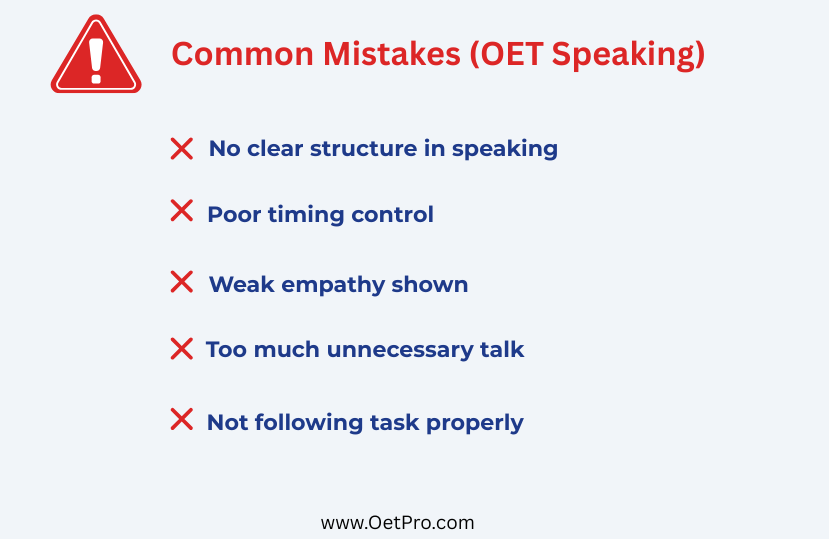
COMMON MISTAKES (HIGH IMPACT ERRORS)
Mistake 1: Treating it like an interview
- Candidates answer randomly
- No conversation control
Mistake 2: No structured flow
- Jumping between ideas
- No clear beginning or ending
Mistake 3: Overcomplicated language
- Using unnecessary medical terms
- Reduces patient understanding
Mistake 4: No empathy expression
- Sounding robotic
- No emotional reassurance
Mistake 5: Monologue speaking
- Talking continuously
- Not engaging patient interaction
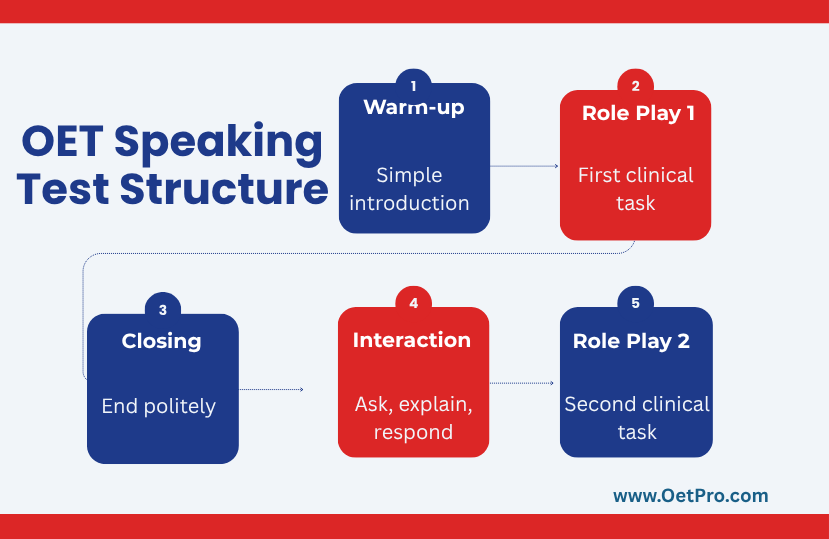
TEST STRUCTURE EXPLAINED
The OET Speaking test follows a fixed format with predictable timing and structure.
Test format:
- 2 role plays in total
- Each role play lasts approximately 5 minutes
- Short preparation time before each task
- Face-to-face interaction with interlocutor
What happens in each role play:
- You receive a scenario card
- You prepare briefly
- You conduct a structured conversation with the patient
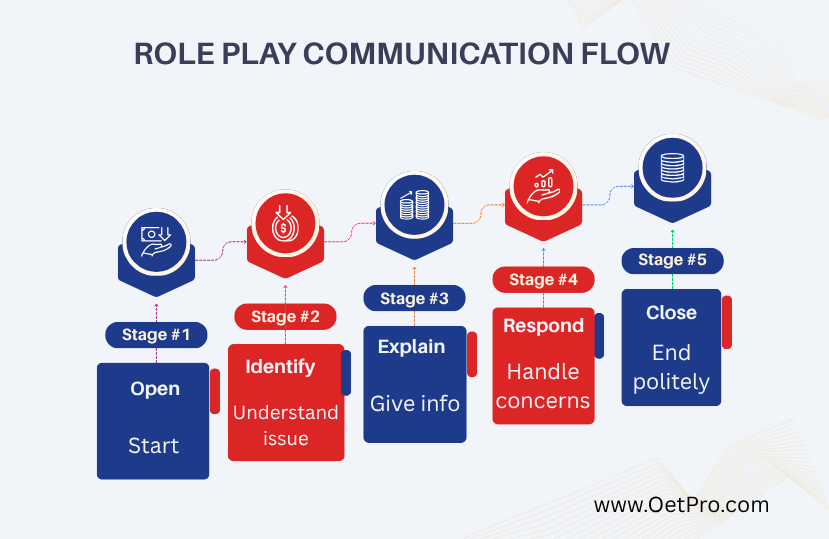
ROLE PLAY COMMUNICATION FLOW SYSTEM
Each role play should follow a clear clinical communication sequence.
Step 1: Introduction
You begin by greeting and introducing yourself professionally.
- Establish trust
- Set professional tone
Step 2: Information Gathering
You ask relevant clinical questions to understand the patient’s condition.
- Use simple questions
- Focus on symptoms and concerns
Step 3: Explanation
You explain medical information in simple, patient-friendly language.
- Avoid jargon
- Use clear everyday words
Step 4: Empathy & Reassurance
You acknowledge patient feelings and reduce anxiety.
- Show understanding
- Provide emotional support
Step 5: Closing
You summarize and end the conversation professionally.
- Confirm understanding
- Explain next steps
EXAMINER EXPECTATIONS
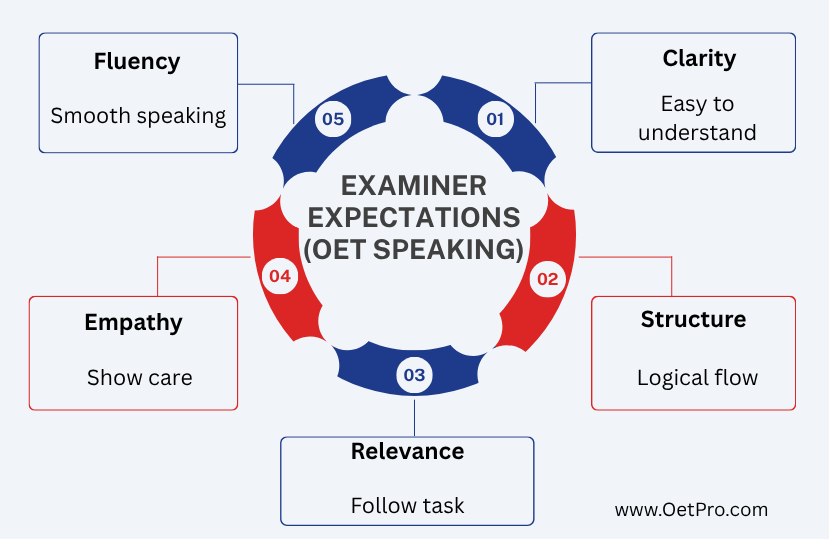
Examiners evaluate your ability to communicate safely and effectively in a clinical setting.
They look for:
- Clear and understandable communication
- Logical structure of conversation
- Professional healthcare tone
- Consistent empathy
- Active patient engagement
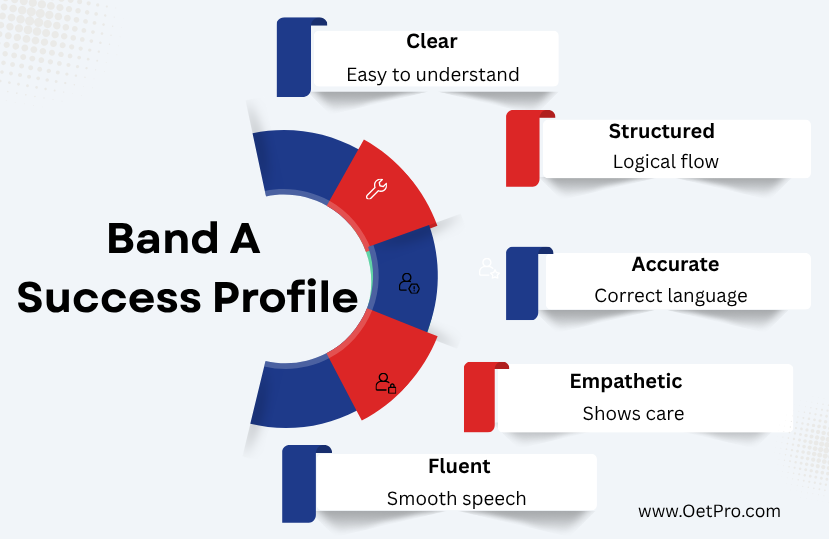
HIGH SCORER CHARACTERISTICS (BAND A PROFILE)
Candidates who achieve high scores consistently demonstrate the following:
Communication Style
- Simple and clear language
- Natural conversation flow
- No unnecessary complexity
Structure Control
- Clear step-by-step progression
- No random speaking
Patient Interaction
- Active engagement
- Continuous dialogue flow
Emotional Intelligence
- Regular empathy statements
- Reassurance throughout conversation
CORE INSIGHT
OET Speaking is NOT a test of advanced English ability.
It is a test of:
How safely and clearly you can communicate in a real healthcare environment
SUMMARY
The OET Speaking test is a structured role-play exam designed to evaluate real clinical communication skills. Success depends on how well you:
- Follow a structured speaking flow
- Use simple and clear language
- Show empathy and professionalism
- Maintain patient-centered communication