OET Speaking Role Play Strategies: Communication Control System for Band A Success
INTRODUCTION
OET Speaking is not just about following a structure, it is about controlling the conversation like a healthcare professional in real clinical settings.
Most candidates know what to say, but they fail in one critical area:
They do NOT control the role play conversation.
This lesson teaches you a Communication Control System that helps you:
- Guide the patient conversation smoothly
- Avoid confusion or loss of structure
- Maintain examiner-friendly flow
- Increase Band A probability significantly
LEARNING OBJECTIVES
By the end of this lesson, you will be able to:
- Control OET Speaking role plays confidently
- Manage patient responses effectively
- Maintain structured conversation flow
- Avoid common communication breakdowns
- Apply examiner-friendly speaking strategies
OVERVIEW: WHAT ROLE PLAY REALLY TESTS
OET Speaking is NOT a scripted dialogue.
It is a dynamic interaction test, where the patient may:
- Ask unexpected questions
- Show anxiety or confusion
- Change direction of conversation
- Need reassurance or clarification
This means:
You are NOT just speaking…
You are managing communication flow in real time
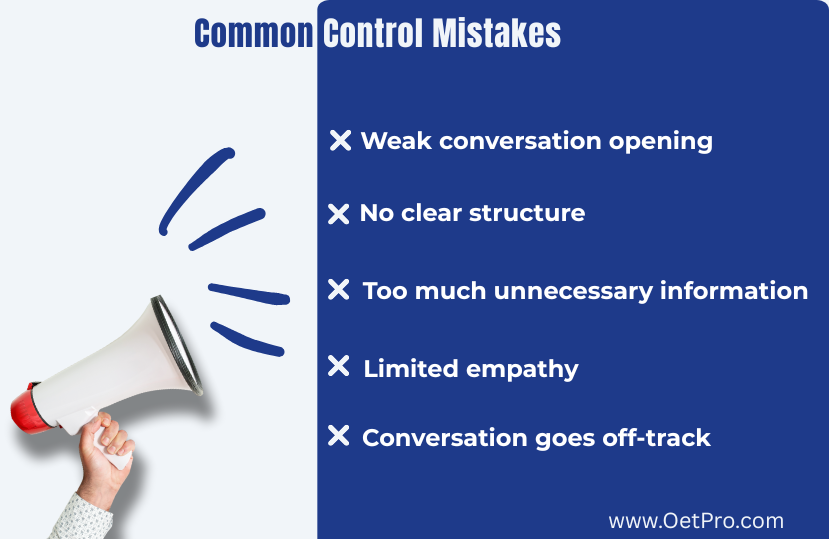
COMMON MISTAKES (CONTROL FAILURE POINTS)
Mistake 1: Patient-Controlled Conversation
Candidates allow patients to dominate the interaction.
Result:
- Loss of structure
- Confused responses
- Examiner difficulty following logic
Mistake 2: No Directional Control
Candidates answer but do not guide conversation forward.
Result:
- Flat interaction
- No progression in role play
Mistake 3: Emotional Overreaction
Candidates get stuck responding emotionally instead of progressing.
Result:
- Time loss
- Broken structure
Mistake 4: Ignoring Transition Control
Candidates jump between topics without linking flow.
Result:
- Disjointed communication
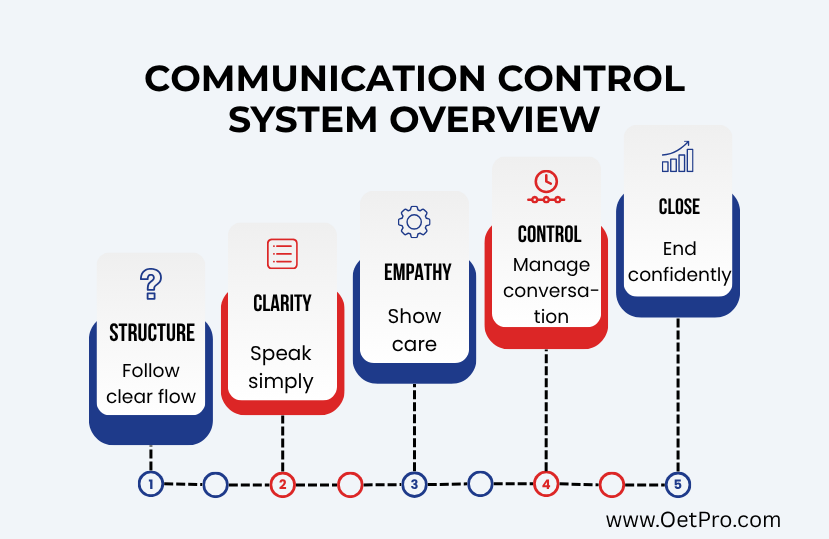
CORE TEACHING FRAMEWORK
OET Communication Control System
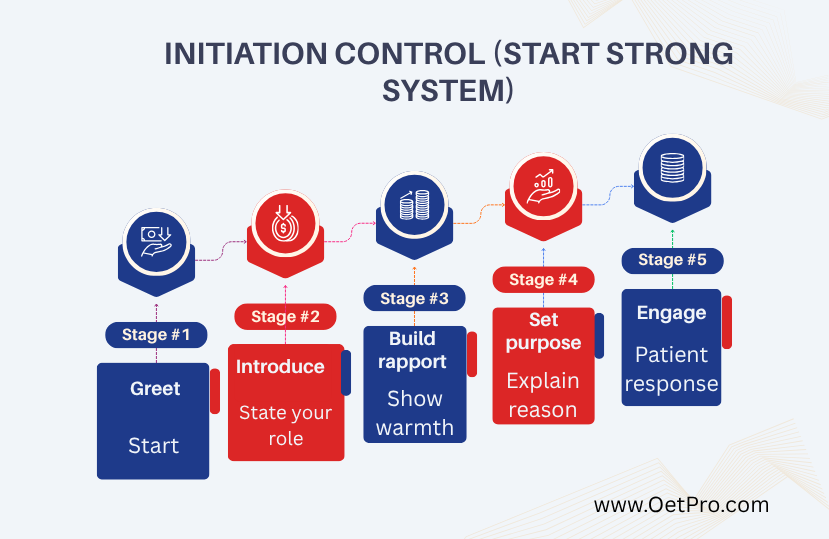
1. INITIATION CONTROL (STARTING STRONG)
You must immediately set direction at the beginning.
Technique:
- Introduce yourself clearly
- Define purpose of conversation
- Take control of flow early
Example:
“Hello, I’m your nurse today. I understand you are feeling unwell, so I’d like to ask you a few questions first.”
This establishes authority + structure
2. QUESTION CONTROL SYSTEM
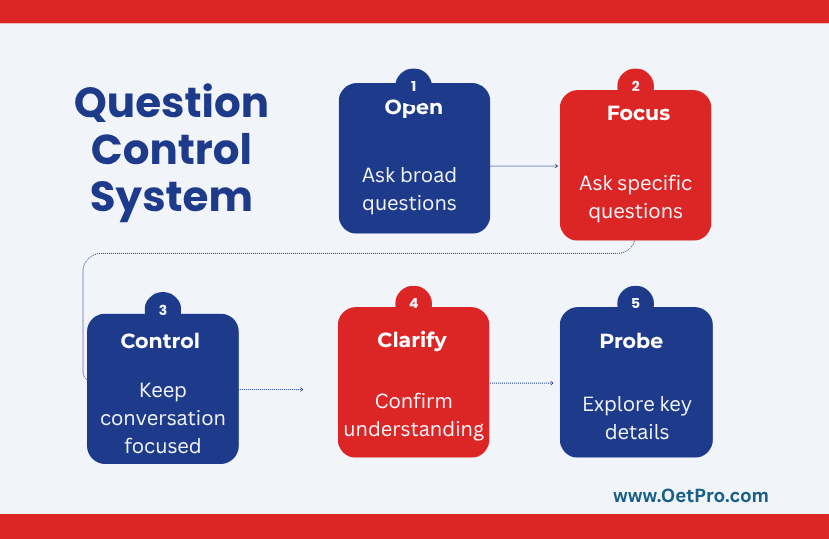
Do NOT ask random questions.
Use structured questioning:
- Open questions -> understand problem
- Closed questions -> confirm details
- Clarifying questions -> reduce confusion
Example flow:
- “Can you describe your symptoms?”
- “When did it start?”
- “Is the pain constant or intermittent?”
This keeps patient inside your communication system
3. EXPLANATION CONTROL (SIMPLIFICATION RULE)
You control understanding by controlling language.
Rule:
Medical knowledge -> Patient understanding conversion
Example:
Instead of:
“Your condition indicates hypertension”
Say:
“Your blood pressure is higher than normal.”
You control clarity = you control exam score
4. EMOTIONAL CONTROL SYSTEM
Patients may show fear, confusion, or anxiety.
You must stabilize conversation.
Techniques:
- Acknowledge emotion
- Reassure quickly
- Redirect back to structure
Example:
“I understand this may feel worrying, but we will manage it step by step.”
Emotion is acknowledged but controlled
5. TRANSITION CONTROL (FLOW MANAGEMENT)
Transitions maintain conversation logic.
Use linking phrases:
- “Now, let me ask you…”
- “Based on that, I would like to explain…”
- “The next step is…”
Prevents fragmented speaking
6. CLOSING CONTROL (FINAL AUTHORITY)
You must end role play professionally and clearly.
Structure:
- Summarize
- Confirm understanding
- Guide next step
Example:
“To summarize, we discussed your symptoms and next steps. Do you have any questions before we finish?”
EXAMINER INSIGHT
Examiners reward candidates who:
- Control conversation flow naturally
- Maintain logical progression
- Reduce patient confusion
- Demonstrate leadership in communication
Control = higher scoring perception
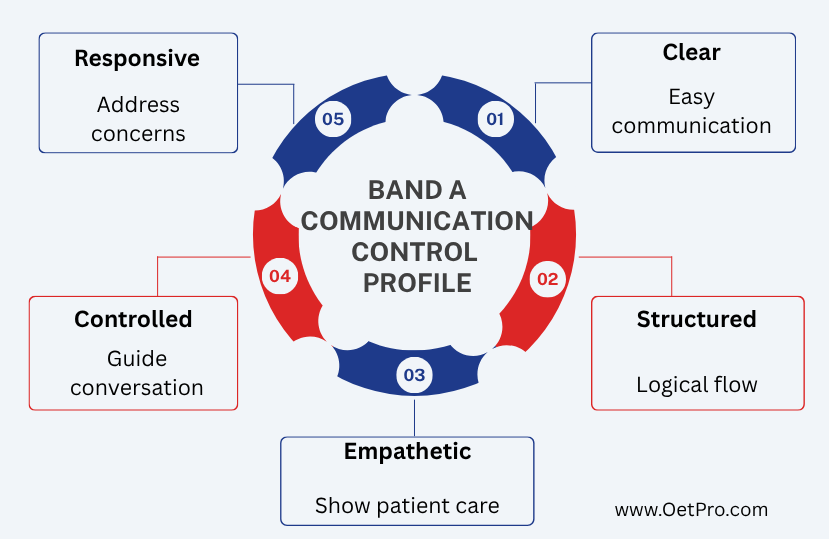
HIGH-SCORER BEHAVIOR (BAND A PROFILE)
Band A candidates ALWAYS:
- Lead conversation from start to end
- Keep communication structured
- Redirect patients when needed
- Maintain emotional balance
- Use simple controlled language
They NEVER:
- Follow random patient direction
- Lose structure under pressure
- Over-explain or over-talk
CORE INSIGHT
OET Speaking is not a conversation test it is a controlled clinical communication test
Your score depends on how well you manage the interaction, not just how well you speak.
SUMMARY
OET Speaking success depends on communication control, not memorized answers.
Key systems include:
- Initiation control
- Question control
- Explanation control
- Emotional control
- Transition control
- Closing control
FINAL CHECKLIST
Before speaking:
- I can control conversation direction
- I can manage patient responses
- I can simplify explanations
- I can maintain structured flow
- I can close professionally