OET Speaking Empathy System: Clinical Language Mastery for Band A Communication Skills
INTRODUCTION
Empathy is one of the most powerful scoring factors in OET Speaking, yet it is also the most misunderstood skill.
Many candidates think empathy means:
- Saying polite sentences
- Being overly emotional
- Using memorized phrases
But in OET Speaking, empathy is actually:
A structured communication tool that reduces patient anxiety and improves clinical trust
This lesson teaches a complete Empathy System + Clinical Language Mastery Framework used by Band A candidates.
LEARNING OBJECTIVES
By the end of this lesson, you will be able to:
- Understand what examiner-level empathy really means
- Use structured empathy phrases naturally
- Convert medical language into patient-friendly communication
- Reduce patient anxiety using controlled language
- Improve Band A scoring potential through emotional intelligence
OVERVIEW: WHY EMPATHY MATTERS IN OET SPEAKING
OET Speaking is not just about giving information.
It is about how safely and calmly you deliver that information to a patient.
Examiners evaluate:
- Emotional tone
- Patient reassurance
- Communication comfort level
- Clinical trust-building ability
Key Insight:
Empathy is NOT optional it is a scoring requirement.
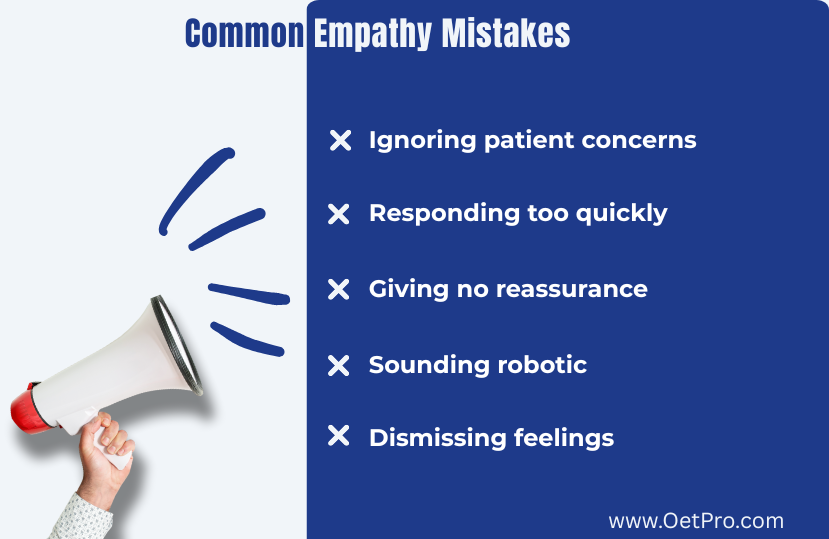
COMMON MISTAKES IN EMPATHY USAGE
Mistake 1: Fake memorized empathy lines
Candidates repeat phrases without natural flow.
Result:
- Sounds robotic
- No real emotional connection
Mistake 2: No emotional acknowledgment
Candidates skip patient feelings.
Result:
- Cold communication
- Lower band perception
Mistake 3: Over-emotional speaking
Too dramatic tone reduces professionalism.
Result:
- Loss of clinical authority
Mistake 4: Empathy without direction
Candidates comfort patient but do not move conversation forward.
Result:
- Broken structure
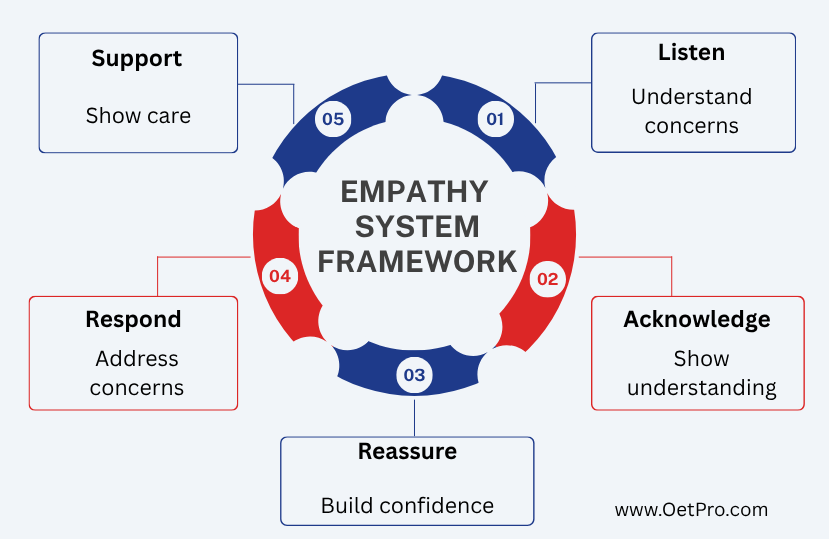
CORE TEACHING FRAMEWORK
OET Empathy System (Band A Model)
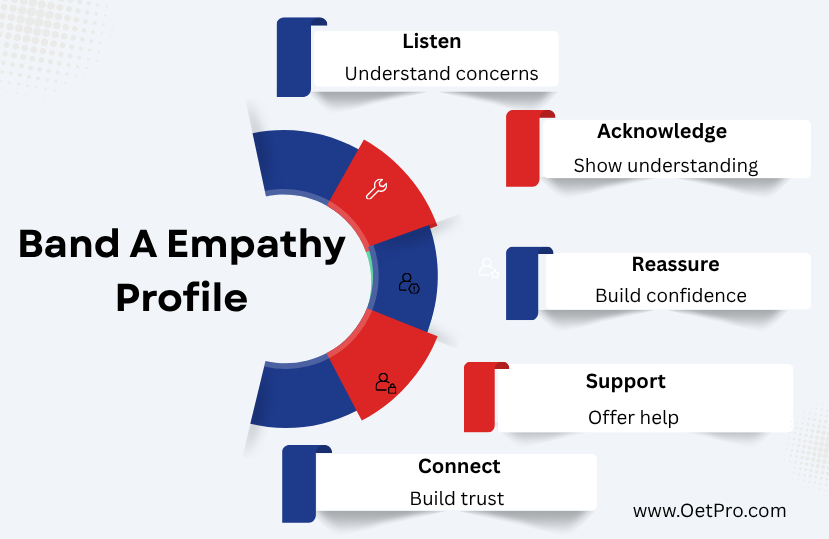
1. ACKNOWLEDGE -> REASSURE -> GUIDE SYSTEM
This is the foundation of all high-scoring empathy.
Step 1: Acknowledge Emotion
Recognize patient feeling clearly.
- “I understand this may be worrying for you.”
Step 2: Reassure Patient
Reduce anxiety with calm explanation.
- “But this condition is manageable.”
Step 3: Guide Forward
Move conversation forward clinically.
- “Let me explain what we will do next.”
This prevents emotional stagnation
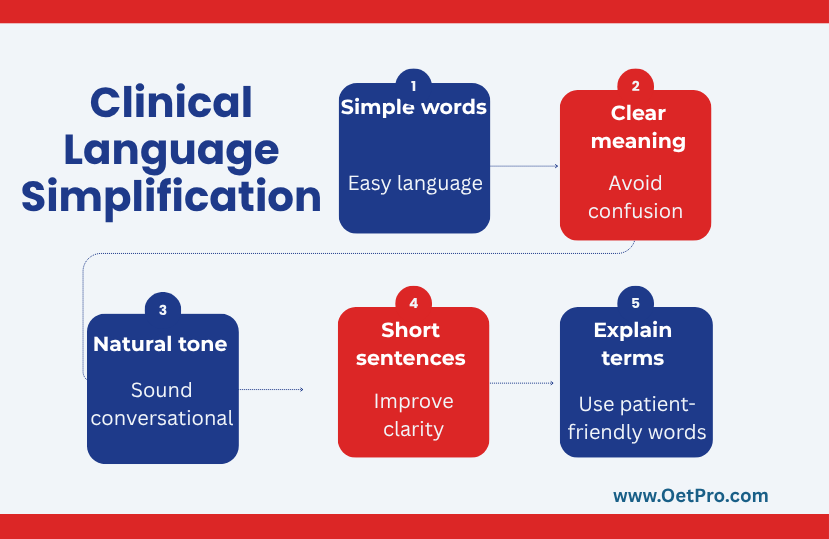
2. CLINICAL LANGUAGE SIMPLIFICATION SYSTEM
You must convert medical language into patient-friendly communication.
Example Transformations:
- “Hypertension” -> “High blood pressure”
- “Medication compliance” -> “Taking medicine regularly”
- “Respiratory distress” -> “Breathing difficulty”
Rule:
If patient cannot understand it instantly -> simplify it
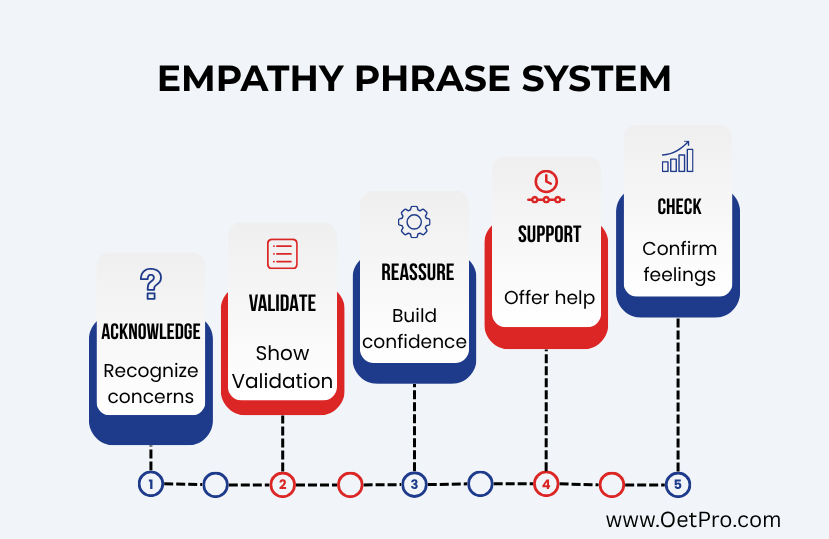
3. EMPATHY PHRASE STRUCTURE BANK
A. Emotional Recognition
- “I understand how you feel.”
- “That must be uncomfortable.”
- “I can see this is worrying for you.”
B. Normalization
- “This is quite common.”
- “Many patients experience this.”
C. Reassurance
- “There is nothing to worry about.”
- “We will manage this step by step.”
4. TONE CONTROL SYSTEM
Empathy is not only words it is tone + delivery control.
High Scorer Tone:
- Calm
- Slow
- Professional
- Reassuring
Low Scorer Tone:
- Fast
- Nervous
- Mechanical
- Flat
5. PATIENT TRUST BUILDING MODEL
To build trust, combine:
- Simple language
- Emotional awareness
- Structured flow
- Clear next steps
Example:
“I understand this is worrying for you, but this condition is common, and we will manage it step by step.”
EXAMINER INSIGHT
Examiners reward candidates who:
- Make patients feel safe
- Reduce emotional tension
- Communicate clearly under pressure
- Maintain professionalism with empathy
Empathy directly influences Band score perception.
HIGH SCORER PROFILE (BAND A BEHAVIOR)
Band A candidates consistently:
- Use natural empathy (not memorized lines)
- Balance emotion + structure
- Simplify medical language
- Maintain calm communication
- Guide conversation smoothly
They NEVER:
- Ignore patient emotion
- Overreact emotionally
- Speak without structure
CORE INSIGHT
Empathy is not about emotion it is about controlled clinical reassurance
SUMMARY
OET Speaking empathy is a structured communication skill that combines:
- Emotional awareness
- Simple language conversion
- Reassurance delivery
- Conversation control
When used correctly, it significantly improves Band A performance.
FINAL CHECKLIST
Before exam, ensure you can:
- Acknowledge patient emotions clearly
- Use simple clinical language
- Reassure calmly
- Maintain structured flow
- Avoid robotic phrases