OET vs IELTS: Which Is Better for Healthcare Professionals in 2026?
Introduction
If you're planning to work, study, or migrate as a healthcare professional, one of the biggest decisions you'll face is:
Should you take OET or IELTS?
Both exams are widely accepted and assess English language proficiency but they are designed for very different purposes.
Many candidates choose the wrong exam simply because they don’t fully understand the differences. This often leads to unnecessary difficulty, lower scores, and repeated attempts.
In this lesson, you’ll get a clear, practical comparison between OET and IELTS so you can choose the exam that best matches your professional goals.
Why This Decision Matters
Choosing between OET and IELTS is not just about passing an English test.
It directly affects:
- Your preparation strategy
- Your chances of success
- Your confidence during the exam
- Your future career opportunities
For example:
- A nurse who chooses IELTS may struggle with general essay topics unrelated to healthcare.
- A doctor who chooses OET may find it easier to apply clinical communication skills they already use in daily practice.
Making the right choice can save you time, effort, and multiple exam attempts.
What Is OET?
The Occupational English Test (OET) is designed specifically for healthcare professionals.
It focuses on real-life medical communication tasks, such as:
- Writing referral and discharge letters
- Speaking with patients during role-plays
- Understanding clinical conversations
- Reading healthcare-related texts
OET reflects the actual communication skills required in a clinical environment. If you decide that OET is the right exam for you, our Complete Guide to OET 2026 covers the exam structure, four skills, scoring, preparation strategies, common mistakes, and study planning.
What Is IELTS?
The International English Language Testing System (IELTS) is a general English proficiency test used for:
- Academic study
- Immigration
- Professional registration
- Employment
It includes:
- Essay writing
- General speaking interviews
- Reading passages on a wide range of topics
- Listening tasks with everyday situations
Unlike OET, IELTS is not specific to healthcare.
Core Difference in One Sentence
- OET tests how you communicate as a healthcare professional.
- IELTS tests how well you use English in general situations.
Common Misconceptions
Many candidates misunderstand the differences between OET and IELTS.
Let’s clarify a few common myths.
Myth 1: OET and IELTS are the same
Reality:
They assess English in very different contexts medical vs general.
Myth 2: IELTS is always easier
Reality:
Difficulty depends on your background. Healthcare professionals often find OET more relevant and manageable.
Myth 3: OET is only for doctors
Reality:
OET is designed for multiple professions, including:
- Nurses
- Dentists
- Pharmacists
- Physiotherapists
- Radiographers
- Veterinary professionals
Myth 4: IELTS is accepted everywhere, but OET is not
Reality:
OET is accepted by many healthcare regulators worldwide. However, requirements vary by country and profession.
Myth 5: You should choose the test everyone else is taking
Reality:
The best test is the one that aligns with your professional needs and strengths.
Key Differences Between OET and IELTS
Now that you understand the purpose of both exams, let’s compare them in detail.
This section will help you clearly see how OET and IELTS differ in format, tasks, scoring, and real exam experience.
1. Target Audience
| Feature | OET | IELTS |
|---|---|---|
| Who is it for? | Healthcare professionals | Students, migrants, professionals |
| Relevance | Medical and clinical settings | General academic and everyday English |
What This Means
- OET is designed for your profession.
- IELTS is designed for a wide audience.
If you are a healthcare professional, OET aligns more closely with your daily communication needs.
2. Exam Content
OET
- Medical scenarios
- Patient case notes
- Clinical communication
- Healthcare workplace language
IELTS
- General topics (education, environment, society)
- Academic passages
- Everyday conversations
- Non-medical contexts
Key Insight
OET allows you to use your existing medical knowledge, while IELTS requires you to handle unfamiliar general topics.
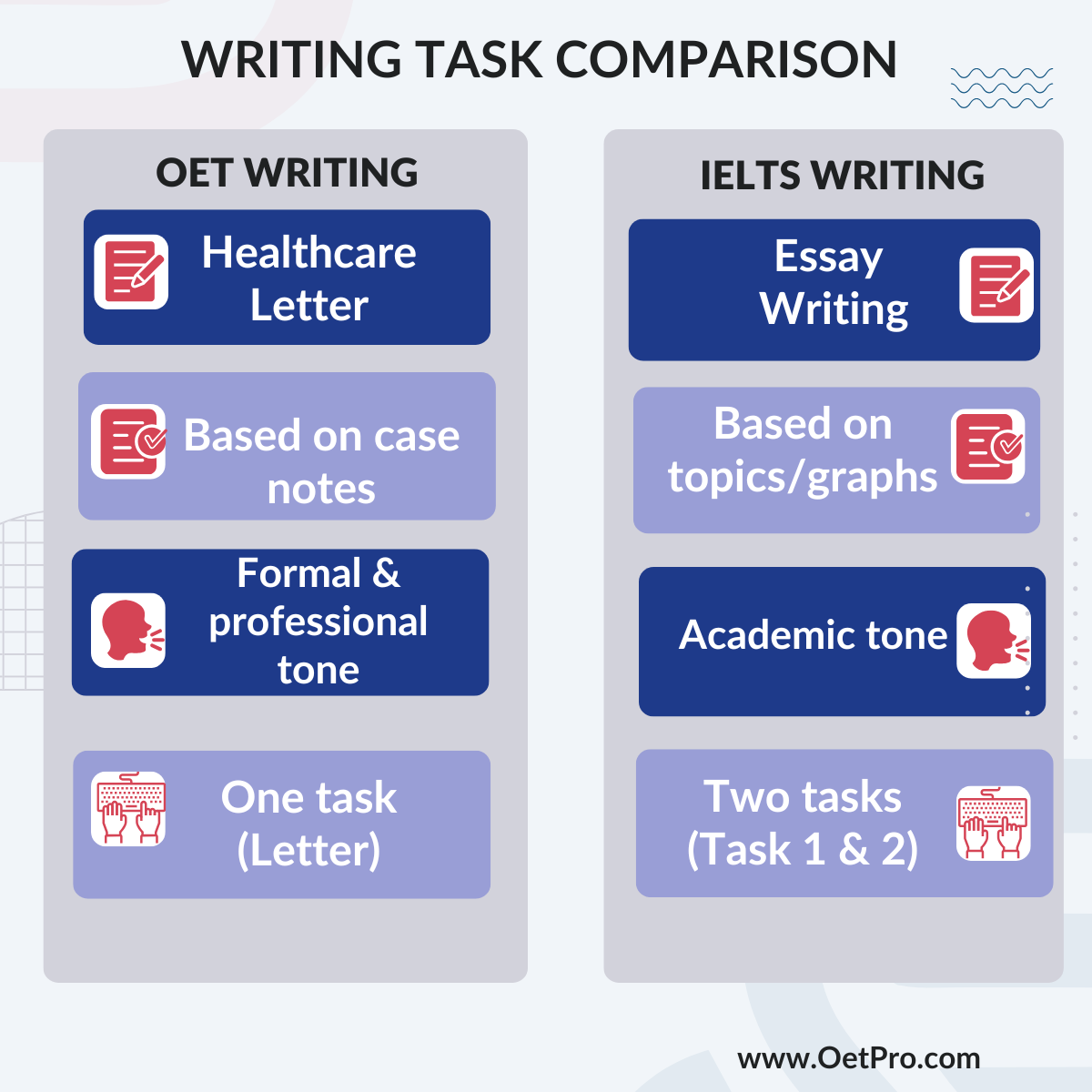
3. Writing Task Comparison
OET Writing
- Write a referral, discharge, or transfer letter
- Based on patient case notes
- Profession-specific
- Focus on clarity and relevance
IELTS Writing
- Task 1: Report (Academic) or Letter (General)
- Task 2: Essay on general topics
Key Difference
- OET Writing is practical and job-related
- IELTS Writing is academic and opinion-based
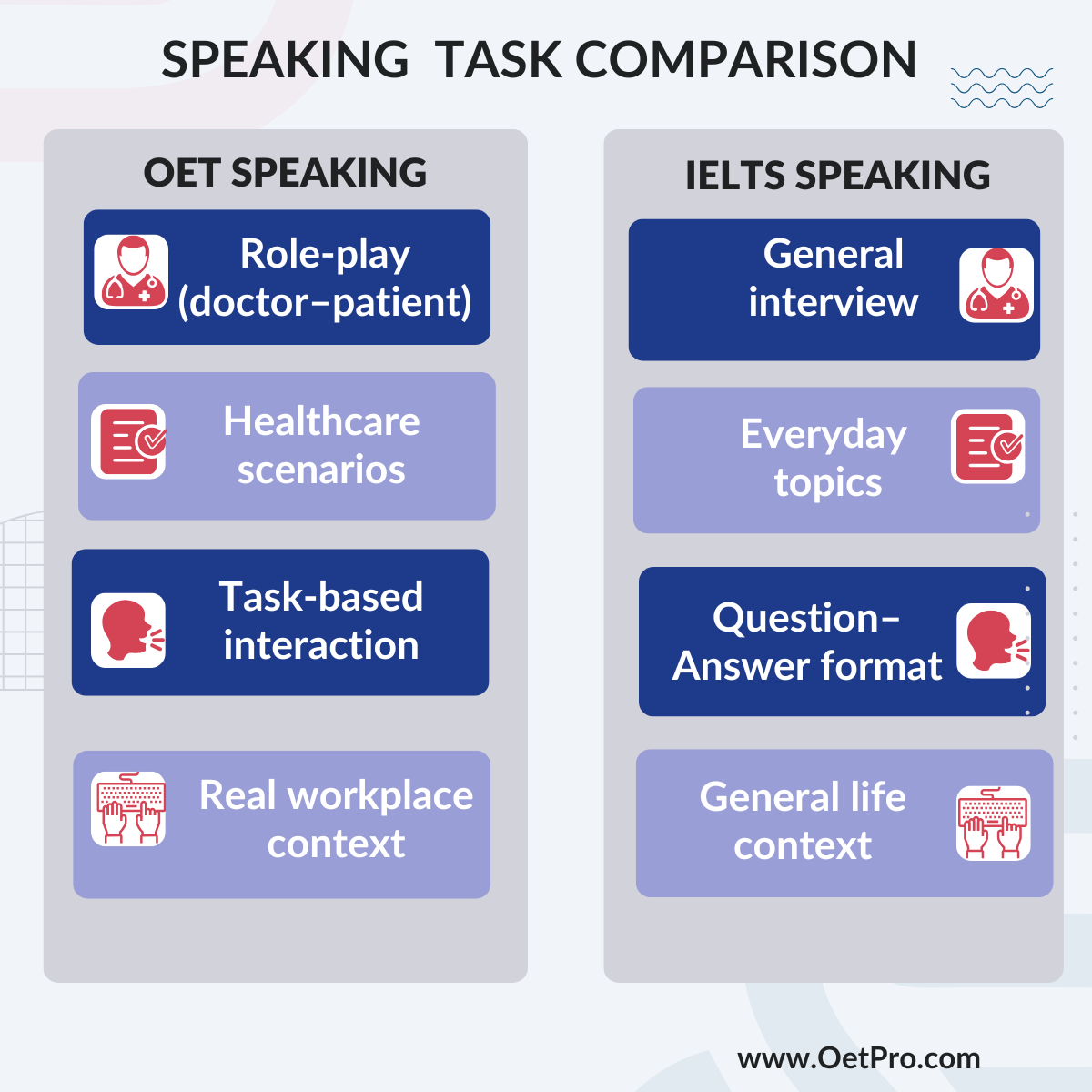
4. Speaking Test Comparison
OET Speaking
- Role-play with a patient
- Real clinical situations
- Focus on empathy and clarity
- Profession-specific interaction
IELTS Speaking
- Interview format
- Personal questions
- General discussion topics
- No professional context
Key Difference
- OET tests patient communication skills
- IELTS tests general conversational ability
5. Listening & Reading Comparison
OET
- Healthcare conversations
- Medical texts and documents
- Workplace scenarios
IELTS
- Everyday conversations
- Academic lectures
- General reading passages
Key Insight
OET content is profession-specific, while IELTS content is broad and general.
6. Scoring System Comparison
| Feature | OET | IELTS |
|---|---|---|
| Score Scale | 0–500 per skill | Band 0–9 |
| Grade System | A–E | Band descriptors |
| Score Reporting | Separate for each skill | Overall band + individual scores |
| Focus | Professional communication | General English ability |
What This Means
- OET provides skill-specific clarity.
- IELTS provides an overall band score in addition to individual scores.
7. Difficulty Level
OET Difficulty
- Easier if you are familiar with medical terminology
- Tasks reflect real-life healthcare situations
- Requires professional communication skills
IELTS Difficulty
- Challenging due to unfamiliar topics
- Requires essay writing and opinion development
- Tests a wide range of general English skills
8. Real Exam Experience
OET
- Feels like a clinical environment
- Tasks are realistic and job-related
- Builds confidence for workplace communication
IELTS
- Feels like an academic test
- Topics may not relate to your profession
- Focus on general English ability
9. Acceptance & Career Use
OET
- Accepted by many healthcare regulators
- Used for professional registration
- Recognised in countries like the UK, Australia, Ireland, and more
IELTS
- Accepted worldwide
- Used for study, immigration, and employment
- Recognised by universities and governments
If OET is the better choice for your healthcare career, the next step is understanding how to prepare effectively. See our Complete Guide to OET 2026 for a step-by-step overview of the exam and preparation strategies.
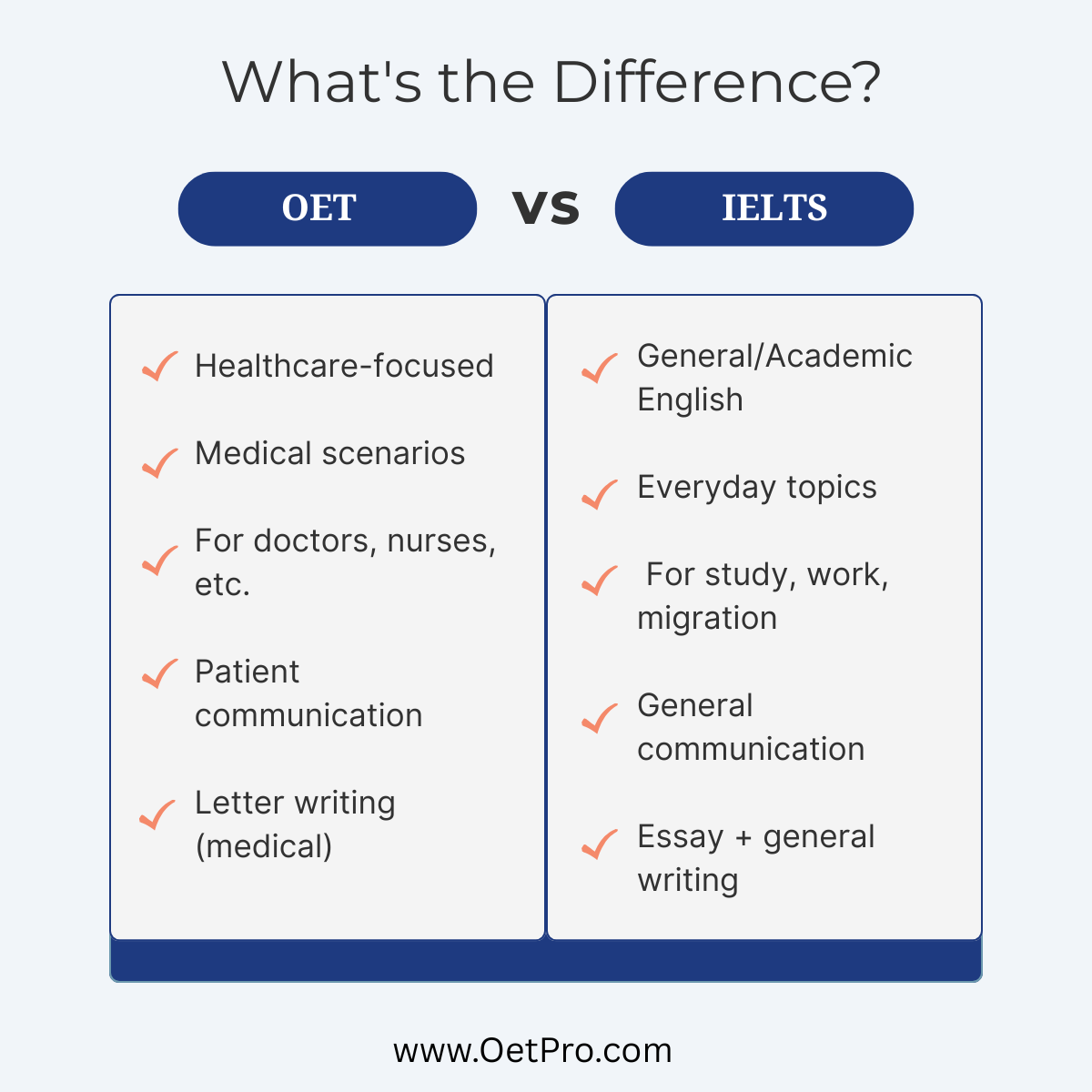
Quick Comparison Summary
| Factor | Best Choice |
|---|---|
| Healthcare relevance | OET |
| General English testing | IELTS |
| Writing (job-related) | OET |
| Speaking (clinical interaction) | OET |
| Academic/immigration flexibility | IELTS |
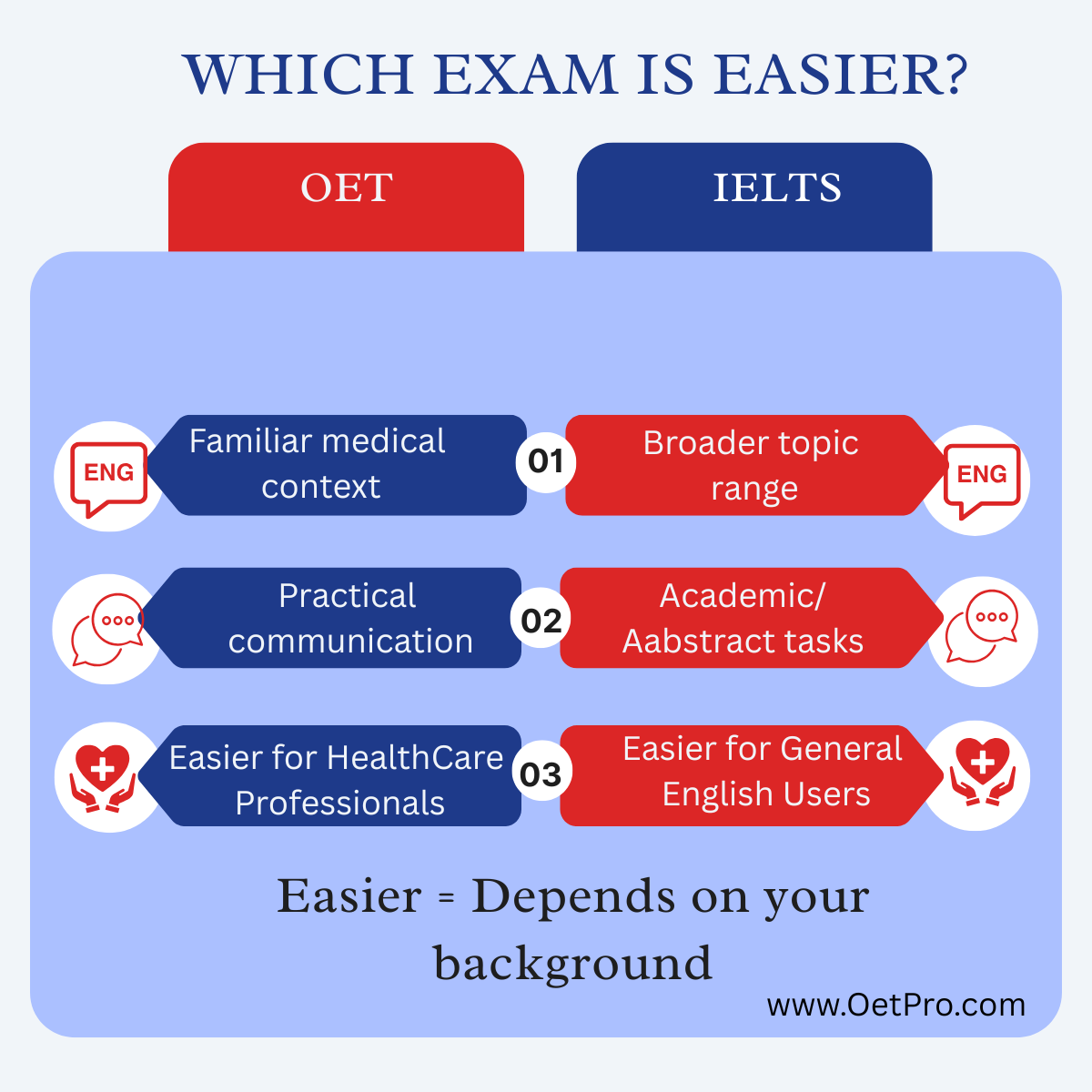
Which Exam Is Easier?
This is the most common question and the most misunderstood.
There is no universally easier exam. The right answer depends on your background, strengths, and career goals.
When OET Feels Easier
OET may feel easier if you:
- Work or study in healthcare
- Are familiar with medical terminology
- Communicate with patients regularly
- Prefer practical, job-related tasks
Why?
Because OET allows you to:
- Use real clinical communication skills
- Understand familiar scenarios
- Focus on professional language instead of general topics
When IELTS Feels Easier
IELTS may feel easier if you:
- Are comfortable with general English topics
- Enjoy essay writing
- Have strong academic reading and writing skills
- Do not have a healthcare background
Why?
Because IELTS focuses on:
- General knowledge
- Opinion-based essays
- Everyday communication
The Decision Framework
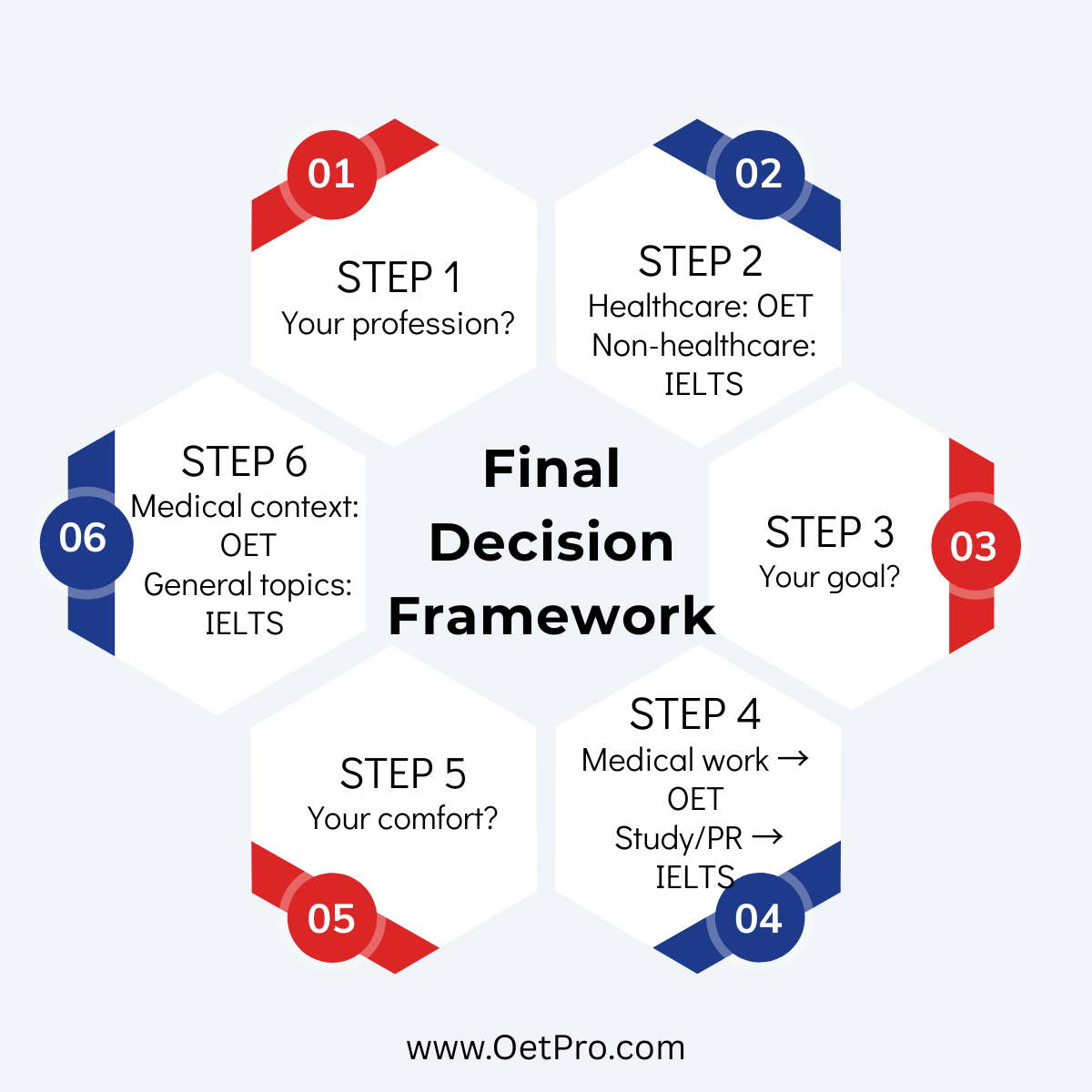
Use this simple framework to choose the right exam.
Step 1: Identify Your Goal
Ask yourself:
- Do I need the exam for healthcare registration?
- Am I applying for university or immigration?
If your goal is healthcare registration, OET is often the better choice.
If your goal is general study or migration, IELTS may be more suitable.
Step 2: Evaluate Your Strengths
Consider:
- Are you stronger in professional communication or academic writing?
- Do you feel confident in patient interaction?
Strong in healthcare communication ? OET
Strong in general English ? IELTS
Step 3: Check Acceptance Requirements
Always verify:
- Country requirements
- Professional regulator requirements
- Employer expectations
Some organisations accept both.
Some specifically prefer OET for healthcare roles.
Step 4: Consider Your Preparation Time
- OET preparation is often faster for healthcare professionals
- IELTS may require broader preparation across multiple topics
Step 5: Make a Strategic Choice
Choose the exam that:
- Matches your professional background
- Aligns with your goals
- Maximises your chances of success
Expert Tips
Tip 1: Don’t Follow the Crowd
Many candidates choose IELTS simply because others are taking it.
That doesn’t mean it’s the best option for you.
Tip 2: Focus on Relevance
The more relevant the exam is to your daily work, the easier it becomes to prepare and perform.
Tip 3: Avoid Overestimating General English
Being comfortable with everyday English does not guarantee success in IELTS academic tasks.
Tip 4: Practice Before Deciding
Try:
- One OET Writing task
- One IELTS Writing task
Compare:
- Comfort level
- Performance
- Confidence
This simple test can guide your decision.
Functional Language Comparison
Understanding the type of language used in each exam can help you decide.
OET Language Style
- Patient-focused
- Clear and professional
- Structured and purposeful
Example
"I am writing to refer this patient for further assessment."
IELTS Language Style
- Opinion-based
- Analytical
- Argument-driven
Example
"In my opinion, governments should invest more in healthcare systems."
Practice Activity
Activity: Choose Your Exam
Answer the following:
- What is your primary goal?
- Which type of communication do you find easier?
- Which writing task feels more natural?
- Which exam format makes you more confident?
Your Result
- Mostly healthcare-focused answers ? Choose OET
- Mostly general English answers ? Consider IELTS
Self-Assessment Checklist
Before making your decision, ensure:
- I understand the difference between OET and IELTS
- I know my professional goal
- I have checked acceptance requirements
- I have tried sample tasks
- I feel confident in my exam choice
Course Progression
You are now ready to make an informed decision between OET and IELTS.
In the next part, we will summarise everything and provide a clear action plan to help you move forward with confidence.
Summary
Choosing between OET and IELTS is one of the most important decisions in your exam journey.
Both tests assess English proficiency, but they are designed for different purposes:
- OET focuses on professional healthcare communication
- IELTS focuses on general academic and everyday English
For healthcare professionals, OET often feels more relevant because it reflects real clinical situations such as patient interaction, medical writing, and workplace communication.
However, the best choice depends on your individual goals, strengths, and requirements.
Quick Comparison Table
| Factor | OET | IELTS |
|---|---|---|
| Purpose | Healthcare communication | General English proficiency |
| Content | Medical scenarios | General topics |
| Writing | Referral/clinical letters | Essays & reports |
| Speaking | Patient role-play | Interview format |
| Scoring | Grades A–E (0–500) | Band score (0–9) |
| Best For | Healthcare professionals | Students & migrants |
Final Decision Checklist
Use this checklist before choosing your exam.
Career Goal
I know whether I need the test for healthcare registration, study, or migration.
Exam Relevance
I understand whether I prefer healthcare-based tasks or general topics
Personal Strengths
I know whether I am stronger in professional communication or academic writing
Acceptance Requirements
I have checked the requirements of my target country and profession
Practice Experience
I have tried sample tasks from both exams
Decision Guide
Choose OET if:
- You are a healthcare professional
- You want job-related communication tasks
- You prefer practical, real-life scenarios
- You feel confident in clinical communication
If OET matches your goals, start your preparation with our complete OET guide, covering the exam format, Listening, Reading, Writing, Speaking, scoring, and preparation strategies.
Choose IELTS if:
- You need a general English qualification
- You are applying for university or migration
- You are comfortable with essays and general topics
- You prefer an academic-style exam
Common Mistakes to Avoid
Choosing Based on Popularity
Just because others are taking IELTS does not mean it is right for you.
Ignoring Your Professional Background
Healthcare professionals often perform better in OET due to familiarity with content.
Not Checking Requirements
Always verify what your regulator or employer accepts before deciding.
Underestimating Exam Differences
OET and IELTS test different types of communication skills.
Weekly Action Plan (After Choosing Your Exam)
Day 1
Confirm your exam choice and review official requirements.
Day 2–3
Understand the exam format in detail.
Day 4–5
Start practising one skill at a time.
Day 6
Complete a mini mock test.
Day 7
Review performance and set improvement goals.
Key Takeaways
- OET is designed for healthcare professionals.
- IELTS is a general English test.
- OET focuses on real clinical communication.
- IELTS focuses on academic and general topics.
- The best choice depends on your goals, strengths, and requirements.
Conclusion
There is no universally “better” exam only the exam that is better for you.
If you are a healthcare professional aiming for international registration or employment, OET often provides a more relevant and practical testing experience.
If your goal is broader such as university admission or general immigration IELTS may be the more suitable option.
The key is to make a strategic, informed decision that aligns with your career path.