OET Exam Format Explained (Detailed Breakdown)
Introduction
If you're preparing for the Occupational English Test, understanding the exam format is one of the smartest ways to improve your confidence and performance. If you want to understand more than just the exam structure—including OET scoring, section-wise strategies, common mistakes, and preparation planning read our Complete Guide to OET 2026.
Many candidates spend weeks studying grammar and vocabulary but still lose marks because they don't fully understand:
- How each section works
- What each task is testing
- How much time they have
- What examiners expect
Knowing the format helps you prepare with purpose instead of guessing.
In this lesson, you'll get a complete walkthrough of the OET exam structure, including every section, timing, task type, and practical preparation advice.
Learning Objectives
By the end of this lesson, you will be able to:
- Explain the complete OET exam structure
- Identify the purpose of each exam section
- Understand the timing and task types
- Recognize how each section is assessed
- Avoid common mistakes related to the exam format
- Create a more effective preparation strategy
Why Understanding the OET Format Matters
Many candidates think that OET simply tests English.
In reality, OET evaluates whether you can communicate safely and professionally in healthcare settings.
Every task is designed to reflect situations you may experience in your professional career, such as:
- Speaking with a patient
- Reading clinical information
- Listening to consultations
- Writing referral or discharge letters
When you understand the format, you can focus your preparation on the skills that matter most instead of spending time on ineffective study methods.
Complete OET Exam Structure
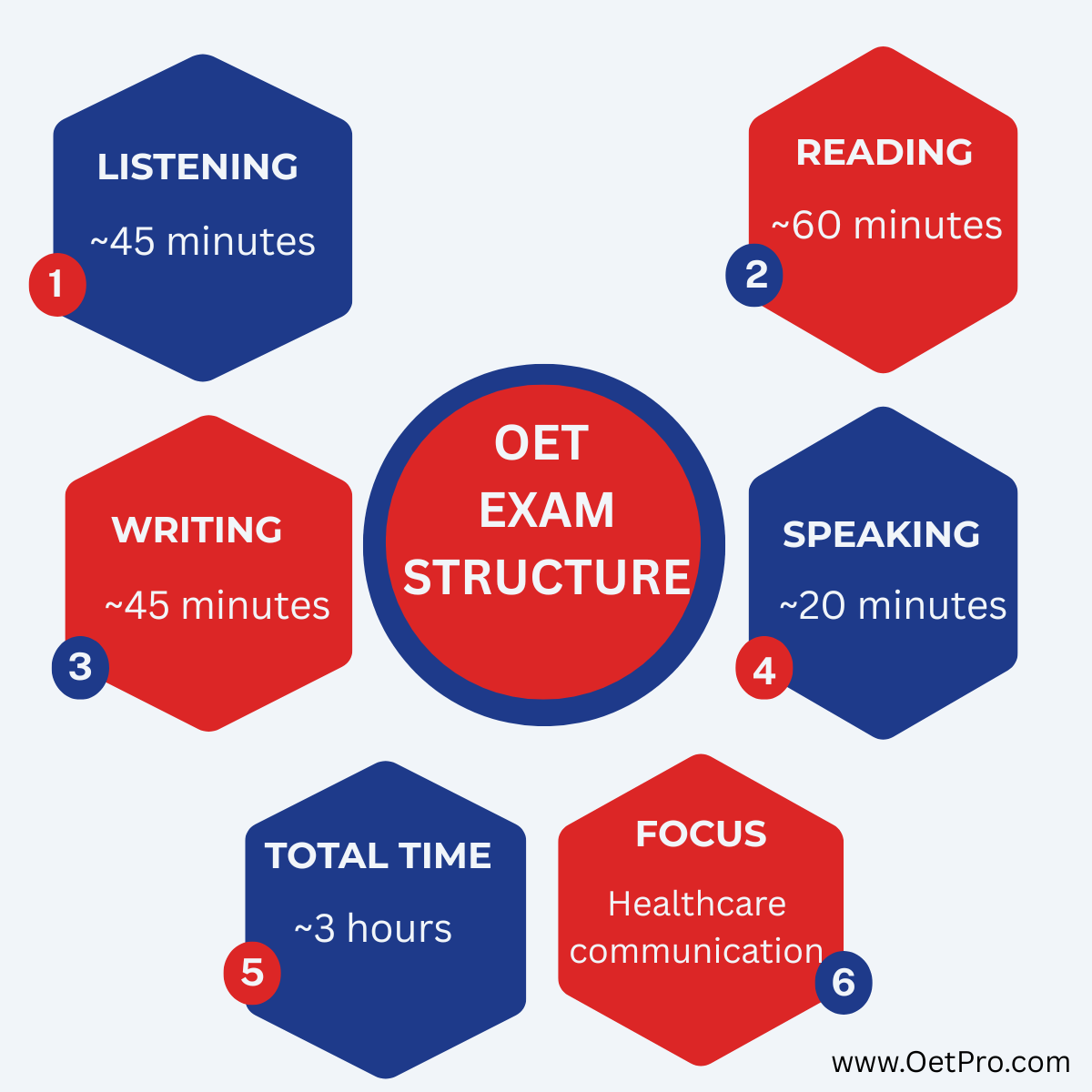
The OET exam consists of four separate language skills, each testing communication in healthcare environments.
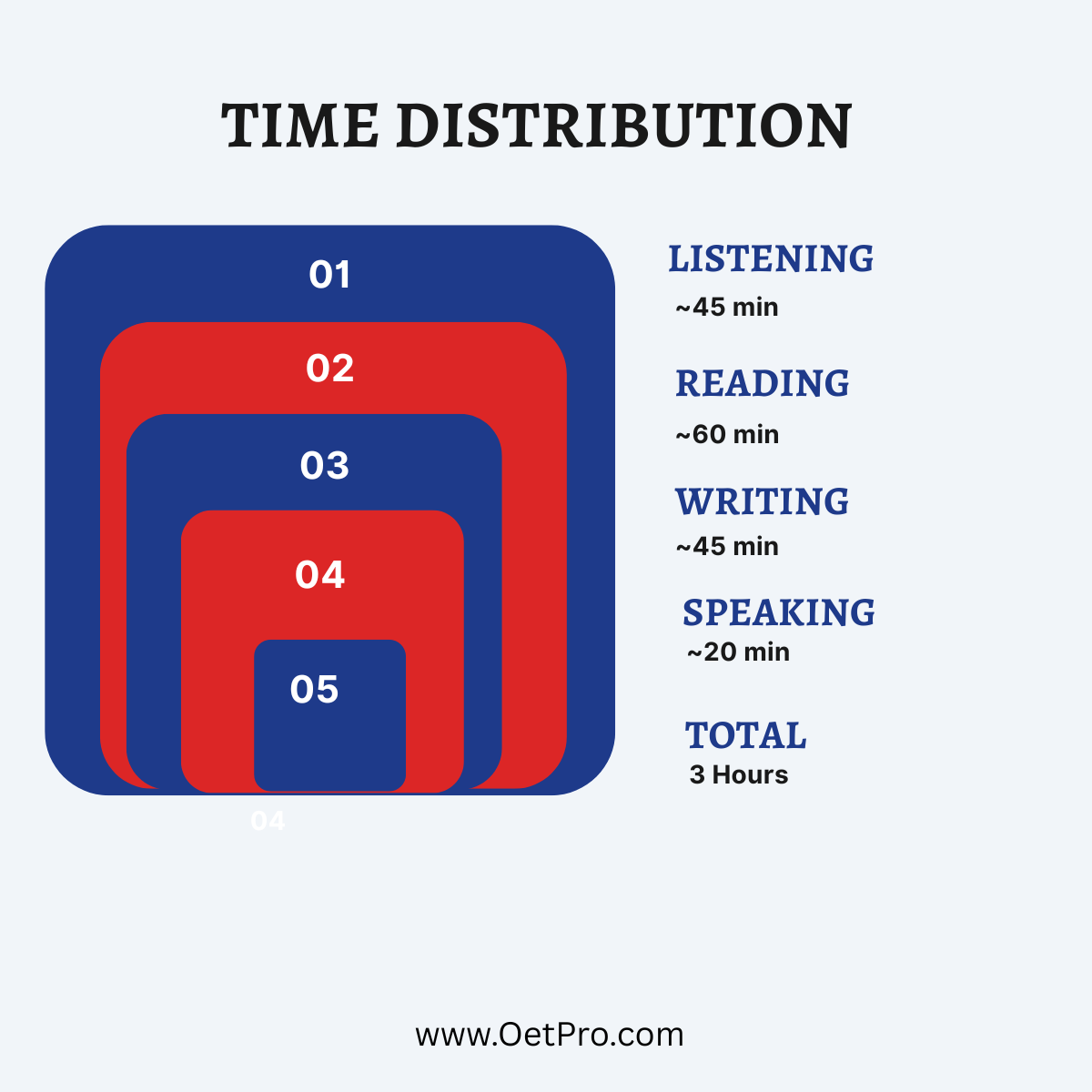
| Section | Approximate Time |
Main Focus |
|---|---|---|
| Listening | ~45 minutes | Understanding healthcare conversations and presentations |
| Reading | 60 minutes | Reading and interpreting healthcare texts |
| Writing | 45 minutes | Writing one profession-specific letter |
| Speaking | About 20 minutes |
Role-playing interactions with a patient or caregiver |
Together, these sections measure how effectively you can communicate as a healthcare professional not just how well you know English grammar. Understanding the exam format is only the first step. For detailed strategies for Listening, Reading, Writing, and Speaking, explore our Complete Guide to OET 2026.
What Makes the OET Different?
Unlike general English examinations, OET places you in realistic healthcare situations.
Instead of writing about general topics, you may write a referral letter.
Instead of discussing everyday issues, you may explain a treatment plan, reassure a patient, or gather medical information.
This practical approach makes OET highly relevant for professionals working in clinical environments.
Common Misunderstandings About the OET Format
Understanding what the exam doesn't require is just as important.
Myth 1: Every profession takes exactly the same exam.
Reality:
Listening and Reading are common across professions, while Writing and Speaking are tailored to your healthcare profession.
Myth 2: Writing is just an English essay.
Reality:
You'll write a professional healthcare letter based on patient case notes.
Myth 3: Speaking is like giving a presentation.
Reality:
Speaking consists of role-plays where you interact naturally with a patient or caregiver.
Myth 4: Memorizing templates guarantees a high score.
Reality:
Examiners reward relevant, purpose-driven communication—not memorized responses.
Myth 5: All four sections require the same preparation strategy.
Reality:
Each section assesses different communication skills and therefore requires different practice techniques.
Detailed Breakdown of the OET Exam
Now that you understand the overall structure, let's explore each section in detail.
Each section assesses a different communication skill, but together they measure one essential ability:
Can you communicate safely and effectively as a healthcare professional?
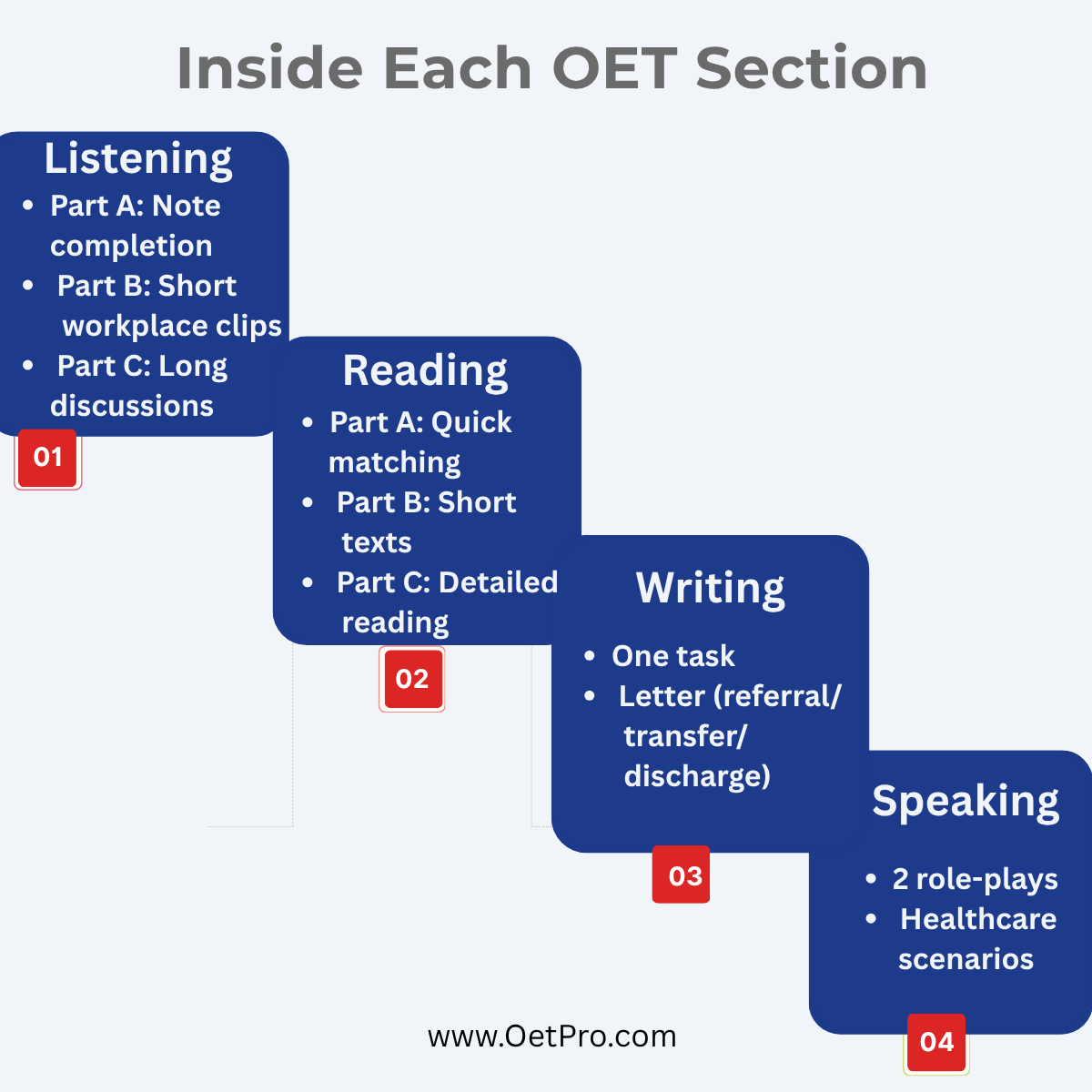
Section 1: Listening
Duration
Approximately 45 minutes
Purpose
The Listening section measures your ability to understand spoken English in healthcare settings.
You may hear:
- Doctor–patient consultations
- Nurse–patient conversations
- Healthcare workplace discussions
- Medical presentations or interviews
The focus is not just on hearing words it is about identifying important clinical information accurately.
Skills Being Assessed
- Active listening
- Understanding specific details
- Identifying opinions and attitudes
- Following the main idea
- Recognising clinical information
Preparation Strategy
- Listen for meaning, not individual words.
- Practise with different English accents.
- Learn common healthcare vocabulary.
- Take notes quickly and accurately.
Section 2: Reading
Duration
60 minutes
Purpose
The Reading section evaluates how efficiently you understand written healthcare information.
You may work with:
- Clinical guidelines
- Hospital notices
- Research summaries
- Patient information leaflets
- Medical journal extracts
Skills Being Assessed
- Skimming for the main idea
- Scanning for specific information
- Understanding vocabulary in context
- Comparing information
- Interpreting professional texts
Preparation Strategy
- Develop fast reading habits.
- Avoid reading every word.
- Identify keywords before searching for answers.
- Manage your time carefully.
Section 3: Writing
Duration
45 minutes
Purpose
The Writing section assesses your ability to produce a professional healthcare letter using patient case notes.
Depending on your profession, you may write:
- Referral letters
- Discharge letters
- Transfer letters
- Advice letters
What Examiners Look For
Your writing should demonstrate:
- Clear purpose
- Logical organisation
- Appropriate tone
- Accurate selection of information
- Professional language
Simple Writing Framework
- Introduce the patient and the purpose of the letter.
- Present only the relevant clinical information.
- Explain the requested action or follow-up.
Remember:
Good OET writing is about selecting information not copying everything from the case notes.
Section 4: Speaking
Duration
Approximately 20 minutes
Purpose
The Speaking section evaluates your ability to communicate professionally with patients or caregivers.
You complete role-play scenarios that reflect real clinical situations.
Examples include:
- Explaining a diagnosis
- Providing lifestyle advice
- Discussing treatment options
- Responding to patient concerns
- Giving discharge instructions
Skills Being Assessed
- Building rapport
- Showing empathy
- Asking appropriate questions
- Explaining information clearly
- Maintaining a professional conversation
Preparation Strategy
- Speak naturally instead of memorising scripts.
- Listen carefully before responding.
- Use empathetic language.
- Keep explanations simple and patient-focused.
How the Four Sections Work Together
Although each section is tested separately, they reflect the communication tasks healthcare professionals perform every day.
| OET Section | Workplace Example |
|---|---|
| Listening | Understanding a patient's consultation |
| Reading | Reviewing clinical guidelines or reports |
| Writing | Preparing a referral or discharge letter |
| Speaking | Explaining treatment to a patient |
When you prepare with this real-world perspective, your English skills become more practical and transferable.
Section-Wise Preparation Priorities
| Section | Primary Focus | Common Challenge |
|---|---|---|
| Listening | Accurate understanding | Missing key details |
| Reading | Speed and comprehension | Poor time management |
| Writing | Relevant information selection | Including unnecessary details |
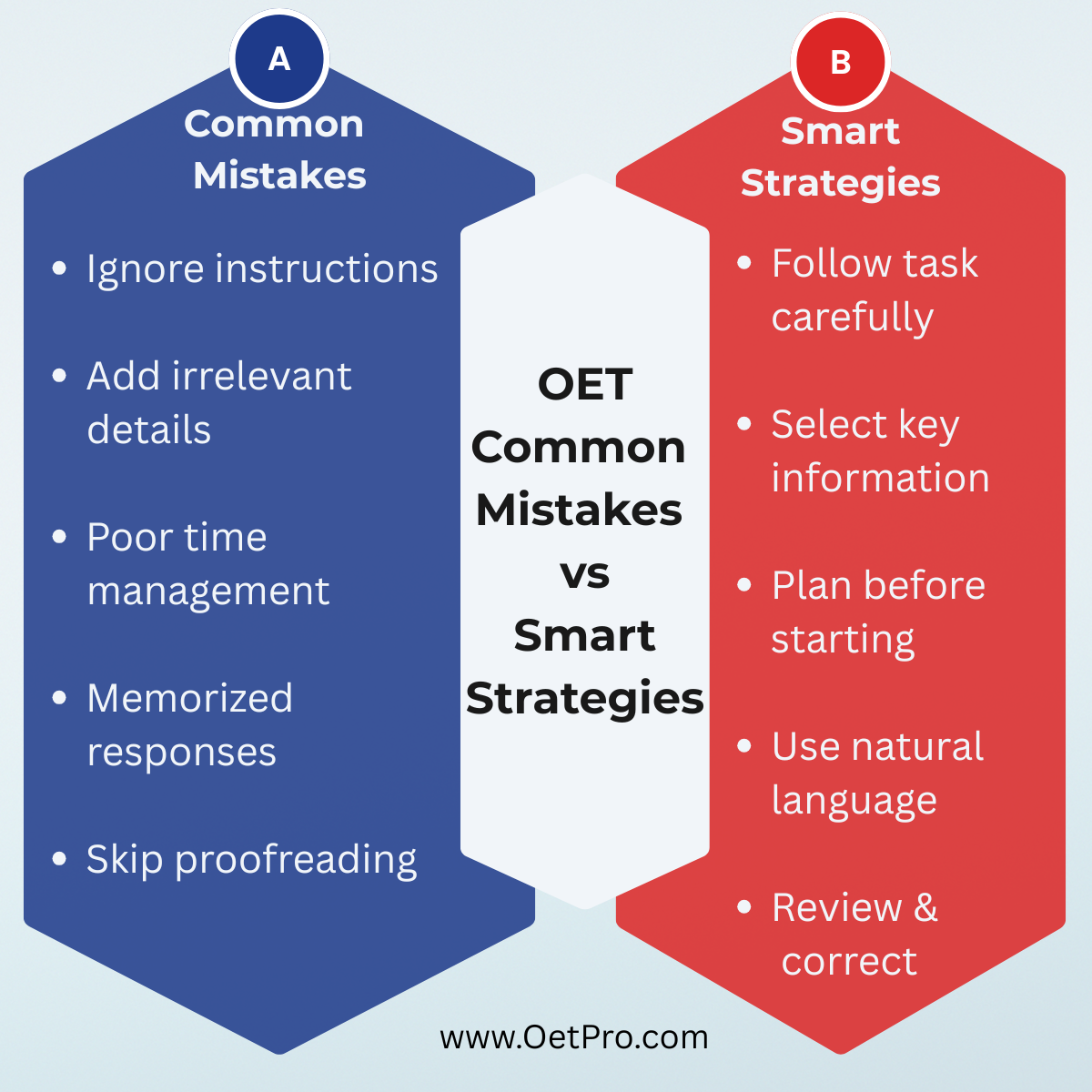
| Speaking | Patient-centred communication |
Sounding memorised instead of natural |
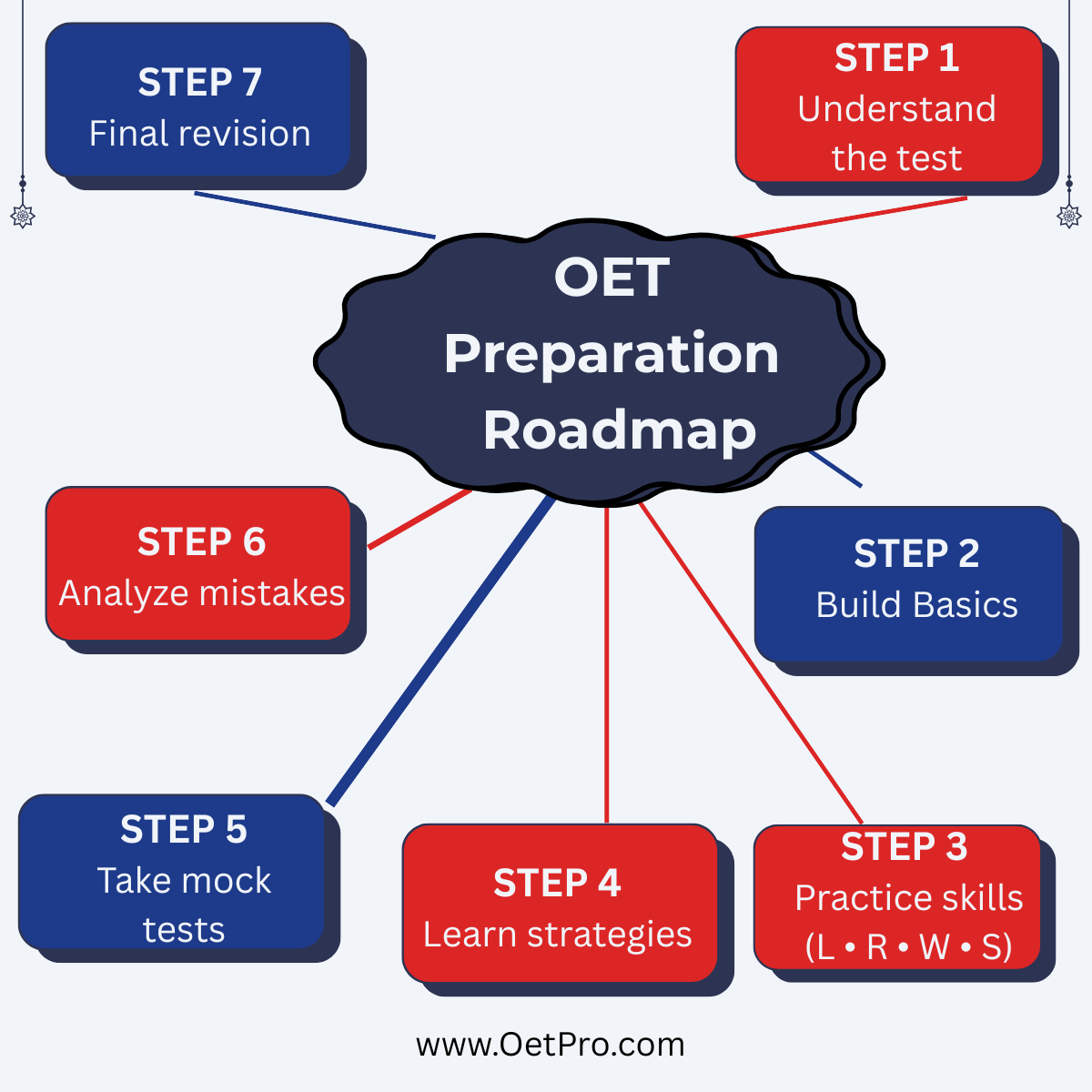
Once you understand the test format, you need a structured preparation strategy. Our Complete Guide to OET 2026 covers study planning, section-wise strategies, common mistakes, scoring, and exam preparation.
Expert Strategy
Instead of studying each skill in isolation, combine them whenever possible.
For example:
- Read a patient case, then explain it aloud.
- Listen to a consultation, then write a referral summary.
- Read a clinical article and discuss its key points with a study partner.
This integrated approach mirrors real healthcare practice and strengthens multiple skills at the same time.
Advanced Preparation Strategies
Once you understand the exam format, the next step is learning how to perform consistently in every section.
High-scoring candidates don't just know the format they know how to adapt their communication to each task.
Strategy 1: Think Like a Healthcare Professional
The OET is designed around real clinical practice.
Instead of asking:
"What English words should I use?"
Ask yourself:
"How would I communicate this information to a patient or another healthcare professional?"
This shift in mindset improves both your Writing and Speaking performance.
Strategy 2: Focus on the Purpose of Every Task
Every OET task has a communication goal.
| Section | Primary Purpose |
|---|---|
| Listening | Understand important healthcare information |
| Reading | Find and interpret relevant information |
| Writing | Communicate professionally with another healthcare professional |
| Speaking | Support, inform and guide a patient or caregiver |
When you understand the purpose, choosing the correct language becomes much easier.
Strategy 3: Build Section-Specific Skills
Trying to improve all four skills in the same way is ineffective.
Instead, develop targeted habits.
Listening
Practice:
- Identifying key facts
- Understanding speaker intention
- Following chronological information
Reading
Practice:
- Skimming first
- Scanning second
- Reading carefully only when necessary
Writing
Practice:
- Selecting relevant case notes
- Organising ideas logically
- Maintaining an appropriate professional tone
Speaking
Practice:
- Building rapport
- Asking open-ended questions
- Explaining information using clear, simple language
Examiner Insights
Understanding what examiners value can help you avoid unnecessary mistakes.
Listening
Examiners expect you to:
- Identify essential information accurately
- Follow conversations without relying on individual words
- Understand meaning in context
Reading
Strong candidates:
- Read efficiently
- Distinguish important information from supporting details
- Manage time effectively
Writing
Examiners reward candidates who:
- Clearly state the purpose of the letter
- Include only relevant information
- Organise ideas logically
- Use an appropriate professional tone
They do not reward longer letters if unnecessary information is included.
Speaking
Successful candidates:
- Build rapport naturally
- Show empathy
- Ask relevant questions
- Explain information clearly
- Respond appropriately to patient concerns
Speaking should feel like a professional consultation not a memorised speech.
Functional Language for Every Section
Rather than memorising advanced vocabulary, focus on language that supports effective communication.
Useful Expressions for Writing
Introducing the purpose
- I am writing to refer...
- I am writing to request...
- Thank you for assessing...
- Please review...
Providing information
- The patient presented with...
- Relevant medical history includes...
- Current medication consists of...
- Recent investigations indicate...
Requesting follow-up
- I would appreciate your assessment.
- Please continue management as appropriate.
- Further evaluation would be beneficial.
Useful Expressions for Speaking
Showing empathy
- I understand your concern.
- That is completely understandable.
- Many patients feel the same way.
Explaining
- Let me explain what this means.
- I'll go through the next steps with you.
- Here's what we recommend.
Checking understanding
- Does that make sense?
- Do you have any questions?
- Could you explain that back to me in your own words?
Practice Activities
Activity 1: Listening
Listen to a short healthcare consultation.
Identify:
- Main complaint
- Duration
- Current treatment
- Follow-up plan
Activity 2: Reading
Read a patient information leaflet.
Answer:
- What is the main purpose?
- Which information is most important?
- What advice is given to patients?
Activity 3: Writing
Using patient case notes:
Write only the opening paragraph of a referral letter.
Check whether:
- The purpose is immediately clear.
- Only relevant information is included.
- The tone is professional.
Activity 4: Speaking
Role-play this situation:
Scenario
A patient has recently been diagnosed with hypertension and is worried about starting medication.
Your objectives:
- Reassure the patient.
- Explain why treatment is important.
- Encourage questions.
- End the consultation positively.
Self-Assessment Checklist
After completing your practice, ask yourself:
- Can I explain the purpose of every OET section?
- Do I understand what each section measures?
- Am I practising skills that match the exam format?
- Can I complete tasks within the time limit?
- Am I communicating clearly rather than simply using complex English?
If you answered "No" to any of these questions, revisit that section before moving on.
Summary
Understanding the OET exam format is the first step toward effective preparation.
Rather than treating OET as a general English test, think of it as a professional communication assessment designed for healthcare environments.
Throughout this lesson, you learned that the exam consists of four sections:
- Listening – Understanding healthcare conversations and presentations
- Reading – Interpreting medical and workplace texts
- Writing – Producing a profession-specific healthcare letter
- Speaking – Communicating with patients through realistic role-plays
Each section measures a different skill, but together they assess your ability to communicate clearly, accurately, and professionally.
Quick Revision Table
| Section | Duration | Main Task | Success Tip |
|---|---|---|---|
| Listening | ~45 minutes | Understand healthcare conversations | Listen for meaning, not individual words |
| Reading | 60 minutes | Read and interpret medical texts | Skim first, then scan for details |
| Writing | 45 minutes | Write one professional healthcare letter | Select only relevant information |
| Speaking | ~20 minutes | Complete two role-plays | Build rapport and communicate naturally |
OET Exam-Day Checklist
Use this checklist before your exam.
Before the Exam
- Understand the format of all four sections
- Complete at least three full mock tests
- Practise under timed conditions
- Review profession-specific vocabulary
- Sleep well before exam day
During the Exam
- Read every instruction carefully
- Manage your time effectively
- Stay calm if you miss one question
- Focus on communication, not perfection
- Keep your responses relevant to the task
Common Exam-Day Mistakes to Avoid
- Spending too long on one question
Move forward and return later if time allows.
- Reading every word carefully
Use skimming and scanning techniques where appropriate.
- Copying all case notes into the Writing task
Only include information that supports the purpose of your letter.
- Sounding rehearsed during Speaking
Examiners are looking for natural, professional interaction not memorized scripts.
- Ignoring the purpose of the task
Always ask yourself:
"What am I trying to achieve in this communication?"
Keeping the purpose in mind will help you make better language choices.
Beginner's Weekly Practice Plan
Monday
- Review the exam structure
- Complete one Listening activity
Tuesday
- Practise Reading Part A
- Learn 15–20 healthcare terms in context
Wednesday
- Write one referral or discharge letter
- Review feedback and make corrections
Thursday
- Complete two Speaking role-plays
- Focus on empathy and clear explanations
Friday
- Combine Reading and Writing practice
- Summarise a clinical case in your own words
Saturday
- Take one timed mini mock test
- Analyse your mistakes
Sunday
- Revise difficult areas
- Plan the following week's study goals
Frequently Asked Questions
How many sections are there in the OET exam?
There are four sections:
- Listening
- Reading
- Writing
- Speaking
Each section evaluates a different aspect of professional English communication.
Which section is profession-specific?
The Writing and Speaking sections are tailored to your healthcare profession.
Listening and Reading are common for all candidates.
Which OET section is usually the most challenging?
Many candidates find Writing challenging because it requires selecting relevant information, maintaining an appropriate tone, and organising ideas clearly.
However, the most difficult section varies depending on your strengths and professional background.
Can I prepare for one section at a time?
Yes, but your preparation should eventually become integrated.
For example:
- Read a clinical case, then write a referral letter.
- Listen to a consultation, then discuss the case aloud.
This approach better reflects real clinical communication.
How long should I prepare for the OET exam?
Preparation time depends on your current English level and target score.
Many candidates benefit from a structured study plan that combines daily practice, regular feedback, and full-length mock exams.
Conclusion
A clear understanding of the OET exam format gives you a significant advantage before you begin intensive preparation.
When you know what each section assesses, how much time you have, and what examiners expect, you can practise with confidence and avoid many common mistakes.
Treat this lesson as your reference guide throughout your OET journey. Revisit it whenever you need a reminder of the structure, timing, or purpose of any section.