OET Reading Practice Mastery System Full Mock Test Strategy to Improve Your Score
Introduction
Most OET candidates fail Reading not because they don’t know the strategies, but because they don’t practice them in a real exam environment.
OET Reading is a test of:
- Speed under pressure
- Accuracy with limited time
- Decision-making in MCQs
- Focus across three different sections (A, B, C)
This lesson builds a complete practice system, not just tips. It shows you how to train like the actual exam so your performance becomes consistent and predictable. To get maximum benefit from mock tests and practice sets in OET Reading, you must first master skimming and scanning techniques. These skills help you handle passages faster and more accurately during practice sessions. You can learn these core techniques in OET Reading Mastery 2026 Complete Guide to Skimming & Scanning High Score Strategy.
Learning Objectives
By the end of this lesson, you will be able to:
- Build a structured OET Reading practice routine
- Simulate real exam conditions at home
- Improve accuracy in Parts A, B, and C
- Identify weak areas systematically
- Reduce time pressure during exams
- Track performance improvement
- Develop exam-level stamina
Overview of OET Reading Practice System
The OET Reading test cannot be improved by random practice. You need a system-based approach.
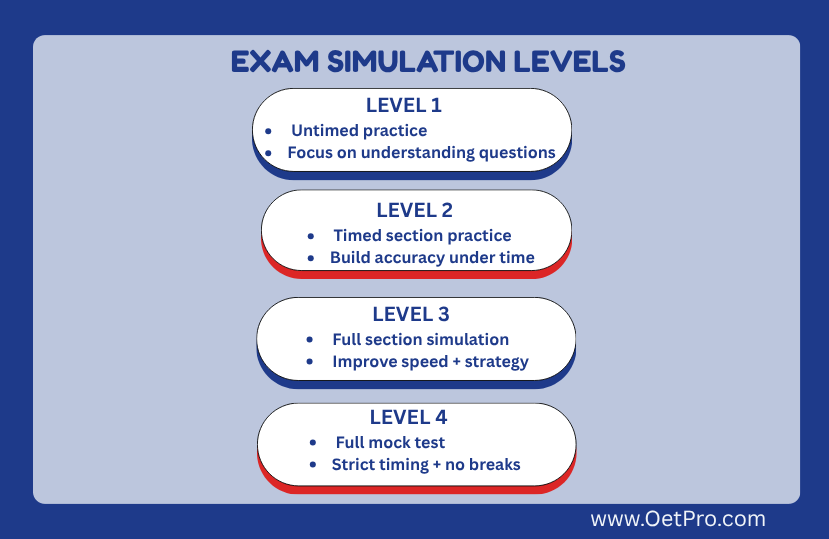
This practice system is divided into three levels:
Level 1 — Skill Practice
Focus on individual parts:
- Part A: Speed + scanning
- Part B: Meaning + MCQs
- Part C: Deep comprehension + inference
Level 2 — Timed Practice
- Practice full sections with time limits
- Focus on speed + accuracy balance
- Build pressure-handling ability
Level 3 — Full Mock Simulation
- Complete Reading test (A + B + C)
- Real exam timing
- No interruptions
- Performance tracking
This 3-level system builds real exam confidence
Common Mistakes in Practice
Most students practice incorrectly, which slows improvement.
Practicing without time limits
Students feel confident but fail in real exam pressure.
Only solving easy questions
Avoiding difficult questions leads to weak performance in Part C.
Not analyzing mistakes
Without review, the same errors repeat again and again.
Ignoring weak sections
Many students avoid Part C instead of improving it.
Random practice without structure
No system = no measurable improvement
The 4-Stage Practice System
Stage 1 — Skill Drills (Foundation Building)
Before doing full tests, you must build individual skills for each section.
What to practice:
- Part A: scanning tables, locating keywords quickly
- Part B: understanding purpose and MCQs
- Part C: reading paragraph ideas and inference
How to practice:
- Solve small sets (5–10 questions per part)
- Focus on one skill at a time
- Do not mix sections initially
Goal: build accuracy without pressure
Stage 2 — Timed Section Practice
Once skills improve, move to timed practice for each section separately.
Time focus:
- Part A -> strict speed training
- Part B -> controlled MCQ accuracy
- Part C -> reading under time pressure
What to do:
- Set real exam timing
- Avoid pauses or distractions
- Simulate exam thinking
Goal: balance speed + accuracy. Mock tests are designed to simulate real exam pressure, where time management becomes critical. Without efficient reading techniques, it becomes difficult to complete all tasks on time. You can build this efficiency using the OET Reading Mastery Skimming and Scanning Framework 2026.
Stage 3 — Full Section Simulation
Now combine each section into a real test format (A + B + C separately).
Key focus:
- Follow exam order
- Do not stop mid-section
- Manage time carefully
Rules:
- No dictionary use
- No rewinding or reviewing while solving
- Treat it like real exam
Goal: build exam stamina
Stage 4 — Full Mock Test (Complete Exam Simulation)
This is the most important stage.
You must simulate the entire OET Reading test in one sitting.
Conditions:
- Full timing (real exam duration)
- No breaks
- No interruptions
- Real pressure environment
What you learn:
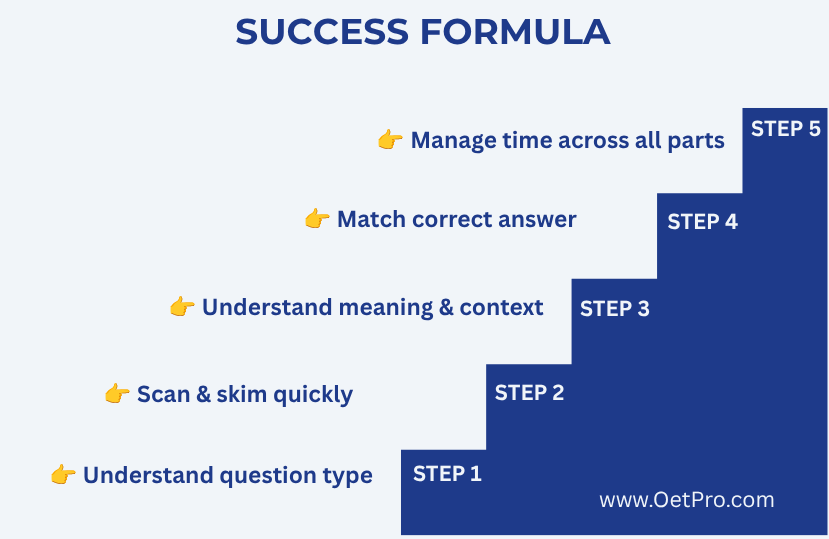
- Time management across all parts
- Mental endurance
- Performance consistency
This stage shows your real exam readiness.
In practice tests, many students struggle not because of lack of knowledge, but because their reading speed and keyword identification are weak. Strong skimming and scanning fixes this issue effectively. These foundational skills are explained in the OET Reading Mastery Strategy Guide for High Score Performance.
Weekly Practice Structure
To improve efficiently, follow this weekly plan:
Days 1–2:
- Skill drills (Part A + B + C separately)
- Focus: accuracy
Days 3–4:
- Timed section practice
- Focus: speed + control
Day 5:
- Mixed practice (A + B + C combined)
Day 6:
- Full mock test simulation
Day 7:
- Error analysis + revision
Consistency is more important than volume
Error Analysis System (Very Important)
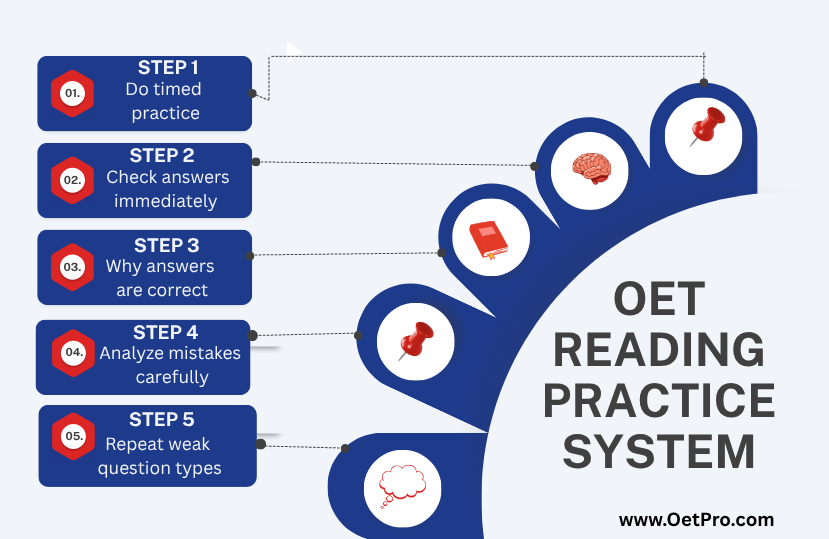
After every test, always review mistakes.
Ask yourself:
- Did I misunderstand the question?
- Did I miss keywords or meaning?
- Was it a time issue or knowledge issue?
Categorize mistakes:
- Concept error
- Speed error
- Careless error
- Vocabulary confusion
This step improves score faster than practice alone
Advanced Practice Techniques & Examiner-Level Training
At this stage, you already know how to practice OET Reading in a structured way. Now the focus shifts to exam-level performance training, where you learn how to think and react like a real test taker under pressure.
This is where top scorers separate themselves from average candidates—not by studying more, but by practicing smarter under realistic conditions.
Examiner-Level Training System
To perform at a high level, your practice must replicate real exam thinking. This means training your brain to handle time pressure, confusion, and traps at the same time.
1. Pressure-Based Practice
In real OET exams, pressure affects decision-making more than difficulty.
How to train:
- Set strict timers for each section
- Do not pause once you start
- Simulate exam silence conditions
- Avoid checking answers during the test
This builds mental stability under stress
2. Mixed Difficulty Practice
Many students only practice easy or medium questions, which creates a false sense of confidence.
Better approach:
- Mix easy + difficult questions in one set
- Include tricky MCQs intentionally
- Practice inference-heavy questions regularly
This prepares you for real exam unpredictability
3. Speed Calibration Training
Speed is not about rushing it is about controlled reading efficiency.
Practice method:
- Set strict time limits per question
- Track time spent per passage
- Gradually reduce reading time without losing accuracy
Goal: faster decisions with stable accuracy
4. Trap Recognition Training
OET Reading is designed with traps, especially in MCQs.
Train yourself to identify:
- Paraphrased answers
- Partially correct options
- Extreme language (always, never, must)
- Distractors that look familiar
The goal is to eliminate confusion quickly
5. Decision-Speed Training
In Part B and C especially, success depends on fast decision-making.
Training method:
- Limit thinking time per question (30–60 seconds)
- Force final answer selection within time
- Avoid revisiting answers unless necessary
Builds confidence in first-choice accuracy
High-Score Practice Habits
Top-performing candidates follow consistent habits during practice.
They always:
- Practice under exam timing
- Review mistakes immediately after tests
- Focus on weak areas instead of repeating strong ones
- Track progress weekly
- Simulate full exams regularly
Consistency is more powerful than intensity
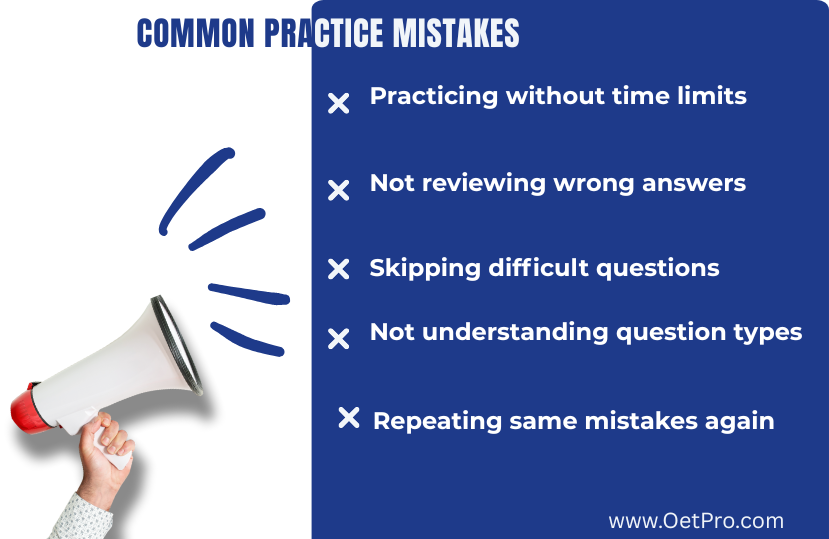
Common Practice Mistakes (Advanced Level)
Even advanced students make these mistakes.
Practicing without pressure
Feels easy but fails in real exam conditions.
Rechecking answers during test
Reduces speed and creates confusion.
Ignoring weak question types
Leads to repeated failure in same areas.
Practicing without analysis
Solving without reviewing mistakes stops improvement.
Final Master Checklist & Complete Practice Plan
At this stage, you are not just “practicing OET Reading” anymore—you are training for exam performance consistency. Part 4 brings everything together into a final system you can follow until exam day.
The goal is simple: turn strategy into automatic performance under pressure.
Complete OET Reading Master Checklist
Before attempting any mock test, ensure you are following this checklist consistently.
1. Reading Strategy Checklist
Make sure you can:
- Read the question before the passage
- Identify purpose quickly in Part B
- Skim structure in Part C effectively
- Locate answers without reading everything
- Avoid keyword-only thinking
If any of these are weak, revise previous parts
2. MCQ Accuracy Checklist
In MCQs, you should consistently:
- Focus on meaning, not exact words
- Use elimination method confidently
- Identify extreme or trap options
- Choose answers based on context, not similarity
Accuracy is more important than speed at this stage
3. Time Management Checklist
You must be able to:
- Finish Part A within strict time limit
- Avoid spending too long on single MCQs
- Balance time across all sections
- Skip and return when necessary
Time control decides your final score
4. Exam Mindset Checklist
Successful candidates always:
- Stay calm under pressure
- Avoid overthinking options
- Trust first logical answer
- Do not panic if one question is difficult
Confidence improves accuracy
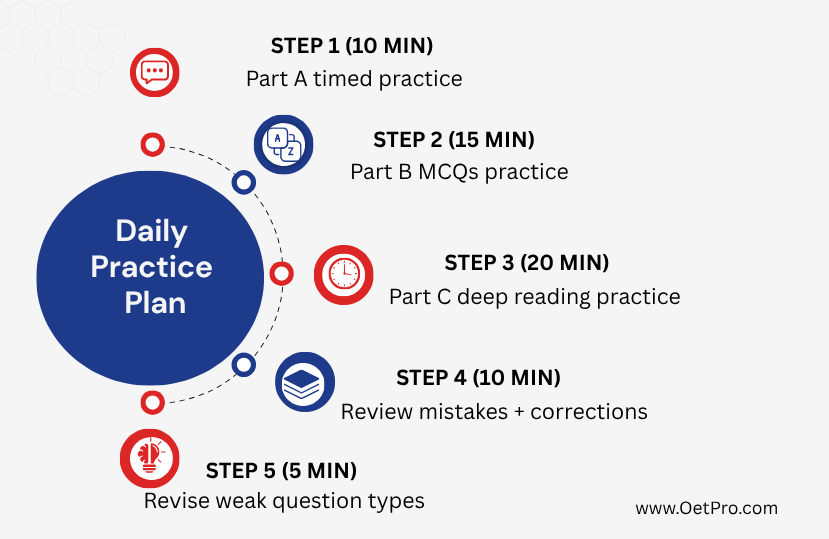
14-Day OET Reading Master Plan
This plan is designed to take you from practice to exam readiness.
Days 1–3: Skill Refinement Phase
Focus on strengthening basics:
- Part A scanning practice
- Part B meaning-based MCQs
- Part C paragraph understanding
Goal: build clarity and accuracy
Days 4–7: Timed Practice Phase
Now introduce pressure:
- Timed section tests
- Strict exam timing
- Focus on speed + accuracy balance
Goal: train decision speed
Days 8–10: Full Mock Phase
Start full Reading tests:
- Complete A + B + C in one sitting
- No breaks or interruptions
- Real exam simulation
Goal: build stamina and consistency
Days 11–14: Improvement Phase
Focus only on mistakes:
- Analyze wrong answers
- Identify weak areas
- Re-solve difficult questions
- Strengthen problem zones
Goal: eliminate recurring errors
Final Exam Strategy Summary
To succeed in OET Reading, always remember:
Part A
- Speed + scanning + accuracy
- Do not read everything
Part B
- Meaning + purpose + elimination
- Avoid keyword traps
Part C
- Structure + inference + deep understanding
- Focus on paragraph logic
Each part tests a different skill
Final Key Insight
OET Reading success is not about working harder.
It is about:
Practicing smarter + reviewing deeply + simulating real exam conditions
Final Encouragement Strategy
On exam day, remember:
- You do not need perfect answers
- You need consistent strategy execution
- You need calm decision-making
Confidence comes from structured practice.