OET Reading Mastery (2026): Complete Guide to Skimming, Scanning & High Score Strategy
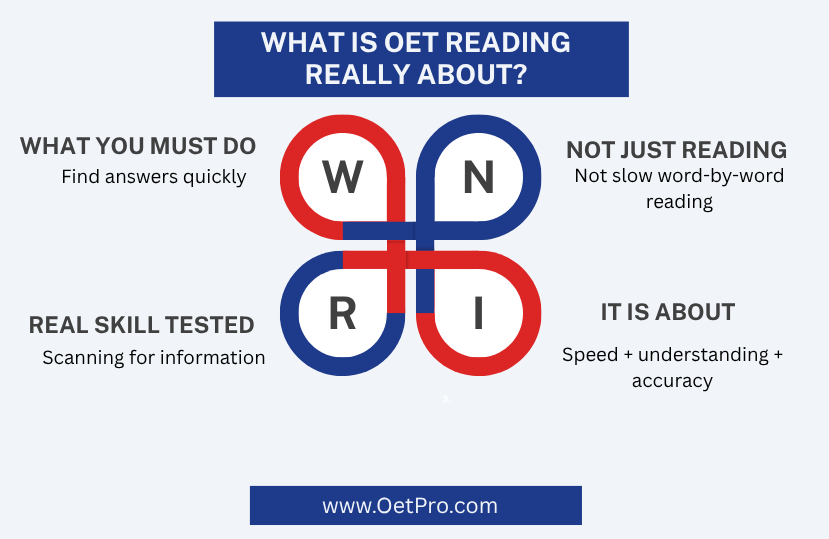
OET Reading is not about reading every word slowly. It is about finding information quickly and understanding meaning under time pressure.
Many candidates struggle in Reading because they:
- Read word by word and run out of time
- Cannot locate answers quickly in long texts
- Get confused by similar-looking MCQ options
- Panic in Part C long passages
But here is the truth:
OET Reading is a skill of speed + strategy, not slow reading
The test is designed to check how efficiently you can:
- Understand medical texts
- Locate information fast
- Make accurate decisions under time pressure
This lesson will teach you the complete system for mastering OET Reading using skimming, scanning, and question-focused strategies. When applying scanning techniques in real exam conditions, it becomes essential to understand how they work in timed tasks. You can see this in action in OET Reading Part A Strategy 2026, where fast note completion techniques are explained in detail.
When you complete skimming and scanning techniques in OET Reading Mastery, the next step is applying these skills in workplace-based MCQs. You can see this in action in OET Reading Part B Strategy 2026, where real exam-style texts are solved using fast decision techniques.
The skimming and scanning techniques explained above become even more important in long passage-based questions. In OET Reading Part C, you must apply these skills more strategically under time pressure. You can see this advanced application in OET Reading Part C Strategy 2026: How to Solve Long Passages & Inference Questions.
The skimming and scanning techniques explained above become much more powerful when applied in real exam practice. Without regular mock test practice, it is difficult to improve speed and accuracy. You can apply these skills in the OET Reading Practice Mastery System: Full Mock Test Strategy to Improve Your Score.
The skimming and scanning techniques explained above are the foundation of OET Reading success, but they become truly powerful when applied across all three parts of the exam. You can see this complete application in the OET Reading Final Mastery System: Complete Strategy for Parts A, B & C Success.
Learning Objectives
By the end of this lesson, you will be able to:
- Understand how OET Reading Part A, B, and C work
- Use skimming to understand main ideas quickly
- Use scanning to locate exact information
- Improve speed in MCQs and matching questions
- Avoid time-wasting reading habits
- Build accuracy under exam pressure
- Develop a high-score reading strategy
Overview of OET Reading Sections
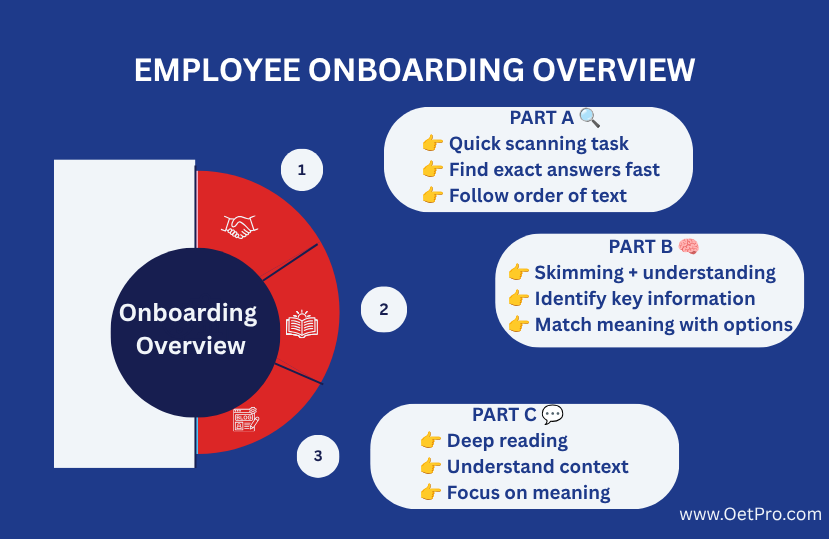
OET Reading is divided into three parts, each testing different skills:
Part A — Fast Reading (Detailed Text Handling)
This section tests:
- Speed reading
- Locating specific information
- Medical text scanning
You must answer quickly and accurately
Part B — Short Workplace Texts
This section includes:
- Emails
- Notices
- Guidelines
- Short workplace documents
Focus: meaning + purpose
Part C — Long Medical Passages
This section includes:
- Research articles
- Medical opinions
- Detailed explanations
Focus: understanding main idea + attitude + inference
Core Skills for High Score
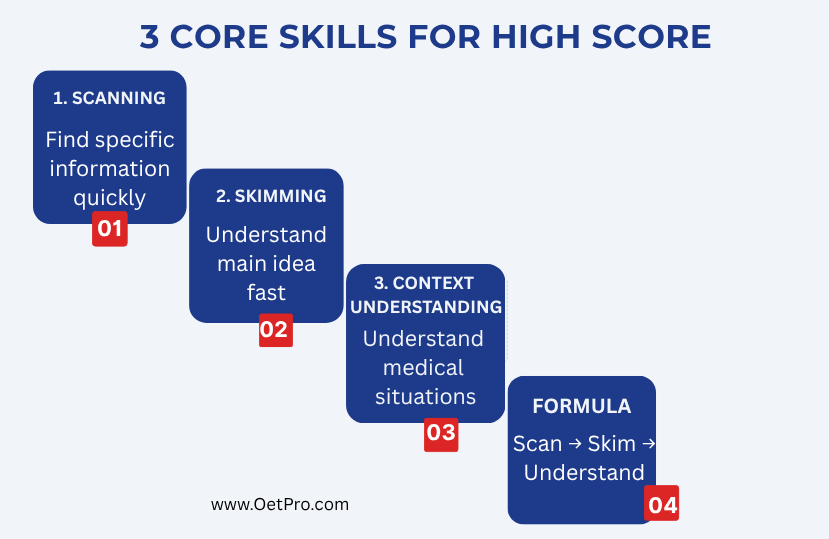
1. Skimming (For Main Idea)
Skimming means:
Reading quickly to understand general meaning
You do NOT focus on every word.
You look for:
- Topic
- Main idea
- Overall message
2. Scanning (For Specific Information)
Scanning means:
Searching for exact words or data
You look for:
- Numbers
- Medical terms
- Names
- Dates
- Instructions
The skimming and scanning skills covered above are the foundation of all OET Reading tasks. For a focused application of these skills in the exam format, refer to OET Reading Part A Fast Note Completion Strategy 2026.
The skimming and scanning methods explained above are essential for understanding OET Reading under time pressure. For practical application in MCQ-based workplace texts, refer to OET Reading Part B Strategy (Workplace Text Techniques).
Once you master basic skimming and scanning, the next step is applying them in complex reading tasks with longer texts. This is exactly what Part C focuses on in the exam.
Learn this advanced application in OET Reading Part C Long Passage Strategy 2026.
After learning reading strategies, the next step is practicing them under exam-like conditions. This helps you build timing control and question-handling accuracy. For structured practice methods, refer to OET Reading Mock Test Strategy and Practice System 2026.
3. Keyword Awareness
OET Reading uses:
- Synonyms
- Paraphrasing
- Medical vocabulary variations
Answers are rarely word-for-word matches
4. Time Management
You must:
- Move fast in Part A
- Not get stuck in Part C
- Avoid overthinking MCQs
Time management and keyword scanning become most critical in Part A of the exam. Learn how these skills are applied under strict timing in OET Reading Part A High-Score Techniques.
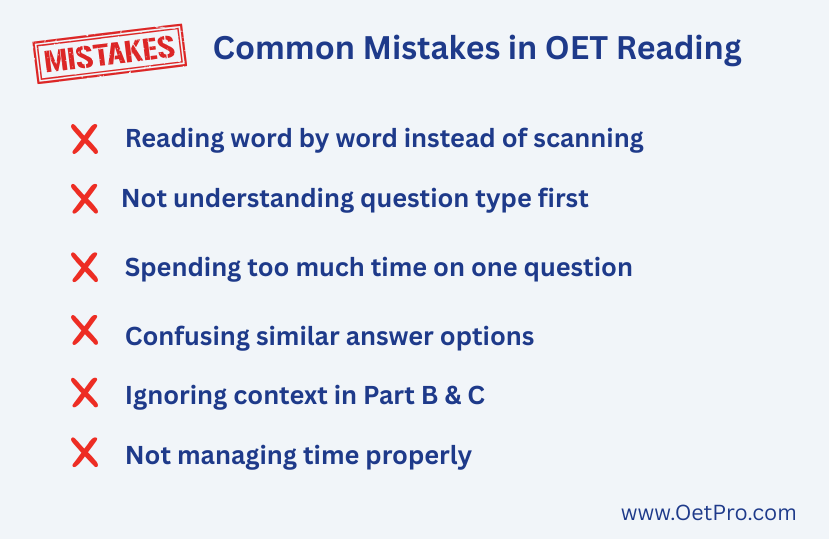
Common Mistakes in OET Reading
Reading every word slowly
This wastes time and reduces score.
Not using skimming or scanning
Students rely on slow reading instead of strategy.
Getting stuck on difficult questions
Leads to time loss in Part C.
Matching keywords blindly
Examiners use paraphrasing to confuse candidates.
Ignoring question type
Each section requires different approach.
Framework for OET Reading Success
To score high in OET Reading, you need a structured method, not random reading.
This framework is designed to help you handle all three parts efficiently:
- Part A (fast information location)
- Part B (short workplace texts)
- Part C (long medical passages)
The 3-Step Reading System
Step 1 — Skim First (Understand the Big Picture)
Before answering questions, you must quickly skim the text.
What skimming means:
- Read title and headings
- Read first and last lines of paragraphs
- Ignore small details initially
Goal of skimming:
Understand “What is this text about?”
Example:
If the passage is about “diabetes management,” you should know:
- Topic = diabetes
- Focus = treatment or care
- Context = medical advice
Step 2 — Scan for Answers (Find Information Fast)
Scanning means searching for exact information in the text.
What to scan for:
- Numbers
- Medical terms
- Names
- Dates
- Keywords from question
Example:
Question: “What is the recommended dosage?”
You scan for:
dosage / mg / frequency
Important rule:
- Don’t read everything
- Only search for relevant parts
Step 3 — Match Meaning (Not Words)
OET Reading answers are not direct copies from text.
They are usually:
- Paraphrased
- Synonym-based
- Reworded
Example:
Text: “Patient should reduce salt intake”
Answer: “Lower sodium consumption recommended”
Key idea:
Meaning is more important than exact words
Section-Wise Strategy
Part A Strategy (Speed + Accuracy)
Focus on:
- Scanning
- Quick keyword identification
- Short answers
Method:
- Skim headings
- Scan for keywords
- Fill answers quickly
- Move forward immediately
Part B Strategy (Understanding Purpose)
Focus on:
- Workplace communication
- Main idea
- Instruction understanding
Method:
- Read question first
- Skim text quickly
- Identify purpose
- Choose correct option
Part C Strategy (Deep Understanding)
Focus on:
- Main idea
- Opinion
Method:
- Skim passage first
- Read questions carefully
- Search for meaning
- Avoid keyword traps
Inference questions in OET Reading Part C require you to read between the lines rather than just finding direct keywords. This level of understanding builds on strong scanning and comprehension skills. For detailed inference techniques, refer to OET Reading Part C Inference Strategy for High Scores.
After mastering individual reading skills like skimming and scanning, the next step is understanding how to use them in a full exam strategy covering all question types. This is explained in OET Reading Final Mastery System for Parts A, B & C.
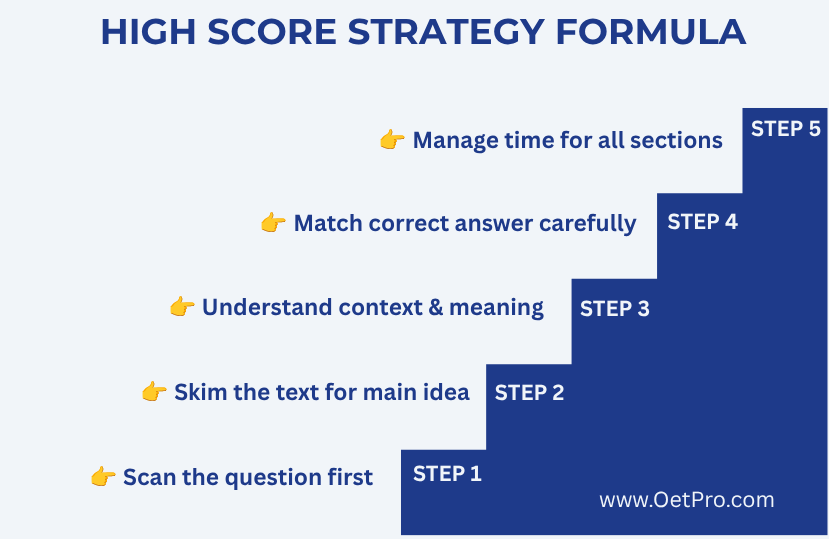
Time Management Framework
Golden Rule:
Do NOT spend equal time on all questions
Recommended timing:
- Part A -> Fastest section
- Part B -> Moderate speed
- Part C -> Controlled reading
Important:
If a question is difficult:
Skip and return later
Common Mistakes in OET Reading Strategy
Reading everything slowly
Leads to time shortage.
Not skimming first
Causes confusion in long texts.
Searching randomly
Waste of time in Part C.
Overthinking s
Leads to wrong answers.
Ignoring question focus
Each part needs different strategy.
To improve accuracy in real exam conditions, you must move from basic reading skills to question-focused strategies. This is demonstrated in OET Reading Part B High Score Techniques, where main idea and purpose-based questions are explained.
Advanced Reading Strategies (High Score Techniques)
Once you understand skimming and scanning, the next step is learning exam-level strategies that separate average candidates from high scorers.
At this stage, your goal is not just understanding the text it is answering accurately under pressure.
Strategy 1 — Question-First Approach
Instead of reading the passage first, start with the questions.
Why this works:
OET Reading passages are long. If you read first, you forget details.
Method:
- Read questions first
- Identify keywords
- Then go to the passage
Benefit:
You read only what is needed
Strategy 2 — Keyword Transformation Awareness
OET does NOT repeat exact words from the passage.
It uses:
- Synonyms
- Paraphrasing
- Medical rephrasing
Example:
Text: “Patient is advised to rest at home”
Question option:
- “Recommended home rest for recovery”
Key Skill:
Train your brain to recognize meaning, not words
Strategy 3 — Elimination Method (MCQ Power Strategy)
In Part B and C, MCQs can be tricky.
Use elimination:
Remove options that:
- Are too extreme (always, never)
- Are unrelated to text
- Change meaning of passage
- Are partially correct but incomplete
Result:
You increase chances of selecting correct answer
Strategy 4 — Time Control Strategy
Time is your biggest challenge in OET Reading.
Golden Rule:
- Do NOT spend too long on one question
- Move forward if unsure
Priority Order:
- Easy questions first
- Medium questions next
- Difficult questions last
Never get stuck in Part C
Strategy 5 — Medical Vocabulary Recognition
OET Reading includes medical terminology like:
- diagnosis
- treatment
- symptoms
- dosage
- recovery
Key Insight:
You don’t need to know every medical word.
You only need to:
Understand context meaning.
To achieve a high score in OET Reading, you must combine skimming, scanning, MCQ strategy, and long passage techniques into one structured system. This is fully covered in the OET Reading Final Mastery System for Complete Exam Success.
Example:
“Hypertension” = high blood pressure
“Analgesic” = pain relief medicine
Examiner Insights (Important)
OET Reading is designed to test:
- Speed under pressure
- Logical understanding
- Ability to find information quickly
- Not memory or deep reading
What examiners expect:
- Fast scanning
- Correct interpretation
- Smart decision-making
Common Student Mistakes
Reading line by line
This wastes time and reduces score.
Ignoring question type
Each section needs different strategy.
Matching keywords blindly
Examiners use traps through paraphrasing.
Overthinking answers
Leads to confusion and time loss.
High-Score Candidate Behavior
Top scorers always:
- Read questions first
- Use scanning effectively
- Eliminate wrong options quickly
- Avoid overthinking
- Move fast in Part A and C
Many students understand skimming and scanning but fail to improve scores because they do not practice them in real test environments. Consistent mock practice solves this gap effectively. You can learn this system in the OET Reading Practice Mastery Full Score Improvement Guide.
Final Summary
OET Reading is not about reading everything slowly. It is about reading smart, finding information quickly, and choosing answers based on meaning.
If you apply the correct system, you can handle:
- Part A with speed and accuracy
- Part B with clear understanding of workplace texts
- Part C with strong comprehension under time pressure
Key Idea
- You don’t win OET Reading by reading more
- You win OET Reading by reading strategically
Complete OET Reading Master System
1. Skimming (Big Picture)
Use skimming to quickly understand:
- Topic
- Main idea
- Overall context
Read headings and first/last lines only
2. Scanning (Fast Searching)
Use scanning to locate:
- Numbers
- Medical terms
- Keywords
- Specific details
Don’t read everything search only
3. Meaning Matching
Answers are usually paraphrased.
You must match:
- Ideas
- Not exact words
Section-Wise Final Strategy
Part A (Fastest Section)
- Skim notes quickly
- Scan for keywords
- Answer immediately
- Do not overthink
Part B (Workplace Texts)
- Understand purpose
- Identify meaning
- Use elimination method
Part C (Long Passages)
- Skim first
- Read questions before deep reading
- Use scanning for answers
- Avoid getting stuck
Final Checklist
Before exam, make sure:
Reading Skills
- I can skim quickly
- I can scan efficiently
- I understand paraphrasing
Exam Strategy
- I read questions first when needed
- I do not spend too long on one question
- I eliminate wrong options logically
Time Control
- I finish Part A fast
- I manage Part B steadily
- I stay calm in Part C
7-Day Practice Plan
Day 1–2: Skimming Practice
- Read medical articles
- Identify main ideas in 30 seconds
Day 3–4: Scanning Training
- Practice finding keywords quickly
- Focus on numbers and medical terms
Day 5: MCQ Practice
- Focus on elimination method
- Practice paraphrased questions
Day 6: Full Reading Test
- Simulate exam timing
- No distractions
Day 7: Review & Fix
- Analyse mistakes
- Identify weak areas
- Re-practice problem sections
The reading mastery system is not complete until you can apply skimming and scanning in all three parts of the OET Reading test. Part C represents the most advanced level of this skill application. This is explained in OET Reading Part C Complete High Score Guide 2026.
FAQs
How can I improve OET Reading score fast?
Use skimming, scanning, and practice under timed conditions with MCQs.
Is reading every word necessary?
No. It wastes time. Focus on meaning and keywords only.
What is hardest part of OET Reading?
Part C, because it tests comprehension and inference under time pressure.
How do I avoid confusion in MCQs?
Use elimination method and focus on meaning, not keywords.
Final Conclusion
OET Reading success comes from:
- Smart reading
- Fast scanning
- Meaning understanding
- Time control
Not from slow reading or memorization.