
OET Reading Part A Strategy (2026): Fast Note Completion & High Score Techniques
Introduction
OET Reading Part A is the fastest and most time-sensitive section of the entire Reading test. Many candidates lose marks here not because the questions are difficult, but because they cannot manage time and information quickly.
This section is a note completion task based on short medical texts. You are required to extract specific information such as symptoms, treatments, dosage, and patient details.
The biggest challenge is not understanding English, it is:
Finding the right information quickly under pressure. Most students fail Part A because they read line by line instead of using speed strategies like skimming and scanning.
This lesson will teach you a structured method to complete Part A efficiently and accurately. While OET Reading Part A focuses on fast note completion using scanning and keyword identification, it is only one part of the complete OET Reading test. To fully understand how skimming, scanning, and detailed reading work across all three parts of the exam, you should also study our OET Reading Mastery 2026 Complete Guide.
Learning Objectives
By the end of this lesson, you will be able to:
- Understand the format of OET Reading Part A
- Use skimming to understand text quickly
- Use scanning to locate answers efficiently
- Predict missing information in notes
- Improve speed and accuracy in note completion
- Avoid common mistakes in Part A
- Build a high-score answering strategy
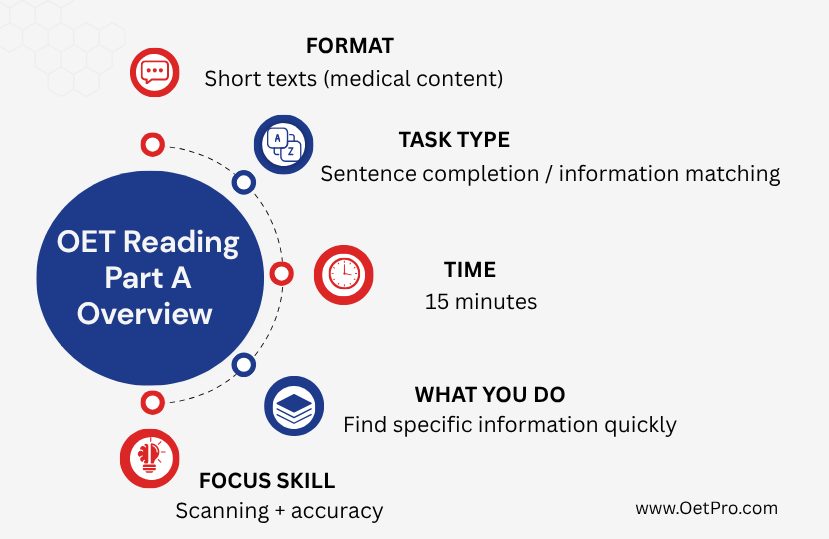
Overview of OET Reading Part A
Part A is designed to test your ability to quickly extract information from medical texts.
What you will see:
- Short medical passages
- Patient case notes
- Clinical summaries
- Referral or discharge information
What you must do:
- Complete missing notes
- Fill in keywords or short phrases
- Identify correct medical details
Key skill tested:
Speed + Accuracy + Information Location. Part A requires strong scanning skills, but to perform consistently well in the OET Reading test, you also need a full understanding of skimming and detailed reading strategies used in Parts B and C. Learn the complete system in our OET Reading Mastery Guide.
Core Strategy for Part A
To score high, you must follow a 3-step system:
Step 1 — Skim the Text First
Skimming helps you understand the general idea.
What to do:
- Read headings
- Read first and last lines
- Identify topic quickly
Goal:
Understand what the case is about (e.g., infection, injury, medication)
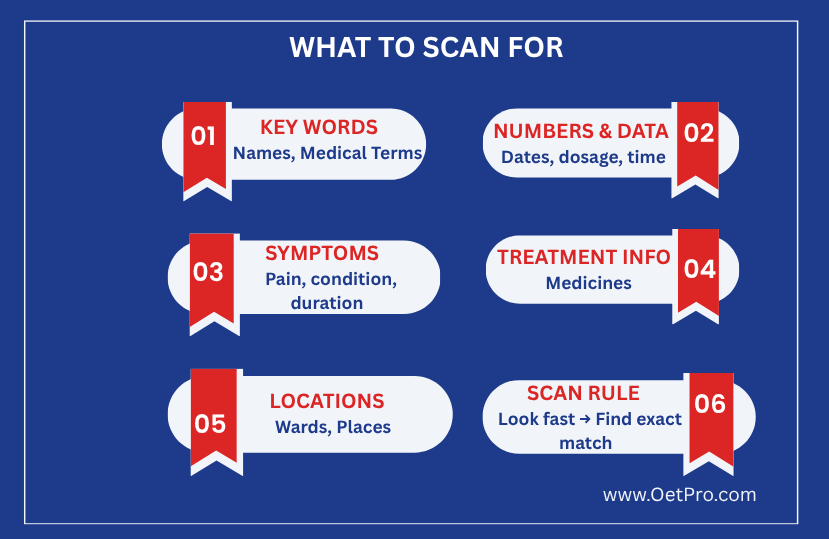
Step 2 — Scan for Keywords
Scanning helps you locate exact answers.
What to scan:
- Symptoms
- Numbers
- Dates
- Medication names
- Instructions
Goal:
Find answers without reading everything
Step 3 — Predict Missing Information
Before writing answers:
- Think logically
- Predict medical terms
- Match context
Example:
If sentence says:
“Patient is advised to take ___ twice daily”
Likely answer: medication or dosage. High scores in Part A come from mastering scanning techniques, but real exam success requires combining this with skimming and comprehension skills across all Reading parts. Read the full strategy in our OET Reading Mastery Guide.
Common Mistakes in Part A
Reading every word
This wastes time and causes panic.
Not looking at notes first
You miss what information is required.
Writing long answers
Part A requires short, precise answers.
Ignoring medical keywords
Important clues are missed.
Not predicting answers
Students wait too long instead of thinking ahead.
Many candidates lose marks in Part A because they focus only on scanning techniques without understanding the broader Reading strategy. This can be improved by learning the complete system.
Step-by-Step Answering Framework (Part A)
Now that you understand the basics of Part A, you need a clear execution system to solve questions quickly and accurately.
This section is where most candidates lose time because they try to read everything. Instead, you must follow a structured method.
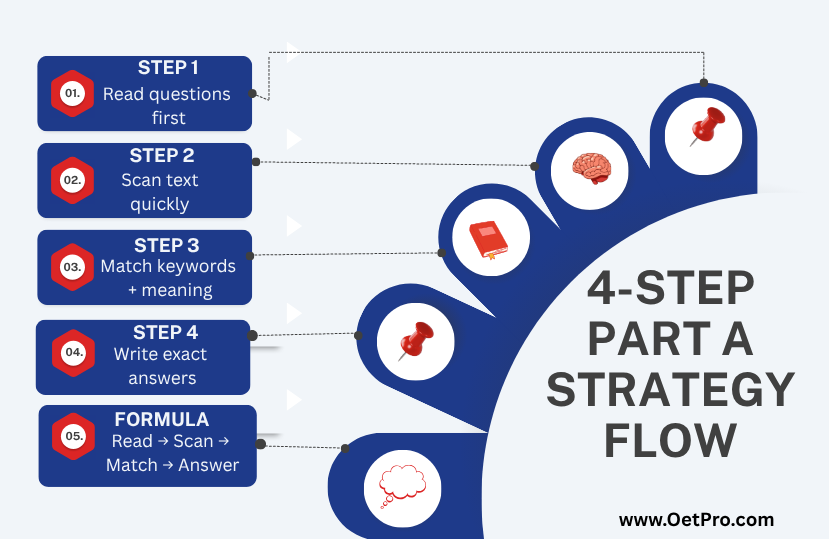
The 4-Step Part A System
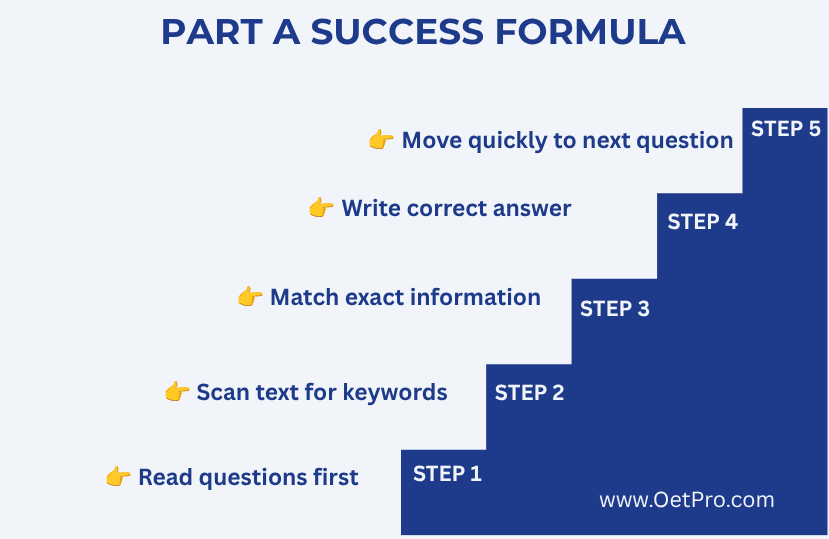
Step 1 — Read the Questions First
Before reading the passage in detail, always check the questions.
Why this works:
- You know what information to look for
- You avoid unnecessary reading
- You focus only on relevant parts
What to do:
- Identify keywords in the question
- Underline medical terms
- Understand what is being asked
This saves significant time in exam
Step 2 — Skim the Passage
Now quickly skim the text.
What to focus on:
- Topic of the case
- Patient condition
- Overall situation
What NOT to do:
- Don’t read every sentence
- Don’t focus on small details
Goal: Understand context in 20–30 seconds
Step 3 — Scan for Keywords
Now go back and search for answers.
What to scan:
- Medical terms
- Numbers and dosage
- Symptoms
- Treatment details
- Dates or timelines
Method:
- Move eyes quickly through text
- Stop only at relevant words
Step 4 — Match and Write Answers
Once you find the answer:
- Check meaning carefully
- Match with question requirement
- Write short, accurate answer
Important Rule:
- Keep answers precise
- Do not write full sentences
Time Management Strategy
Golden Rule:
Do not spend too long on any single question
Recommended approach:
- Easy questions -> Solve immediately
- Medium questions -> Use scanning
- Hard questions -> Skip and return later
Part A rewards speed, not perfection
Example Strategy Flow
Question:
“What medication was prescribed?”
Step 1:
Scan for “medication” or “drug”
Step 2:
Find keyword in passage
Step 3:
Write exact answer (e.g., “Paracetamol”)
Done in seconds with correct method
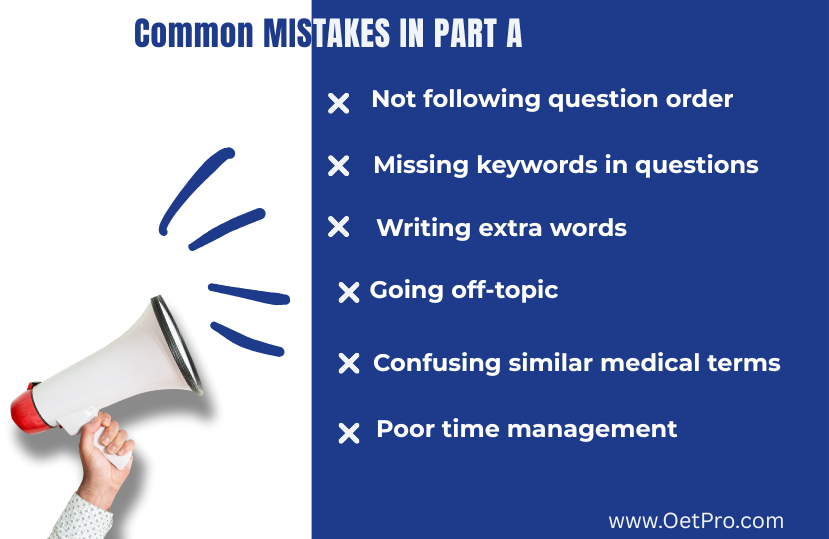
Common Mistakes in Execution
Reading full passage first
Leads to time waste.
Ignoring question keywords
Causes confusion during scanning.
Writing long answers
Reduces accuracy and wastes time.
Not moving quickly between questions
Creates panic in last minutes.
Guessing without checking context
Leads to wrong answers.
Key Insight
Part A is not about deep understanding.
It is about:
Fast location + smart matching + accurate writing
Advanced Tips, Vocabulary & Examiner Insights
At this stage, you already know how to locate answers quickly. Now we move to exam-level skills that help you avoid traps and increase accuracy.
Part A is designed to look simple, but examiners include carefully hidden challenges.
Strategy 1 — Keyword Trap Awareness
Examiners often repeat similar words to mislead you.
Example Trap:
Text:
“Patient is advised to reduce salt intake”
Wrong option:
- “Increase salt intake”
Correct understanding:
- “Lower sodium consumption”
Key Insight:
- Same topic, opposite meaning traps are common
Strategy 2 — Paraphrasing Recognition
Answers are rarely direct copies from text.
Example:
Text:
“Patient experiences severe headache”
Answer:
- “Intense head pain reported”
Skill Needed:
Understand meaning, not exact words
Strategy 3 — Medical Vocabulary Awareness
You don’t need advanced medical knowledge, but you must recognize common terms.
Important examples:
- Hypertension -> high blood pressure
- Fever -> elevated temperature
- Prescription -> prescribed medicine
- Dosage -> amount of medicine
Understanding context is enough
Strategy 4 — Avoid Overthinking
Many students lose marks because they:
- Doubt correct answers
- Change answers unnecessarily
- Spend too much time per question
Rule:
First correct instinct is usually right
Strategy 5 — Speed Decision Technique
Part A is time-sensitive.
Method:
- If answer is found -> write immediately
- If not found in 10–15 seconds -> move on
- Return later if time remains
Speed is more important than perfection
Examiner Insights
OET Reading Part A is designed to test:
- Information extraction speed
- Keyword recognition
- Decision-making under time pressure
What examiners expect:
- Fast scanning ability
- Logical matching
- Minimal hesitation
Common Student Mistakes
Searching word by word
This slows down performance.
Ignoring synonyms
Leads to missed answers.
Spending too long on one question
Creates time pressure for others.
Changing answers repeatedly
Reduces accuracy.
High-Score Candidate Behavior
Top performers:
- Scan quickly
- Trust keywords and context
- Avoid overthinking
- Move fast through questions
- Focus only on relevant information
Final Summary
OET Reading Part A is not difficult, but it is time-sensitive and strategy-based. If you try to read everything slowly, you will lose marks even if your English is strong.
Success in Part A depends on how quickly you can:
- Understand the context
- Locate keywords
- Match meaning correctly
- Write short accurate answers
Core Strategy Recap
1. Skim First
Understand the topic quickly
- Identify general case
- Do not read every line
2. Scan for Answers
Search only for keywords
- Medical terms
- Numbers
- Symptoms
- Medication
3. Match Meaning
Focus on meaning, not exact words
- Expect paraphrasing
- Use context understanding
Final Execution System
Step-by-step approach:
- Read questions first
- Skim passage quickly
- Scan for keywords
- Write short answers
- Move forward without delay
Final Checklist
Before exam, ensure:
Speed Skills
- I can skim a passage in under 30 seconds
- I can scan keywords quickly
- I don’t read word by word
Accuracy Skills
- I understand paraphrased answers
- I avoid keyword traps
- I write precise answers
Exam Behavior
- I do not overthink
- I move quickly between questions
- I skip difficult items and return later
7-Day Practice Plan
Day 1–2: Skimming Practice
- Practice reading medical passages
- Identify main topic in seconds
Day 3–4: Scanning Practice
- Focus on finding numbers and terms
- Practice keyword spotting
Day 5: Note Completion Practice
- Practice filling missing information
- Focus on accuracy
Day 6: Timed Practice Test
- Simulate real Part A conditions
- Strict timing
Day 7: Review & Fix
- Identify weak areas
- Repeat difficult question types
FAQs
Is OET Reading Part A difficult?
No, but it is time-sensitive. Speed matters more than difficulty.
How many words should I write in answers?
Keep answers short usually one word or short phrase.
What is most important skill?
Scanning quickly and accurately finding keywords.
How can I improve speed?
Practice timed exercises and avoid reading every word.
Final Conclusion
OET Reading Part A is designed to test your ability to:
- Find information quickly
- Understand meaning efficiently
- Work under time pressure
If you use the correct strategy:
- Your speed increases
- Your accuracy improves
- Your confidence becomes stronger
To master OET Reading Part A, you need strong scanning skills, but to achieve a high overall Reading score, you must also understand skimming and detailed reading strategies for all parts of the exam. Start with our OET Reading Mastery Guide for complete preparation.