OET Reading Part C Strategy: How to Solve Long Passages & Inference Questions
OET Reading Part C is the most challenging section of the OET Reading test because it contains long academic-style medical passages followed by complex MCQ questions.
Unlike Part A (speed-based) and Part B (meaning-based), Part C focuses on deep comprehension and inference skills.
Most candidates struggle here because they try to read everything slowly. However, success in Part C depends on your ability to understand structure, identify meaning, and locate answers efficiently under time pressure. To solve MCQs in OET Reading Part B effectively, you need strong skimming and scanning skills to quickly identify key ideas in workplace texts. Without these basics, accuracy in MCQs becomes difficult. You can build these essential skills in OET Reading Mastery 2026 Complete Guide to Skimming & Scanning High Score Strategy.
Learning Objectives
By the end of this lesson, you will be able to:
- Understand the structure of OET Reading Part C
- Develop effective skimming techniques for long passages
- Identify key ideas and supporting details
- Solve inference-based MCQs correctly
- Avoid confusion caused by similar answer options
- Improve reading speed without losing comprehension
- Build a structured approach for long texts
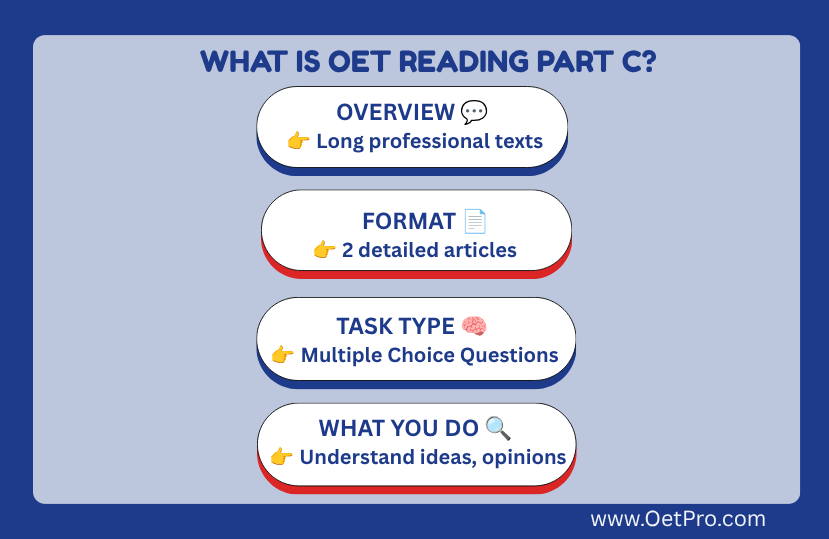
Overview of OET Reading Part C
Part C consists of two long passages, usually related to healthcare topics such as:
- Medical research
- Clinical studies
- Healthcare policies
- Professional opinions
- Patient care approaches
Each passage is followed by multiple MCQs that test understanding of both:
- Explicit information (stated ideas)
- Implicit information (inference-based meaning)
What you will see:
- Long medical articles
- Complex vocabulary
- Academic tone
- Multiple MCQ questions per passage
What you must do:
- Understand main ideas
- Identify supporting arguments
- Interpret implied meaning
- Select best answer from close options
Key skill tested:
Deep reading + inference + logical reasoning
Core Challenge in Part C
Part C is difficult because:
- Passages are long and detailed
- Answers are not directly written in text
- Options are very similar
- Meaning is often hidden in context
- Requires strong concentration and patience
This is where most students lose marks due to confusion and time pressure
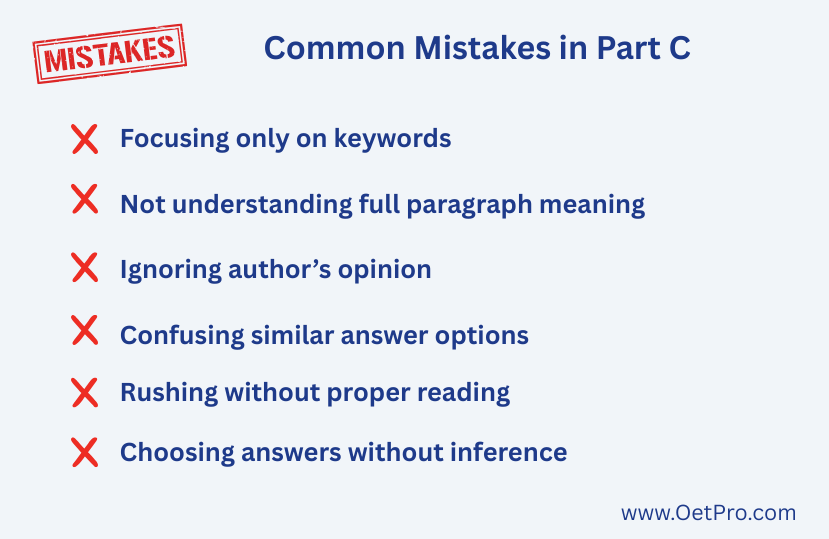
Common Mistakes in Part C
Reading everything slowly line by line
This wastes time and reduces overall performance.
Searching for exact keywords
Part C is heavily based on paraphrasing and inference.
Ignoring passage structure
Students often miss how ideas are connected.
Overthinking MCQ options
Changing correct answers due to doubt is very common.
Not understanding main idea first
Without understanding structure, MCQs become confusing.
Step-by-Step Strategy Framework (Part C)
OET Reading Part C looks difficult mainly because of long passages and complex MCQs. But if you use a structured approach, it becomes predictable and much easier to handle.
Instead of reading everything in detail, you must learn how to control the passage, not get controlled by it.
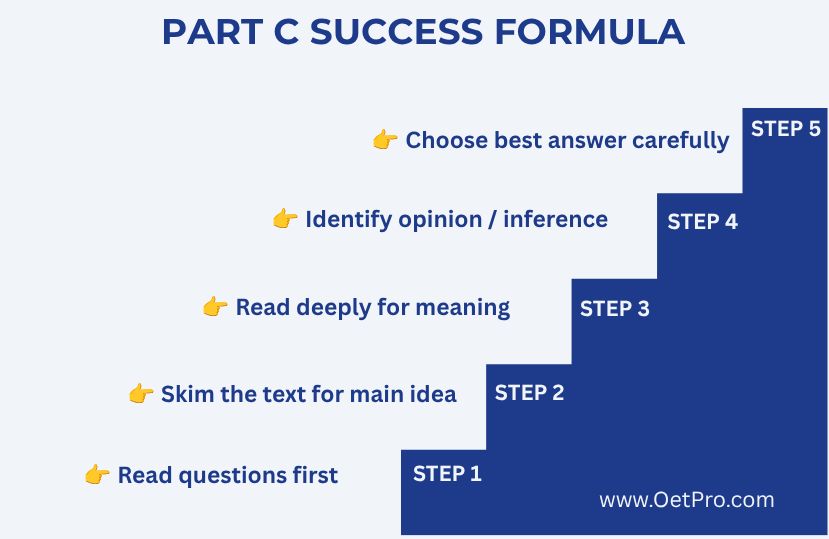
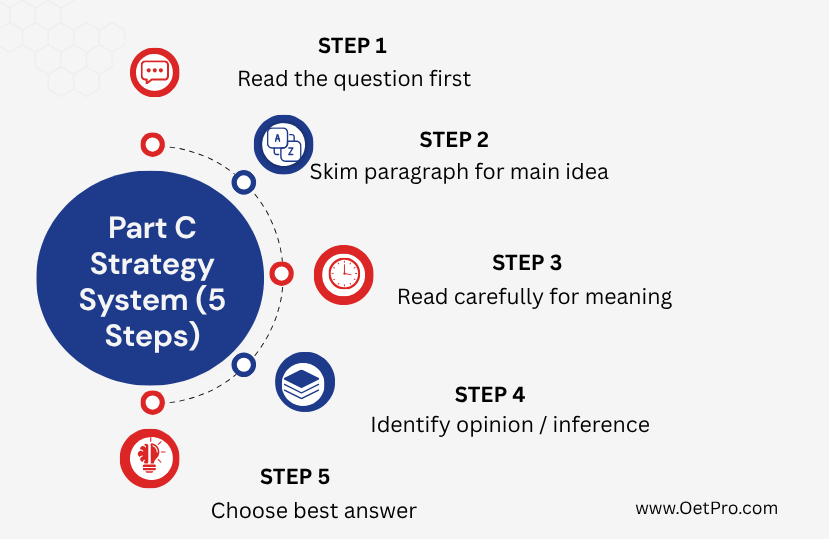
The 5-Step Part C Strategy System
Step 1 — Read the Questions First
Start with the MCQs before reading the passage in detail.
This helps you understand:
- What information you need
- Which parts of the passage are important
- What type of answer is expected (fact, inference, opinion)
This step gives direction and reduces confusion later.
Step 2 — Skim the Passage for Structure
Now quickly skim the passage, but do NOT read line by line.
Focus on:
- Main topic of each paragraph
- Headings or topic sentences
- Overall flow of ideas
Your goal is to understand “what each paragraph is about”
Step 3 — Locate Relevant Paragraphs
After skimming, go back to the question and identify where the answer might be located.
Look for:
- Keywords (not exact matches, but related ideas)
- Paragraph relevance
- Supporting ideas linked to the question
This helps you avoid reading unnecessary sections
Step 4 — Read for Meaning (Not Words)
Now carefully read only the relevant section.
Focus on:
- Meaning of sentences
- Writer’s intention
- Logical connection between ideas
Do not get stuck on difficult vocabulary
Step 5 — Match and Eliminate Options
Finally, compare answer choices with your understanding of the passage.
Use elimination by removing options that:
- Change the meaning of the passage
- Are not supported by the text
- Are partially correct but not fully accurate
- Contain extreme or absolute language
The correct answer is usually the most balanced and context-based option
Time Management Strategy
Part C requires strong time control because passages are long.
Smart Approach:
- Do not read full passage deeply at first
- Focus only on question-relevant sections
- Skip difficult questions temporarily
- Return if time allows
Balance between speed and understanding is key
Example Strategy Flow
Question:
“What is the main reason for the study mentioned in paragraph 3?”
Step 1:
Read question -> Focus on “main reason”
Step 2:
Skim passage -> Identify paragraph structure
Step 3:
Locate paragraph 3 -> Focus only there
Step 4:
Read meaning -> Understand purpose of study
Step 5:
Eliminate options -> Choose best match
This makes long passages manageable
Common Mistakes in Part C
Reading full passage in detail first
Leads to time waste and confusion.
Looking for exact keywords
Part C uses paraphrasing and indirect meaning.
Ignoring paragraph structure
Without structure, MCQs become unclear.
Overthinking options
Changing correct answers reduces score.
Spending too long on one question
Affects performance in remaining questions.
Advanced Examiner Insights, Inference Skills & Vocabulary (Part C)
Once you understand how to navigate long passages, the next challenge in Part C is dealing with inference-based questions and examiner-designed traps. This is the section where many students feel confused because the answers are not directly written in the text.
Part C is designed to test your ability to understand hidden meaning, writer intention, and logical connections between ideas. Before applying MCQ strategies in Part B, it is important to first develop general reading efficiency and structured scanning techniques. These form the base of all OET Reading success. The complete foundation system is covered in OET Reading Mastery 2026 Guide.
Examiner Trick 1 — Inference Trap
In Part C, answers are often not directly stated. Instead, you must understand what the text suggests, not what it explicitly says.
Example:
Text:
“The study suggests a possible link between stress and immune response.”
Question:
What can be inferred?
Correct idea:
Stress may affect immunity, but it is not confirmed.
Always look for “suggested meaning”, not direct statements
Examiner Trick 2 — Paraphrasing at Paragraph Level
In Part C, entire ideas are rewritten, not just single words.
What this means:
- One idea = multiple sentence forms
- Same meaning = different expression
- Paragraphs are restructured in options
You must understand the concept, not the wording
Examiner Trick 3 — Distractor Options (Partially Correct Answers)
Many answer choices in Part C are designed to look correct but are only partially true.
Types of traps:
- Option matches one sentence but not full paragraph
- Option is true but not relevant to question
- Option is too narrow or too broad
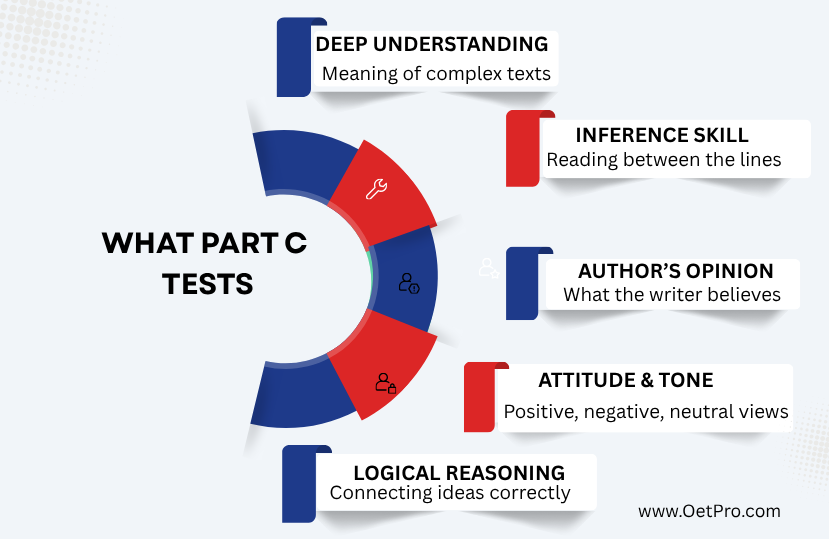
Always check if the option fully matches the question requirement
Vocabulary Insight (What You Really Need)
You do NOT need advanced vocabulary to succeed in Part C. However, you must understand academic medical language in context.
Important examples:
- “findings” -> results
- “suggests” -> indicates
- “significant” -> important/relevant
- “impact” -> effect
- “approach” -> method
Focus on meaning in context, not memorizing definitions
High-Score Thinking Pattern
Top candidates in Part C do not read passively. They actively think while reading.
Their habits include:
- Understanding paragraph purpose first
- Linking ideas between paragraphs
- Thinking about “why this is mentioned”
- Eliminating options logically
- Avoiding keyword-based guessing
They read like analysts, not readers
Common Student Mistakes
Taking sentences literally
Leads to wrong inference answers.
Ignoring paragraph relationships
Breaks understanding of overall meaning.
Matching keywords only
Part C rarely repeats exact words.
Overthinking complex vocabulary
Vocabulary is simpler than it looks in context.
Spending too long on one question
Reduces time for remaining questions.
Final Summary & Master Strategy
OET Reading Part C is the most advanced section of the OET Reading test. It is designed to check how well you can handle long academic passages, complex ideas, and inference-based questions.
Success in Part C does not depend on reading every word. It depends on how effectively you can understand structure, locate information, and interpret meaning under time pressure.
Complete Part C Strategy System
To perform well in Part C, you must follow a structured system instead of reading randomly. This approach helps you stay focused even when passages are long and complex.
1. Read the Questions First
Always begin with MCQs before reading the passage in detail. This gives you direction and reduces confusion later.
Focus on:
- What information is being asked
- Whether the question is about fact or inference
- Keywords that guide your reading
This step helps you read with purpose, not confusion
2. Skim the Passage for Structure
Next, quickly skim the passage to understand its structure. You should NOT read line by line.
Focus on:
- Main idea of each paragraph
- Topic sentences
- Flow of arguments or ideas
Your goal is to understand “what each section is about”
3. Locate Relevant Sections
After skimming, return to the question and identify where the answer is most likely located.
Focus on:
- Related ideas (not exact keywords)
- Paragraph relevance
- Supporting arguments in the text
This step prevents unnecessary reading
4. Read for Meaning, Not Words
Now carefully read only the relevant section. Avoid getting stuck on difficult vocabulary.
Focus on:
- Writer’s intention
- Logical meaning of sentences
- Connection between ideas
Understanding meaning is more important than word-by-word reading
5. Use Elimination Method
Compare options carefully and eliminate incorrect ones.
Remove options that:
- Change the meaning of the passage
- Are not fully supported by the text
- Are partially correct but incomplete
- Contain extreme or absolute language
The best answer is always fully supported by context
Time Management Rule
Time control is critical in Part C because passages are long and complex.
- Do not read full passage deeply in the first attempt
- Focus only on question-relevant areas
- Skip difficult questions and return later if time remains
Balance between and understanding is essential. Part B questions test your ability to understand meaning quickly without reading every line in detail. This requires fast reading habits and strong keyword recognition skills. These core techniques are explained in the OET Reading Mastery Skimming and Scanning Framework.
Final Checklist Before Exam
Reading Skills Checklist
- I can identify main ideas of long passages
- I can understand paragraph structure quickly
- I can interpret meaning instead of reading word-by-word
MCQ Strategy Checklist
- I read questions before passages
- I locate relevant sections efficiently
- I use elimination to remove wrong options
Exam Behavior Checklist
- I manage time effectively
- I do not overthink answers
- I stay focused under pressure
7-Day Practice Plan
Days 1–2: Passage Understanding
- Read academic medical articles
- Identify paragraph main ideas
- Focus on structure
Days 3–4: Inference Practice
- Solve inference-based questions
- Focus on meaning, not keywords
Day 5: Mixed Practice
- Combine reading + MCQs
- Improve accuracy
Day 6: Timed Test
- Simulate real exam conditions
- Practice full passages under time limit
Day 7: Review & Correction
- Analyze mistakes
- Repeat weak areas
- Improve strategy execution
Many mistakes in Part B happen because students cannot filter important information quickly from workplace texts. Strengthening your reading foundation solves this issue effectively. You can learn this improvement system in the OET Reading Mastery High Score Strategy Guide.
Final Conclusion
OET Reading Part C requires advanced comprehension skills. If you apply the correct system, even long passages become manageable.
The key to success is:
- Understanding structure
- Finding relevant information
- Interpreting meaning correctly