OET Reading Part B Strategy (2026): Workplace Text MCQ Techniques for High Scores
Introduction
OET Reading Part B is often underestimated by students because the texts are short and look simple. However, this section is designed to test something very specific:
Your ability to understand workplace communication quickly and accurately.
Unlike Part A, which focuses on scanning for details, Part B focuses on:
- Meaning
- Purpose
- Intention behind the text
Most candidates lose marks here because they try to read every word instead of focusing on why the text is written.
This lesson will teach you a clear strategy to handle Part B MCQs with confidence and accuracy.
Learning Objectives
By the end of this lesson, you will be able to:
- Understand the format of OET Reading Part B
- Identify purpose of workplace texts quickly
- Use skimming to understand meaning
- Apply elimination techniques in MCQs
- Avoid common traps in answer choices
- Improve accuracy under exam pressure
- Develop a structured solving approach
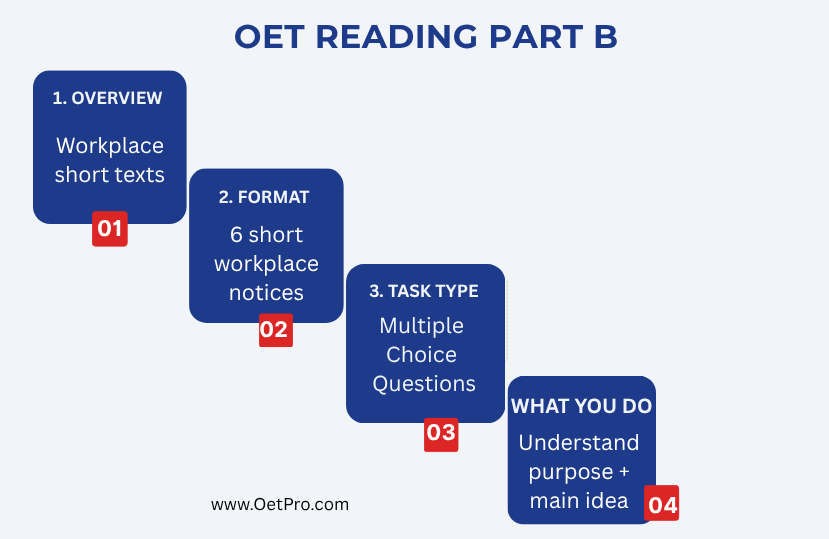
Overview of OET Reading Part B
Part B is based on short workplace texts commonly found in healthcare environments.
What you will see:
- Emails between staff
- Hospital notices
- Internal guidelines
- Short instructions or memos
What you must do:
- Answer multiple-choice questions (s)
- Identify correct meaning or purpose
- Choose best option based on context
To answer workplace-based MCQs in Part B, you first need strong skimming and scanning skills. These core reading techniques are explained in detail in OET Reading Mastery 2026 Complete Guide to Skimming & Scanning.
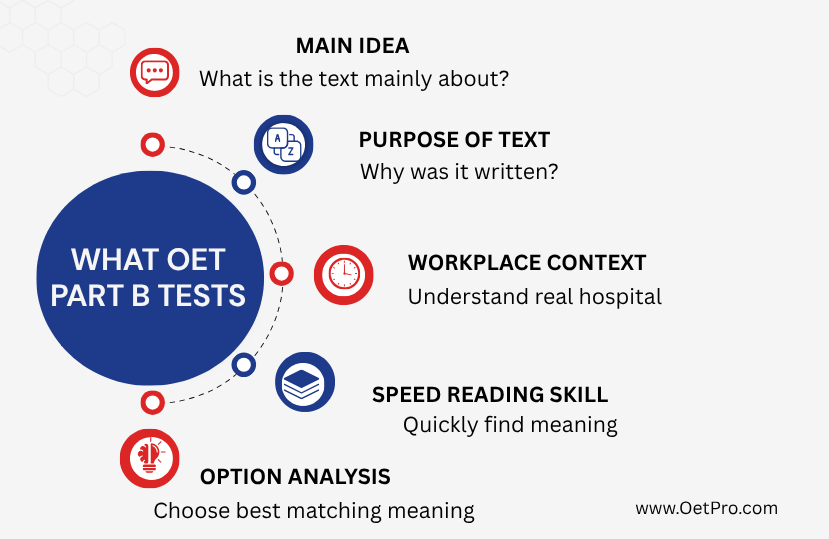
Key skill tested:
Understanding communication purpose and meaning
Core Challenge in Part B
Part B looks easy, but it is tricky because:
- All options look similar
- Answers are paraphrased
- Meaning is hidden in context
- Distractor options are very close
This is where most students lose marks
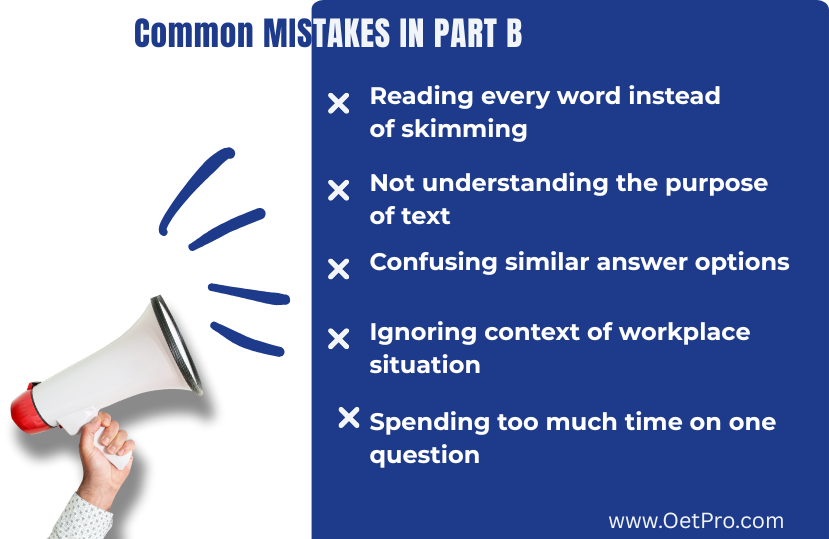
Common Mistakes in Part B
Reading without understanding purpose
Students read text but don’t ask: “Why is this written?”
Choosing keyword-based answers
Matching words instead of meaning leads to wrong answers.
Not reading questions carefully
Missing key focus of MCQ question.
Overthinking options
Changing correct answers due to doubt.
Ignoring context
Not understanding workplace communication tone.
Step-by-Step MCQ Framework (Part B)
OET Reading Part B is not about reading fast or reading more. It is about understanding meaning quickly and selecting the best answer with logic.
In this section, you will see short workplace texts like emails, notices, or instructions. Each text is followed by MCQ questions. The challenge is that all options look similar, so you must use a clear system instead of guessing. In Part B, many students lose marks because they focus too much on details instead of quickly identifying the main idea. Building strong reading efficiency solves this problem effectively. For complete training on reading efficiency, refer to OET Reading Mastery 2026 Skimming & Scanning Guide.
The 4-Step Part B Strategy System
To solve Part B efficiently, follow this structured method. This system helps you reduce confusion and improve accuracy under time pressure.
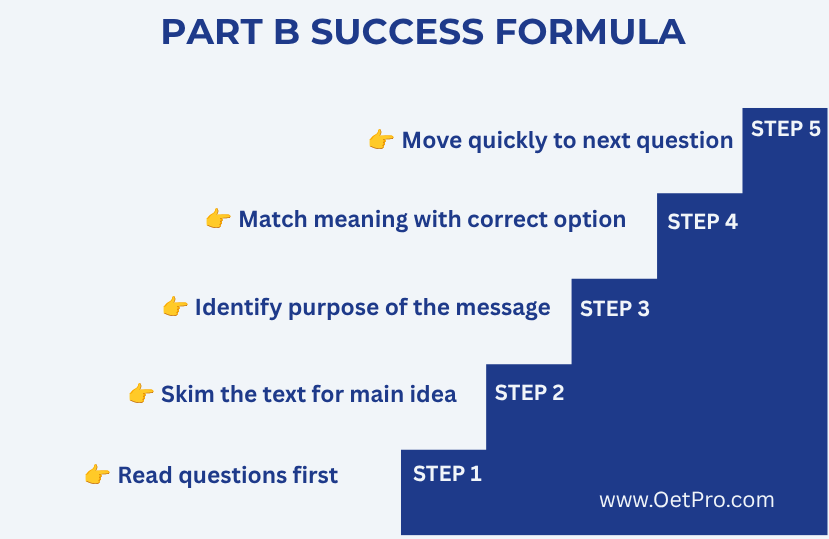
Step 1 — Read the Question First
Before reading the text, always start with the question. This gives you direction and saves time.
When you read the question, focus on:
- What is being asked (purpose, meaning, intention)
- Key keywords in the question
- Any specific focus (e.g., “main reason”, “purpose”, “suggestion”)
This step tells your brain what information to search for.
Step 2 — Skim the Workplace Text
Now quickly skim the text to understand the overall message. Do NOT read every line in detail.
Skimming helps you identify:
- General purpose of the message
- Tone (instruction, request, update, warning)
- Who is communicating and why
The goal is simple: understand “what is happening” in the text, not every detail.
Step 3 — Match Meaning with Options
After skimming, go to the answer choices and start comparing meaning.
Important point:
OET Part B does NOT test exact words it tests understanding of meaning and intent.
Look for:
- Which option best matches the purpose
- Which option fits the situation logically
- Which option reflects the correct tone of communication
Do not choose answers just because they contain similar words.
Step 4 — Use Elimination Method
This is one of the most powerful techniques in Part B.
Instead of trying to find the correct answer directly, remove wrong options first.
You should eliminate options that:
- Change the meaning of the text
- Are too extreme (always, never, must, only)
- Do not match the workplace context
- Look similar but don’t match intent
After elimination, the correct answer becomes much clearer.
Time Management Strategy
Time control is very important in Part B because students often overthink MCQs.
- Do not spend too long on one question
- If confused, eliminate and move forward
- Return only if time is left
Speed + accuracy must be balanced, not speed alone. Part B questions test how fast and accurately you can understand workplace information without reading every word in detail. This is only possible if your skimming and scanning ability is strong. These essential skills are explained in the OET Reading Mastery Strategy for High Score Reading Performance.
Example Flow (How It Works in Exam)
Let’s understand how this system works in real exam conditions:
Question: “What is the purpose of this email?”
- Step 1: Read question -> focus on “purpose”
- Step 2: Skim email -> identify tone (e.g., update or instruction)
- Step 3: Compare options -> match meaning, not words
- Step 4: Eliminate wrong answers -> choose best fit
This process is fast and structured, not random reading.
Advanced Examiner Insights, Vocabulary & Trap Patterns
Once you understand how to solve Part B MCQs using the basic framework, the next step is to understand how examiners intentionally design traps. This is what separates average candidates from high scorers.
Part B is not difficult in terms of language, but it is designed to test how well you understand meaning, intention, and workplace communication logic.
Examiner Trick 1 — Paraphrasing Trap (Most Common)
In OET Reading Part B, answers are rarely written using the same words as the passage. Instead, examiners rewrite ideas using synonyms and different structures.
What this means:
- Same meaning
- Different words
- Different sentence structure
Example:
Text:
“Staff must complete the report before leaving the shift.”
Option:
- “Employees are required to finish documentation prior to ending duty”
The meaning is identical, but wording is changed
Examiner Trick 2 — Purpose Confusion
Many questions in Part B ask about the purpose of a message, but answer options are designed to confuse you with similar intentions.
Common trap options include:
- Partially correct purpose
- Too general meaning
- Slightly incorrect intention
Always ask: “Why was this written in a workplace setting?”
Examiner Trick 3 — Extreme Language Distractors
Examiners often include options with strong or absolute words to mislead candidates.
Be careful with:
- always
- never
- only
- must
Even if the idea sounds correct, extreme language often makes the option wrong.
Vocabulary Insight (What You Really Need)
You do NOT need advanced vocabulary for Part B. You only need to understand common workplace communication terms used in healthcare settings.
Key vocabulary examples:
- notify -> inform
- update -> new information
- procedure -> process
- guidelines -> instructions
- urgent -> immediate importance
Focus on meaning, not memorization
High-Score Strategy Pattern
Top-performing candidates in Part B follow a simple approach:
- Identify purpose first
- Focus on meaning, not keywords
- Eliminate wrong options quickly
- Stay calm under time pressure
- Avoid overthinking similar choices
Before applying MCQ solving techniques in workplace texts, you must first develop fast reading habits and keyword recognition skills. These form the base of all OET Reading success. You can study this complete foundation system in the OET Reading Mastery High Score Framework.
Common Student Mistakes
Matching keywords only
This leads to wrong answers because OET uses paraphrasing.
Ignoring communication purpose
Students forget to ask: “Why was this written?”
Overthinking options
Changing correct answers due to doubt reduces score.
Reading word-by-word
Slows down performance and causes confusion.
Final Summary & Master Strategy
OET Reading Part B is designed to test how well you understand workplace communication in real healthcare settings. It is not a test of difficult grammar or advanced vocabulary. Instead, it focuses on your ability to quickly understand meaning, purpose, and intent.
If you apply the correct strategy, Part B becomes a highly scoring section because the texts are short and structured. The real challenge is not reading — it is choosing the correct meaning under pressure.
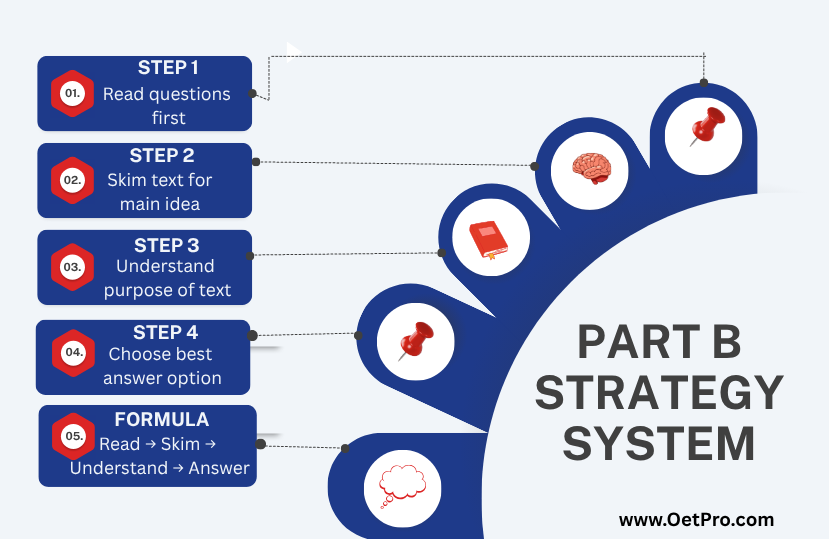
Complete Part B Strategy System
To consistently score high in Part B, you must follow a structured approach instead of random reading. This system helps you stay focused and avoid confusion in MCQs.
1. Read the Question First
Start by reading the question before the text. This gives you direction and helps you understand what you are looking for.
Focus on:
- What the question is asking (purpose, meaning, intention)
- Key keywords in the question
- Whether it requires overall meaning or specific detail
This step ensures your reading is focused and not wasted on unnecessary details.
2. Skim the Workplace Text
Next, quickly skim the text to understand the overall message. You do not need to read every sentence in detail.
When skimming, focus on:
- General purpose of the message
- Tone (instruction, update, request, warning)
- Overall context of workplace communication
The goal is to understand “why this message exists” in simple terms.
3. Match Meaning with Options
After skimming, move to the answer choices and compare them with the passage. This is where many students make mistakes by focusing on keywords instead of meaning.
Focus on:
- Which option best matches the purpose of the text
- Which option reflects correct workplace intention
- Which option fits the overall meaning logically
Always prioritize meaning over exact word matching because OET uses paraphrasing heavily.
4. Use Elimination Method
Elimination is one of the most powerful tools in Part B. Instead of trying to find the correct answer directly, remove wrong options first.
You should eliminate options that:
- Change the meaning of the original text
- Use extreme language (always, never, only, must)
- Do not match the workplace context
- Look similar but differ in intention
After elimination, the correct answer becomes much easier to identify.
Time Management Rule
Time control is very important in Part B because students often overthink MCQs.
- Do not spend too long on a single question
- If unsure, eliminate and move forward
- Return only if time is available
The goal is to maintain both speed and accuracy, not perfection on every question.
Final Checklist Before Exam
Before attempting Part B in the exam, ensure you are confident in both strategy and execution.
Reading Skills Checklist
- I can identify the purpose of workplace texts quickly
- I understand paraphrased meanings
- I avoid keyword-based guessing
MCQ Strategy Checklist
- I read the question before the text
- I use elimination to remove wrong options
- I focus on meaning, not exact words
Exam Behavior Checklist
- I do not overthink answers
- I manage time efficiently
- I stay calm under pressure
7-Day Practice Plan
To master Part B, follow a structured weekly practice routine.
Days 1–2: Understanding Practice
- Read workplace emails and notices
- Identify purpose of each message
- Focus on tone and intent
Days 3–4: MCQ Practice
- Solve Part B-style MCQs
- Practice elimination method
- Focus on paraphrased answers
Day 5: Mixed Practice
- Combine reading and MCQs
- Focus on accuracy over speed
Day 6: Timed Practice Test
- Simulate real exam conditions
- Manage time strictly
Day 7: Review and Improvement
- Analyze mistakes
- Identify weak question types
- Re-practice difficult areas
Final Conclusion
Success in OET Reading Part B depends on your ability to understand meaning and purpose quickly, not just reading speed.
If you consistently apply this system:
- Your accuracy improves
- Your confusion reduces
- Your confidence increases in exam conditions