OET Speaking Phrases: High-Scoring Clinical Communication Language for Nurses & Doctors
Introduction
In OET Speaking, most candidates assume the main challenge is finding the “right answers” during role plays. In reality, the real difficulty is expressing medical ideas in a structured, clear, and natural clinical way.
Many candidates already understand basic medical concepts such as diabetes, asthma, infection, or medication advice. However, when they enter the speaking test, they struggle to convert this knowledge into smooth, professional communication. As a result, their responses become either too simple or unnecessarily complex.
The key issue is not knowledge. It is communication control.
OET does not reward memorized or complicated language. It rewards clear, structured, and patient-centered communication that reflects real healthcare interactions.
Learning Objectives
By the end of this lesson, you will be able to use clinical communication phrases confidently and naturally in OET Speaking role plays. This will help you sound more professional, structured, and patient-focused.
You will learn to:
- Use high-scoring clinical phrases in real-time speaking
- Communicate like a healthcare professional, not a language learner
- Build structured sentences without memorization
- Improve clarity, empathy, and fluency together
- Avoid unnatural or translated expressions
- Develop a reusable phrase system for any OET scenario
Overview of Clinical Communication in OET
OET Speaking is not random conversation. It follows a predictable communication structure that reflects real healthcare interactions.
Every role play generally moves through five communication zones, and each zone requires a different type of language. Understanding this structure is essential because your phrases must match the purpose of each stage.
These zones include:
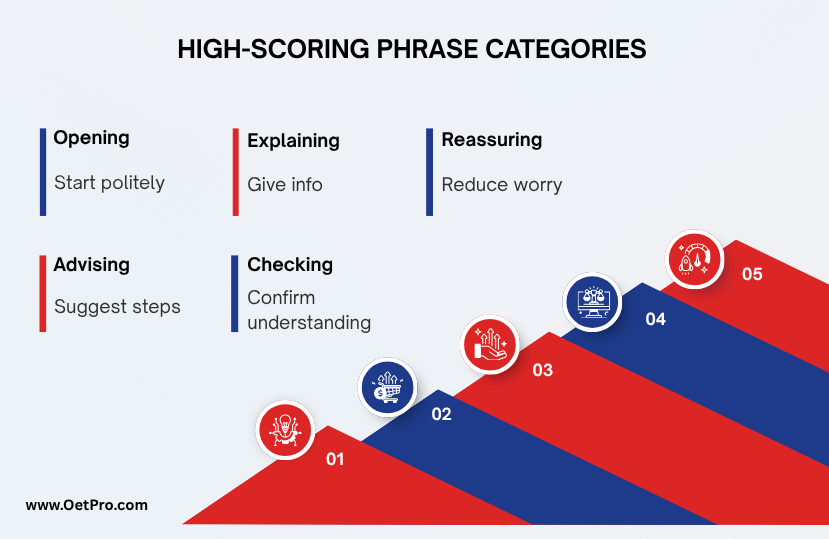
- Opening the conversation
- Explaining medical information
- Showing empathy and reassurance
- Giving advice or instructions
- Closing the interaction professionally
Instead of thinking in isolated sentences, strong candidates use communication patterns that fit each stage of the conversation. To fully understand how these phrases fit into a complete role play strategy, read our detailed guide on OET Speaking Mastery: Role Play Strategies for Clinical Communication (Band A Success System)
The core idea is simple:
You don’t need more vocabulary you need better communication patterns.
Why Most Candidates Struggle
Even candidates with strong grammar and vocabulary often perform poorly in OET Speaking because they lack clinical communication control.
The most common reasons include:
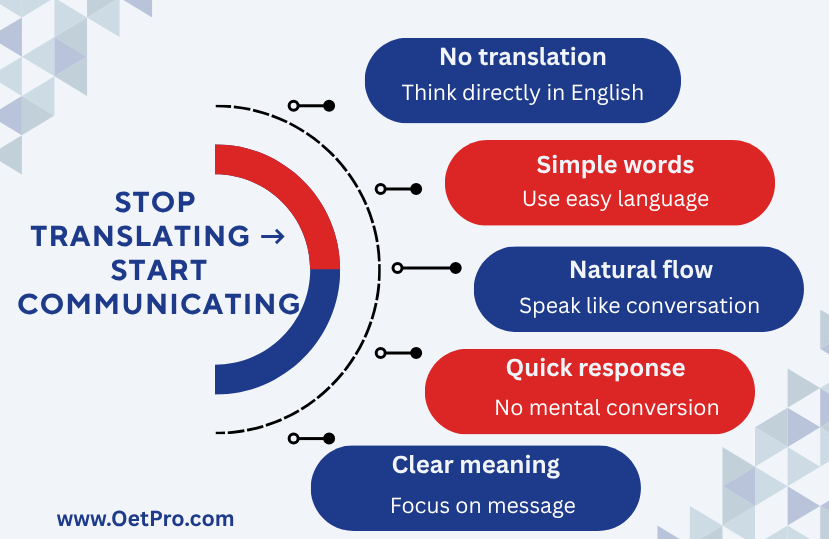
- They translate directly from their native language instead of thinking in English patterns
- They speak without structure, leading to unclear responses
- They use overly simple or overly complex language without balance
- They focus on information but ignore emotional communication
- They sound like students instead of healthcare professionals
This creates a gap between knowing English and using English effectively in clinical situations.These clinical phrases become powerful only when used within a structured system—learn the full framework in OET Speaking Mastery: Role Play Strategies for Clinical Communication (Band A Success System)
Common Mistakes in OET Speaking Language
Understanding mistakes is the fastest way to improve performance.
1. Overcomplicated Language
Many candidates try to sound professional by using complex words, but this reduces clarity.
- “Your condition indicates pathological elevation in glucose levels.”
- “Your blood sugar levels are higher than normal.”
Clear communication always scores higher than complex wording.
2. Direct Translation from Native Language
Some sentences sound unnatural because they are translated word-for-word.
- “You don’t take tension about this.”
- “There is no need to worry about this.”
Natural English structure is essential for clinical clarity.
3. Lack of Emotional Communication
Candidates often focus only on medical facts and forget patient emotions. This weakens empathy scoring.
You must always balance:
- Medical explanation + emotional reassurance
4. Memorized Sentences
Examiners can easily identify rehearsed responses because they sound robotic and inflexible.
Signs include:
- Flat delivery
- No interaction with patient
- No adaptation to situation
5. No Clear Communication Purpose
Many candidates speak without knowing the purpose of their sentence, which leads to confusion.
Every sentence should serve a function such as:
- Informing
- Reassuring
- Guiding
- Clarifying
- Supporting
If a sentence does not serve a purpose, it reduces effectiveness. If you want to see how these phrases are applied step-by-step in real role plays, check OET Speaking Mastery: Role Play Strategies for Clinical Communication (Band A Success System)
Core Principle of This Lesson
The foundation of high-scoring OET Speaking is not vocabulary size or grammar perfection. It is purpose-driven communication.
Every phrase you use must contribute to one of the following goals:
- Inform the patient
- Reassure the patient
- Guide the patient
- Clarify information
- Support decision-making
If your language does not serve a purpose, it does not help your score.
Communication Zones You Will Master
In this lesson series, we will build a structured phrase system for each stage of OET Speaking:
- Opening communication (starting naturally and professionally)
- Explanation language (describing medical conditions simply)
- Empathy language (showing understanding and reassurance)
- Instruction language (giving clear medical advice)
- Closing language (ending the interaction professionally)
Each zone will include practical, exam-ready phrases that you can apply immediately in role plays.
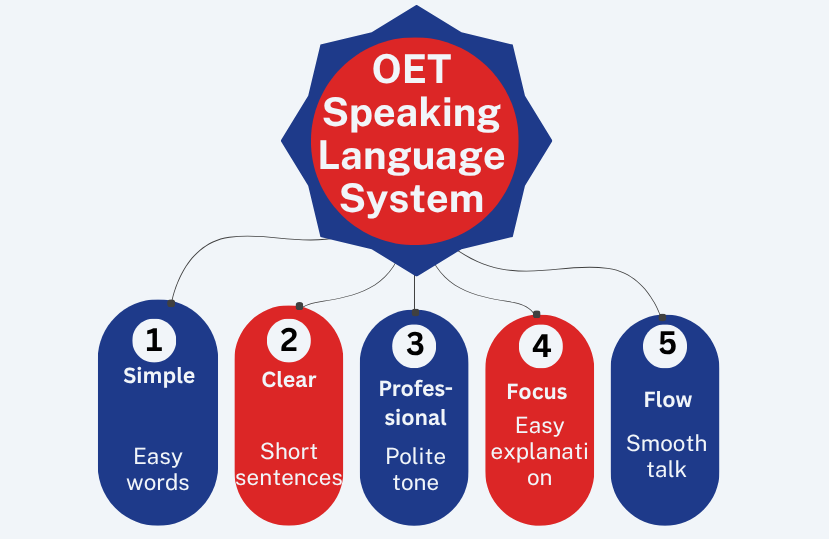
Foundation Mindset Shift
To improve your OET Speaking score, you must change how you think during the exam.
Instead of asking:
- “What English sentence should I use?”
Start asking:
- “What is my communication purpose right now?”
This shift immediately improves:
- Clarity
- Confidence
- Fluency
- Examiner impression
Opening Communication (How to Start Like a Healthcare Professional)
The opening of an OET role play is your first impression moment. Many candidates lose marks here because they either start too abruptly or sound unnatural. In real clinical settings, the opening should always feel calm, structured, and reassuring.
Your goal in the opening is simple:
- Build trust
- Introduce yourself clearly
- Set a comfortable tone
You are not jumping into medical details immediately. You are first establishing a human connection.
High-Scoring Opening Phrases
Use these naturally based on the situation:
- “Good morning, I’m here to help you today.”
- “Hello, I’m Nurse/Doctor ____. I understand you’ve been feeling unwell.”
- “Let’s talk about what’s been going on.”
- “I’d like to understand your situation better and help you.”
These openings work because they are:
- Simple
- Professional
- Patient-focused
Opening Structure Pattern
A strong opening usually follows this flow:
- Greeting
- Introduction
- Emotional acknowledgment
- Transition into purpose
Example:
“Good morning, I’m Dr. Ali. I understand you’ve been experiencing some discomfort. Let’s talk about it so I can help you better.” Master how to combine phrases with patient interaction and scoring strategies in OET Speaking Mastery: Role Play Strategies for Clinical Communication (Band A Success System)
Explanation Language (Making Medical Information Simple)
This is the most important scoring zone in OET Speaking. Many candidates fail here because they either use too complex language or explain in a confusing way.
Your goal is not to sound advanced. Your goal is to make the patient understand easily.
High-Scoring Explanation Phrases
- “This means that…”
- “In simple terms…”
- “What this condition involves is…”
- “Let me explain this in an easy way…”
- “Basically, your body is…”
These phrases help you:
- Slow down your explanation
- Structure your ideas
- Improve clarity instantly
Example 1 — Diabetes Explanation
Instead of:
“You have metabolic dysfunction affecting glucose regulation.”
Say:
“This means your blood sugar levels are higher than normal, and your body is not using sugar properly.”
Example 2 — Infection Explanation
“In simple terms, this is an infection caused by bacteria. It means your body is reacting to harmful germs.”
Explanation Structure Pattern
A strong explanation should follow:
- Simple definition
- Cause or reason
- Impact on the body
- Reassurance or next step
Empathy Integration (Natural Clinical Communication)
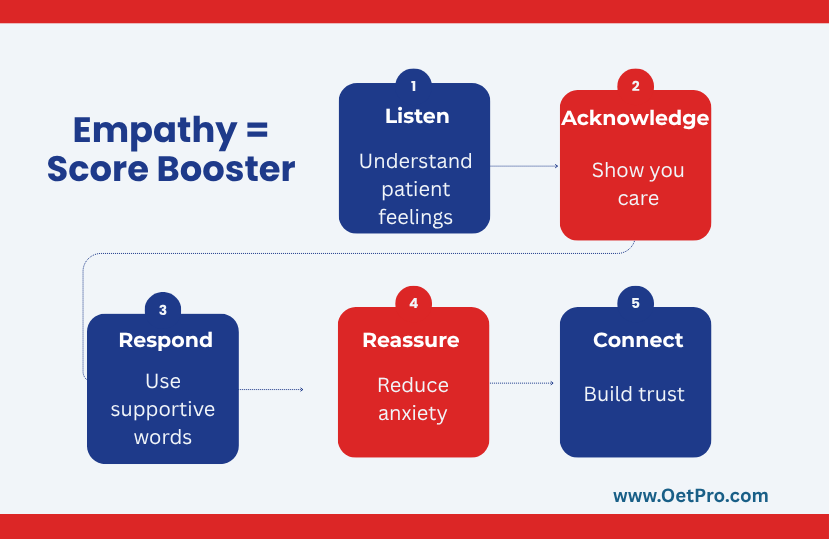
Empathy is not a separate sentence. It must be blended into your explanation.
High-Scoring Empathy Phrases
- “I understand this might be worrying for you.”
- “It’s completely normal to feel this way.”
- “Many patients feel the same initially.”
- “I can see why you’re concerned.”
Example — Integrated Communication
“Your blood pressure is slightly high. I understand this might be worrying, but the good news is that it can be managed very effectively with lifestyle changes and medication.”
This works because:
- Information is clear
- Emotion is acknowledged
- Reassurance is included
Instruction Language (Giving Advice Clearly)
Instructions must be simple, direct, and professional. Avoid over-explaining or sounding like a textbook.
High-Scoring Instruction Phrases
- “I would recommend that you…”
- “It is important to…”
- “You should try to…”
- “It would be helpful if you could…”
- “The next step is to…”
Example — Lifestyle Advice
“I would recommend that you reduce salt in your diet and try to exercise regularly.”
“It would be helpful if you could take your medication at the same time every day.”
Full Role Play Mini Simulation
Scenario: Patient diagnosed with high blood pressure and anxious
Opening
“Good morning, I’m Nurse Priya. I understand you’ve recently been diagnosed with high blood pressure. Let’s talk about it so I can help you understand it better.”
Explanation
“Your blood pressure is higher than normal. This means your heart is working harder than it should. In simple terms, it is a condition that can be managed with proper care.”
Empathy Integration
“I understand this might be worrying for you, but many people manage this condition very well with the right treatment.”
Advice
“I would recommend that you reduce salt in your diet and try to stay physically active.”
Transition to Next Step
“We will monitor your condition regularly and adjust treatment if needed.” Learn how to structure your entire role play (from opening to closing) using a proven Band A framework in OET Speaking Mastery: Role Play Strategies for Clinical Communication (Band A Success System)
Closing Communication (How to End Like a Professional)
The closing of an OET Speaking role play is often ignored, but it has a strong impact on your final impression. A weak closing makes even a good conversation feel incomplete.
Your goal in closing is simple:
- Summarize clearly
- Reassure the patient
- Provide next steps
- End professionally
You should never stop suddenly or leave the conversation unfinished. In real clinical practice, closure is part of patient safety and clarity.
High-Scoring Closing Phrases
Use these naturally:
- “To summarize what we discussed…”
- “Let me quickly go over the main points…”
- “The next step will be…”
- “We will continue to monitor your condition…”
- “Please feel free to contact us if you have any concerns.”
Example Closing Structure
A strong closing usually follows this flow:
- Brief summary
- Clear next steps
- Reassurance
- Open invitation for questions
Example:
“To summarize, your condition is manageable with medication and lifestyle changes. We will monitor your progress regularly. If you have any concerns, please don’t hesitate to reach out.”
Advanced Clinical Communication Patterns
At this level, you are not just using phrases you are controlling the conversation flow like a healthcare professional.
1. Information + Emotion Balance
High scorers never give information alone. They always combine it with emotional awareness.
Example:
“This condition is manageable with treatment, and I understand it may feel overwhelming at first.”
This shows:
- Clinical clarity
- Emotional intelligence
- Patient-centered communication
2. Chunking Information
Instead of long explanations, break information into small parts.
Example:
“There are three important things we need to focus on. First is medication. Second is lifestyle changes. Third is regular monitoring.”
This improves:
- Clarity
- Memory retention for patient
- Examiner impression
3. Guided Conversation Control
You should always guide the patient through the conversation.
Use phrases like:
- “Let me explain this step by step…”
- “There are a few important points here…”
- “First, I’ll explain the condition…”
This shows structure and leadership in communication. These advanced phrases work best when combined with a complete communication system explore OET Speaking Mastery: Role Play Strategies for Clinical Communication (Band A Success System)
4. Softening Medical Information
Medical communication must be clear but not alarming.
Instead of:
“This is serious.”
Say:
“This is something we need to manage carefully, but it is very treatable.”
This reduces patient anxiety and increases empathy score.
Examiner Simulation Insight (How You Are Really Evaluated)
Examiners are not judging your grammar alone. They are observing your communication behavior in a clinical setting.
They focus on:
- Do you sound natural or memorized?
- Are you guiding or confusing the patient?
- Is the patient emotionally supported?
- Is the conversation structured and logical?
What High-Scoring Candidates Do Differently
They consistently:
- Use simple, clear language
- Maintain conversation structure
- Show empathy naturally
- Avoid overloading information
- Keep patient interaction active
What Low-Scoring Candidates Do
- Speak too fast or too much
- Ignore emotional cues
- Use memorized sentences
- Lack clear structure
- End abruptly
Full Advanced Role Play Simulation
Scenario: Patient worried about medication side effects
Opening
“Good morning, I’m Dr. Ali. I understand you have concerns about starting this medication. Let’s talk about it.”
Explanation
“This medication helps control your condition and prevents it from getting worse. In simple terms, it supports your body’s healing process.”
Empathy Integration
“I understand your concern about side effects. It’s very common for patients to feel this way at the beginning.”
Information Control
“There are some mild side effects, but most patients tolerate this medication very well.”
Patient Involvement
“Have you heard something specific that is worrying you about this medication?”
Reassurance
“We can start with a low dose and monitor how your body responds. We will adjust if needed.”
Closing
“To summarize, we will start the medication carefully and monitor your progress. If you have any concerns, please feel free to contact us anytime.”
Summary (What This Lesson Really Teaches)
OET Speaking is not about memorizing sentences. It is about building a controlled communication system that works in any clinical situation.
In this module, you learned that every strong response is built on purpose-driven language, not vocabulary complexity.
Instead of thinking “What sentence should I say?”, you should now think:
“What is my communication goal right now?”
That single shift improves clarity, fluency, and examiner perception instantly.
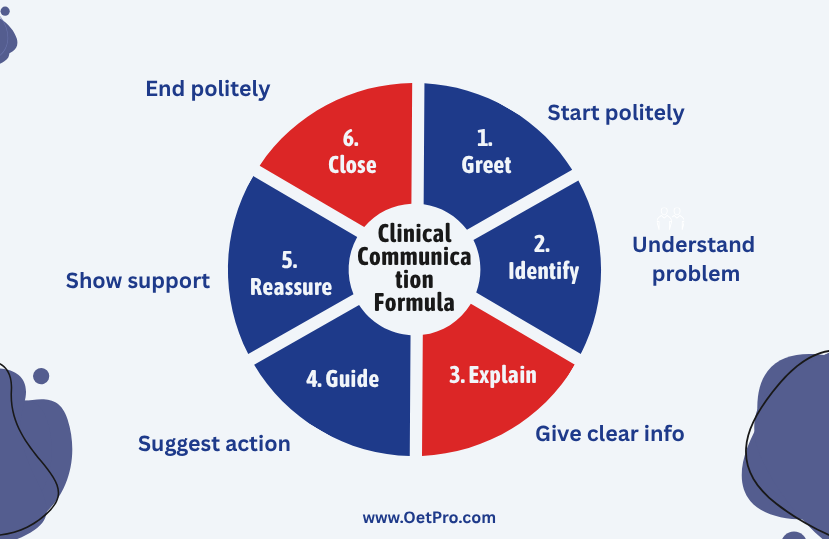
Core Structure You Now Master
Every high-scoring response follows this communication flow:
- Opening -> Build trust
- Explanation -> Make medical information simple
- Empathy -> Acknowledge patient emotion
- Instruction -> Give clear guidance
- Closing -> Summarize and end professionally
This is your clinical communication blueprint.
Final Clinical Language Checklist
Before and during every role play, mentally check:
Opening Phase
- Did I greet the patient naturally?
- Did I introduce myself clearly?
- Did I set a calm tone?
Explanation Phase
- Am I using simple language?
- Did I avoid medical complexity?
- Did I break information into clear parts?
Empathy Phase
- Did I acknowledge patient feelings?
- Did I avoid sounding robotic?
- Did I reassure without overpromising?
Instruction Phase
- Are my instructions clear and direct?
- Did I avoid confusion or long sentences?
- Did I guide the patient properly?
Closing Phase
- Did I summarize key points?
- Did I explain next steps clearly?
- Did I end professionally?
Common Mistakes to Avoid (Final Warning System)
Even after learning phrases, candidates still lose marks due to:
1. Memorized Sentences
They sound unnatural and reduce flexibility.
2. Over-Complicated Language
Complex vocabulary reduces clarity and patient understanding.
3. No Emotional Awareness
Ignoring patient fear or anxiety reduces empathy score.
4. No Communication Flow
Jumping between ideas without structure confuses the examiner.
5. Mechanical Speaking
Sounding robotic instead of natural clinical interaction.
To turn these phrases into a high-scoring performance, follow the full role play strategy system in OET Speaking Mastery: Role Play Strategies for Clinical Communication (Band A Success System)
Frequently Asked Questions (Exam-Focused)
1. Do I need advanced English for OET Speaking?
No. You need clear, structured, and patient-friendly communication, not advanced vocabulary.
2. Can I use simple English and still get Grade B?
Yes. In fact, simple English with correct structure scores higher than complex but unclear language.
3. How important is empathy in OET Speaking?
Very important. Empathy directly impacts your clinical communication score, which is a major scoring area.
4. Should I memorize phrases?
No. You should understand patterns, not memorize sentences. Flexibility is key.
5. What is the biggest mistake candidates make?
They focus on speaking English instead of focusing on communicating effectively with the patient.
7-Day Practice Plan (Application System)
This plan helps convert knowledge into performance.
Day 1–2: Phrase Familiarity
- Practice opening, explanation, empathy phrases
- Focus on natural tone, not memorization
- Read aloud clinical communication examples
Day 3–4: Structured Speaking Practice
- Practice full role plays
- Use all 5 communication zones
- Focus on flow, not speed
Day 5: Empathy Integration Training
- Add emotional responses in every sentence
- Practice reassurance language
- Avoid robotic speech
Day 6: Real Exam Simulation
- Timed role plays (5 minutes)
- No stopping or correcting
- Full structure application
Day 7: Review & Correction
- Identify weak areas
- Fix clarity issues
- Improve sentence simplicity
Final Performance Mindset
Stop thinking like a language learner.
Start thinking like a healthcare professional.
Your goal is not:
- Perfect English
Your goal is:
- Safe communication
- Clear understanding
- Patient reassurance
When you achieve this mindset shift, your score improves naturally.