OET Listening Part A Mastery (2026): Notes, Structure & High-Score Strategy for Healthcare Professionals
OET Listening Part A is where your exam truly begins.
This is not just a listening test. It is a real-time clinical communication task.
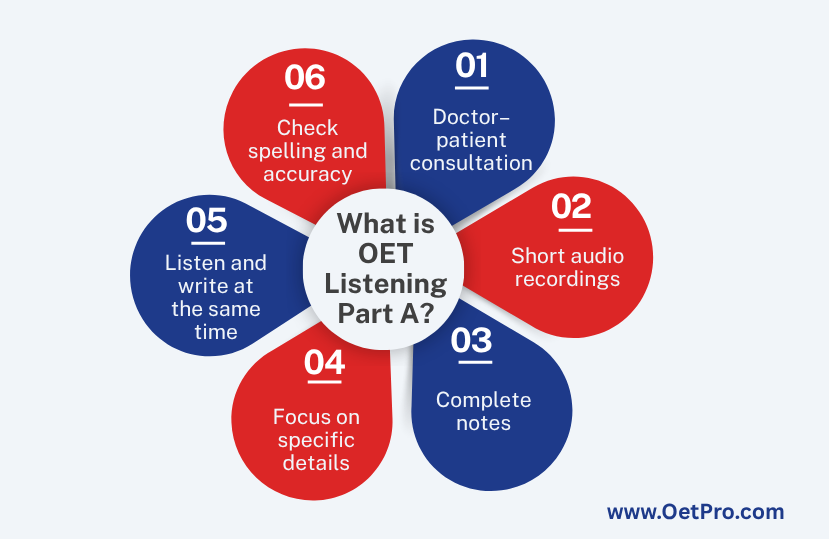
You will listen to two healthcare consultations between a professional and a patient. Your job is to capture key medical information accurately while the conversation is happening.
- There is no pause.
- No repetition.
- No second chance.
Many healthcare professionals find this part challenging not because of English, but because of speed, attention, and note-taking under pressure. OET Listening Part A focuses on note completion, but your overall score depends on how well you perform across all three parts of the listening test. A complete strategy is essential for success. You can understand this full system in OET Listening Mastery: Complete Guide to Part A, B & C for Healthcare Professionals.
In real life, you already do this:
- You listen to patients
- You identify symptoms
- You record notes
OET simply tests this ability in a structured format.
This lesson will help you convert your real-world medical listening skills into exam success.
Learning Objectives
By the end of this lesson, you will be able to:
- Understand the exact format of OET Listening Part A
- Identify what information examiners are testing
- Apply a structured note-taking approach
- Improve speed and accuracy while listening
- Avoid common mistakes that reduce your score
- Build confidence for real exam conditions
Key Features
- 2 separate consultations
- 24 questions total (12 each)
- Note-completion format
- You fill in missing words or short phrases
- Audio is played only once
- You hear realistic healthcare conversations
To perform well in Part A, you need strong note-taking skills, but these skills are part of a larger listening framework used across all OET Listening sections.
This complete framework is explained in OET Listening Mastery Complete Strategy Guide.
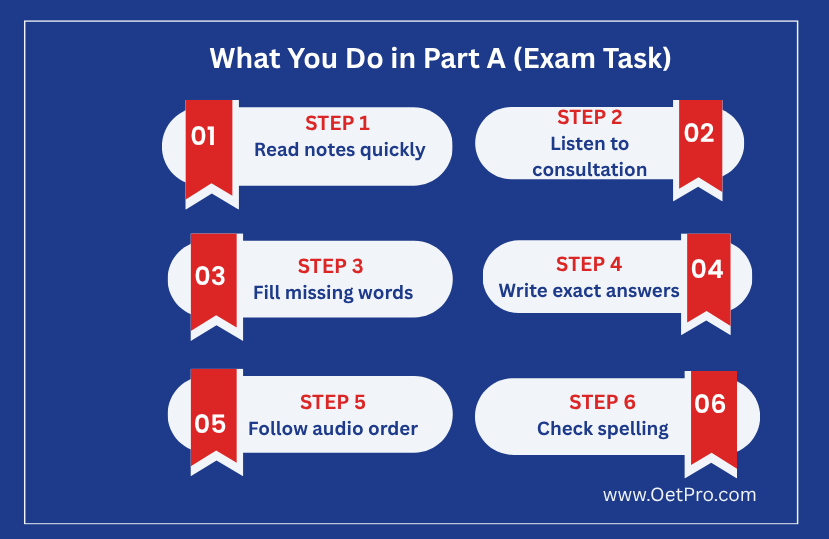
What You Actually Do in the Exam
You will see:
- A set of structured medical notes
- With gaps/blanks
While listening, you must:
- Identify specific details
- Write accurate answers
- Follow word limits
What Skills Are Being Tested
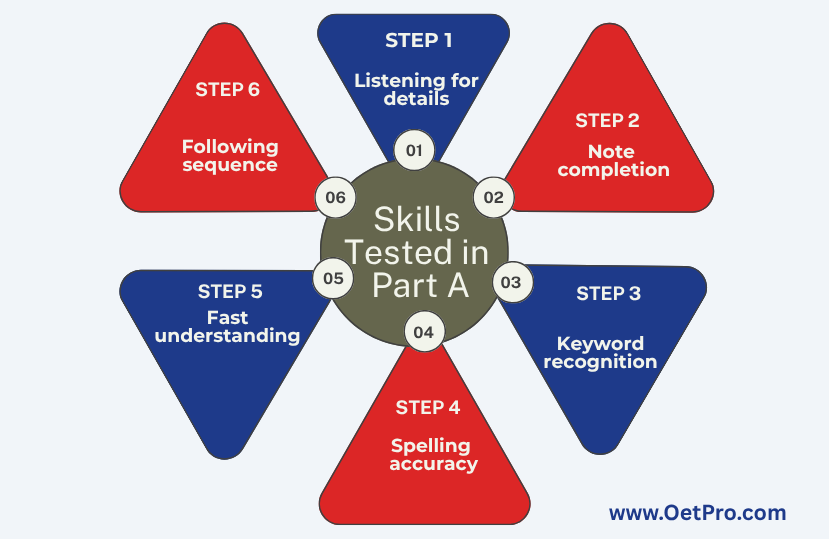
This section is designed to test:
- Listening for specific information
- Understanding patient symptoms and concerns
- Recognizing medical vocabulary in context
- Following natural speech (accents, speed, pauses)
- Writing clear and accurate notes
Real-Life Connection
Think of this as:
A patient is speaking, and you must quickly extract useful clinical information.
This is exactly what:
- Nurses do during triage
- Doctors do during consultations
- Physiotherapists do during assessments
OET simply measures how well you can do this in English and under time pressure. Achieving high scores in Part A requires strong attention to detail, listening accuracy, and consistent performance across all listening tasks. You can build these skills using OET Listening Mastery for High Scores (Part A, B & C).
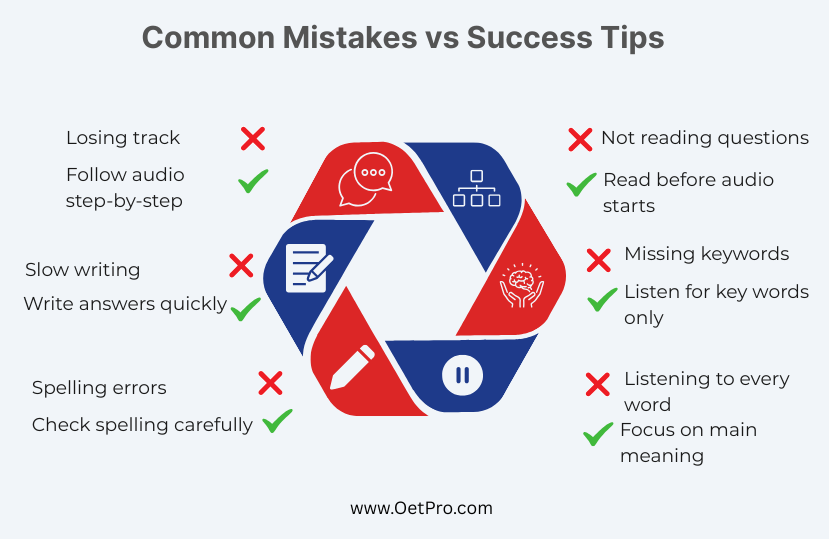
Common Mistakes in OET Listening Part A
Many candidates lose marks in Part A due to avoidable errors.
Let’s fix them early.
1. Writing Too Many Words
Each answer has a word limit.
- Writing extra words = incorrect answer
- Keep answers short and precise
2. Spelling Mistakes
OET is strict about spelling.
“Diabities” instead of “Diabetes”
Always double-check common medical terms
3. Missing the Answer Timing
Answers come as the audio flows.
If you lose focus for even 2–3 seconds, you may miss the answer completely.
4. Not Reading Questions Before Listening
Many candidates start listening without preparation.
Always:
- Read notes first
- Predict possible answers
5. Trying to Understand Every Word
This is a major mistake.
You do NOT need full understanding.
Focus only on:
- Keywords
- Required information
6. Poor Handwriting
If the examiner cannot read your answer,
you will lose marks.
Write clearly and neatly
7. Panicking After Missing One Answer
Missing one answer is normal.
- Panic -> lose next 3–4 answers
- Stay calm -> move forward
Many candidates lose marks in Part A because they focus only on note completion without understanding the full structure of the OET Listening exam. To fix this, refer to OET Listening Mastery Complete Listening Strategy.
The Core Idea: You Don’t Listen… You Extract
Most candidates try to understand everything.
That approach fails.
High scorers do something different:
They listen with a purpose to extract answers, not understand the whole conversation.
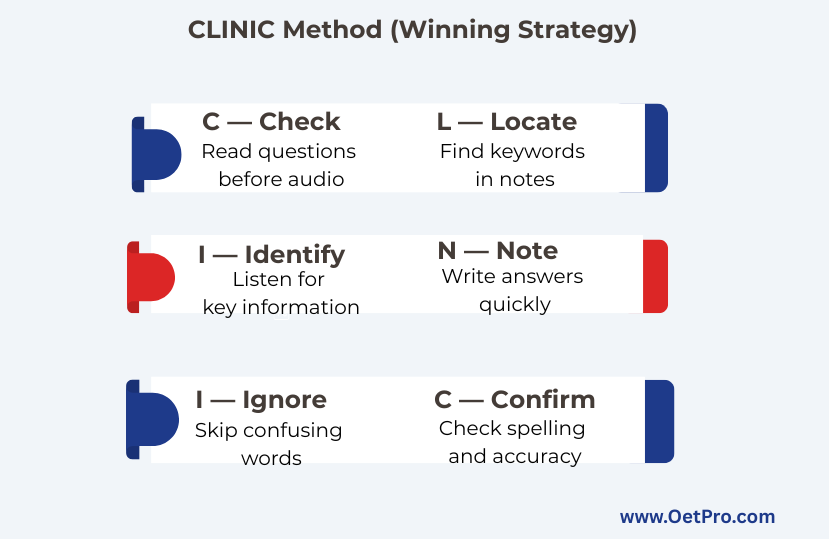
The OET Listening Part A Framework (CLINIC Method)
Use this proven system during the exam:
C — Context First
Before audio starts:
- Read the title (e.g., Initial Consultation, Follow-up Visit)
- Identify:
- Patient type
- Situation
This prepares your brain for expected vocabulary.
L — Look Ahead
Quickly scan all notes.
Focus on:
- Headings (Symptoms, History, Medication)
- Gaps/blanks
You are building a mental map.
I — Identify Keywords
Each blank has clues.
Example:
“Patient complains of ______ pain”
Keyword = pain
Expect:
- back pain
- chest pain
- abdominal pain
N — Note While Listening
Now the audio starts.
You must:
- Listen actively
- Write immediately
- Don’t wait
- Don’t overthink
I — Ignore Distractions
Speakers often:
- Repeat
- Correct themselves
- Add extra details
Only write what matches the question.
C — Check Word Limit
After writing:
- Ensure answer fits:
- ONE word
- TWO words
- SHORT phrase
The Prediction Technique (Top Scorer Secret)
Before listening, try this:
Look at the gap:
“Allergic to ______”
Ask yourself:
- Is it a drug? -> penicillin
- Food? -> nuts
- Substance? -> dust
Now your brain is ready to catch the answer instantly.
Example 1: Basic Consultation
Notes Extract
Chief Complaint:
Patient reports ______ pain in lower back
Audio Says
“I’ve been having this dull pain in my lower back for about two weeks…”
Correct Answer
Dull
Why?
- Keyword = pain
- Type of pain = dull
- Simple, one-word answer
Example 2: Faster Conversation
Notes Extract
Medication:
Currently taking ______ for blood pressure
Audio Says
“I’ve been on amlodipine for my blood pressure for the last six months…”
Correct Answer
Amlodipine
Key Insight
Even if pronunciation is fast:
- Focus on drug names
- Expect common medications
Example 3: Trap Situation
Notes Extract
Symptoms:
Experiencing ______ at night
Audio Says
“I used to have headaches during the day, but now it’s more at night…”
Correct Answer
Headaches
Why This Is a Trap
- Speaker mentions:
- day (past)
- night (present)
You must capture current condition only. Practicing Part A is important, but you must also practice all listening parts together to improve timing, focus, and overall exam performance. Follow the full system in OET Listening Mastery Complete Preparation Strategy.
Golden Strategies for High Scores
1. Write As You Hear
Do NOT wait for sentence completion.
Answers often come quickly.
2. Expect Synonyms
Audio: “high blood pressure”
Answer: “hypertension”
Both are possible.
3. Follow the Structure
The audio usually follows:
- Notes order
- Logical medical flow
4. Stay 100% Focused
Part A requires:
- Continuous attention
- Zero distraction
5. Move On Quickly
Missed one?
Forget it.
Focus on next.
Advanced Tips to Reach Grade B and Above
At higher levels, Part A is not about basic understanding.
It is about precision under pressure.
1. Train Your Ear for Fast Speech
In real OET audio:
- Speakers talk naturally
- They may speak fast
- They may reduce words
Example:
“going to” -> gonna
“want to” -> wanna
You must understand natural spoken English, not textbook English.
2. Handle Self-Corrections
Patients often correct themselves:
“It started on Monday… actually, Tuesday morning.”
Correct answer = Tuesday morning
Always choose the final, corrected information
3. Watch for Signposting Language
Doctors guide the conversation using signals:
- “Let’s talk about your symptoms…”
- “Now, regarding your medication…”
- “Can you tell me about your history?”
These signals help you:
- Predict answers
- Stay aligned with notes
4. Recognize Distractors
OET deliberately includes:
- Extra information
- Irrelevant details
Example:
“I had a headache last week, but now it’s gone.”
Do NOT write:
Headache
(No answer, or current symptom only)
5. Improve Writing Speed + Accuracy Together
You must:
- Listen
- Process
- Write
All at the same time.
Practice:
- Writing short forms quickly
- Keeping handwriting readable
Examiner Insights (How You Lose Marks)
Understanding how examiners think gives you an advantage.
1. Exact Meaning Matters
Your answer must match meaning, not just similar words.
Example:
Audio: “severe pain”
Answer: “bad pain” (Incorrect)
2. Spelling Is Strict (But Logical)
- Common words -> must be correct
- Medical terms -> minor errors may be accepted IF understandable
Still, aim for 100?curacy.
3. Word Limit Rule Is Critical
If the instruction says:
NO MORE THAN TWO WORDS
Then:
- “severe chest pain” (3 words)
- “chest pain”
4. Handwriting Can Cost Marks
If your answer is unclear:
Examiner cannot guess
Write cleanly, even under speed
High-Frequency Vocabulary for Part A
You will often hear these categories:
Symptoms
- pain (sharp, dull, severe)
- swelling
- dizziness
- nausea
- fatigue
Medical Conditions
- diabetes
- hypertension
- asthma
- infection
Medications
- antibiotics
- insulin
- painkillers
- antihypertensives
Time Expressions
- recently
- last week
- for two months
- since Monday
Frequency
- once a day
- twice daily
- occasionally
- regularly
Mini Practice Drill
Try this:
Notes Extract
History:
Patient has had symptoms for ______
Audio (Simulated)
“I think it started about three months ago, maybe a bit longer…”
Your Answer
______ ?
Correct Answer
Three months
Why?
- Clear duration
- Matches note requirement
- Within word limit
Daily Practice Technique (10-Minute Drill)
Use this simple routine:
- Take one Part A sample
- Read notes (1 minute)
- Predict answers
- Listen once
- Check answers
- Review mistakes
Do this daily -> rapid improvement.
Quick Summary
OET Listening Part A is a focused note-completion task based on real healthcare consultations.
To succeed, you must:
- Listen with purpose (not full understanding)
- Capture specific medical details
- Follow word limits strictly
- Write clearly and quickly
- Stay fully focused from start to end
Your success depends on one skill:
Turning listening into accurate clinical notes in real time
OET Listening Part A Checklist (Exam Ready)
Use this checklist before and during the exam:
Before Audio Starts
- Read all notes carefully
- Identify keywords
- Predict possible answers
- Understand context (patient + situation)
During Listening
- Write answers immediately
- Follow note order
- Ignore extra information
- Stay calm and focused
After Writing
- Check spelling
- Follow word limit
- Ensure handwriting is clear
Frequently Asked Questions (FAQs)
1. How many questions are in OET Listening Part A?
There are 24 questions in total:
- 2 consultations
- 12 questions each
2. Can I hear the audio again?
No.
Audio is played only once.
3. Is spelling important?
Yes, Very important.
- Common words must be correct
- Medical terms should be accurate
4. Can I write abbreviations?
Only if they are commonly accepted.
Example:
“BP” for blood pressure (if context allows)
5. What if I miss one answer?
Move on immediately.
Do NOT panic.
One mistake should not affect the rest.
7-Day Practice Plan (Part A Focus)
Day 1–2
- Understand format
- Practice slowly
- Focus on accuracy
Day 3–4
- Practice under time pressure
- Improve note prediction
Day 5
- Focus on weak areas
- Review mistakes
Day 6
- Full Part A test practice
Day 7
- Revision + light practice
- Build confidence
Final Conclusion
OET Listening Part A is not difficult but it is highly technical.
You already have the medical knowledge.
Now you must build:
- Listening precision
- Note-taking speed
- Exam awareness
Once you master this section, you gain:
- Confidence
- Strong start in the exam
- Higher overall listening score
Mastering Part A is a strong starting point, but your final listening score depends on performance across all sections of the test. Start with OET Listening Mastery Complete Guide for Healthcare Professionals.