OET Listening Mastery (2026): Complete Guide to Part A, B & C for Healthcare Professionals
Introduction
OET Listening is not simply about hearing English words; it is about understanding real medical communication in high-pressure situations. During the exam, you will listen to doctor–patient consultations, workplace discussions, and healthcare presentations that reflect real clinical environments. Many candidates assume that listening is the easiest part of the OET, but this assumption often leads to low scores. The reality is that OET Listening quietly reduces marks because it demands a combination of:
- Speed in processing information
- Accuracy in identifying key details
- Understanding of medical context
- Strong focus under time pressure
Since the audio is played only once, there is no opportunity to go back and check your answers. This makes it essential to move beyond casual practice and adopt a structured listening system that prepares you for real exam conditions.
The OET Listening test includes three parts, and Part A focuses on note completion from healthcare consultations. This section requires high accuracy and quick listening skills.
You can master this in OET Listening Part A Notes Strategy (High Accuracy Guide).
The OET Listening test includes three parts, and Part B focuses on understanding short workplace extracts and answering MCQs accurately. This section tests your ability to identify meaning quickly. You can master this in OET Listening Part B Strategy: Short Workplace Extracts Mastery
The OET Listening test includes three parts, and Part C focuses on understanding long conversations and identifying deeper meaning and speaker opinions. This section requires strong inference skills. You can master this in OET Listening Part C Inference & Long Conversation Mastery.
The OET Listening test includes three parts, but success depends on how well you combine all sections into one integrated system rather than preparing them separately. You can master this in Integrated OET Listening Strategy: Part A, B & C Master System.
Understanding the OET Listening structure is important, but real improvement comes when you practice under full exam conditions with proper timing and pressure.
You can master this in OET Listening Mock Test Strategy: Full Exam Simulation & Score Improvement System.
Learning Objectives
By the end of this lesson, you will have a clear understanding of how the OET Listening section works and what skills are required to succeed. You will learn how to approach each part of the test with a defined strategy instead of guessing answers. This lesson will help you:
- Understand the complete structure of OET Listening
- Identify what each part is really testing
- Avoid common score-reducing mistakes
- Build a foundation for achieving 350–450+ scores
Most importantly, you will begin thinking like a high-scoring candidate rather than a passive listener. A strong listening strategy is not just about individual techniques for each part it is about connecting skills across Part A, B, and C into a unified approach. This system is explained in OET Listening Integrated Strategy Guide (Part A, B & C).
Overview of OET Listening
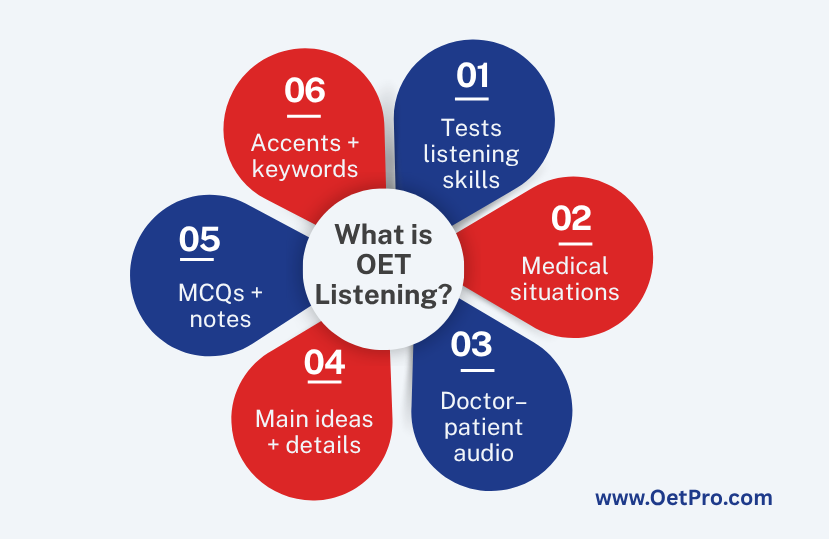
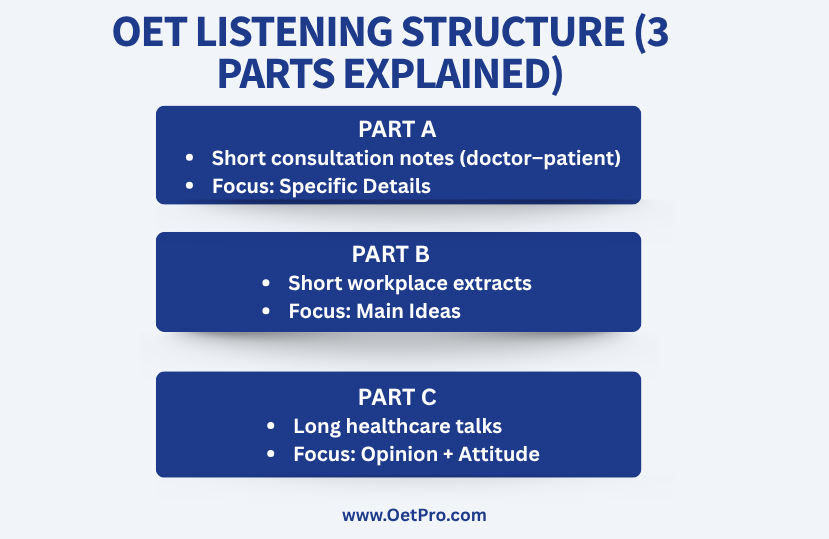
The OET Listening test is divided into three parts, and each part is designed to assess a different type of listening skill required in healthcare settings. Part A tests your ability to capture specific details from conversations between patients and healthcare professionals. Many students lose marks due to missing key information. A complete method is explained in OET Listening Part A Note-Taking Strategy Guide.
Part B requires you to understand short conversations and workplace situations while identifying the speaker’s purpose and meaning. Many students lose marks due to confusion between similar options. A complete method is explained in OET Listening Part B MCQ Strategy Guide (Workplace Extracts).
Part C tests your ability to understand complex discussions and identify attitudes, opinions, and implied meaning. Many students struggle with inference-based questions.
A complete method is explained in OET Listening Part C Inference Strategy Guide (Long Conversations).
Many students practice each section individually but fail to improve because they cannot apply a combined strategy during the real exam. Integration is the key to higher scores.
You can improve this using OET Listening Full Integration Strategy for High Scores.
A strong listening strategy must be applied in real exam scenarios to build confidence, accuracy, and timing across all parts of the test.
This system is explained in OET Listening Full Mock Test Strategy Guide (Exam Simulation).
Part A: Consultation Note Completion
In this section, you listen to two medical consultations and complete notes while the audio is playing. Your focus must be on identifying specific details such as symptoms, patient history, and treatment instructions.
This part requires you to:
- Capture accurate keywords
- Follow patient narratives clearly
- Write answers quickly and correctly
Part B: Short Workplace Conversations
In Part B, you will hear six short audio clips based on workplace communication. Each clip is followed by one multiple-choice question.
This section tests your ability to:
- Understand the main idea quickly
- Identify the purpose of the conversation
- Recognize professional communication tone
Part C: Long Presentations & Interviews
Part C includes two longer recordings, such as presentations or interviews, followed by multiple questions. This is often considered the most challenging section because it requires deep understanding.
You must be able to:
- Follow extended discussions
- Identify speaker opinions and attitudes
- Distinguish between main ideas and distractions
The Real Challenge (What Most Students Miss)
Most candidates prepare for OET Listening by practicing each part separately. They focus on Part A, Part B, and Part C as independent sections. However, the real exam does not test these skills in isolation. Instead, it requires you to transition smoothly between different listening styles.
In a single test, you must shift between:
- Detail listening (Part A)
- Quick comprehension (Part B)
- Deep analytical listening (Part C)
This shift is where many candidates struggle. They often perform well during practice but underperform in the actual exam because they lack a unified strategy.
The problem is not your English level. The problem is the absence of a complete listening system. To perform well in Part B, you must focus on meaning, tone, and intent rather than just keywords. This helps you choose the correct answer more accurately. You can apply this system from OET Listening Part B High Score Strategy for Workplace Texts.
To perform well in Part C, you must go beyond keywords and focus on understanding context, tone, and speaker intention. This improves your accuracy in inference questions.
You can apply this system from OET Listening Part C High Score Inference Strategy.
Common Mistakes in OET Listening
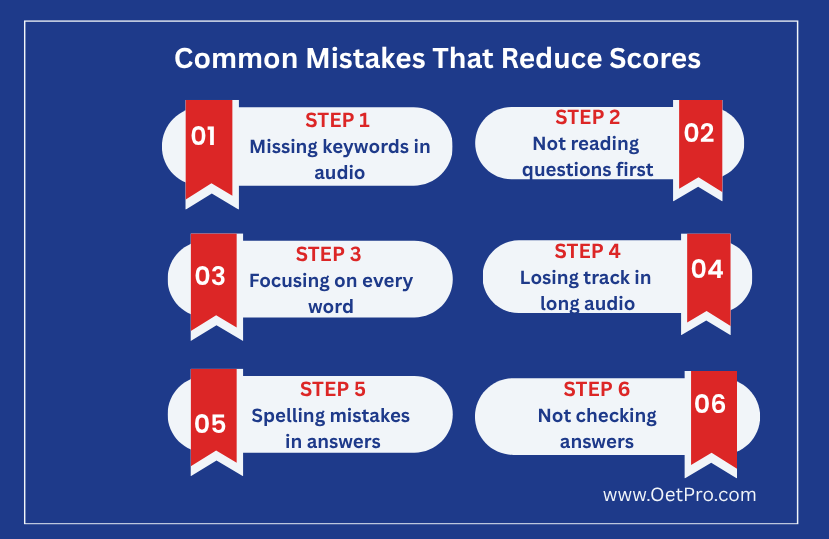
A major mistake candidates make is listening without a clear strategy. Simply hearing the audio and hoping to understand the answers leads to confusion and missed information. Another common error is trying to understand every single word, which is unnecessary and mentally exhausting.
Here are the most common score-killing mistakes:
- Listening without a strategy
-> Leads to missed answers and confusion - Trying to understand every word
-> Reduces focus on important information - Poor spelling in Part A
-> Correct answer but wrong spelling = no marks - Losing focus in Part C
-> Long audio requires mental stamina - Ignoring medical context
-> Makes it difficult to follow real scenarios - No time awareness
-> Causes fatigue and errors in later sections
Avoiding these mistakes alone can significantly improve your score. To perform well in Part A, you must develop strong note-taking techniques, focus on keywords, and avoid common traps in fast conversations. You can apply this system from OET Listening Part A High Score Notes Strategy. Many candidates lose marks in Part B because they focus on keywords instead of understanding the speaker’s intention and overall meaning. This leads to incorrect answers. Avoid these mistakes with OET Listening Part B Master Guide (Short Extract Strategy).
Many candidates lose marks in Part C because they focus on individual words instead of understanding the overall message and implied meaning. This leads to incorrect answers.
Avoid these mistakes with OET Listening Part C Master Guide (Inference Strategy). Many candidates lose marks because they treat each listening part separately instead of understanding how the exam works as a complete system. Avoid this with OET Listening Integrated Strategy Master Guide.
Many candidates lose marks because they rely only on practice questions instead of full-length mock tests, which limits their exam readiness.
Avoid this with OET Listening Mock Test Master Guide (Full Exam Strategy).
Lesson Connection (Curriculum Flow)
This lesson is an important part of your overall OET preparation journey. In the previous lesson, OET004 (Reading), you developed the ability to understand written medical English. Now, in OET005, you are building the skill of understanding spoken medical communication.
Together, these skills help you:
- Understand patient information
- Follow clinical discussions
- Prepare for real workplace communication
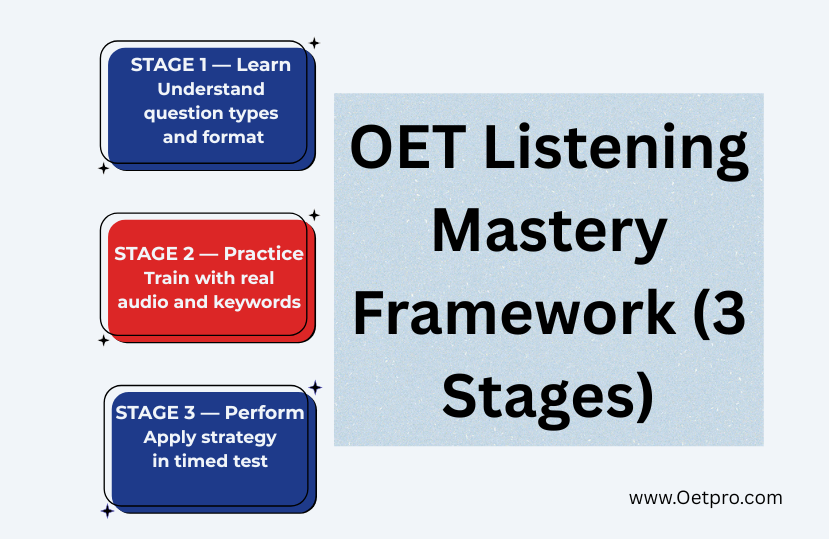
The OET Listening Mastery Framework
To score high in OET Listening, you need more than practice.
You need a repeatable system.
This framework will help you:
- Stay focused during the entire test
- Capture the right information
- Avoid confusion and mental overload
- Perform consistently across Part A, B, and C
Think of this as your mental roadmap during the exam.
Stage 1: Pre-Listening Preparation (Before Audio Starts)
Most students ignore this stage.
Top scorers use it strategically.
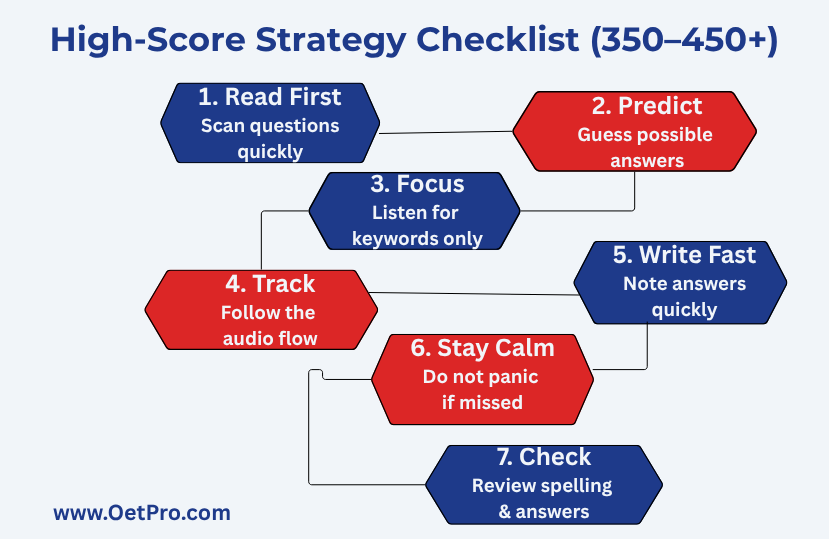
Before the audio begins, you get time to read the questions. This is your opportunity to prepare your brain.
Focus on:
- Keywords in questions
- Type of information required
- Context (patient, doctor, topic)
What you should do:
- Predict possible answers
- Underline important words
- Identify if you are listening for:
- Symptoms
- Numbers
- Opinions
- Instructions
This step improves your listening accuracy by 30–40%. In Part A, accuracy depends on how effectively you capture important details while listening only once. Speed and focus are critical for success. You can improve this in OET Listening Part A Fast Note Completion Guide.
Stage 2: Active Listening (During Audio)
This is where most candidates lose marks.
They either:
- Panic
- Try to understand everything
- Or miss key answers
Instead, you must listen with purpose.
Your focus should be:
- Listening for answers, not sentences
- Identifying signal words
- Ignoring unnecessary details
Key Listening Signals to Train
These words guide you to answers:
- Correction signals
-> “Sorry, I mean…”, “Actually…” - Emphasis signals
-> “The main issue is…”, “Important point…” - Change of idea
-> “However”, “But”, “Although” - Listing information
-> “First…”, “Next…”, “Finally…”
Golden Rule
Do NOT try to understand 100%.
Focus on:
Relevant information only
Stage 3: Answer Capture Strategy
Different parts require different answer approaches.
Part A Strategy (Precision Mode)
In Part A, your job is to capture exact information.
Focus on:
- Correct spelling
- Accurate keywords
- Listening for:
- Names
- Dates
- Symptoms
- Medication
Technique:
- Write short forms while listening
- Complete neatly during transfer time
Part B Strategy (Speed Mode)
In Part B, speed is critical.
You must:
- Understand the situation quickly
- Identify the purpose of the speaker
Technique:
- Read the question before listening
- Focus only on the main idea
- Ignore extra details
Part C Strategy (Deep Understanding Mode)
Part C requires advanced listening.
You must:
- Follow long conversations
- Understand opinions
- Avoid traps in options
Technique:
- Predict answer types
- Track speaker attitude
- Eliminate wrong options logically
Stage 4: Mental Control & Focus
OET Listening is also a focus test.
Even if your English is good, you can lose marks due to:
- Stress
- Distraction
- Mental fatigue
How to Maintain Focus
Train your brain to:
- Stay present for long audio
- Ignore missed answers and move on
- Reset focus after each question
Golden Exam Mindset
- One missed answer ? failure
- Stay calm and continue
- Every new question is a new opportunity
Real Healthcare Example
Let’s apply the framework.
Scenario: Doctor–Patient Consultation
Doctor says:
“Initially, we thought it was a minor infection, but after reviewing the test results, it appears to be a chronic condition.”
What average students hear:
- Infection
- Test results
- Chronic condition
-> Confusion
What trained students hear:
- “Initially” -> old idea
- “But” -> change
- “Appears to be” -> final answer
Correct focus: Chronic condition
Why This Framework Works
This system trains you to:
- Think like an examiner
- Listen actively, not passively
- Focus on answers, not noise
Instead of random practice, you now have:
- A clear process
- A structured approach
- A high-performance listening strategy
Advanced Listening Skills for High Scores
Once you understand the basic framework, the next step is to think like a high-scoring candidate (Grade B / 350–450+).
At this level, success depends on:
- Precision
- Interpretation
- Decision-making under pressure
You are no longer just listening.
You are analyzing communication like a healthcare professional.
Examiner Insights (What Really Gets You Marks)
OET examiners are not checking if you “heard something.”
They are checking if you understood:
- The correct meaning
- The final idea
- The speaker’s intention
Key Insight 1: Answers Often Come After Corrections
Speakers frequently change information.
Example:
“He’s been taking 5 mg… sorry, 10 mg daily.”
Correct answer: 10 mg
Key Insight 2: Distractors Are Intentionally Placed
You will hear:
- Similar words
- Opposite ideas
- Early incorrect information
These are designed to trap you.
Key Insight 3: Tone Matters in Part C
In long audios, answers are not always direct.
You must understand:
- Agreement vs disagreement
- Concern vs confidence
- Suggestion vs instruction
High-Scoring Vocabulary Awareness
You don’t need complex vocabulary.
You need functional medical listening awareness.
Common Patterns You Must Recognize
- Symptoms
-> “persistent cough”, “shortness of breath” - Time references
-> “for the past two weeks”, “recently” - Change indicators
-> “improving”, “worsening”, “stable” - Uncertainty
-> “possibly”, “likely”, “suspected” - Instructions
-> “you should”, “I recommend”, “we’ll start”
These patterns help you identify answers faster and more accurately
Trap Questions (Especially in Part B & C)
Let’s break this down clearly.
Trap Type 1: Similar Meaning Options
All options look correct.
But only one matches the exact meaning.
Strategy:
- Focus on what the speaker really means, not just keywords
Trap Type 2: Opposite Ideas
Example:
- Option A: Condition is improving
- Option B: Condition is worsening
If you miss one word -> you choose wrong.
Strategy:
- Listen for tone and direction of change
Trap Type 3: Partial Truth
Option includes:
- One correct idea
- One incorrect detail
This makes it wrong.
Strategy:
- Check the full meaning, not half
Advanced Listening Strategy in Action
Let’s analyze a Part C example.
Audio Statement:
“The treatment has shown some improvement, although the long-term effects are still uncertain.”
Average Student Thinking:
- Improvement -> positive
Chooses overly positive answer
High-Scoring Thinking:
- “Although” -> contrast
- “Uncertain” -> key idea
Correct understanding:
Results are promising but not confirmed
Practice Section (Guided Training)
Let’s apply your skills.
Mini Practice 1
Audio:
“The patient initially responded well, but symptoms returned after two weeks.”
Question: What is the current condition?
Correct Thinking:
- “Initially” -> past
- “But” -> change
- “Returned” -> current
Answer: Symptoms are back
Mini Practice 2
Audio:
“We don’t need surgery at this stage, but we’ll monitor closely.”
Question: What is the plan?
Answer:
- No surgery now
- Monitoring required
Performance Upgrade Strategy
To move from average to high score:
Daily Practice Method
- 20 minutes -> Part A (accuracy)
- 15 minutes -> Part B (speed)
- 25 minutes -> Part C (deep listening)
Skill Focus Plan
Train these 3 core abilities:
- Listening for answers, not words
- Recognizing signal language
- Maintaining focus for long audio
What Makes a Top Performer
Top OET candidates:
- Do NOT panic when they miss an answer
- Do NOT try to understand everything
- Do focus on:
- Meaning
- Structure
- Communication intent
They treat listening like a clinical skill.
OET Listening is a structured test that evaluates your ability to understand real healthcare communication in three different formats: consultations, workplace conversations, and extended presentations. Each part requires a different listening skill, but all three are connected through one core ability: understanding meaning under pressure.
Part A focuses on accurate note completion from medical consultations, where detail recognition is critical. Part B tests your ability to quickly understand the purpose and main idea of short workplace conversations. Part C challenges you to follow long discussions, identify opinions, and separate key ideas from distractions.
Success in OET Listening does not depend on hearing every word. It depends on your ability to:
- Focus only on relevant information
- Recognize signal words and changes in meaning
- Avoid traps and distractors
- Maintain concentration throughout the test
A structured approach always outperforms random practice.
Final Checklist (Before Exam Day)
Before you enter the exam, ensure you are confident with the following:
Listening Skills
- I can identify key information quickly
- I can follow medical conversations without panic
- I understand signal words like “however”, “but”, “actually”
Part A Preparation
- I can spell common medical terms correctly
- I can listen for numbers, symptoms, and treatments
- I can complete notes while listening
Part B Preparation
- I can understand the main purpose of conversations
- I do not get distracted by extra details
- I can answer quickly without overthinking
Part C Preparation
- I can follow long audio without losing focus
- I can identify opinions and attitudes
- I can eliminate wrong options logically
FAQs
1. Is OET Listening difficult?
OET Listening is challenging because it tests real medical communication, but with the right strategy, it becomes highly manageable.
2. How can I improve my OET Listening score quickly?
Focus on structured practice: Part A for accuracy, Part B for speed, and Part C for deep understanding. Avoid passive listening practice.
3. Do I need to understand every word in OET Listening?
No. You only need to understand key information that helps answer the questions. Understanding every word can actually reduce focus.
4. What is the most important part of OET Listening?
All parts are important, but Part C is often the most challenging because it tests deep understanding and opinion recognition.
5. How many times is the audio played?
The audio is played only once, which is why focus and preparation are critical.
7-Day Practice Plan (High-Score Strategy)
This plan helps you build consistent improvement.
Day 1–2: Part A Focus
- Practice note completion
- Improve spelling accuracy
- Train keyword listening
Day 3–4: Part B Focus
- Practice short conversations
- Identify main ideas quickly
- Work on speed and accuracy
Day 5–6: Part C Focus
- Listen to long medical talks
- Identify opinions and tone
- Practice elimination technique
Day 7: Full Mock Test
- Simulate real exam conditions
- No pauses
- One-time listening only
Final Exam Strategy
On exam day, remember:
- Stay calm even if you miss an answer
- Move forward immediately
- Focus on meaning, not individual words
- Trust your preparation system
A strong mindset is as important as listening skill.
Conclusion
OET Listening is not just a test of hearing ability it is a test of structured thinking under pressure. When you follow a system instead of relying on guesswork, your accuracy improves significantly across all three parts.
This lesson builds your foundation for real exam performance. With consistent practice, you can move from uncertainty to confidence and achieve a high band score. Mastering Part A is essential for building strong listening accuracy, but overall success depends on performance across all listening sections. Start with OET Listening Part A Complete Notes Strategy Guide.
Mastering Part B is essential for improving listening accuracy in workplace scenarios, but overall success depends on performance across all listening parts. Start with OET Listening Part B Complete Strategy Guide.
Mastering Part C is essential for handling complex listening tasks, but overall success depends on strong performance across all listening sections. Start with OET Listening Part C Complete Strategy Guide.
The listening mastery system becomes more effective when all three parts are combined into a single structured approach for the exam. Start with OET Listening Complete Integrated Strategy for Part A, B & C.
The listening mastery system becomes more effective when combined with full test simulations that train you for real exam conditions. Start with OET Listening Complete Mock Test Strategy for Score Improvement.