OET Listening Mock Test Strategy (2026): Full Exam Simulation, Timing & Score Improvement Techniques
Introduction
OET Listening mock tests are not just practice exercises. They are full performance simulations of the real exam.
Most candidates make one critical mistake:
- They use mock tests only for practice
- Top scorers use mock tests for performance training
Mock tests help simulate the real OET exam, but your final score depends on how well you understand the complete structure of all listening parts. A strong foundation is essential. You can understand this full system in OET Listening Mastery: Complete Guide to Part A, B & C for Healthcare Professionals.
Learning Objectives
By the end of this lesson, you will be able to:
- Use OET Listening mock tests effectively
- Simulate real exam conditions
- Build timing and focus control
- Identify weak areas in Part A, B, and C
- Improve score through structured analysis
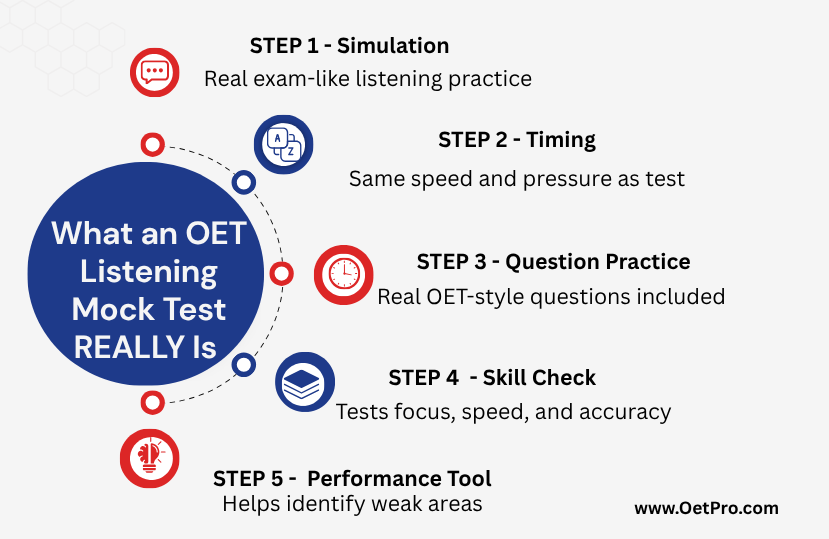
What is an OET Listening Mock Test?
A mock test is a full-length practice exam that includes:
- Part A -> Note completion
- Part B -> MCQs (workplace extracts)
- Part C -> Inference-based MCQs
It simulates:
- real exam timing
- real difficulty level
- real pressure conditions
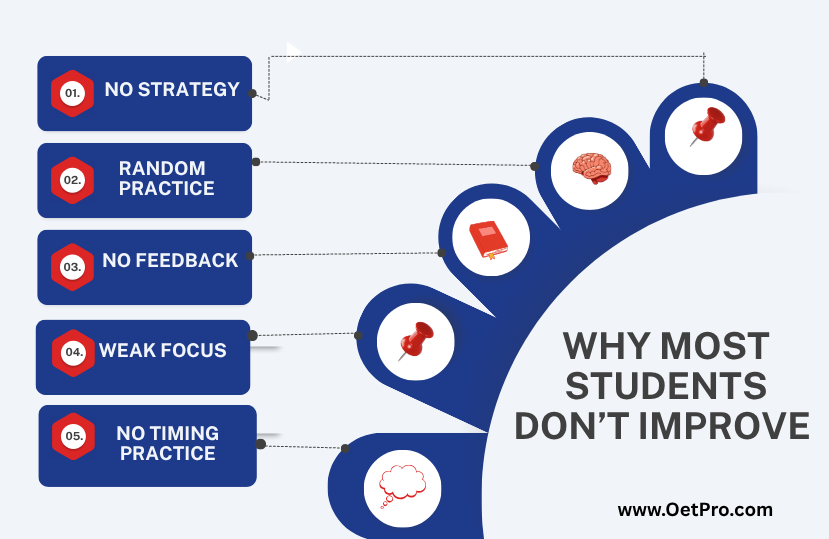
Why Most Students Fail Mock Tests
Mock tests fail when used incorrectly.
Mistake 1: Treating Mock Test Like Practice
Students pause audio, replay sections, and relax.
This does NOT build exam readiness.
Mistake 2: No Error Analysis
Many candidates:
- check score
- ignore mistakes
This prevents improvement.
Mistake 3: No Timing Discipline
Stopping between sections destroys:
- focus endurance
- real exam stamina
Mistake 4: Random Practice
Doing tests without strategy leads to:
- repeated mistakes
- no progress tracking
Core Mock Test Principle
A mock test is not for learning it is for testing your exam readiness. Practicing full-length tests is important, but without a clear understanding of each listening part, it becomes difficult to apply strategies effectively. This complete framework is explained in OET Listening Mastery Complete Strategy Guide.
Correct Mock Test Mindset
You must treat every mock test like the real exam:
- No pauses
- No repetition
- No distractions
- No stopping midway
One attempt = real score evaluation
Mock Test Success Framework (3 Steps)
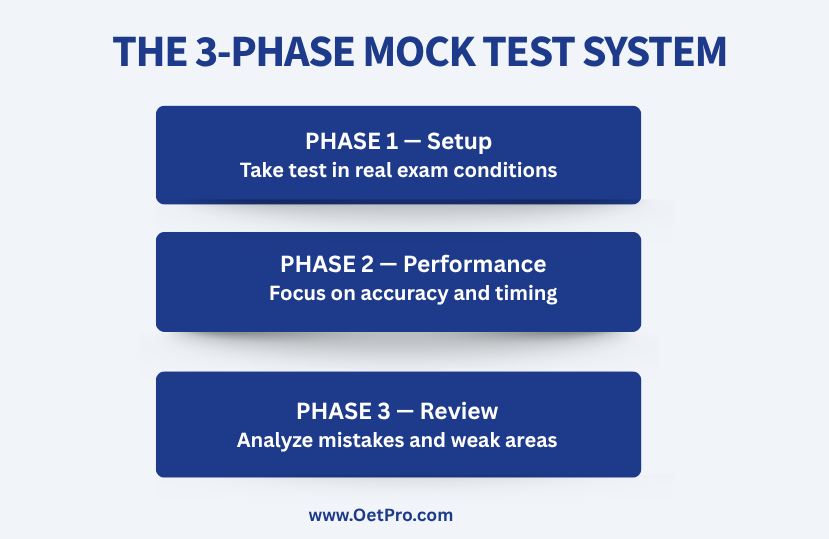
Step 1: Simulate Real Exam Conditions
- Sit in quiet place
- Use headphones
- Follow exact timing
- Do not pause audio
Step 2: Attempt Without Interruption
- Write answers continuously
- Move forward even if you miss answers
- Do NOT go back
Step 3: Post-Test Analysis (Most Important)
After finishing:
- Review wrong answers
- Identify patterns
- Categorize mistakes (A, B, C)
Types of Mistakes You Must Track
- Keyword mistake (Part A)
- Meaning mistake (Part B)
- Inference mistake (Part C)
- Focus loss
- Timing error
The Real Purpose of a Mock Test
A mock test is NOT just a score report.
It is a diagnostic tool that shows:
- where you are losing marks
- why you are losing marks
- how to fix those mistakes
Without analysis, mock tests are useless.
The 3-Level Mock Test Analysis System
Level 1: Score Breakdown
First, divide your performance:
- Part A score
- Part B score
- Part C score
This tells you which section is weak
Level 2: Error Categorization
Now classify every mistake into:
Part A Errors
- spelling mistakes
- missed keywords
- writing too slow
Part B Errors
- wrong MCQ selection
- misunderstanding purpose
- distractor confusion
Part C Errors
- wrong inference
- missed opinion shift
- confusion between speakers
Achieving high scores requires not only mock test practice but also strong performance in Part A, B, and C individually with proper technique. You can build these skills using OET Listening Mastery for High Scores (Part A, B & C).
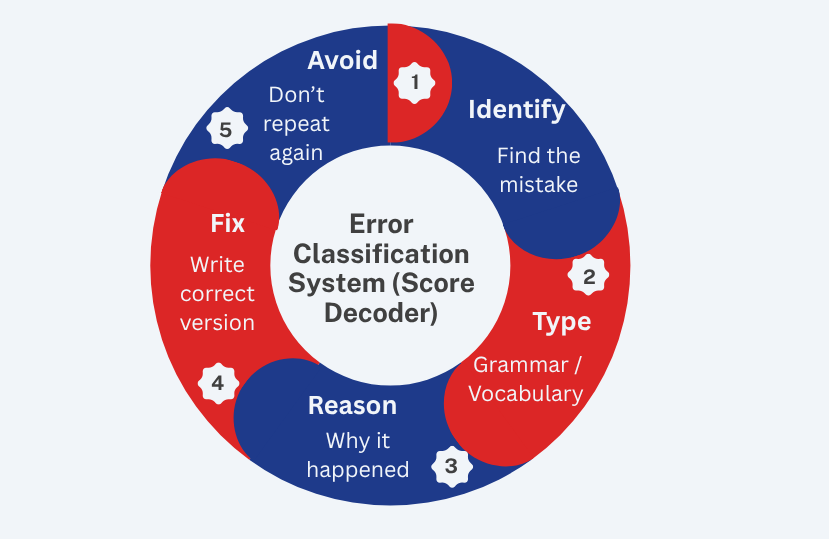
Level 3: Root Cause Analysis
Now ask:
WHY did I make this mistake?
Common root causes:
- poor focus
- weak vocabulary recognition
- overthinking
- lack of practice under time pressure
Fixing the cause = permanent improvement
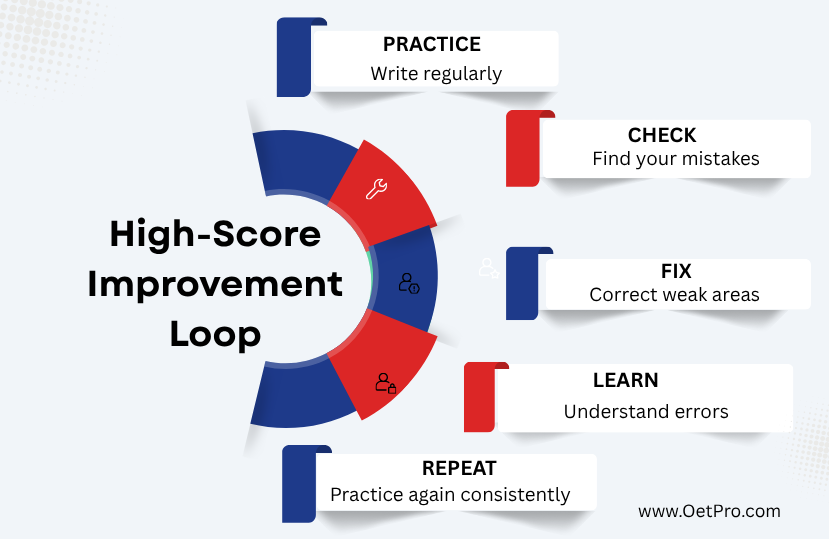
The Improvement Loop (Top Scorer Method)
Follow this loop after EVERY mock test:
Step 1: Attempt Mock Test
Full exam simulation
Step 2: Analyze Mistakes
Identify error type + reason
Step 3: Fix Weak Area
Focus only on weak section
Step 4: Retest
Repeat after improvement
This loop is how you go from 6.0 -> 7.5+ level
Score Improvement Strategy (Very Important)
If Part A is weak:
- practice note speed
- improve spelling accuracy
- focus on keyword prediction
If Part B is weak:
- practice MCQ elimination
- train purpose-based listening
- reduce keyword dependency
If Part C is weak:
- practice inference questions
- track opinion changes
- focus on “however / but / now” signals
Golden Rule of Mock Tests
A mock test without analysis is just practice.
A mock test with analysis is training.
Final Mock Test Success Checklist
Before every mock test, ensure:
Setup Checklist
- Quiet environment
- Headphones ready
- No interruptions allowed
- Full exam timing followed
During Test Checklist
- No pausing audio
- No replaying sections
- Move forward even if answer is missed
- Focus mode maintained throughout
After Test Checklist
- Check answers immediately
- Categorize mistakes (A, B, C)
- Identify weak section
- Note repeating errors
Full Exam-Day Simulation Strategy
Treat every mock test like the real exam:
Step 1: Real Exam Setup
- Sit straight
- Set timer mindset
- Avoid distractions
Step 2: Full Flow Execution
- Part A -> fast capture mode
- Part B -> meaning mode
- Part C -> inference mode
Step 3: Mental Discipline
- No overthinking
- No hesitation
- No backtracking
Score Improvement System (Scientific Method)
Track your progress like this:
Weekly Score Tracking
- Mock Test 1 -> baseline score
- Mock Test 2 -> improvement check
- Mock Test 3 -> stability check
Error Pattern Tracking
Record:
- repeated mistakes
- weak sections
- timing issues
Improvement Measurement
You improve only if:
- same mistakes reduce
- accuracy increases
- focus time improves
Revision Blueprint (Final Stage Preparation)
Phase 1: Repetition Control
- Do 3–5 full mock tests
- No analysis skipping allowed
Phase 2: Weak Area Fixing
- Focus only on weakest part
- Practice targeted drills
Phase 3: Full Simulation Mastery
- Complete tests without breaks
- Achieve consistent scoring
Final Key Insight
Mock tests do not improve your score.
Mock test analysis improves your score.
Final Formula for Success
OET Listening Mastery = Simulation + Analysis + Correction + Repetition.
Final Summary: Mock Test Mastery System
OET Listening mock tests are not practice tools alone.
They are performance measurement systems.
Your goal is NOT to “do more tests”
Your goal is to improve after every test.
Final Exam Checklist (Last Revision System)
Before Mock Test
- Full exam environment setup
- No interruptions allowed
- Headphones ready
- Mental focus activated
During Mock Test
- No pause / replay
- Follow real timing strictly
- Switch modes (A -> B -> C)
- Move forward even if unsure
After Mock Test
- Review every answer
- Identify mistake type
- Find root cause
- Fix weak area immediately
Common Mistakes to Avoid (Final Warning)
- Doing mock tests without analysis
- Repeating same mistakes
- Not simulating real exam conditions
- Ignoring timing discipline
- Overconfidence after one good score
7-Day Final Improvement Plan
Day 1–2
- Full mock test simulation
- No interruptions allowed
Day 3–4
- Error analysis only
- Fix weakest section
Day 5
- Second full mock test
- Compare improvement
Day 6
- Focused practice on weak parts
Day 7
- Final revision + confidence building
Final Key Insight
A high OET Listening score is not built by practice alone.
It is built by controlled repetition + error correction.
Final Formula
OET Listening Success = Mock Test + Analysis + Correction + Discipline. Mock test practice is a powerful tool, but your final success depends on mastering the complete OET Listening system. Start with OET Listening Mastery Complete Guide for Healthcare Professionals.