OET Listening Part B Strategy (2026): Master Short Workplace Extracts & MCQ Success Techniques
Introduction
OET Listening Part B is where the exam shifts from patient consultation to real workplace communication.
Here, you will listen to short extracts from healthcare settings such as:
- Hospital meetings
- Team discussions
- Workplace updates
- Shift handovers
- Professional announcements
Each extract is followed by multiple-choice questions (MCQs).
Unlike Part A, you are not writing answers. You are choosing the best meaning, opinion, or purpose from what you hear. OET Listening Part B focuses on short workplace extracts, but your final score depends on how well you perform across all three parts of the listening test. A complete strategy is essential. You can understand this full system in OET Listening Mastery: Complete Guide to Part A, B & C for Healthcare Professionals.
Why Part B is Tricky
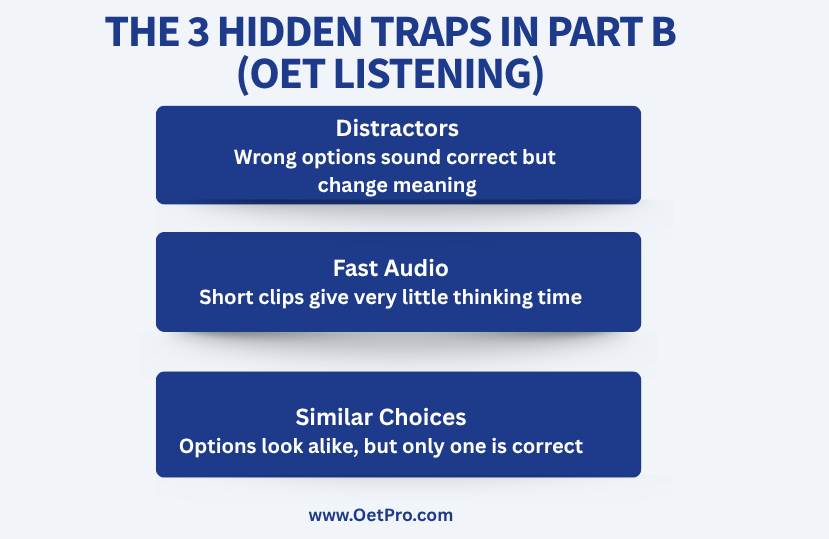
Many candidates struggle here because:
- Options sound very similar
- Speakers talk naturally and quickly
- Answers are based on meaning, not keywords
- Distractors are designed to confuse you
This is a thinking + listening test, not just a listening test.
Learning Objectives
By the end of this lesson, you will be able to:
- Understand the structure of OET Listening Part B
- Identify main ideas and speaker intention
- Answer MCQs with high accuracy
- Eliminate distractor options effectively
- Improve speed of comprehension in workplace English
To perform well in Part B, you must understand meaning, tone, and intent, but these skills are part of a broader listening framework used across all OET Listening sections.
This complete framework is explained in OET Listening Mastery Complete Strategy Guide.
Overview of OET Listening Part B
OET Listening Part B focuses on realistic workplace communication in healthcare environments.
Key Features
- 6 short extracts
- 1–2 MCQs per extract
- Workplace-based English
- Focus on purpose, opinion, or attitude
- Audio played only once
What You Are Tested On
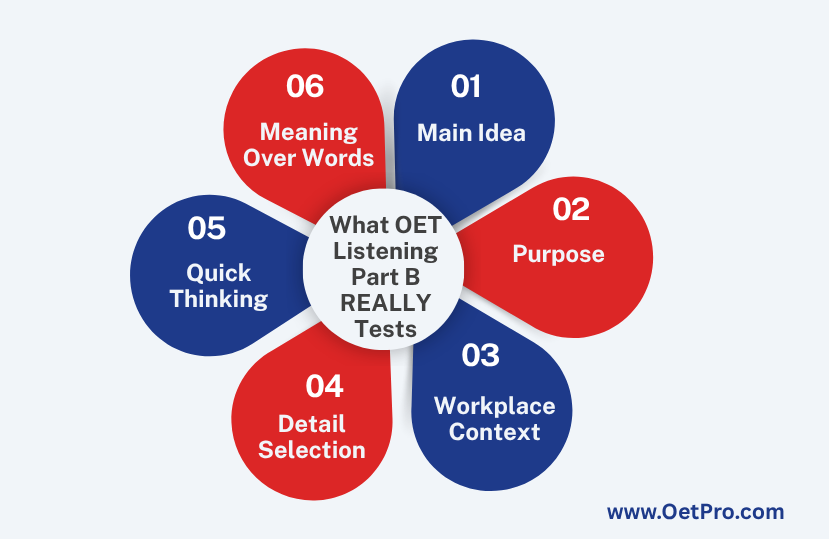
Part B is designed to test your ability to understand:
- Main idea of a conversation
- Purpose of communication
- Speaker’s attitude or opinion
- Key decisions or instructions
Not details. Not spelling. Not writing.
Only understanding meaning in context. Achieving high scores in Part B requires quick understanding, strong focus, and consistent performance across all listening tasks. This goes beyond just answering MCQs correctly. You can build these skills using OET Listening Mastery for High Scores (Part A, B & C).
How Part B Works in Real Exam
You will see:
- A short workplace situation
- 3 answer options (A, B, C)
- One correct answer based on meaning
While listening, you must:
- Understand tone
- Identify purpose
- Eliminate wrong options quickly
Common Mistakes in OET Listening Part B
1. Focusing on Keywords Instead of Meaning
Wrong approach:
- Listening for single words
Correct approach:
- Understanding full idea of conversation
2. Choosing Familiar Words
Many candidates pick options just because they:
- Sound familiar
- Were heard in audio
This is a trap.
3. Ignoring Speaker Tone
Tone tells you:
- Agreement
- Disagreement
- Concern
- Instruction
Often, tone = correct answer.
4. Overthinking Options
Candidates spend too long comparing options.
Result: Miss next question
Solution: First strong instinct is often correct
5. Missing Context
Without understanding situation:
- You may misunderstand meaning
- Choose logically wrong option
Many candidates lose marks in Part B because they focus only on individual questions instead of understanding the full structure of the OET Listening exam. To fix this, refer to OET Listening Mastery Complete Listening Strategy.
Key Insight for Success
In Part B, the answer is rarely a word it is an idea.
You must train your brain to think:
- “What is the speaker trying to do?”
- “What is the purpose of this conversation?”
- “What is the main message?”
The Core Truth of Part B
OET Listening Part B is NOT a keyword test.
It is a:
“Meaning + Purpose + Workplace Thinking” test
You are not listening for words.
You are listening for intent.
The P.E.R.F.E.C.T MCQ Strategy
Use this system for every question:
P — Preview the Question
Before audio starts:
- Read question stem
- Understand situation
- Identify topic (training, complaint, update, instruction)
This sets mental context.
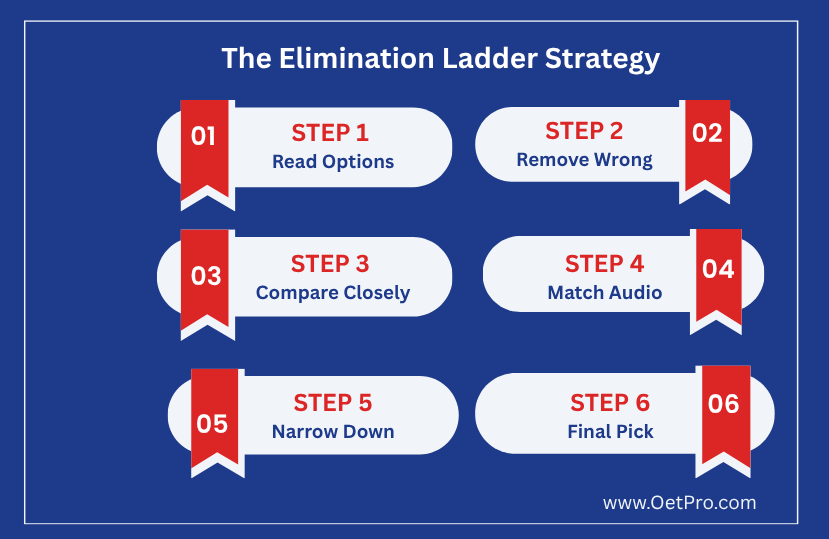
E — Eliminate First
Look at options A, B, C.
Quickly eliminate:
- Clearly unrelated options
- Extreme statements
- Illogical workplace actions
Reduce pressure before listening.
R — Recognize Purpose
While listening ask:
“Why is the speaker saying this?”
Common purposes:
- Informing
- Warning
- Suggesting
- Requesting
- Clarifying
Purpose = correct answer in most cases.
F — Follow Tone
Tone tells hidden meaning:
- Calm = routine update
- Concerned = problem
- Firm = instruction
- Hesitant = uncertainty
Tone often reveals correct option.
E — Extract Main Idea Only
Do NOT focus on every detail.
Ignore:
- Examples
- Side comments
- Repeated phrases
Focus on:
- Main message
C — Compare Options After Listening
Now match:
- What you heard
- With best option
Do NOT compare during listening.
T — Trust First Logical Answer
Your first logical interpretation is usually correct.
Overthinking = biggest score killer.
Practicing Part B is important, but you must also practice all listening parts together to improve timing, focus, and overall exam performance. Follow the full system in OET Listening Mastery Complete Preparation Strategy.
Real Exam Example 1
Question Situation
A nurse is talking about a new hospital procedure.
Question
Why is the nurse speaking to the team?
A. To complain about workload
B. To explain a new procedure
C. To request leave approval
Audio Idea
“The hospital has updated the discharge process, so I want to walk you through the new steps…”
Correct Answer
B. To explain a new procedure
Why?
- Keyword trap: “hospital”, “process”
- BUT purpose = explanation
Real Exam Example 2
Situation
Doctor speaking to staff during shift change.
Question
What is the doctor doing?
A. Giving an urgent warning
B. Providing routine update
C. Asking for patient feedback
Audio Idea
“Nothing serious today, just a few updates for tonight’s shift…”
Correct Answer
B. Providing routine update
Key Insight
Words like:
- “just”
- “nothing serious”
Indicate routine communication
High-Scoring Mindset Shift
Stop thinking:
“What word did I hear?”
Start thinking:
“What is the speaker doing?”
Part B Success Formula
Context + Purpose + Tone = Correct Answer
If you master these three:
- You stop guessing
- You start predicting
- You start scoring higher
Advanced Techniques for High Scores
At this level, Part B is no longer about basic listening.
It becomes a test of:
- judgment
- context awareness
- professional reasoning
1. Train for Meaning-Based Listening
Do NOT focus on individual words.
Instead, train your brain to detect:
- Purpose of speech
- Decision being made
- Problem being discussed
Example:
“If we don’t adjust this schedule, patient flow will be affected…”
Meaning = operational concern
Not just “schedule”
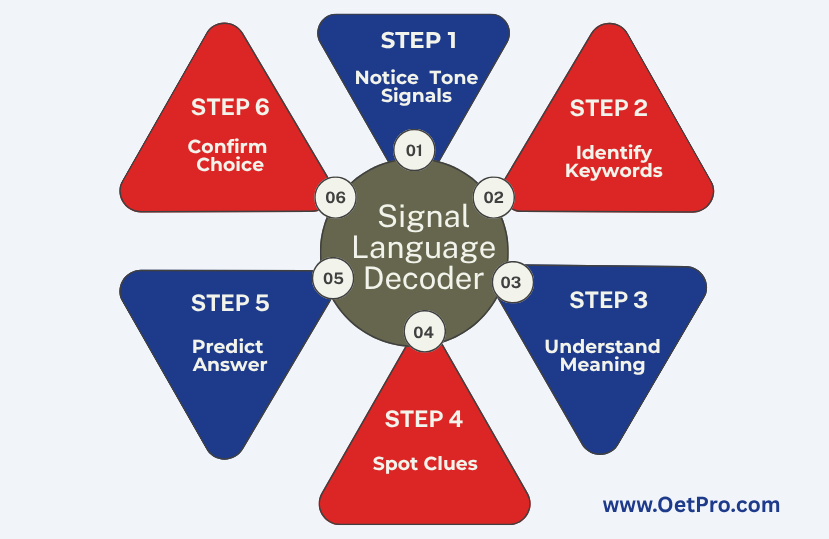
2. Identify Hidden Triggers in Speech
Certain phrases signal correct answers:
- “We need to…” -> action required
- “I suggest…” -> recommendation
- “It might be better…” -> soft advice
- “We should consider…” -> evaluation
These are answer signals
3. Decode Distractors (Exam Trick System)
OET often adds:
- Extra explanations
- Past events
- Irrelevant opinions
Example:
“I thought it was fine earlier, but now I feel we should change it…”
Correct focus = final decision, not earlier opinion
4. Manage Information Overload
You may hear:
- Multiple speakers
- Multiple ideas
- Changing opinions
Rule:
Only the final agreed idea matters
5. Build Workplace Listening Thinking
You must think like a healthcare worker:
- What is the issue?
- What is the solution?
- What action is needed?
Examiner Insights (How Marks Are Decided)
Understanding examiner logic helps you avoid traps.
1. You Are Tested on Understanding, Not Memory
You don’t need to remember details.
You need to understand:
- Meaning
- Purpose
- Decision
2. Similar Options Are Designed on Purpose
Options often look like:
- Same keywords
- Slightly different meaning
Only context decides correctness
3. Wrong Answers Are “Partially True”
Most wrong options:
- Sound logical
- Match part of audio
- But miss the main point
4. First Interpretation Matters
Examiners expect:
- Quick thinking
- Natural comprehension
Not over-analysis.
Essential Vocabulary for Part B
Workplace Action Verbs
- implement
- arrange
- coordinate
- review
- update
- postpone
Communication Phrases
- “We need to…”
- “Let’s consider…”
- “I suggest…”
- “It would be better if…”
Professional Situations
- shift change
- team briefing
- policy update
- incident report
- patient handover
Practice Drill (Exam Style)
Situation
Hospital staff discussing scheduling issue.
Question
What is the main purpose of the discussion?
A. To cancel all shifts
B. To adjust staffing schedule
C. To report a medical emergency
Audio Idea
“We’re a bit short-staffed next week, so we may need to adjust some shifts…”
Correct Answer
B. To adjust staffing schedule
Why?
- Focus = staffing adjustment
- Not emergency
- Not cancellation
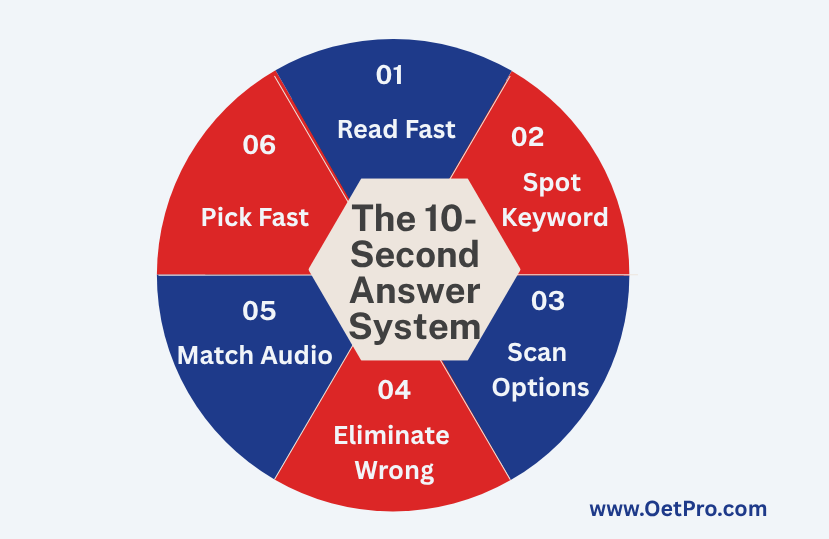
Daily Improvement Method (15-Min Practice)
Follow this routine:
- 5 MCQs (Part B sets)
- Review explanations
- Identify trap patterns
- Repeat weak questions
Consistency builds accuracy
Summary: What You Must Remember
OET Listening Part B is not about details.
It is about meaning, purpose, and workplace intent.
To succeed, always remember:
- You are answering WHY something is said
- Not WHAT exact words are used
- Not small details
Think like a healthcare professional, not a language learner.
Final Checklist (Exam Ready)
Before Listening
- Read question stem carefully
- Identify workplace situation
- Predict purpose (update, instruction, suggestion)
During Listening
- Focus on meaning, not words
- Identify speaker intention
- Ignore distractors and extra comments
- Follow tone and context
After Listening
- Choose most logical option
- Avoid overthinking
- Trust first correct interpretation
Common Error Summary
Avoid these final mistakes:
- Choosing based on keywords
- Overthinking MCQs
- Ignoring tone
- Getting distracted by extra information
- Focusing on details instead of purpose
FAQs (Exam Focused)
1. Is OET Listening Part B difficult?
It feels difficult only if you focus on words.
If you focus on purpose and meaning, it becomes much easier.
2. How many questions are in Part B?
There are 6 short extracts, each with MCQs.
3. What is the most important skill?
- Understanding speaker intention
- Not vocabulary or spelling
4. Should I take notes in Part B?
No.
Focus fully on listening and MCQ options.
5. How can I improve fast?
Practice:
- workplace conversations
- MCQ elimination
- listening for purpose
7-Day Improvement Plan (Part B Mastery)
Day 1–2
- Understand format
- Learn purpose-based listening
Day 3–4
- Practice MCQ elimination
- Identify distractors
Day 5
- Full Part B practice sets
- Review mistakes
Day 6
- Timed listening test
Day 7
- Final revision + weak areas
Conclusion
OET Listening Part B becomes easy when you stop treating it like a vocabulary test.
Instead:
- Listen for intent
- Think in workplace logic
- Choose based on meaning
This shift alone can improve your score significantly. Mastering Part B is an important step, but your final listening score depends on how well you handle the entire test as a complete system. Start with OET Listening Mastery Complete Guide for Healthcare Professionals.