
OET Listening High-Score Improvement Loop (2026): Complete System to Move from 250 to 350+
Introduction
Most OET Listening candidates reach a score plateau around 250–300 and struggle to move beyond it. The main reason is not lack of effort, but lack of a structured improvement system.
Many candidates repeat the same cycle:
- Take a mock test
- Check answers
- Move to next test
- Repeat the same mistakes
This creates the illusion of practice, but no real progress happens.
To reach 350+, you need a closed-loop improvement system, not random practice. A system where every test produces measurable improvement in listening accuracy, understanding, and decision-making. Improving your OET Listening score from 250 to 350 requires structured practice, but real progress also depends on applying full exam simulation under real test conditions. You can strengthen this using OET Listening Mock Test Strategy: Full Exam Simulation.
This lesson introduces the High-Score Improvement Loop, a structured method used by top performers to convert every mock test into score growth.
Error classification is essential for improving OET Listening scores, but your real progress comes when you practice full mock tests under real exam conditions. You can apply this in OET Listening Mock Test Strategy: Full Exam Simulation.
Learning Objectives
By the end of this lesson, you will be able to:
- Understand why most candidates stay stuck at 250–300
- Learn the High-Score Improvement Loop system
- Convert mock tests into structured progress cycles
- Improve accuracy in Part A, B, and C systematically
- Build a repeatable 350+ scoring strategy
Overview: Why Improvement Stalls at Mid Scores
At intermediate level, most students:
- Do enough practice but without structure
- Repeat tests instead of analyzing them
- Do not track error patterns
- Do not adjust strategy based on performance
Result: Performance remains flat despite effort.
The missing element is not practice it is feedback-based improvement control. Understanding your mistakes is important, but you must also test yourself in full-length listening exams to see how these errors appear under real pressure. This system is explained in OET Listening Mock Test Full Exam Strategy Guide.
A score improvement loop works best when combined with regular mock tests that help you measure performance and identify weak areas in real exam conditions. This system is explained in OET Listening Mock Test Full Exam Simulation Strategy Guide.
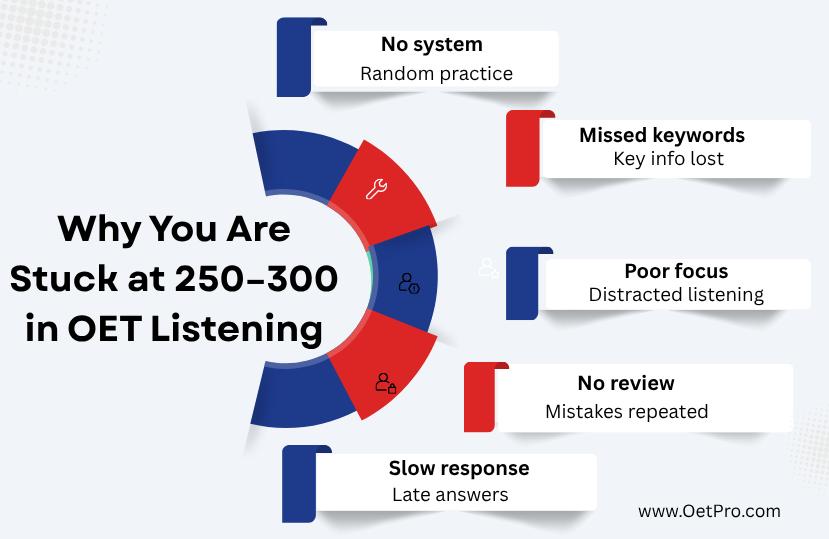
Common Mistakes (Why You Stay Stuck)
Mistake 1: Random Mock Test Practice
Students:
- Take tests whenever they feel like it
- Do not follow a system
Result:
No structured improvement pattern
Mistake 2: No Feedback Integration
Students:
- Check answers
- Do not analyze deeply
- Do not change strategy
Result:
Same mistakes repeat
Mistake 3: Ignoring Weak Areas
Students:
- Focus only on full tests
- Never isolate weak skills
Result:
Weak areas remain weak
Mistake 4: No Progress Tracking
Students:
- Do not measure improvement
- Do not compare test performance
Result:
No awareness of growth. Many candidates lose marks because they only analyze mistakes but do not practice enough full mock tests to apply improvements in real conditions.
Avoid this with OET Listening Mock Test Master Guide for Exam Success.
Core Teaching Framework: The Closed Improvement Loop
Most candidates think improvement happens by doing more practice.
High scorers understand something different:
Improvement happens only when every test improves the next test
This is called the High-Score Improvement Loop System.
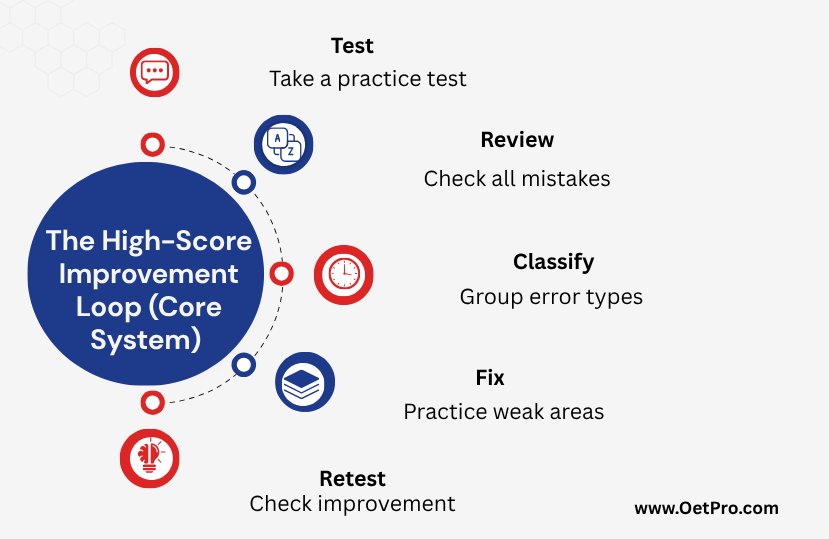
It is a 4-step continuous cycle:
- Test - Analyze - Correct - Retest
If any step is missing, your score stays flat.
STEP 1: TEST (Controlled Simulation Phase)
This is where most students stop but here it is only the beginning.
What you must do:
- Attempt full OET Listening mock test
- No pauses, no repetition
- Strict exam timing
- Treat it like real OET exam
Purpose:
- Build real exam pressure control
- Identify natural performance level
- Capture real mistakes
This step does NOT improve your score directly. It only reveals your weaknesses.
To move from 250 to 350, you must combine continuous improvement techniques with full-length mock test practice for real exam readiness. You can apply this using OET Listening Mock Test Practice & Score Improvement System.
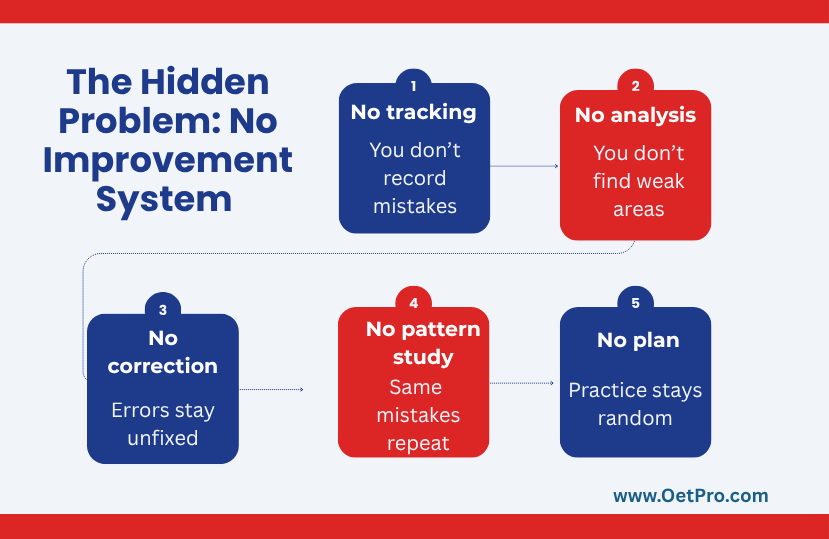
STEP 2: ANALYZE (Error Intelligence Phase)
This is the most important stage in the entire system.
You do not check answers casually you perform structured analysis.
What you must do:
- Review every wrong answer
- Identify error type:
- Keyword Miss
- Meaning Misinterpretation
- Distractor Trap
- Timing Pressure
- Write down patterns
Purpose:
- Understand WHY mistakes happen
- Identify repeated weaknesses
- Detect score-blocking patterns
Without this step, improvement is impossible.
STEP 3: CORRECT (Targeted Skill Repair Phase)
This is where real improvement begins.
Instead of repeating full tests, you fix specific weaknesses.
What you must do:
- Re-listen only to weak sections
- Focus on missed question types
- Practice paraphrasing for meaning errors
- Train keyword spotting for Part A
- Practice inference for Part C
Purpose:
- Convert mistakes into skills
- Strengthen weak areas only
- Improve efficiency of learning
This step directly increases score potential.
STEP 4: RETEST (Validation Phase)
This step checks whether your correction worked.
What you must do:
- Take a new mock test OR similar section test
- Apply corrected strategies
- Compare error types with previous test
Purpose:
- Measure improvement
- Validate correction effectiveness
- Track progress objectively
To reach a 350+ score, you must combine error analysis with consistent mock test practice to build accuracy and exam confidence together. You can achieve this using OET Listening Mock Test Practice & Score Improvement System.
The Full Improvement Loop
Your complete cycle looks like this:
TEST
-> Find real weaknesses
ANALYZE
-> Understand mistake patterns
CORRECT
-> Fix weak skills
RETEST
-> Measure improvement
Then repeat the loop again.
Why Most Students Stay Stuck (Loop Failure)
Students fail because they break the loop:
- They TEST but do not ANALYZE
- They ANALYZE but do not CORRECT
- They CORRECT but do not RETEST
Result: No measurable improvement.
Advanced Loop Optimization: Making the System Faster and More Accurate
Once you understand the basic Test - Analyze - Correct - Retest loop, the next step is not just repeating it, but optimizing it for speed and precision.
Most candidates improve slowly because their loop is too “heavy”:
- Too much full test repetition
- Too little focused correction
- Too slow feedback cycles
High scorers compress the loop into a fast learning cycle where each mistake is corrected immediately and reused in the next attempt.
The goal is simple:
reduce time between mistake and correction
High-Score Optimization Techniques
1. Micro-Loop Training (Fast Correction System)
Instead of waiting for full test completion:
- Stop after each section (A, B, or C)
- Immediately review that section
- Identify errors instantly
- Fix weak question type before moving on
This prevents repeated mistakes within the same test.
2. Error Clustering System
Instead of treating mistakes individually, group them:
- All keyword misses together
- All meaning errors together
- All distractor traps together
- All timing issues together
This helps you identify dominant weakness patterns faster
3. Weak Skill Isolation
High scorers do NOT repeat full tests when weak.
They isolate skills:
- Part A -> medical detail extraction drills
- Part B -> purpose recognition practice
- Part C -> inference listening training
This reduces wasted practice time.
Examiner Insight: Why Students Plateau at 250–300
From an examiner perspective, mid-score candidates show a very clear pattern:
- They understand basic English well
- But they fail under complex decision conditions
- They rely on keywords instead of meaning
The biggest issue is not listening ability it is decision accuracy under pressure.
Examiners design questions so that:
- Multiple options sound correct
- Only one option matches exact intent
- Small wording differences change meaning completely
This is why many students feel “I understood everything but still got it wrong.” Your listening performance improves when you apply error correction techniques while regularly attempting full mock tests. This approach is explained in OET Listening Full Mock Test Simulation Strategy.
Your listening performance improves significantly when each cycle of the improvement loop is tested through full exam simulations. This approach is explained in OET Listening Full Mock Test Simulation Strategy.
Speed Improvement System (From Slow to Real-Time Thinking)
To move from 250 -> 350+, you must improve processing speed, not just accuracy.
Key Training Shift:
- From “understanding after audio”
- To “processing during audio”
Speed Training Methods:
- Practice 10–15 second audio segments
- Train immediate answer prediction
- Reduce internal translation
- Focus on meaning recognition, not sentence structure
Real-Time Listening Skill
High scorers develop:
- Instant keyword recognition
- Fast paraphrase mapping
- Immediate elimination of wrong options
This reduces hesitation during exam pressure.
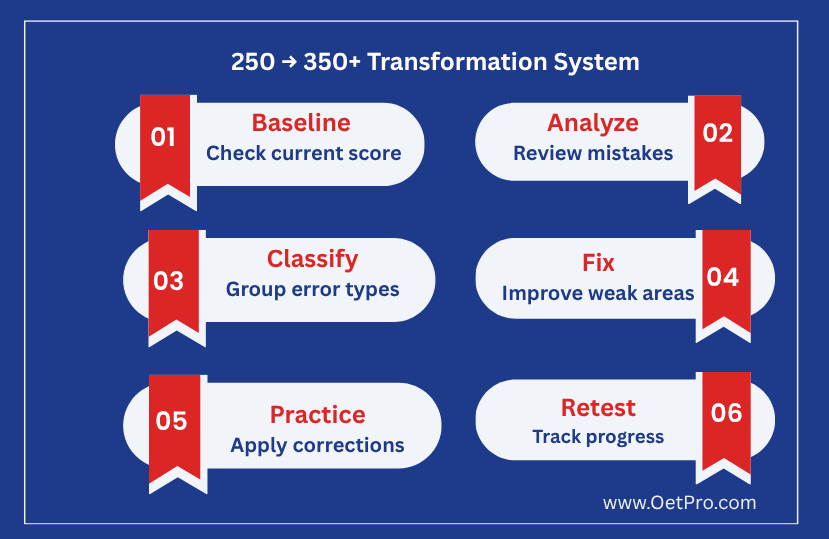
Real Score Transformation Pattern
Candidates who successfully apply this system usually follow this progression:
Stage 1 (250 Level)
- Random mock tests
- No analysis system
- Repeated mistakes
Stage 2 (270–300 Level)
- Basic error awareness
- Some analysis
- Partial improvement loop
Stage 3 (300–330 Level)
- Structured loop system active
- Weak areas identified
- Targeted correction applied
Stage 4 (330–350+ Level)
- Fast micro-loops
- Precision correction
- Strong inference + accuracy balance
Summary
The OET Listening High-Score Improvement Loop is a structured system designed to replace random practice with measurable progress.
Instead of repeatedly taking mock tests without direction, you follow a controlled cycle:
Test - Analyze - Correct - Retest
Each stage has a specific function:
- Test reveals real weaknesses under exam pressure
- Analyze identifies exact error patterns
- Correct fixes targeted skill gaps
- Retest validates improvement
When this loop is applied correctly, every mock test becomes a stepping stone toward a higher score instead of just another practice attempt.
The key principle is simple:
Improvement happens only when mistakes are converted into targeted corrections.
Final Checklist (Before & After Every Mock Test)
Before Test
- Treat test as real OET exam simulation
- No pauses, no replay, no distractions
- Prepare for full concentration mode
- Focus on listening for meaning, not words
During Test
- Predict question type before audio starts
- Focus only on relevant information
- Avoid overthinking or translating
- Stay calm under time pressure
- Trust first understanding
After Test (Most Important Stage)
- Identify all wrong answers
- Classify errors:
- Keyword Miss
- Meaning Misinterpretation
- Distractor Trap
- Timing Pressure
- Find repeated patterns
- Do NOT immediately repeat full test
Correction Stage
- Re-listen only weak sections
- Practice only weak question types
- Focus on paraphrasing and inference training
- Avoid unnecessary full test repetition
FAQs
1. Why am I not improving even after many mock tests?
Because you are repeating tests without completing the improvement loop (analysis and correction are missing).
2. How long does it take to see improvement with this system?
Most candidates see noticeable improvement in 1–2 weeks if the loop is followed properly.
3. Should I focus more on practice or analysis?
Analysis and correction are more important than practice itself.
4. Can this system help reach 350+?
Yes, because it improves accuracy, decision-making, and timing control together.
5. What is the biggest mistake students make?
They stop at “Test” stage and ignore the rest of the loop.
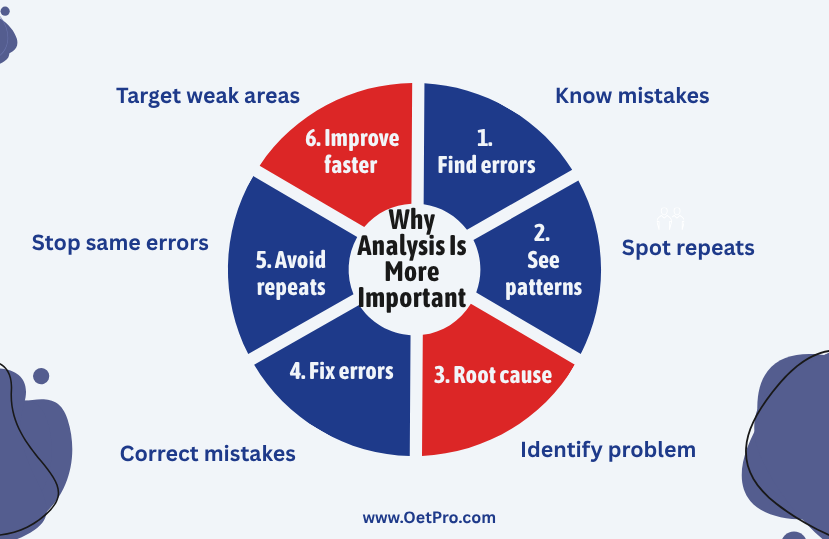
7-Day Loop Practice Plan (Score Improvement Cycle)
Day 1 — Full Mock Test (Simulation)
- Complete test under real conditions
- No pauses or repetition
Day 2 — Deep Analysis
- Classify all errors
- Identify dominant mistake type
Day 3 — Targeted Correction
- Practice weak question types
- Focus on error-specific drills
Day 4 — Section Practice
- Focus on Part A OR Part B OR Part C
- Train weakest section only
Day 5 — Micro Mock Test
- Shorter test segments
- Apply corrected strategies
Day 6 — Reinforcement Practice
- Repeat weak audio types
- Strengthen paraphrasing + inference
Day 7 — Full Retest
- Full mock test again
- Compare results with Day 1
Conclusion
OET Listening improvement is not random it is engineered.
If you follow the improvement loop properly:
- You identify mistakes clearly
- You fix them systematically
- You retest to confirm progress
This turns your preparation into a controlled score-building system rather than repeated guessing. Error analysis becomes truly powerful only when combined with full exam simulation practice that strengthens real exam readiness. Start with OET Listening Complete Mock Test Strategy for High Scores
The real difference is simple:
- Average students practice more
- High scorers improve faster through structured loops