OET Listening Mock Tests Explained: How to Turn Practice into High Scores (350+)
OET Listening mock tests are one of the most misunderstood tools in exam preparation. Most healthcare professionals take them as simple practice activities where they listen to an audio, mark answers, check the key, and move on. While this feels productive, it does not actually build exam performance. As a result, many candidates repeatedly score the same range without any real improvement.
In reality, OET Listening mock tests are not practice exercises they are full exam simulation tools designed to train real test conditions. The actual exam demands fast comprehension of clinical conversations, workplace communication, and academic discussions, all delivered only once under strict timing. Mock tests are the only safe environment where you can replicate this pressure and learn how to respond accurately in real time.
The OET Listening mock test strategy is important for exam practice, but your performance depends on how strong your basic understanding of all listening parts is. A solid foundation is essential before simulation. You can build this foundation in OET Listening Foundations: Part A, B & C Complete Guide.
When used correctly, mock tests help you develop three critical abilities: listening accuracy under pressure, structured note-taking for clinical information, and quick decision-making without replaying audio. These are the exact skills required to reach a high score like 350+. OET Listening mock tests help you practice under real exam conditions, but real score improvement happens when you understand and fix your mistakes systematically. You can learn this in OET Listening Error Classification System: Identify, Analyze & Fix Mistakes for 350+ Score.
This lesson will show you how to stop using mock tests as simple practice and instead turn them into a performance training system that systematically improves your OET Listening score across Part A, Part B, and Part C.
The OET Listening mock test strategy helps you practice real exam conditions, but consistent score improvement requires a structured system that continuously fixes weak areas.
You can achieve this in OET Listening High Score Improvement Loop: 250 to 350 System.
OET Listening mock tests help you simulate real exam conditions, but success also depends on how well you manage time and stay focused under pressure during the test.
You can strengthen this in OET Listening Time Control & Focus Mastery: Stay Calm and Accurate Under Exam Pressure.
Learning Objectives
By the end of this lesson, you will be able to:
- Use OET Listening mock tests as full exam simulations
- Identify and correct listening errors systematically
- Improve accuracy in Part A, Part B, and Part C
- Develop timing control under exam pressure
- Build a structured performance improvement loop
Overview: How OET Listening Mock Tests Actually Work
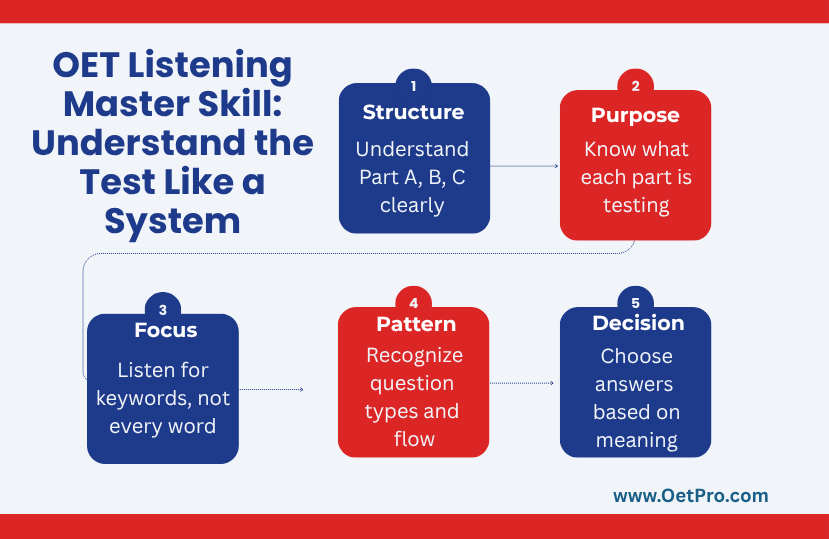
OET Listening is divided into three sections:
Part A — Consultation Task
- Clinical conversation (doctor–patient or nurse–patient)
- Requires fast note-taking
- Focus on facts: symptoms, history, treatment
Part B — Workplace Conversations
- Short extracts from healthcare settings
- Focus on purpose, opinion, or decision
- Multiple-choice questions
Part C — Presentation / Interview
- Longer academic or workplace discussion
- Focus on attitude, inference, and opinion
- Requires deep understanding of meaning
Full mock tests help you improve timing and accuracy, but they only work effectively when your core understanding of each listening part is strong and clear. This base system is explained in OET Listening Foundations Complete Guide (Part A, B & C).
Practicing full-length tests is important, but without analyzing your errors, it becomes difficult to improve accuracy and avoid repeating the same mistakes. This system is explained in OET Listening Error Classification Strategy Guide.
Full mock tests are important, but real improvement happens only when each attempt is analyzed and used to strengthen weak listening areas step by step.
This system is explained in OET Listening Score Improvement Loop (Complete 250–350 Strategy).
What Mock Tests Should Simulate
A real mock test must recreate:
- Real exam timing (no pauses)
- Audio pressure conditions
- One-time listening only
- No repetition or replay habit
- Strict answer transfer discipline
If your mock test does not simulate these conditions, it is not training your exam performance.
Full mock tests are useful, but without strong time control and focus skills, many students lose accuracy in real exam conditions. This system is explained in OET Listening Time Management and Focus Strategy Guide.
Common Mistakes Students Make
Most candidates fail to improve because they misuse mock tests.
Mistake 1: Treating Mock Tests as Practice Only
- Listening casually
- Not tracking errors
- No performance review
Result: Same mistakes repeat again and again
Mistake 2: Not Analyzing Errors
Students often:
- Check answers and move on
- Ignore WHY they got it wrong
- Never classify mistakes
Without analysis, improvement does not happen.
Mistake 3: Replaying Audio Multiple Times
In real OET exam:
- Audio plays only once
But students:
- Replay audio during practice
- Depend on second chances
This creates false confidence
Mistake 4: No Timing Discipline
Common behavior:
- Pause between sections
- Stop audio to think
- Slow response practice
In exam: this leads to time pressure failure
Mistake 5: Ignoring Part-Wise Weakness
Students treat Listening as one skill, but:
- Part A = accuracy + speed
- Part B = purpose recognition
- Part C = inference skill
Weakness in one part reduces total score significantly.
Many candidates lose marks because they directly jump into mock tests without first building a strong foundation for all listening parts. Avoid this mistake with OET Listening Foundations Master Guide (Part A, B & C).
Many candidates repeat the same mistakes because they only take mock tests without applying a structured improvement loop to fix weak areas. Avoid this with OET Listening Score Improvement System (250–350 Method).
To improve your OET Listening score, you must combine mock test practice with strong time control techniques and calm focus under pressure. You can apply this using OET Listening Focus & Time Control Mastery System (High Score Strategy).
Teaching Framework: The Mock Test Transformation System
To use OET Listening mock tests correctly, you must stop thinking in terms of “practice” and start thinking in terms of a 3-stage performance system.
Stage 1: Simulation (Exam Conditions)
You attempt the mock test exactly like the real exam:
- No pauses
- No replaying audio
- Strict timing discipline
- One-time listening only
- Answer selection in real time
Goal: Train your brain for real exam pressure.
Stage 2: Breakdown (Error Identification)
After completing the test, you do not immediately check answers casually. Instead, you classify every mistake.
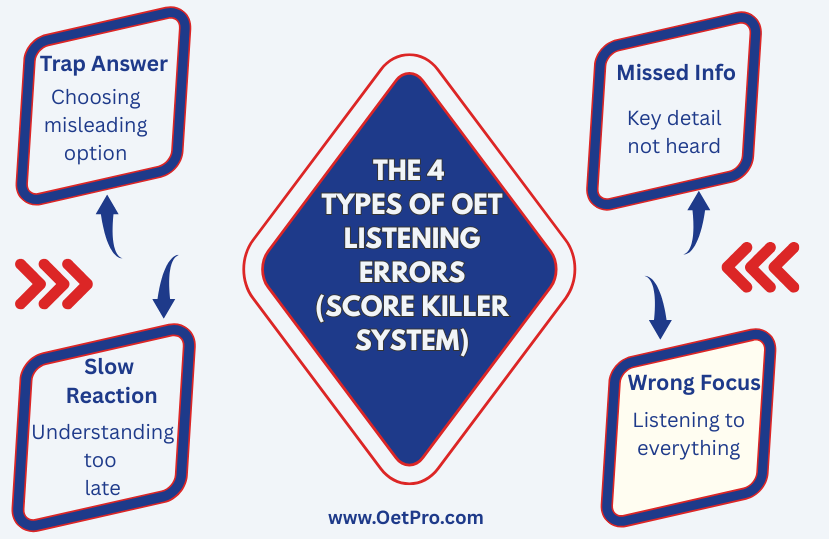
Errors are grouped into:
- Keyword Miss Error -> You missed a key word in audio
- Meaning Misinterpretation Error -> You understood incorrectly
- Distractor Trap Error -> You selected wrong option due to similarity
- Timing Error -> You ran out of time or rushed
- Note-Taking Error -> You failed to capture key clinical details
To improve your OET Listening score, you must combine mock test practice with strong foundational skills in note-taking, comprehension, and inference. You can build this system using OET Listening Foundations Strategy Guide for All Parts.
Goal: Understand why you lost marks.
Stage 3: Correction (Skill Repair Loop)
Once errors are identified, you rebuild weak areas:
- Re-listen only to problem sections (not full audio)
- Rewrite correct answers with reasoning
- Create keyword maps for missed questions
- Train weak question types separately
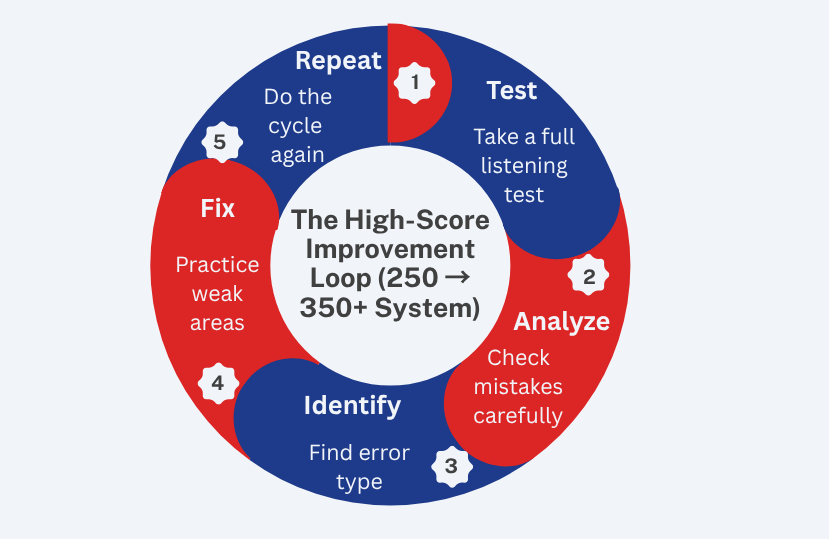
Goal: Convert mistakes into long-term improvement. To move from 250 to 350, you must follow a continuous improvement cycle where mock tests, analysis, and correction work together in a loop system. You can use OET Listening 250–350 Score Improvement Strategy Guide.
Core Strategy: How High Scorers Use Mock Tests
Top OET candidates do NOT take more mock tests they take smarter mock tests.
Strategy 1: One Test = One Learning Cycle
Each mock test is treated as a full training cycle:
- Attempt (Simulation)
- Review (Analysis)
- Fix (Correction)
- Retest (Validation)
Without this loop, mock tests become repetitive practice.
Strategy 2: Part-Wise Focus Training
Each section requires a different mental skill:
Part A (Clinical Accuracy Mode)
Focus on:
- Numbers, symptoms, medication, duration
- Fast note-taking
- Exact spelling and spelling recognition
Strategy:
- Write keywords, not full sentences
- Predict answer types before listening
Part B (Purpose Recognition Mode)
Focus on:
- Why something is being said
- Workplace decisions and intentions
Strategy:
- Identify tone (suggesting, informing, deciding)
- Eliminate options with similar meaning but wrong intent
Part C (Inference Mode)
Focus on:
- Attitude and opinion
- Indirect meaning
- Speaker intention
Strategy:
- Listen for emotional tone and emphasis
- Focus on “what is implied, not said directly”
Mock tests improve performance only when your understanding of each section is clear, especially Part A, B, and C fundamentals. These core skills are explained in OET Listening Foundations Complete System Guide.
To improve your OET Listening score, you must not only take mock tests but also classify and correct your errors to understand weak areas clearly. You can do this using OET Listening Mistake Analysis System for High Scores (350+).
Your listening performance improves significantly when every mock test is used as feedback for targeted improvement instead of just practice. This method is explained in OET Listening High Score Loop System for Continuous Improvement.
Your listening performance improves significantly when you stay calm, manage time effectively, and avoid panic during tricky sections of the exam. This method is explained in OET Listening Calmness and Accuracy Under Pressure Guide.
Real Exam Simulation Technique
To maximize mock test effectiveness, follow this exact structure:
Step 1: Full Exam Conditions
- Sit in quiet environment
- No interruptions
- No stopping audio
- Treat it like final exam
Step 2: Immediate Recall Notes (2 minutes only)
After each section:
- Write what you remember
- Mark difficult questions
- Do NOT check answers yet
Step 3: Deep Review Phase
Now analyze:
- Why did you choose each wrong answer?
- Which keywords misled you?
- Was it listening failure or understanding failure?
Example: How a Mistake Should Be Treated
Student Mistake:
In Part C, student chooses answer based on one keyword match.
Example:
Audio says: “The treatment is effective but slow.”
Student selects: “Treatment is fast and effective.”
Real Issue:
- Ignored contrast word “but”
- Misread meaning
- Focused only on keyword “effective”
Correct Fix Strategy:
- Train contrast signal recognition (but, however, although)
- Practice paraphrasing exercises
- Build “meaning vs keyword” awareness
Advanced Listening Improvement Strategy
At the advanced level, OET Listening improvement is not about “hearing more English.” It is about processing speed + meaning accuracy under pressure. Your listening performance improves significantly when you analyze errors from mock tests and convert them into targeted improvement steps. This method is explained in OET Listening Error Fixing & Analysis Guide.
High scorers do not listen passively. They actively train their brain to:
- Predict information type
- Filter irrelevant words
- Catch meaning shifts instantly
- Confirm answers using context
This is what separates 300-level candidates from 350+ scorers.
Core High-Score Listening Method
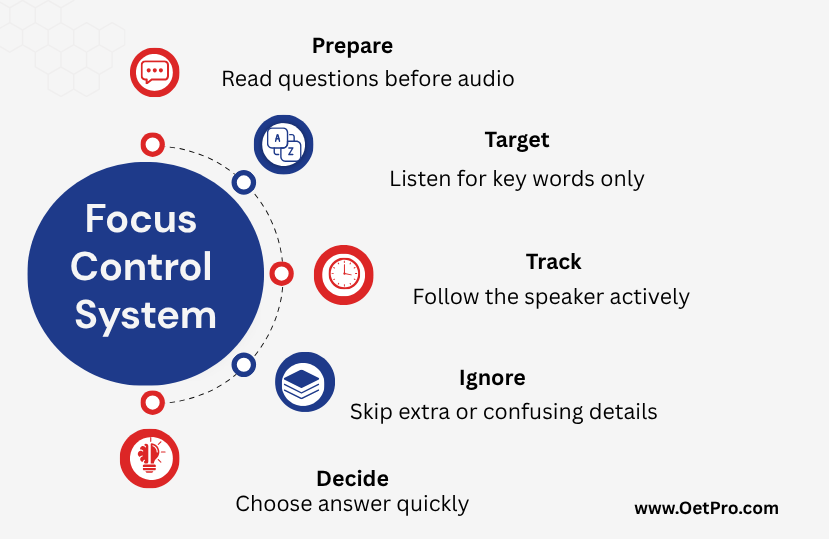
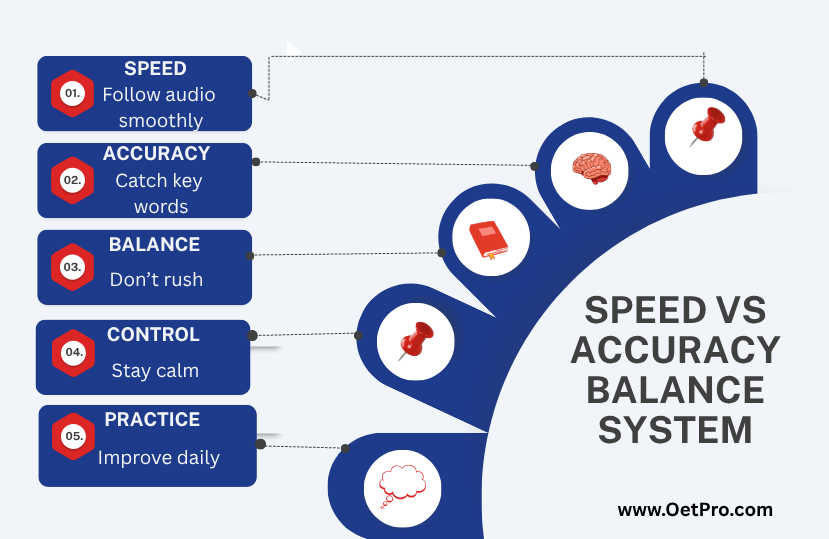
Use this 3-step mental system during every audio:
- Predict -> What type of answer is expected? (number, symptom, reason, opinion)
- Listen -> Focus only on relevant information
- Confirm -> Match meaning, not just keywords
This reduces confusion and increases accuracy in all parts. Many candidates lose marks because they know the content but cannot manage time or maintain focus during high-pressure listening sections. Avoid this with OET Listening Time Control Master Guide for Exam Success.
Examiner Insights: Why Students Lose Marks
From examiner patterns, most mistakes come from thinking errors, not English errors.
Main reasons candidates lose marks:
- Focusing on every word instead of key meaning
- Missing small clinical details in Part A
- Confusing purpose in Part B
- Misreading implied meaning in Part C
- Falling for distractor options that “sound correct”
How exam questions are designed
OET Listening questions are built with traps:
- Options are often all partially correct
- Only one matches exact intention or detail
- Distractors use similar vocabulary with different meaning
- Paraphrasing is heavily used to confuse learners
Success depends on precision listening, not general understanding.
Vocabulary System for High Scores
OET Listening vocabulary is not memorization it is meaning recognition training.
Common paraphrase patterns:
- “shortness of breath” -> difficulty breathing
- “prescribed medication” -> given treatment / medicine
- “worsening condition” -> symptoms getting worse
- “discharged” -> sent home from hospital
You must train your brain to instantly map meanings.
Signal Words (Very Important)
These words change meaning direction:
- however
- but
- although
- on the other hand
- whereas
Many candidates hear them but ignore their impact
High scorers treat them as meaning reversal signals
Practice Training System (High-Score Routine)
Mock tests should NOT be repeated randomly. Use a structured system:
Phase 1: Simulation Mode
- Full test under exam conditions
- No pauses or replay
- Strict timing control
- One-time listening only
Phase 2: Error Breakdown
After test completion:
- Identify wrong answers
- Classify error type:
- Listening error
- Meaning error
- Distractor trap
- Timing issue
- Mark weak question types
Phase 3: Targeted Repair
Instead of repeating full test:
- Re-listen only weak sections
- Focus on missed question types
- Train specific skills (not full exam again)
- Rebuild understanding of missed logic
Many candidates repeatedly lose marks because they take mock tests but never properly analyze their mistakes or understand error patterns. Avoid this with OET Listening Error Classification Master Guide.
Focused Improvement Rules
- Do NOT repeat full mock tests for the same mistakes
- Train weak question types separately
- Focus more on analysis than number of tests
- Reduce passive listening habits
- Build “meaning-first listening” mindset
Summary (What You Must Remember)
OET Listening mock tests are not practice materials. They are full exam simulation tools designed to train real performance under pressure.
Most candidates fail to improve because they:
- Only check answers
- Do not analyze mistakes
- Repeat tests without correction
High scorers use a completely different system. They treat every mock test as a 3-stage improvement cycle: simulation, breakdown, and correction. This transforms every mistake into a learning opportunity and gradually builds accuracy across Part A, Part B, and Part C.
The key idea is simple:
You do not improve by doing more tests.
You improve by analyzing and fixing every test properly.
Final Checklist (Before Your Next Mock Test)
Make sure you follow this system every time:
Before the Test
- Treat mock test as real exam
- No distractions or pauses
- Prepare mindset for one-time listening
During the Test
- Focus only on key information
- Do not try to understand every word
- Use prediction for question type
- Stay calm under time pressure
After the Test
- Identify wrong answers
- Classify error types:
- Listening error
- Meaning error
- Distractor trap
- Timing error
- Re-listen only weak sections
- Do NOT blindly repeat full test
FAQs
1. Are OET Listening mock tests enough to improve score?
No. Mock tests alone are not enough. Improvement comes from analysis + correction system, not repetition.
2. How many mock tests should I do?
Focus on fewer tests with deep analysis. Quality is more important than quantity.
3. Why do I keep repeating the same mistakes?
Because you are not classifying your errors. Without error breakdown, your brain repeats the same listening patterns.
4. What is the biggest mistake in OET Listening preparation?
Treating mock tests as practice instead of performance simulation training.
5. Can I reach 350+ using mock tests?
Yes, but only if you:
- Simulate real exam conditions
- Analyze every mistake
- Train weak areas separately
Practice Plan (7-Day Improvement System)
Day 1–2
- Take 1 full mock test
- Complete full error analysis
Day 3–4
- Focus only on weak question types
- Practice short audio segments
Day 5
- Retake another full mock test
- Compare improvement
Day 6
- Deep review of repeated mistakes
- Focus on Part C inference training
Day 7
- Final simulation test
- Evaluate progress pattern
Repeat cycle weekly for steady score growth.
Conclusion
OET Listening is not a test of how much English you know. It is a test of how well you perform under pressure. Mock test practice becomes truly effective only when supported by strong foundational knowledge of all listening sections. Start with OET Listening Foundations Complete Guide for Healthcare Professionals.
If you only practice, your score will stay stable.
If you simulate, analyze, and correct, your score will grow.
Mock tests become powerful only when combined with structured error analysis and continuous improvement based on your mistakes. Start with OET Listening Complete Error Classification System for High Scores.
Mock test practice becomes powerful only when combined with a continuous improvement loop that steadily upgrades your listening accuracy and score. Start with OET Listening Complete High Score Improvement System for 250–350.
Mock test success depends not only on practice but also on your ability to stay focused and control time under real exam pressure. Start with OET Listening Complete Time Control & Focus Strategy for High Scores.
The difference between average and high scorers is simple:
- Average students take mock tests
- High scorers train with mock tests