OET Listening Error Classification System (2026): Identify, Analyze & Fix Mistakes for 350+ Score
Introduction
Many healthcare professionals preparing for OET Listening face a frustrating problem: they practice regularly, take multiple mock tests, and still see no significant improvement in their scores.
The reason is simple but critical.
They focus on answers, not on errors.
In OET Listening, improvement does not come from doing more tests. It comes from understanding why you are making mistakes. Every wrong answer contains valuable information about your listening habits, attention patterns, and decision-making under pressure.
Without a structured way to identify and classify mistakes, your brain continues repeating the same patterns. This is why many candidates remain stuck at the same score level despite consistent effort. Understanding the foundations of OET Listening is essential, but your final score depends on how well you perform under real exam conditions using full mock tests and timing practice. You can improve this in OET Listening Mock Test Strategy: Full Exam Simulation.
This lesson introduces a powerful system called the Error Classification System, which helps you break down your mistakes into clear categories and fix them systematically. Instead of guessing what went wrong, you will learn to diagnose your performance like a healthcare professional diagnosing a patient.
Learning Objectives
By the end of this lesson, you will be able to:
- Identify different types of OET Listening errors
- Understand why each type of mistake happens
- Classify your mistakes using a structured system
- Apply targeted correction strategies for each error type
- Build a personal error analysis framework for score improvement
Overview: Why Error Classification is Essential
OET Listening is not random. Your mistakes follow patterns.
Most candidates make repeated errors such as:
- Missing keywords
- Misunderstanding meaning
- Falling into distractor traps
- Losing focus under time pressure
Without classification:
- All mistakes look the same
- No clear improvement strategy exists
With classification:
- You identify exact weaknesses
- You apply targeted solutions
- You improve faster with fewer mock tests
Think of this as a diagnostic system for your listening performance. Strong basics in Part A, B, and C are important, but they must be applied in full-length exam simulations to build real test readiness and accuracy. This system is explained in OET Listening Mock Test Full Exam Strategy Guide.
Common Mistakes Students Make
Mistake 1: Only Checking Correct Answers
Students often:
- Look at correct answers
- Compare with their answers
- Move to the next test
Problem:
No learning happens because the reason for the mistake is ignored.
Mistake 2: No Error Tracking System
Most candidates:
- Do not record mistakes
- Do not identify patterns
- Do not track improvement
Result:
Same mistakes repeat across multiple tests.
Mistake 3: Blaming “Difficult Audio”
Students assume:
- “Audio was too fast”
- “Accent was difficult”
Reality:
The issue is usually:
- Attention failure
- Meaning misunderstanding
- Lack of strategy
Mistake 4: Repeating Tests Without Fixing Errors
Candidates:
- Take another mock test immediately
- Expect improvement automatically
Result:
Performance remains the same because the root problem is not solved.
Many candidates lose marks because they focus only on theory and do not practice full mock tests under real exam conditions. Avoid this with OET Listening Mock Test Master Guide for Exam Success.
Core Teaching Framework: The Error Diagnosis System
To improve your OET Listening score, you must think like a healthcare professional.
Just as you would not treat a patient without diagnosis, you should not try to improve your score without identifying the exact problem.
Every mistake has a cause
Every cause needs a specific correction
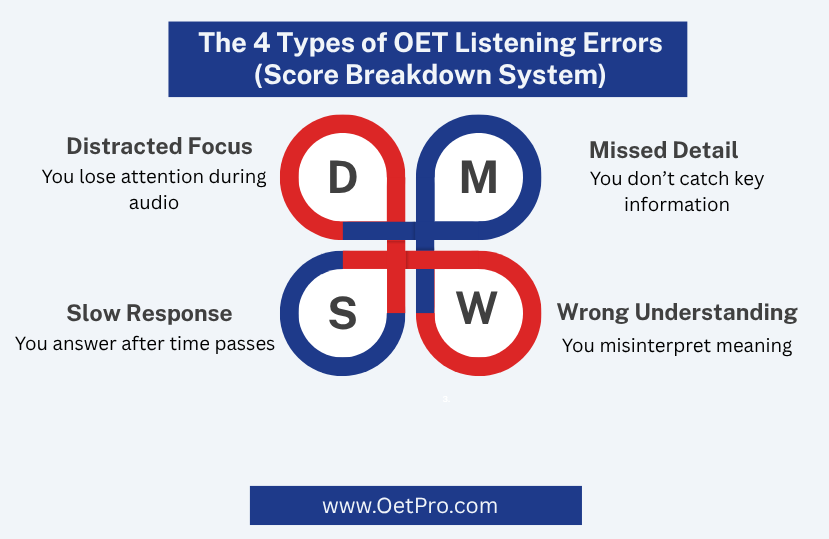
This lesson introduces a 4-Type Error Classification Model that helps you diagnose and fix mistakes systematically.
To improve your OET Listening score, you must combine foundational skills with full mock test practice that simulates real exam pressure and timing. You can achieve this using OET Listening Mock Test Practice & Score Improvement System.
The 4 Core Error Types in OET Listening
All OET Listening mistakes can be grouped into four major categories.
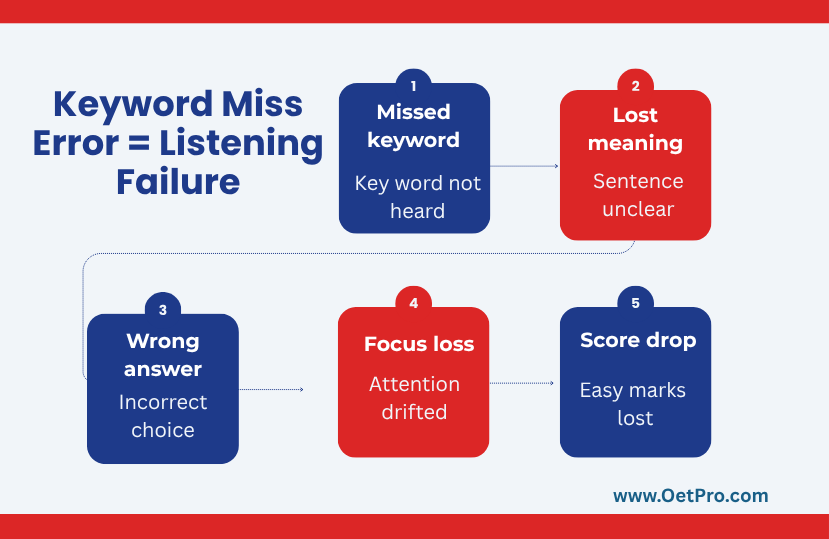
Error Type 1: Keyword Miss Error (Listening Failure)
This happens when you do not hear or capture important information.
Why it happens:
- Audio moves too fast
- Lack of focus
- Weak note-taking in Part A
- Missing numbers, names, or key terms
Impact:
- Common in Part A
- Leads to direct loss of marks
Correction Strategy:
- Train short listening bursts (10–20 seconds)
- Practice keyword spotting (symptoms, dates, medication)
- Improve note-taking speed
- Focus on “what matters,” not full sentences
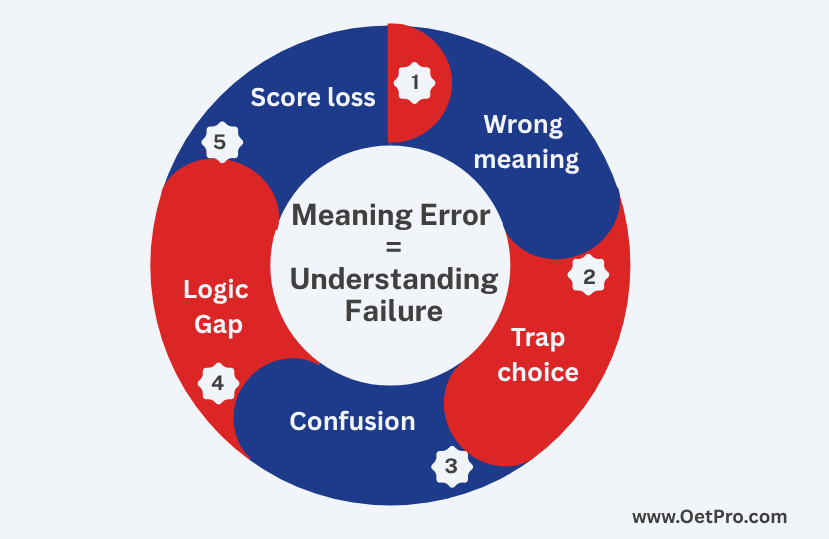
Error Type 2: Meaning Misinterpretation (Understanding Failure)
This happens when you hear the words but misunderstand the meaning.
Why it happens:
- Weak paraphrasing recognition
- Translating word-by-word
- Ignoring context of sentence
Impact:
- Common in Part B and Part C
- Leads to selecting “almost correct” answers
Correction Strategy:
- Practice paraphrasing exercises
- Focus on sentence meaning, not individual words
- Train “meaning-first listening”
- Compare similar expressions with different meanings
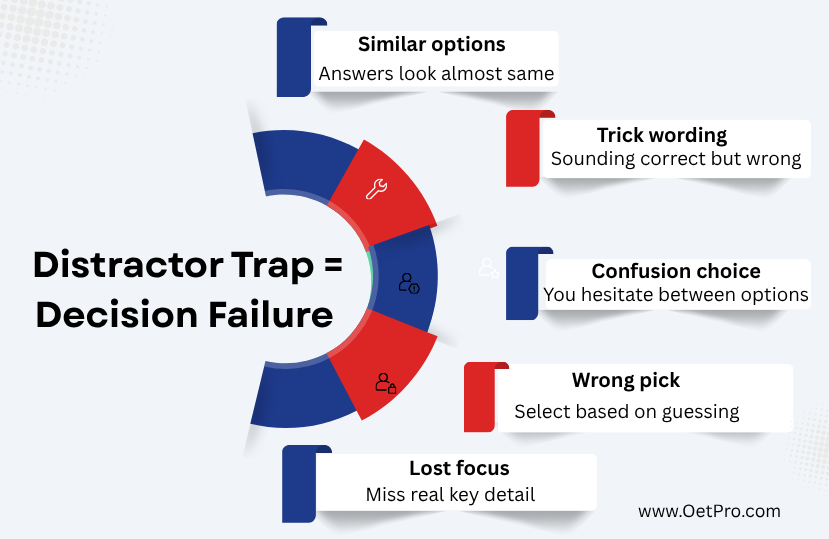
Error Type 3: Distractor Trap Error (Decision Failure)
This happens when you choose an option that sounds correct but is not accurate.
Why it happens:
- Over-reliance on keywords
- Not reading options carefully
- Ignoring small differences in meaning
Impact:
- Very common in Part B and Part C
- Major reason for score stagnation
Correction Strategy:
- Learn to eliminate wrong options
- Compare options carefully before selecting
- Focus on exact intention, not similarity
- Train with “why this is wrong” analysis
Error Type 4: Timing & Pressure Error (Performance Failure)
This happens when your performance drops due to time pressure.
Why it happens:
- Lack of exam simulation
- Panic or stress during listening
- Losing focus mid-audio
Impact:
- Affects all parts
- Reduces accuracy even when you know the answer
Correction Strategy:
- Practice full tests under real conditions
- Build concentration endurance
- Train without pause or replay
- Improve mental calmness during listening
Your listening performance improves significantly when you practice full tests after understanding the core structure of all listening sections. This approach is explained in OET Listening Full Mock Test Simulation Strategy.
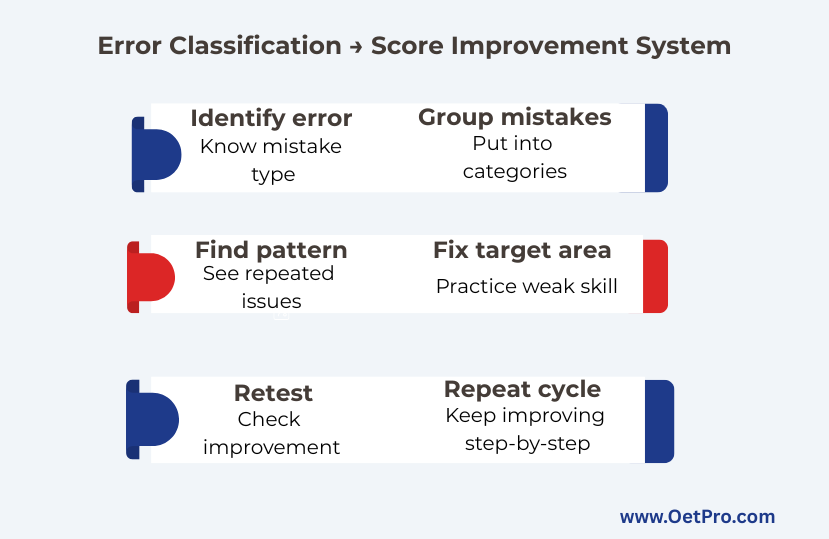
Error Classification Model (Simple System)
After every mock test, follow this process:
Step 1: Identify Wrong Answers
- Mark all incorrect questions
Step 2: Assign Error Type
For each mistake, ask:
- Did I miss the word? -> Keyword Error
- Did I misunderstand meaning? -> Meaning Error
- Did I fall for a trap? -> Distractor Error
- Did pressure affect me? -> Timing Error
Step 3: Record Pattern
- Count how many errors in each category
- Identify your dominant weakness
Example of Error Classification
A student gets 10 wrong answers:
- 4 Keyword Miss Errors
- 3 Meaning Errors
- 2 Distractor Errors
- 1 Timing Error
Interpretation:
- Main problem = Listening accuracy
- Secondary problem = Meaning understanding
Action:
- Focus training on Part A + paraphrasing
- Reduce full test repetition
Strategy Integration: Part-Wise Error Focus
Each part is more sensitive to specific errors:
- Part A -> Keyword + Note-taking errors
- Part B -> Meaning + Distractor errors
- Part C -> Meaning + Inference + Distractor errors
This helps you train smarter, not harder.
Advanced Error Analysis: Going Beyond Basic Classification
Once you start classifying errors into the four types, the next step is to go deeper and understand patterns inside each error.
At this stage, improvement comes from asking better questions:
- When exactly did I lose focus?
- What kind of questions do I consistently get wrong?
- Is my problem listening, meaning, or decision-making?
Instead of just labeling errors, you now analyze triggers.
Error Trigger Analysis (High-Score Technique)
Every mistake has a trigger. Identifying it helps you fix the root problem.
Common triggers include:
- Fast speech speed -> leads to keyword miss
- Long sentences -> causes meaning confusion
- Similar options -> leads to distractor trap
- Complex tone -> affects inference in Part C
Your goal is to identify what kind of audio or question causes your mistakes.
Examiner Patterns: How Traps Are Designed
OET examiners follow predictable patterns when designing wrong answer options.
Understanding these patterns gives you a major advantage.
Pattern 1: Keyword Matching Trap
- Option contains same word as audio
- But meaning is different
Example:
Audio: “The patient may require surgery.”
Option: “The patient requires surgery.”
Looks correct -> Actually wrong
Pattern 2: Partial Truth Trap
- Option is partly correct
- But misses key detail
Example:
Audio: “The medication helps but causes side effects.”
Option: “The medication is effective.”
Incomplete -> Wrong
Pattern 3: Opposite Meaning Trap
- Option reverses meaning
Example:
Audio: “The condition is not serious.”
Option: “The condition is serious.”
Small change -> Big impact
Pattern 4: Overgeneralization Trap
- Option sounds logical but not stated
Example:
Audio: “Some patients improve with therapy.”
Option: “All patients improve with therapy.”
Sounds reasonable -> Not accurate
Vocabulary Trap System (Paraphrasing Awareness)
At higher levels, OET Listening becomes a paraphrasing test.
Common Trap Types:
- Direct word vs indirect meaning
- Simple term vs medical term
- Positive tone vs neutral tone
- Suggestion vs decision
Examples of Vocabulary Mapping:
- “pain relief” -> symptom improvement
- “treatment adjusted” -> change in medication
- “unlikely outcome” -> low probability
- “recommended” -> suggested (not required)
High scorers quickly match meaning, not words.
Targeted Practice System (Advanced Level)
At this stage, you must stop practicing randomly.
Use a precision training system based on your error data.
Step 1: Identify Weak Error Type
Example:
- 60% errors = Meaning Misinterpretation
Step 2: Isolate Skill
Instead of full tests:
- Practice only meaning-based questions
- Use short audio clips
- Focus on paraphrasing
Step 3: Rebuild Skill
- Listen -> pause -> explain meaning
- Compare similar sentences
- Practice inference questions
Step 4: Re-test
- Take a new mock test
- Check if error type reduced
Smart Practice Rules
- Do NOT repeat full tests without analysis
- Focus on weakest error category first
- Practice short, targeted exercises
- Track improvement after each cycle
- Train Part A, B, C separately if needed
Summary (What You Must Remember)
Improving your OET Listening score is not about doing more mock tests it is about understanding your mistakes at a deeper level.
This lesson introduced the Error Classification System, which breaks every mistake into four types:
- Keyword Miss (Listening Failure)
- Meaning Misinterpretation (Understanding Failure)
- Distractor Trap (Decision Failure)
- Timing & Pressure (Performance Failure)
When you classify your errors, you move from guessing to diagnosing. This allows you to apply targeted corrections instead of repeating the same practice patterns.
The biggest shift is this:
Stop focusing on correct answers
Start focusing on why answers go wrong
That is where real score improvement begins.
Final Checklist (After Every Mock Test)
Use this checklist every time you complete a listening test:
Step 1: Identify Mistakes
- Mark all incorrect answers clearly
- Do not rush to the next test
Step 2: Classify Errors
For each wrong answer, ask:
- Did I miss the keyword?
- Did I misunderstand the meaning?
- Did I fall into a distractor trap?
- Did pressure affect my performance?
Step 3: Find Patterns
- Count number of errors in each category
- Identify your strongest weakness
Step 4: Apply Correction
- Focus only on weak error types
- Practice targeted listening exercises
- Avoid repeating full tests immediately
Step 5: Re-test Strategically
- Take a new mock test after correction
- Check if error pattern improves
Many candidates fail to improve because they focus only on improvement techniques but do not practice enough full mock tests under real exam conditions. Avoid this with OET Listening Mock Test Master Guide for Exam Success.
FAQs
1. Why am I not improving even after many mock tests?
Because you are not analyzing your mistakes. Without error classification, your brain repeats the same patterns.
2. Which error type is the most common?
Meaning misinterpretation and distractor traps are the most common in Part B and Part C.
3. Can I fix all errors at once?
No. Focus on one dominant error type at a time for faster improvement.
4. How often should I analyze mistakes?
After every mock test. Analysis is the most important step in improvement.
5. How long does it take to see improvement?
If you apply this system correctly, you can see noticeable improvement within 1–2 weeks.
Practice Plan (Error-Based 7-Day System)
Day 1: Full Mock Test
- Attempt under exam conditions
- No pauses or repetition
Day 2: Error Analysis
- Classify all mistakes
- Identify dominant error type
Day 3–4: Targeted Training
- Practice only weak error category
- Use short audio clips and focused exercises
Day 5: Reinforcement
- Revisit similar questions
- Check improvement in understanding
Day 6: Mixed Practice
- Practice Part A, B, and C with focus on corrected skill
Day 7: Re-test
- Take new full mock test
- Compare error pattern with Day 1
Conclusion
OET Listening improvement is not random it is systematic.
If you:
- Ignore mistakes -> your score stays the same
- Understand mistakes -> your score improves
The Error Classification System gives you a clear roadmap. Instead of guessing what went wrong, you now have a method to diagnose, correct, and improve continuously.
Strong foundations are important, but real success comes from applying them in full mock test simulations that mirror the actual OET exam. Start with OET Listening Complete Mock Test Strategy for High Scores. True score improvement happens when continuous learning is combined with full exam simulation practice that strengthens real test performance. Start with OET Listening Complete Mock Test Strategy for High Scores.
The difference between average and high scorers is clear:
- Average students take tests
- High scorers learn from every mistake