OET Listening Time Control & Focus Mastery (2026): How to Stay Calm and Accurate Under Exam Pressure
Introduction
One of the biggest reasons candidates lose marks in OET Listening is not lack of understanding, but loss of focus under time pressure.
Many candidates start the exam well but gradually:
- Miss key details in Part A
- Lose concentration in Part B
- Become mentally exhausted in Part C
This happens because OET Listening is not just a language test it is a mental endurance and focus control test.
Even candidates with good English struggle because they cannot maintain:
- Continuous attention
- Emotional control under pressure
- Consistent listening accuracy across all three parts
This lesson teaches you how to build time control and focus stability, so you can perform consistently from start to finish without mental breakdown or distraction.
Learning Objectives
By the end of this lesson, you will be able to:
- Maintain focus across all three parts of OET Listening
- Control mental pressure during fast audio sections
- Avoid concentration drops in long listening tasks
- Improve accuracy under real exam timing conditions
- Build sustainable attention endurance for full test performance
Overview: Why Time Control Matters in OET Listening
OET Listening is structured in increasing difficulty:
- Part A -> Fast clinical detail capture
- Part B -> Workplace decision understanding
- Part C -> Long inference-based listening
As difficulty increases, mental fatigue also increases.
Most candidates lose marks not because they cannot understand English, but because:
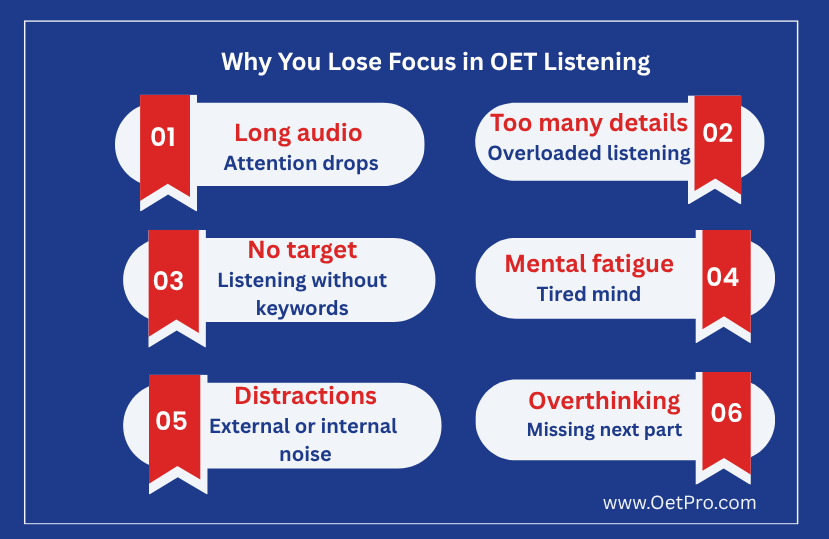
- Their attention breaks in the middle
- They panic when they miss one answer
- They lose focus on following questions
OET Listening is a test of consistent attention, not just comprehension
Common Mistakes (Focus & Time Problems)
Mistake 1: Mental Panic After Missing One Answer
Students often:
- Miss one question
- Panic and lose focus
- Miss next 2–3 answers
Result: Score drops sharply even if understanding is good
Mistake 2: Over-Focusing on Previous Question
Candidates:
- Think about previous answer while audio continues
- Lose track of current information
Result: “Mental lag” effect
Mistake 3: Inconsistent Attention Across Parts
Students:
- Strong in Part A
- Weak in Part C due to fatigue
Result: uneven scoring pattern
Mistake 4: Emotional Reaction During Exam
Candidates:
- Get frustrated when confused
- Lose confidence mid-exam
- Stop actively listening
Result: breakdown in performance flow.
Core Teaching Framework: The Focus Control System
OET Listening is not only a test of understanding it is a test of continuous attention control under time pressure.
Most candidates fail because their focus moves uncontrollably:
- They get stuck on one missed answer
- They lose attention during fast sections
- They mentally “disconnect” in Part C
High scorers do something different.
They follow a structured Focus Control System that manages attention like a resource.
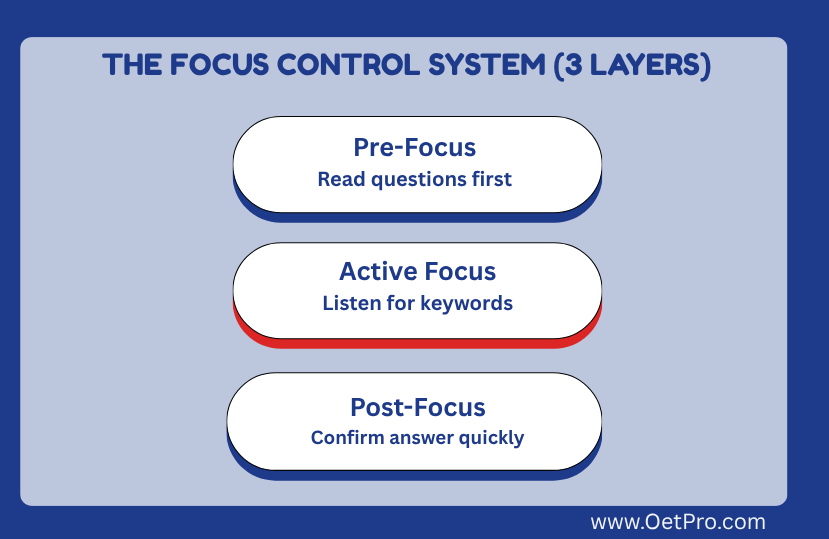
The Time-Control Listening Model (3 Layers)
To maintain performance across the full test, you must train three levels of control:
Layer 1: Micro Focus (Question-Level Attention)
This is the smallest unit of focus.
You train your brain to:
- Focus only on the current question
- Ignore previous questions completely
- Listen for one answer at a time
Rule: One question = one mental target
Layer 2: Section Focus (Part-Level Stability)
Each part of OET Listening requires sustained attention:
- Part A -> fast extraction focus
- Part B -> purpose recognition focus
- Part C -> inference focus
You must switch mental mode between parts without losing control.
Rule: Each section has its own focus mode
Layer 3: Full-Test Endurance (Stamina Control)
This is where most candidates collapse.
You must maintain:
- Attention from start to end
- Emotional stability after mistakes
- Mental energy for all three parts
Rule: No mental reset during the test
Focus Architecture System (How Attention Breaks)
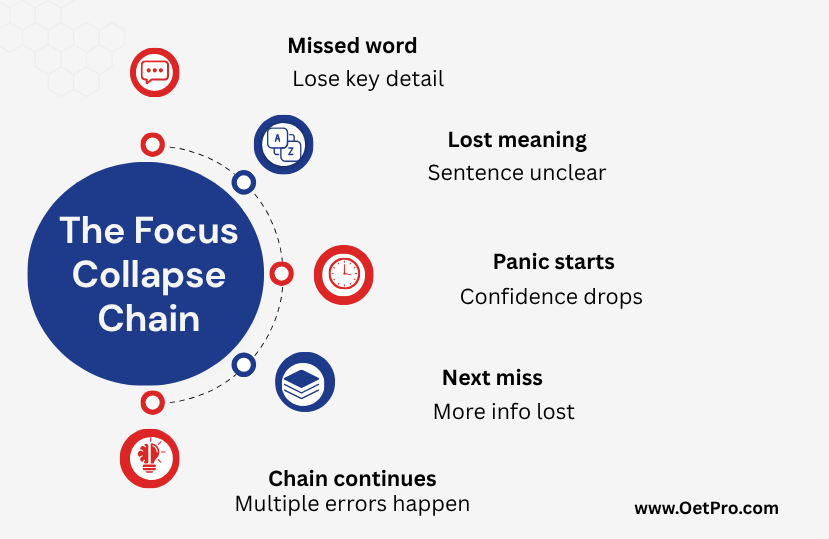
Understanding how focus breaks is key to fixing it.
Most candidates lose focus in this pattern:
Step 1: Small mistake happens
Step 2: Brain reacts emotionally
Step 3: Attention shifts backward
Step 4: Current audio is missed
Step 5: Chain of errors begins
This is called the Focus Collapse Chain
Focus Control Strategy (High-Score Method)
To prevent focus collapse, use this system:
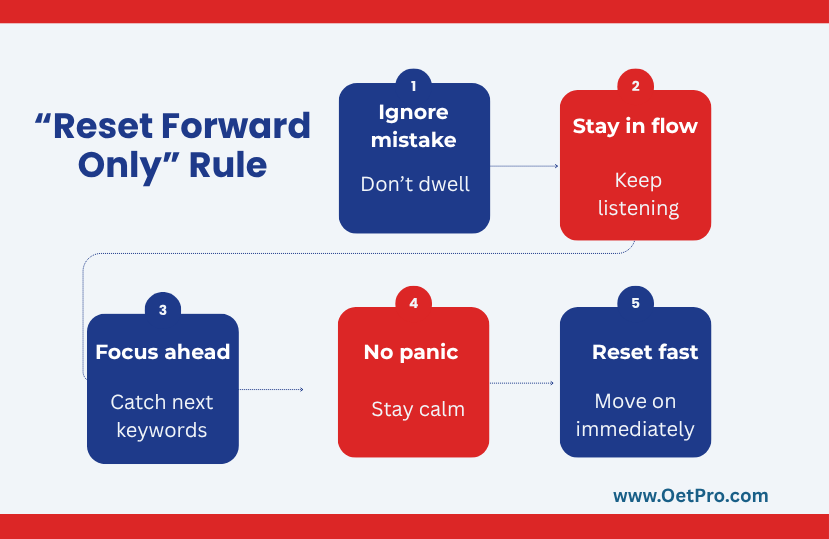
Strategy 1: “Reset Forward Only” Rule
If you miss an answer:
- Do NOT think about it
- Do NOT try to recover it mentally
- Immediately move forward
Focus must always move forward, never backward.
Strategy 2: Single-Point Listening
During audio:
- Focus only on current question target
- Ignore all unrelated information
- Avoid multitasking thinking
Your brain should process one signal at a time.
Strategy 3: Emotional Neutral Mode
During exam:
- No panic after mistakes
- No excitement after correct answers
- Maintain neutral mental state
Emotional stability = consistent accuracy
Strategy 4: Attention Anchoring
Train your mind to anchor focus using:
- Keywords in question stem
- Expected answer type (number, symptom, opinion)
- Section-specific listening mode
Examiner Insight: Why Focus Breaks Cost Marks
From an examiner perspective, most lost marks are not due to misunderstanding audio.
They happen because:
- Candidates stop listening after confusion
- Attention shifts away from audio stream
- Emotional reaction interrupts processing
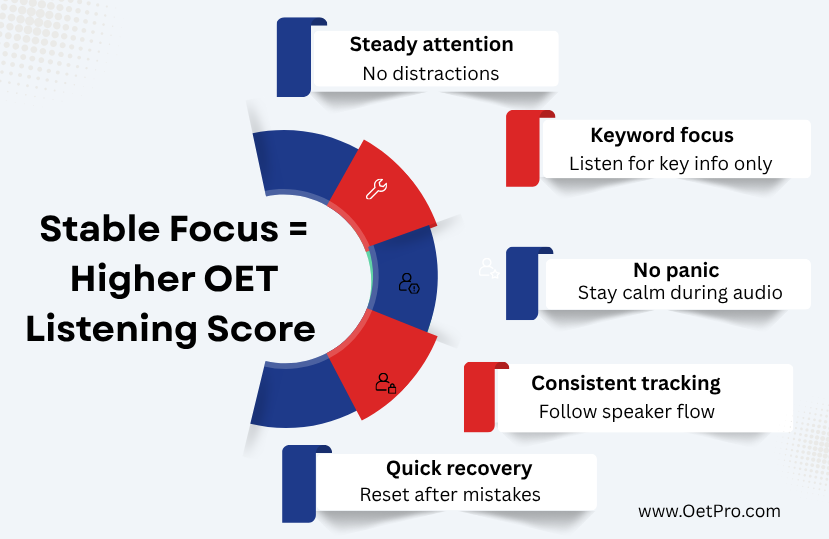
OET Listening rewards continuity of attention, not perfection.
Advanced Focus Training: Building Automatic Attention Control
At the advanced level of OET Listening, focus is no longer a “conscious effort.” It becomes an automatic system of attention control.
High scorers do not constantly remind themselves to focus. Instead, they train their brain to:
- Lock onto relevant information instantly
- Ignore irrelevant audio automatically
- Recover focus quickly after distraction
This is achieved through repeated attention conditioning, not just practice tests.
Cognitive Endurance System (Staying Strong Across All Parts)
OET Listening is designed to increase mental load gradually:
- Part A -> fast processing + note-taking
- Part B -> decision-making under clarity pressure
- Part C -> long inference + attention fatigue
Most candidates lose performance in Part C because their cognitive energy drops over time.
Endurance Training Principles
To build mental stamina:
- Practice full-length tests without breaks
- Avoid stopping between sections
- Train for 30–40 minutes continuous listening focus
- Simulate real exam fatigue conditions
The goal is not just understanding—it is sustained attention under fatigue
Exam Pressure Control Techniques
Pressure is the main reason focus collapses in real exams.
To control it, you must re-train your reaction system.
Technique 1: “Miss and Move” Rule
When you miss an answer:
- Accept immediately
- Do NOT re-think it
- Move forward instantly
This prevents emotional disruption
Technique 2: Real-Time Recovery System
Instead of trying to “fix” missed information:
- Re-anchor attention to current question
- Reconnect with audio flow immediately
- Treat each question independently
Each question is a fresh start
Technique 3: Pressure Neutralization Training
During practice:
- Simulate exam stress conditions
- Avoid comfort breaks
- Train under strict timing rules
Your brain adapts to pressure only through exposure
Real Performance Strategy: How High Scorers Stay Consistent
Top candidates do not rely on perfect understanding.
They rely on consistent attention flow.
Strategy 1: Continuous Listening Flow
- No mental pauses
- No backward thinking
- No replaying missed questions
Focus is always forward-moving
Strategy 2: Question Isolation Method
Each question is treated as:
- Independent task
- Separate decision point
- No connection to previous errors
This reduces cognitive overload
Strategy 3: Controlled Attention Switching
Between Part A, B, C:
- Reset mental mode
- Switch focus type immediately
- Do not carry pressure forward
Why Most Candidates Fail Focus Control
Common failure pattern:
- One mistake -> emotional reaction
- Emotional reaction -> focus loss
- Focus loss -> multiple missed answers
This is not a listening problem
This is a attention management problem.
Summary
OET Listening Time Control & Focus Mastery is not about “trying to concentrate harder.” It is about building a structured attention system that stays stable under pressure.
Most candidates lose marks because their focus breaks after small mistakes, leading to a chain reaction of missed answers. High scorers avoid this by using controlled attention strategies across all three parts of the test.
The key idea is simple:
Your score is not only decided by listening ability, but by how well you manage attention, pressure, and mental energy throughout the exam.
Final Checklist (Before & During Exam)
Before Exam (Focus Preparation)
- Train full-length listening tests without breaks
- Practice strict timing conditions
- Prepare mentally for continuous attention
- Understand question types for each part
During Exam (Real-Time Control)
- Focus only on current question (no backward thinking)
- Follow “Miss and Move” rule immediately
- Switch focus mode between Part A, B, and C
- Stay emotionally neutral after mistakes
- Avoid overthinking during audio
During Pressure Moments
- Do not panic after missing answers
- Do not try to recover previous questions
- Re-anchor focus to current audio immediately
- Treat every question as independent
FAQs
1. Why do I lose focus in Part C?
Because cognitive fatigue builds up. You must train full-test endurance to handle long listening passages.
2. How can I stop panic after missing answers?
Use the “Miss and Move” rule: accept immediately and shift attention forward.
3. Is focus more important than understanding?
Both matter, but without focus control, even good understanding fails under pressure.
4. How long does it take to build focus stamina?
With consistent training, noticeable improvement appears within 1–2 weeks of full-test practice.
5. What is the biggest focus mistake in OET Listening?
Thinking about previous questions instead of staying in the current listening flow.
Practice Plan (7-Day Focus Mastery System)
Day 1 — Full Simulation Test
- Complete full OET Listening test
- No breaks or pauses
- Focus on maintaining continuous attention
Day 2 — Focus Breakdown
- Identify where focus broke
- Note emotional reactions and timing issues
Day 3 — Micro Focus Training
- Practice short audio clips (10–20 seconds)
- Train question-level attention control
Day 4 — Section Focus Practice
- Focus only on one part (A or B or C)
- Train section-specific attention mode
Day 5 — Pressure Simulation
- Full test under strict timing
- No comfort breaks
- Apply “Miss and Move” rule
Day 6 — Weak Area Reinforcement
- Identify weakest focus stage
- Practice targeted listening drills
Day 7 — Full Retest
- Complete full mock test
- Compare focus stability with Day 1
Conclusion
OET Listening success is not only about English ability. It is about mental control under continuous pressure.
If your focus breaks, your score drops even if your understanding is good.
If your focus stays stable, your score improves even with minor mistakes.
The difference between average and high scorers is simple:
- Average candidates react to mistakes
- High scorers control attention and move forward