
OET Speaking Mastery: Role Play Strategies, Clinical Communication & Band A Success System
Introduction
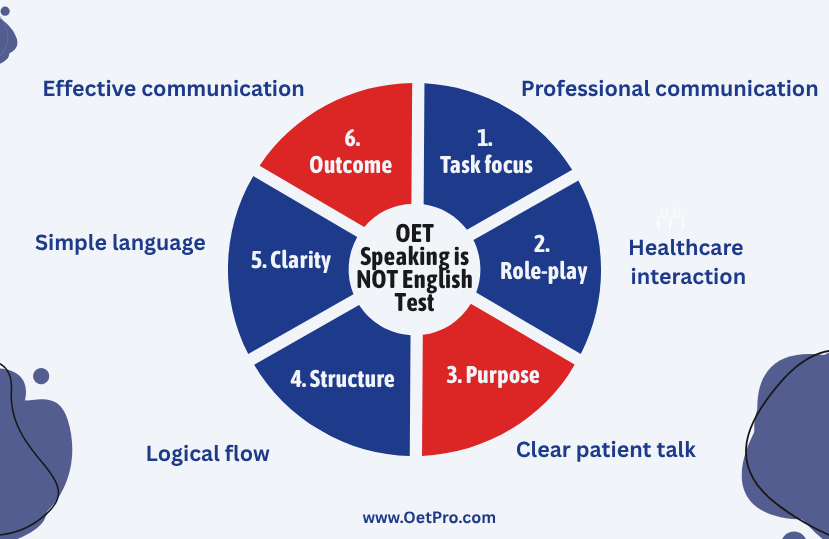
OET Speaking is not just a test of English. It is a test of how you communicate as a healthcare professional.
In real clinical settings, patients are not judging your grammar. They are trying to understand:
- What is happening to them
- What they should do next
- Whether they can trust you
This is exactly what OET evaluates.
Many candidates misunderstand this. They focus too much on sounding “advanced” instead of being clear, calm, and helpful. As a result, even with good English, their score stays stuck. OET Speaking success depends heavily on role-play performance, where clear structure and communication determine your Band A or high score outcome. You can master this in OET Speaking Role Play Structure: Step-by-Step Breakdown for High Score Communication.
OET Speaking success depends on clear clinical communication, and using the right phrases can significantly improve your fluency and professional tone during role-play. You can master this in OET Speaking High-Scoring Clinical Communication Phrases for Nurses & Doctors.
The truth is simple:
OET Speaking rewards effective communication, not complicated language. To understand how your performance is actually evaluated during role plays, read OET Speaking Scoring Criteria: Examiner System & Band B/A Breakdown (How Marks Are Awarded)
Many candidates struggle in real exams due to avoidable errors learn the full breakdown in OET Speaking Mistakes: Common Errors, Score Loss Reasons & Recovery Strategy for Grade B/A
To move from theory to real exam conditions, practice with full simulation using OET Speaking Mock Test Practice: Real Exam Simulation & Role Play System (Band B/A Strategy)
Learning Objectives
By the end of this lesson, you will clearly understand how to approach OET Speaking in a structured and professional way.
You will learn how to:
- Communicate like a real healthcare professional
- Structure your response during role plays
- Handle patient emotions confidently
- Deliver clear explanations without confusion
- Avoid common mistakes that reduce your score
- Build a system to consistently achieve Grade B or higher
Overview of OET Speaking
OET Speaking is designed to simulate real clinical conversations. You are not giving a speech. You are interacting with a patient.
A strong role-play strategy is not only about structure but also about using effective clinical phrases that show empathy, clarity, and professionalism. This is explained in OET Speaking Clinical Communication Phrases Strategy Guide.
Each candidate completes two role plays, and each one represents a different healthcare scenario.
In every role play:
- You take the role of your profession (doctor, nurse, etc.)
- The examiner acts as the patient or caregiver
- You must manage the conversation effectively
Test Structure (Quick View)
- Preparation Time: 3 minutes
- Speaking Time: 5 minutes per role play
- Total Duration: approximately 20 minutes
During the preparation time, you receive a role card. This card contains:
- The situation
- Your role
- Key points you must cover
Understanding this card properly is critical for success. A strong role-play strategy requires not just clinical communication skills but also a clear step-by-step structure to guide your responses effectively. This system is explained in OET Speaking Role Play Structure Step-by-Step Guide for High Scores.
To achieve Band A, you must combine communication strategies with high-scoring phrases that make your responses sound natural and patient-centered. You can build this using OET Speaking High Score Phrases for Clinical Communication (Band A Strategy).
What You Are Actually Being Tested On
Many students think OET Speaking is about “speaking fluently”. Even with a strong role play strategy, small mistakes can reduce your score understand them in OET Speaking Mistakes: Common Errors, Score Loss Reasons & Recovery Strategy for Grade B/A
That is only partially true.
You are assessed on two major areas:
1. Linguistic Skills
This includes your basic language ability:
- Grammar accuracy
- Vocabulary usage
- Pronunciation
- Fluency
2. Clinical Communication Skills (Most Important)
This is where high scores are decided. It includes:
- Building rapport with the patient
- Understanding patient concerns
- Explaining medical information clearly
- Structuring the conversation logically
The key idea:
Language supports communication it does not replace it. Your speaking performance improves significantly when you use the right phrases at the right time to express empathy, give advice, and explain clearly. This method is explained in OET Speaking Clinical Language Master Guide for High Scores.
Why Most Candidates Do Not Improve
Many candidates practice regularly, but their score does not increase.
This is frustrating, especially when they feel they are working hard. This strategy becomes powerful when you understand how examiners award marks learn it in OET Speaking Scoring Criteria: Examiner System & Band B/A Breakdown (How Marks Are Awarded)
The reason is not lack of effort.
The real issue is lack of a clear system.
Most candidates:
- Speak randomly during practice
- Do not analyze their mistakes
- Focus only on fluency instead of structure
As a result, they repeat the same errors again and again.
Practice without structure leads to slow or no improvement. To achieve Band A success, you must combine clinical communication skills with a structured approach to handling role-play scenarios under exam pressure. You can apply this in OET Speaking Role Play Structure Master Strategy for High Scores.
Common Mistakes in OET Speaking
Understanding mistakes is the first step to improvement. Let’s look at the most common problems candidates face.
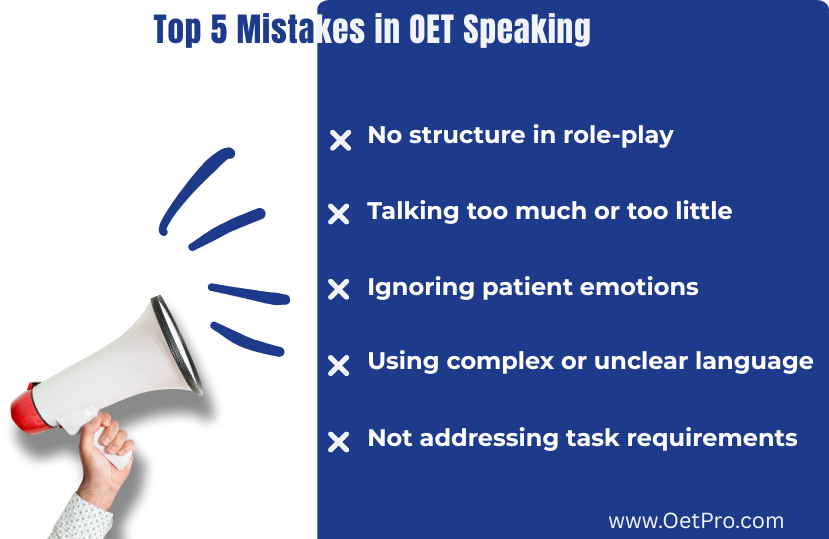
1. Speaking Without Structure
Many candidates begin speaking immediately without planning their approach. This leads to disorganized responses.
Common results include:
- Talking in circles
- Repeating ideas
- Losing direction mid-conversation
A structured approach is essential to stay clear and focused.
2. Ignoring Patient Emotions
Some candidates focus only on delivering medical information. They forget that patients may feel anxious, confused, or worried. Your role play strategy becomes more effective when tested under real exam conditions in OET Speaking Mock Test Practice: Real Exam Simulation & Role Play System (Band B/A Strategy)
This creates a communication gap.
You must:
- Acknowledge feelings
- Show empathy
- Reassure the patient
Without this, your communication feels incomplete. Many candidates lose marks because they use basic or repetitive language instead of applying professional clinical phrases during role-play. Avoid this with OET Speaking High-Scoring Phrase Bank for Band A Success.
3. Overusing Complex Vocabulary
Trying to impress the examiner with difficult words often creates more problems than benefits.
It can lead to:
- Incorrect word usage
- Hesitation while speaking
- Reduced clarity
In OET, simple and clear communication scores higher than complex language.
4. Missing Key Task Points
Every role play includes specific instructions. Many candidates fail to cover all of them.
This results in:
- Incomplete performance
- Lower marks in communication criteria
Carefully reading and using the role card is critical. To achieve Band A consistently, you must first eliminate common speaking errors explained in OET Speaking Mistakes: Common Errors, Score Loss Reasons & Recovery Strategy for Grade B/A
5. Lack of Interaction
Some candidates speak continuously without involving the patient. Each communication skill in this framework directly links to scoring criteria explore the breakdown in OET Speaking Scoring Criteria: Examiner System & Band B/A Breakdown (How Marks Are Awarded)
This turns the role play into a monologue.
Strong candidates:
- Ask relevant questions
- Respond to patient cues
- Adjust their communication based on responses
6. Weak Opening and Closing
The beginning and end of your conversation matter more than you think.
Common issues:
- Starting abruptly without greeting
- Ending without summarizing or guiding the patient
A professional interaction should always:
- Start with clarity and confidence
- End with reassurance and next steps
7. Memorized Responses
Memorizing answers might feel safe, but it does not work in OET. Each communication technique must also avoid examiner-penalized mistakes see full analysis in OET Speaking Mistakes: Common Errors, Score Loss Reasons & Recovery Strategy for Grade B/A
Examiners can easily recognize:
- Robotic speech
- Lack of flexibility
- Irrelevant responses
Instead of memorizing, you need a flexible communication system. Many candidates lose marks because they focus only on medical language but fail to follow a clear structure during role-play interactions. Avoid this with OET Speaking Role Play Structure Master Guide for Band A Success.
Core Principle to Remember
At this stage, focus on one important idea:
High scores in OET Speaking come from structured communication, not natural talent. To apply clinical communication skills under pressure, use structured mock tests in OET Speaking Mock Test Practice: Real Exam Simulation & Role Play System (Band B/A Strategy)
Once you understand the system, your performance becomes:
- More confident
- More controlled
- More professional
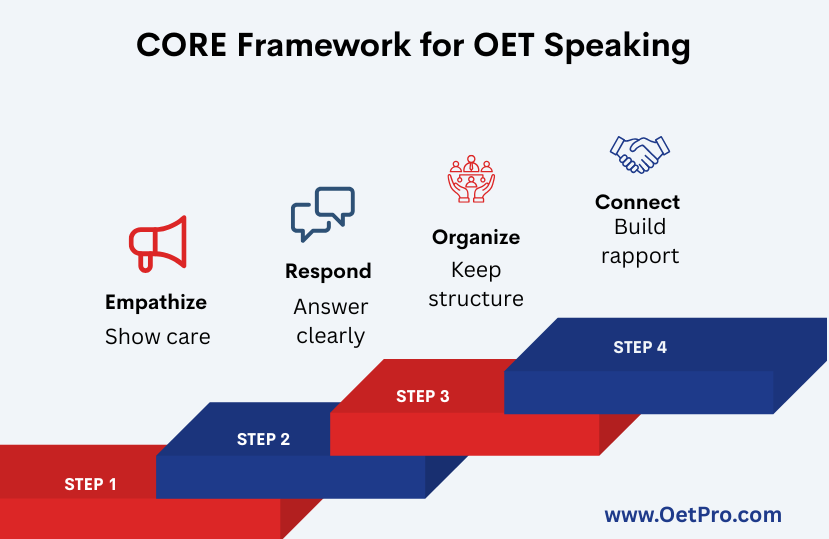
The OET Speaking System (CORE Framework)
To perform well in OET Speaking, you need a repeatable system that works in every role play.
Instead of thinking randomly during the exam, you should follow a clear communication flow. If your practice is not improving scores, you may be repeating common mistakes fix this using insights from OET Speaking Mistakes: Common Errors, Score Loss Reasons & Recovery Strategy for Grade B/A
The OET CORE Framework
C - Connect
O - Open & Organize
R - Respond & Reassure
E - End Effectively
This framework ensures that your conversation is:
- Structured
- Patient-centered
- Easy to follow
- Professionally delivered
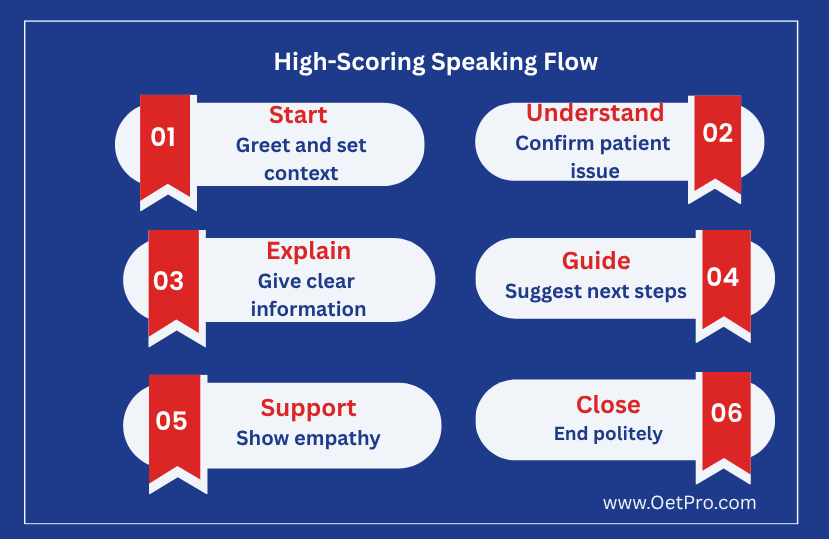
Step 1: CONNECT (Build Trust First)
The first 20–30 seconds are critical.
This is where you create the first impression.
Instead of jumping into medical details, start by building a connection. If your goal is Band A, you must understand what examiners look for see OET Speaking Scoring Criteria: Examiner System & Band B/A Breakdown (How Marks Are Awarded)
What to do:
- Greet the patient
- Introduce yourself and your role
- Confirm patient identity (if needed)
- Create a comfortable tone
Example:
“Good morning, I’m Nurse Simran. I’ll be taking care of you today. How are you feeling right now?”
This simple opening:
- Builds rapport
- Shows professionalism
- Creates a natural conversation flow
Step 2: OPEN & ORGANIZE (Control the Conversation)
After the greeting, you must set direction.
Many candidates fail here because they:
- Start explaining randomly
- Do not guide the conversation
You need to show the examiner that you are in control.
What to do:
- State the purpose clearly
- Outline what you will discuss
- Transition smoothly into the task
Example:
“I understand you’re concerned about your recent diagnosis. Let me explain what it means and how we can manage it.”
This does two things:
- Reduces patient anxiety
- Gives structure to your response
Step 3: RESPOND & REASSURE (The Main Scoring Zone)
This is the most important part of the role play.
Here, you must balance:
- Information
- Empathy
- Interaction
A. Provide Clear Information
Avoid complex explanations.
Focus on:
- Simple language
- Short sentences
- Logical flow
Example:
“Diabetes is a condition where your body has difficulty controlling blood sugar levels. With proper care, it can be managed effectively.” Achieving Band A requires repeated real exam simulation practice explained in OET Speaking Mock Test Practice: Real Exam Simulation & Role Play System (Band B/A Strategy)
B. Show Empathy
Patients are often worried or confused.
You must acknowledge their feelings.
Useful expressions:
- “I understand this can be worrying.”
- “It’s completely normal to feel this way.”
- “You’re not alone in this situation.”
Empathy improves your score significantly.
C. Involve the Patient
Do not speak continuously.
Make the conversation interactive.
You can:
- Ask open-ended questions
- Check understanding
- Invite concerns
Examples:
- “Have you experienced any symptoms recently?”
- “Does that make sense to you?”
- “Is there anything specific you’re worried about?”
D. Handle Concerns Professionally
Patients may:
- Refuse treatment
- Show fear
- Ask difficult questions
Your job is to:
- Stay calm
- Provide reassurance
- Guide them logically
Example:
“I understand your concern about the side effects. However, this medication is important for your recovery. Let’s go through the benefits and possible alternatives.”
Step 4: END EFFECTIVELY (Strong Closing)
Many candidates lose marks at the end.
They either:
- Stop suddenly
- Forget to summarize
A good closing shows professionalism.
What to include:
- Quick summary
- Reassurance
- Next steps
- Offer for further help
Example:
“So, to summarize, we’ll start with this treatment and monitor your progress. If you notice any unusual symptoms, please contact us. Do you have any other questions?”
This leaves a strong final impression. Many mistakes happen because candidates don’t understand scoring fix this by reading OET Speaking Scoring Criteria: Examiner System & Band B/A Breakdown (How Marks Are Awarded)
Role Play Strategy (During Preparation Time)
You get 3 minutes to prepare.
This is where top scorers gain an advantage.
Instead of reading passively, follow a system.
During preparation, do this:
- Identify the scenario
- Diagnosis / Advice / Complaint / Follow-up
- Highlight key task points
- These are your scoring checkpoints
- Plan your structure
- Opening
- Main explanation
- Patient interaction
- Closing
- Predict patient emotions
- Worried? Angry? Confused?
- Prepare 2–3 key phrases
- For empathy
- For explanation
Real Clinical Example (Role Play Simulation)
Scenario:
A patient has been diagnosed with hypertension and is worried about long-term effects.
High-Scoring Response (Simplified Flow)
Connect:
“Hello, I’m Dr. Aman. I understand you’ve recently been diagnosed with high blood pressure. How are you feeling about it?” Structured practice must include timed role plays and examiner-like conditions in OET Speaking Mock Test Practice: Real Exam Simulation & Role Play System (Band B/A Strategy)
Open & Organize:
“I’d like to explain what this means and how we can manage it effectively.”
Respond & Reassure:
“High blood pressure means your heart is working harder than normal. The good news is that with lifestyle changes and medication, it can be controlled.”
“I understand this may sound serious, but many patients live healthy lives with proper care.”
“Can you tell me about your daily routine so we can identify areas to improve?” Understand exactly how candidates lose marks during role plays in OET Speaking Mistakes: Common Errors, Score Loss Reasons & Recovery Strategy for Grade B/A
End Effectively:
“To summarize, we’ll focus on diet, exercise, and medication if needed. We’ll monitor your progress regularly. Please feel free to ask if you have any concerns.”
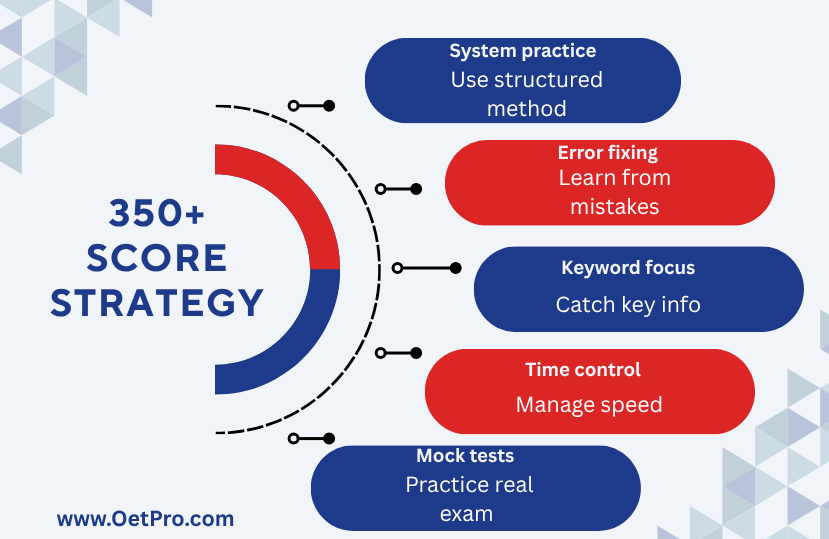
What Separates a 300 Score from 350+?
At the basic level, candidates can communicate.
At the advanced level, candidates control the conversation like professionals.
The difference is not English level.
It is:
- Precision
- Awareness
- Communication control
A 300-level candidate speaks.
A 350+ candidate guides the patient experience.
Examiner Insights (What They Actually Look For)
Understanding the examiner mindset is a major advantage.
Examiners are not impressed by:
- Difficult vocabulary
- Long explanations
- Memorized answers
They are evaluating:
1. Clarity Over Complexity
Can the patient understand you easily?
If your answer is long but confusing -> lower score
If your answer is simple but clear -> higher score
2. Patient-Centered Communication
Are you focusing on the patient or yourself?
Strong candidates:
- Acknowledge emotions
- Adapt their tone
- Personalize responses
3. Logical Flow
Is your conversation structured?
Examiners expect:
- Clear beginning
- Organized middle
- Controlled ending
4. Interaction Quality
Are you communicating with the patient or at the patient? To build confidence under exam pressure, train with realistic mock test systems in OET Speaking Mock Test Practice: Real Exam Simulation & Role Play System (Band B/A Strategy)
High scorers:
- Ask questions
- Pause naturally
- Respond to patient cues
Advanced Communication Techniques
Now let’s move beyond basics and build high-scoring behavior.
1. Chunking Information
Do not give too much information at once.
Break it into small parts.
Instead of:
Explaining everything in one long sentence
Do this:
- Give one idea
- Pause
- Check understanding
Example:
“There are two main reasons for your symptoms. First, your blood sugar levels are high. Second, your body is not responding properly to insulin. Does that make sense so far?” For a complete understanding of how to maximize your score on test day, review OET Speaking Scoring Criteria: Examiner System & Band B/A Breakdown (How Marks Are Awarded)
2. Signposting (Guiding the Conversation)
Help the patient follow your explanation.
Use guiding phrases like:
- “Let me explain…”
- “There are three things we should focus on…”
- “First…, second…, finally…”
This improves:
- Clarity
- Structure
- Examiner impression
3. Softening Difficult Information
In healthcare, not all information is positive.
You must communicate carefully.
Instead of:
“This is serious.”
Say:
“This is something we should take seriously, but the good news is that we can manage it effectively.”
This shows:
- Professionalism
- Emotional intelligence
4. Controlled Reassurance
Avoid over-promising.
Bad example:
“Everything will be fine.”
Better:
“With the right treatment and regular follow-up, most patients manage this condition very well.” To refine your speaking performance and eliminate hidden errors, study OET Speaking Mistakes: Common Errors, Score Loss Reasons & Recovery Strategy for Grade B/A
5. Strategic Questioning
Questions should have a purpose.
Avoid random questions.
Use questions to:
- Gather information
- Involve the patient
- Guide the conversation
Types of questions:
- Open-ended: “Can you tell me more about your symptoms?”
- Checking: “Does that make sense?”
- Confirming: “Is this something you’ve experienced before?”
High-Scoring Vocabulary & Phrase Bank
You do not need complex words.
You need functional medical communication phrases.
For Starting the Conversation
- “I understand you’re here because…”
- “Let’s talk about your concern…”
For Explaining
- “This means that…”
- “In simple terms…”
- “What this involves is…”
For Reassuring
- “You’re not alone in this.”
- “This can be managed effectively.”
- “We will support you throughout the process.”
For Suggesting / Advising
- “I would recommend that…”
- “It would be helpful if you could…”
For Closing
- “To summarize…”
- “Let’s review the next steps…”
- “Do you have any questions before we finish?”
Advanced Role Play Example
Scenario:
Patient refuses to take medication due to fear of side effects.
High-Level Response Strategy
Acknowledge Emotion First
“I understand why you might feel concerned about side effects.”
Provide Balanced Information
“While some medications can have side effects, most patients tolerate this one very well.”
Explain Benefits Clearly
“This medication is important because it helps control your condition and prevents complications.”
Offer Control to Patient
“We can start with a low dose and monitor how your body responds.”
Encourage Trust
“I’ll be here to support you, and we can adjust the treatment if needed.”
Before the real exam, strengthen your readiness using OET Speaking Mock Test Practice: Real Exam Simulation & Role Play System (Band B/A Strategy)
Practice System (Score Improvement Model)
To move from average to high score, you need a structured practice loop.
Step 1: Record Your Speaking
Do not rely on memory.
Always record your role plays.
Step 2: Identify Mistakes
Use a simple classification:
- Clarity problem
- Structure problem
- Vocabulary problem
- Interaction problem
Step 3: Fix One Issue at a Time
Do not try to improve everything at once.
Focus on:
- One skill per practice session
Step 4: Repeat with Improvement
Apply corrections in the next role play.
Step 5: Simulate Exam Conditions
Practice with:
- Time limits
- Real scenarios
- Pressure
Performance Upgrade Strategy (300 -> 350+)
To reach a higher score:
- Stop focusing only on fluency
- Start focusing on communication quality
Key upgrades:
- Use structure in every response
- Add empathy naturally
- Improve interaction (questions + responses)
- Control your opening and closing
Summary
OET Speaking is not about speaking more. It is about communicating better.
Throughout this lesson, you have learned a complete system that transforms your performance from unstructured speaking to professional clinical communication.
At its core, success in OET Speaking depends on:
- Clear structure
- Patient-centered communication
- Controlled delivery
- Consistent practice
The CORE Framework gives you a reliable method:
- Connect -> Build rapport
- Open & Organize -> Set direction
- Respond & Reassure -> Deliver value
- End Effectively -> Close professionally
When you apply this system, your speaking becomes:
- More confident
- More natural
- More effective
Final Exam Checklist
Before every role play, quickly review this mental checklist.
Before You Start
- Did I understand the scenario clearly?
- Did I identify all task points?
- Did I predict patient emotions?
During the Role Play
- Did I start with a proper greeting?
- Am I following a clear structure?
- Am I using simple and clear language?
- Am I showing empathy where needed?
- Am I involving the patient with questions?
Before Ending
- Did I summarize the key points?
- Did I give clear next steps?
- Did I ask if the patient has questions?
Frequently Asked Questions (FAQs)
1. How can I get Grade B in OET Speaking?
Focus on:
- Clear structure
- Simple communication
- Patient interaction
Avoid memorization. Use a flexible system like CORE.
2. Is fluency the most important factor?
No.
Fluency helps, but clarity and communication quality matter more.
3. Can I use advanced vocabulary to get a higher score?
Only if used correctly.
Simple and accurate language is always better than complex and confusing language.
4. What if I don’t understand the role play?
Stay calm.
- Ask for clarification
- Focus on general communication
- Use logical responses
5. How can I improve quickly?
Use a structured practice system:
- Record
- Analyze
- Fix
- Repeat
6. How important is empathy in OET Speaking?
Very important.
Empathy directly improves your clinical communication score.
7-Day Practice Plan (Score Improvement System)
This plan is designed to help you build consistency and confidence.
Day 1–2: Foundation
- Understand role play structure
- Practice opening and closing
- Focus on clarity
Day 3–4: Communication Skills
- Practice empathy phrases
- Improve explanation techniques
- Use simple language
Day 5: Interaction Focus
- Practice asking questions
- Improve patient involvement
- Avoid monologue speaking
Day 6: Full Role Play Practice
- Simulate real exam conditions
- Use timer
- Record your performance
Day 7: Analysis & Improvement
- Review recordings
- Identify mistakes
- Focus on weak areas
Final Advice
Do not try to be perfect.
Try to be:
- Clear
- Helpful
- Professional
Remember:
You are not performing for the examiner.
You are helping a patient.
When you shift your mindset, your performance improves naturally.
Conclusion
OET Speaking becomes easy when you follow a system. Strong role-play performance comes from combining structured communication with clinical accuracy and consistent practice under exam conditions. Start with OET Speaking Role Play Structure Complete Guide for High Scores.
Strong role-play performance comes from combining structured strategies with powerful clinical phrases that improve clarity and professionalism. Start with OET Speaking Complete Clinical Communication Phrase Guide for High Scores.
Without structure, it feels difficult.
With structure, it becomes predictable and manageable.
By applying:
- CORE Framework
- Advanced techniques
- Practice system
You can confidently move from:
- Average performance -> High score (350+)