OET Speaking Role Play Structure: Step-by-Step Breakdown for High Score Communication
Introduction
OET Speaking role plays are not random conversations. They are structured clinical communication tasks designed to test how you think and respond in real healthcare situations.
Most candidates make a critical mistake here:
They treat role plays like free speaking practice.
But OET is not testing free speech.
It is testing controlled, structured communication under time pressure.
Each role play is built around a simple idea:
Can you understand a clinical situation quickly and communicate it in a safe, clear, and patient-friendly way?
If the answer is yes, you score high.
If the answer is unclear or unstructured, your score drops even if your English is good. Understanding the step-by-step structure of OET Speaking role-play is important, but real success comes when you apply it with strong clinical communication strategies and Band A-level performance techniques. You can develop this in OET Speaking Mastery: Role Play Strategies for Clinical Communication Band A Success System.
Learning Objectives
By the end of this lesson, you will understand how to:
- Decode OET role play cards quickly and correctly
- Use the 3-minute preparation time effectively
- Build a clear structure before speaking
- Manage the 5-minute interaction confidently
- Avoid confusion during live communication
- Apply a repeatable system in every role play
This lesson is the foundation of all OET Speaking success.
Overview of OET Role Play Structure
Every OET Speaking test has a very predictable structure.
It includes:
- 2 Role Plays
- Each Role Play = 5 minutes speaking time
- Preparation time = 3 minutes before each role play
What Happens in the Exam
You receive a role card, which includes:
- Your professional role (nurse, doctor, pharmacist, etc.)
- Patient scenario
- Key points you must cover
- Patient concerns or instructions
Then the process looks like this:
- You get 3 minutes to prepare
- You analyze the role card
- You plan your communication structure
- You enter the role play
- You interact for 5 minutes with the examiner
A clear structure is essential for role-play, but it becomes powerful only when combined with clinical communication skills that help you respond naturally and professionally.
This system is explained in OET Speaking Role Play Strategies for Clinical Communication Success.
The Real Purpose of Role Plays
OET role plays are designed to test:
- Clinical clarity
- Communication control
- Empathy and patient handling
- Structured thinking under pressure
It is not about memorized answers.
It is about real-time decision making in healthcare communication.
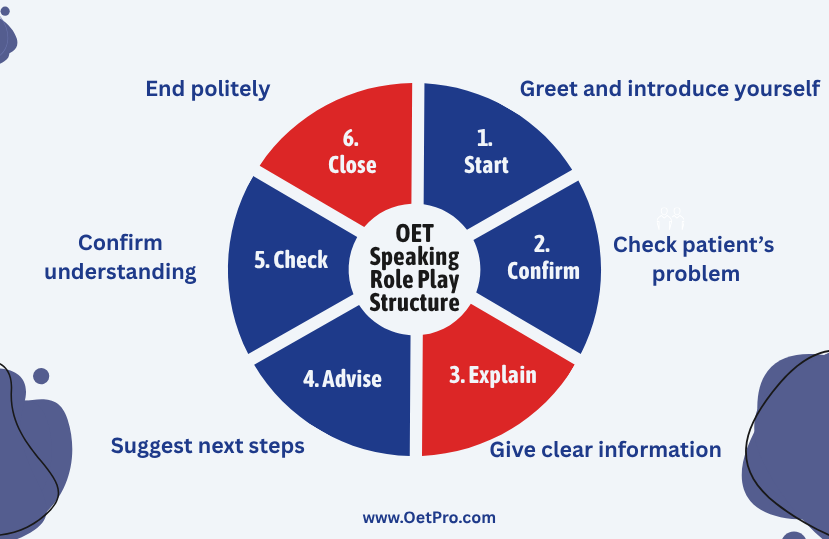
The Hidden Structure Inside Every Role Play
Every role play follows a hidden communication pattern:
1. Opening (Connection Phase)
- Greeting
- Introducing yourself
- Setting comfort level
2. Information Phase
- Explaining condition or situation
- Giving clear instructions
3. Interaction Phase
- Asking questions
- Responding to patient concerns
- Handling emotions
4. Closing Phase
- Summarizing
- Giving next steps
- Ending professionally
This structure is always present even if the scenario changes. To achieve Band A in OET Speaking, you must combine structured responses with effective clinical communication strategies that show empathy and accuracy. You can apply this using OET Speaking Mastery Role Play Band A Strategy System.
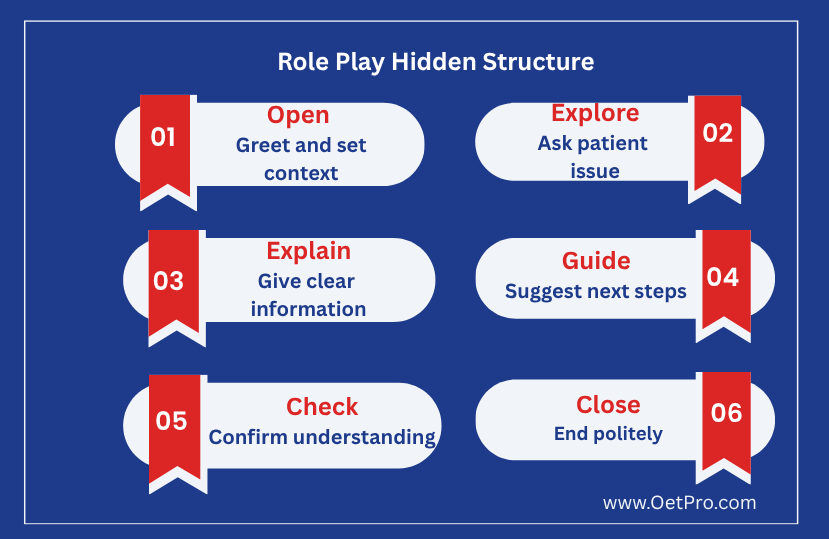
Common Mistakes in OET Role Play Structure
Understanding mistakes is the fastest way to improve.
1. Starting Without Understanding the Role Card
Many candidates begin speaking immediately without analyzing the situation.
This leads to:
- Confusion
- Missing key points
- Disorganized responses
2. No Preparation Strategy in 3 Minutes
The preparation time is often wasted.
Instead of planning structure, candidates:
- Read passively
- Panic
- Start speaking without clarity
3. Random Speaking Without Flow
Candidates jump between ideas without structure.
This creates:
- Loss of clarity
- Examiner confusion
- Lower communication score
4. Ignoring Task Points
Each role card has specific instructions.
Missing even one point can reduce your score.
5. Treating It Like a Conversation, Not a System
OET is not casual speaking.
It requires:
- Controlled flow
- Clinical logic
- Structured communication
6. No Clear Opening or Closing
Weak candidates:
- Start abruptly
- End suddenly
This reduces professionalism and scoring impact. Many candidates lose marks because they understand the structure but fail to apply proper clinical communication techniques during role-play scenarios. Avoid this with OET Speaking Role Play Master Guide for Band A Success.
The 3-Minute Advantage (Why This Phase Decides Your Score)
Most candidates think OET Speaking starts when they begin talking.
This is incorrect.
Your performance is largely decided in the 3-minute preparation time.
Top scorers don’t speak better by chance they prepare better under structure.
Those 3 minutes are not reading time.
They are thinking and designing time.
The PREP Structure for 3-Minute Preparation
To avoid confusion, use a fixed system:
P -> Preview the scenario
R -> Read task points carefully
E -> Emotion mapping (patient mindset)
P -> Plan structure (opening -> body -> closing)
This transforms chaos into clarity.
.png "3-Minute_Preparation_System_(PREP).png")
Step 1: PREVIEW the Scenario
First, understand the situation quickly.
Ask yourself:
- Who is the patient?
- What is the problem?
- What is my role?
Do not read word by word at this stage.
Focus on meaning first, language second.
Example:
If the card says “patient diagnosed with asthma and anxious,” your brain should immediately register:
- Condition: Asthma
- Emotion: Anxiety
- Goal: Reassure + explain + guide
Step 2: READ Task Points Carefully
Now focus on what you must do, not just the story.
Most role cards include 3–5 key tasks such as:
- Explain condition
- Give advice
- Address concern
- Encourage treatment
Important Rule:
Each task point = 1 scoring opportunity
If you miss a task point, you lose marks even if your English is perfect.
Step 3: EMOTION MAPPING (Critical High-Score Skill)
This is what most candidates ignore.
Every patient in OET has an emotion behind the condition:
- Fear
- Confusion
- Anxiety
- Resistance
- Frustration
You must identify it quickly.
Example:
| Condition | Likely Emotion |
|---|---|
| Diabetes diagnosis | Shock / fear |
| Surgery advice | Anxiety |
| Chronic illness | Stress / confusion |
| Medication refusal | Resistance |
Why this matters
If you address emotion correctly, your score increases in:
- Clinical communication
- Empathy marking
- Interaction quality
Step 4: PLAN STRUCTURE (Before Speaking)
Now design your conversation in your mind.
Never start speaking without a flow.
Use this structure:
1. Opening
- Greeting
- Introduction
- Comfort statement
2. Body
- Explain condition
- Address tasks
- Ask questions
- Handle concerns
3. Closing
- Summary
- Next steps
- Reassurance
Execution Model (During Speaking)
Once the 3 minutes are over, you must switch to performance mode.
Follow this fixed flow:
1. CONNECT (First 20–30 seconds)
Goal: Build trust
Example:
“Good morning, I’m Nurse Priya. I understand you’ve been feeling unwell recently. How are you feeling right now?”
Key focus:
- Calm tone
- Friendly introduction
- Patient comfort
2. CONTROL THE FLOW (Mid Conversation)
Now you guide the conversation.
You must avoid random speaking.
Instead, use structured transitions:
- “Let me explain…”
- “There are two important points…”
- “First…, second…”
This shows control and clarity.
3. RESPOND WITH EMPATHY
This is the highest scoring zone.
Always combine:
- Information + Emotion
Example:
“I understand this might be worrying for you, but this condition is very manageable with proper treatment.”
4. INTERACT (Do NOT monologue)
Many candidates lose marks here.
You must involve the patient:
- “Have you noticed any other symptoms?”
- “Does that make sense so far?”
- “Do you have any concerns about this?”
This creates real conversation flow.
5. CLOSE PROFESSIONALLY
Never end abruptly.
Always:
- Summarize
- Reassure
- Offer support
Example:
“To summarize, we will start with this treatment and monitor your condition. If you have any concerns, please feel free to contact us.”
Common Execution Mistakes
1. Starting Without a Plan
Leads to confusion and repetition.
2. Ignoring Emotion Mapping
Reduces empathy score.
3. Jumping Between Points
Breaks logical flow.
4. Overexplaining Medical Details
Confuses patient.
5. Ending Without Summary
Looks unprofessional.
High-Score Insight (Examiner Perspective)
Examiners are not asking:
“Is this English correct?”
They are asking:
- Is this communication clear?
- Does the patient feel understood?
- Is the doctor/nurse in control of the conversation?
How Examiners Actually Score Your Role Play
To improve your score, you must stop thinking like a candidate and start thinking like an examiner.
OET Speaking is assessed using two main dimensions:
1. Linguistic Criteria
- Fluency
- Pronunciation
- Grammar
- Vocabulary
2. Clinical Communication Criteria (MOST IMPORTANT)
- Relationship building
- Understanding patient needs
- Providing relevant information
- Interaction quality
Key insight:
Even perfect grammar cannot save poor communication structure.
Examiner Focus (What They Really Notice)
Examiners are trained to observe:
- Do you sound natural or memorized?
- Are you guiding the conversation or lost in it?
- Is the patient emotionally understood?
- Is information clear and structured?
They are NOT counting mistakes.
They are evaluating communication effectiveness.
High-Scoring Communication Behaviors
To reach Grade B or A, you must consistently show:
1. Clarity Under Pressure
- Short sentences
- Simple language
- Controlled pace
2. Empathy Integration
Do not “add” empathy.
You must blend it naturally into communication.
Example:
“I understand this might be worrying for you, let’s go through it step by step.”
3. Structured Delivery
Always organize thoughts before speaking:
- Point 1
- Point 2
- Point 3
This makes your communication predictable and clear.
4. Interactive Speaking Style
High scorers never dominate the conversation.
They:
- Ask questions
- Check understanding
- Respond to patient emotions
.png "High-Scoring_Role_Play_Formula_(1).png")
Clinical Phrase Bank (High-Impact Expressions)
These are NOT memorized scripts.
They are functional communication tools.
Opening the Conversation
- “Good morning, I’m here to help you today.”
- “I understand you’ve been feeling unwell recently.”
- “Let’s talk about what’s going on.”
Explaining Medical Conditions
- “This means that…”
- “In simple terms…”
- “What this condition involves is…”
Showing Empathy
- “I understand this might be concerning for you.”
- “It’s completely normal to feel this way.”
- “I can see why you feel worried.”
Giving Reassurance
- “This is manageable with proper treatment.”
- “We will monitor your condition closely.”
- “You are not alone in this.”
Asking Questions
- “Can you tell me more about your symptoms?”
- “Have you experienced this before?”
- “Does that make sense so far?”
Closing the Conversation
- “To summarize what we discussed…”
- “The next step will be…”
- “If you have any concerns, please contact us.”
Advanced Role Play Simulation (Real Exam Style)
Scenario:
Patient is anxious about starting a new medication due to side effects.
High-Scoring Response Flow
1. CONNECT
“Good morning, I’m Nurse Priya. I understand you have concerns about starting this medication. How are you feeling about it?”
2. OPEN & EXPLAIN
“I’d like to explain how this medication works and why it is important for your condition.”
3. RESPOND WITH EMPATHY
“I understand your concern about side effects. Many patients feel the same way initially.”
4. PROVIDE CLEAR INFORMATION
“This medication helps control your condition and prevents it from getting worse.”
5. INVOLVE PATIENT
“Have you read or heard something specific that is worrying you?”
6. REASSURE & GUIDE
“We can start with a low dose and monitor how your body responds. We will support you throughout the process.”
7. CLOSE PROFESSIONALLY
“To summarize, we will begin treatment carefully and monitor your progress. Please feel free to ask any questions at any time.”
Advanced Performance Strategy
To move from 300 -> 350+, you must:
Stop Doing:
- Memorizing answers
- Speaking without structure
- Ignoring patient emotions
Start Doing:
- Using structured flow every time
- Integrating empathy naturally
- Controlling conversation direction
- Keeping language simple and clear
Summary (What You Must Remember)
OET Speaking role plays are not about improvisation.
They are about controlled clinical communication using a repeatable structure.
Every high-scoring candidate follows the same invisible system:
- They understand the role card quickly
- They plan in the 3-minute preparation time
- They execute with structure and empathy
- They close with clarity and professionalism
This removes confusion and creates consistency.
Core Idea of This Lesson
If we simplify everything:
OET Speaking = Structured communication under time pressure
Not:
- Random speaking
- Memorized answers
- Fancy vocabulary
But:
- Clear thinking
- Logical flow
- Patient-centered response
Final Role Play Structure (Master Model)
Use this as your universal template:
1. CONNECT (Start)
- Greeting
- Introduction
- Build comfort
2. OPEN (Set direction)
- Explain purpose
- Set agenda
- Reduce anxiety
3. RESPOND (Core communication)
- Explain condition
- Answer concerns
- Show empathy
- Ask questions
4. CLOSE (End professionally)
- Summarize
- Give next steps
- Reassure patient
Final Exam Checklist (Before Speaking)
Use this checklist every time:
Before Preparation Ends
- Did I understand the scenario clearly?
- Did I identify all task points?
- Did I understand patient emotion?
- Did I plan structure (opening–body–closing)?
During Speaking
- Am I following a clear structure?
- Am I speaking simply and clearly?
- Am I showing empathy?
- Am I interacting with the patient?
Before Ending
- Did I summarize key points?
- Did I give clear next steps?
- Did I close professionally?
Common Mistakes to Avoid (Final Warning List)
Even now, candidates lose marks due to:
- Starting without structure
- Ignoring emotional cues
- Speaking too fast or too much
- Forgetting task points
- Ending abruptly without summary
Avoiding these alone can significantly improve your score.
Frequently Asked Questions
1. Do I need advanced English for OET Speaking?
No.
You need clear, structured, and patient-friendly English, not advanced vocabulary.
2. What is the most important part of the test?
Clinical communication:
- Empathy
- Clarity
- Structure
- Interaction
3. How do I improve quickly?
Use this cycle:
- Practice role plays
- Record yourself
- Identify mistakes
- Fix one skill at a time
4. What if I forget what to say during the exam?
Stay calm and:
- Use simple language
- Ask questions
- Follow structure (Connect -> Respond -> Close)
5. Is memorization helpful?
No.
Examiners can detect memorized answers easily.
It reduces flexibility and score.
7-Day Practice Plan (Implementation System)
This plan converts knowledge into performance.
Day 1–2: Structure Awareness
- Practice reading role cards
- Identify task points
- Plan opening and closing
Day 3–4: Communication Practice
- Focus on empathy phrases
- Practice explanations
- Use simple language only
Day 5: Interaction Training
- Ask questions in every role play
- Practice patient engagement
- Avoid monologue speaking
Day 6: Full Simulation
- Timed role plays
- Real exam conditions
- No stopping during practice
Day 7: Review & Correction
- Analyze recordings
- Identify weak areas
- Improve one skill area
Final Performance Mindset
Do not aim to “speak English perfectly”.
Aim to:
- Communicate clearly
- Help the patient
- Stay structured under pressure
This mindset alone can shift your score significantly.
True success in OET Speaking role-play comes from combining structured answers with strong clinical communication and consistent practice. Start with OET Speaking Mastery Complete Role Play Strategy for High Scores.