
OET Speaking Mock Test Practice: Real Exam Simulation, Role Play System & Band B/A Strategy
Introduction
Most OET Speaking candidates prepare by reading phrases, practicing answers, or watching sample dialogues. But in the real exam, none of that matters if you cannot perform under timed pressure with unpredictable role play conditions.
That is where mock simulation training becomes essential.
OET Speaking is not a knowledge test.
It is a performance test under time pressure.
This lesson trains you to think, speak, and respond like you are already inside the real exam room.
The goal is not to “practice speaking English.”
The goal is to simulate real clinical performance conditions.
When simulation is correct, confidence becomes automatic. After practicing real exam simulations, refine your performance using OET Speaking Mastery: Role Play Strategies for Clinical Communication (Band A Success System)
Learning Objectives
By the end of this lesson, you will be able to:
- Understand the real structure of OET Speaking exam simulation
- Practice role plays under timed conditions
- Build exam-day communication confidence
- Apply full speaking system under pressure
- Eliminate hesitation during real performance
- Convert preparation into real exam execution
Overview of OET Speaking Mock Simulation System
OET Speaking mock practice is not random role play.
It follows a structured clinical simulation system designed to replicate exam pressure and decision-making.
A complete mock simulation includes:
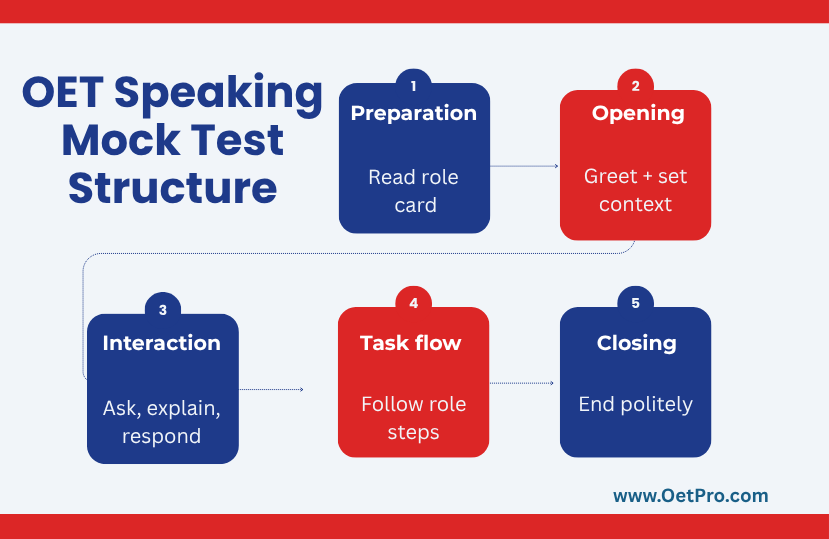
1. Real Exam Timing Simulation
- 3 minutes preparation time
- 2 role plays of 5 minutes each
- No stopping or restarting
2. Role Card Analysis Phase
Before speaking, candidates must:
- Identify patient problem
- Understand task objectives
- Plan structure mentally
3. Controlled Speaking Phase
During speaking:
- Follow structured communication flow
- Maintain interaction
- Use empathy naturally
- Keep clarity under pressure
4. Examiner Mindset Simulation
Practice as if someone is evaluating:
- Clarity
- Structure
- Interaction
- Emotional response
Why Mock Simulation Is Critical
Most candidates fail not because of English ability, but because of:
- Panic under pressure
- Loss of structure
- Slow thinking during speaking
- Lack of real exam conditions practice
Mock simulation solves this by training your brain to perform under stress conditions repeatedly. To perform consistently under exam pressure, strengthen your communication framework in OET Speaking Mastery: Role Play Strategies for Clinical Communication (Band A Success System)
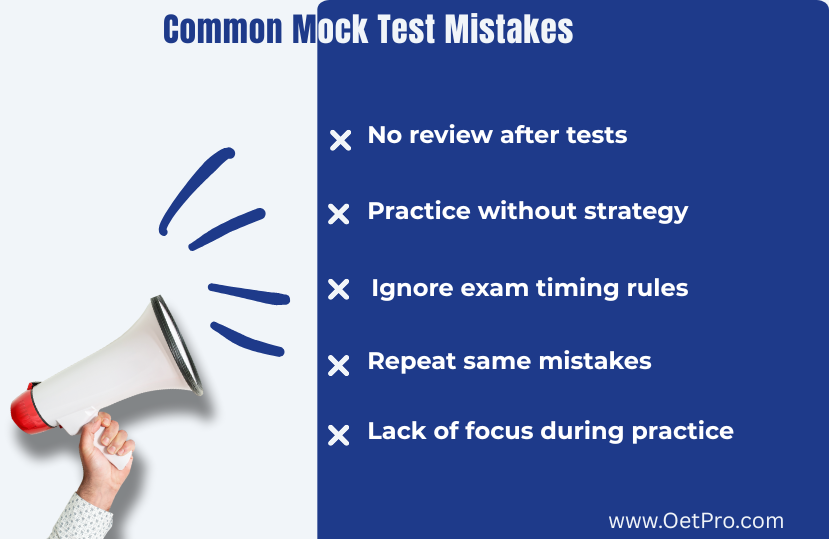
Common Mistakes in OET Speaking Mock Practice
Even students who practice often make critical errors.
1. Practicing Without Time Limit
Candidates speak comfortably without pressure.
This creates false confidence.
Fix:
Always use strict timing (3 + 5 + 5 minutes).
2. Memorizing Instead of Simulating
Candidates prepare fixed answers.
In real exam:
- Patient response changes everything
- Memorization breaks flow
Fix:
Focus on structure, not scripts.
3. No Role Card Analysis
Candidates start speaking immediately without planning.
This leads to:
- Disorganized communication
- Poor structure
- Missed task points
Fix:
Always spend first 3 minutes analyzing scenario.
4. No Interaction Practice
Candidates speak continuously without patient involvement.
Fix:
Insert questions every 30–40 seconds.
5. Ignoring Emotional Response
Candidates focus only on medical facts.
Fix:
Always include empathy and reassurance.
Step-by-Step OET Speaking Mock Execution System
A real OET Speaking mock test is not just “practice speaking”.
It is a controlled performance simulation system.
If you follow the correct steps, your brain starts behaving like it is already inside the real exam.
Step 1 — Exam Environment Setup
Before starting the mock:
- Sit in a quiet place (no interruptions)
- Set strict timer (3 + 5 + 5 minutes)
- Keep role card unseen until start
- Use only paper for quick notes
Goal: Create real exam pressure environment
Step 2 — Role Card Analysis (3 Minutes)
This is the MOST important phase.
You must quickly identify:
- Patient condition
- Main concern
- Your role (nurse / doctor / pharmacist)
- Communication goal
What you should write mentally:
- Opening line
- 2–3 key points
- Empathy trigger sentence
- Closing summary plan
Golden Rule:
If you fail to plan, you will lose structure in speaking.
Step 3 — Opening Phase Control (First 30 Seconds)
Start strong and structured:
Example:
“Good morning, I’m Dr. Smith. I understand you are not feeling well today. I’m here to help you with your concern.” Mistakes made during mock tests should be corrected using structured role play techniques in OET Speaking Mastery: Role Play Strategies for Clinical Communication (Band A Success System)
Focus points:
- Calm tone
- Clear introduction
- Patient reassurance
Step 4 — Controlled Communication Flow
During speaking:
You must follow this cycle:
OPEN -> EXPLAIN -> INTERACT -> REASSURE -> MOVE FORWARD
Key Execution Rules:
- One idea per sentence
- Do not overload information
- Keep patient involved
- Maintain logical flow
Step 5 — Interaction Control System
Every 30–40 seconds, insert interaction:
Examples:
- “How are you feeling about this?”
- “Does that make sense so far?”
- “Do you have any concerns?”
Why this matters:
Without interaction, your score drops in clinical communication.
Step 6 — Pressure Handling Strategy
During mock test, pressure will increase.
You must NOT:
- Stop speaking
- Restart sentences
- Freeze due to mistakes
Instead use:
- Slow down slightly
- Simplify sentences
- Use structure anchors
Example:
“Let me explain this step by step…”
Step 7 — Closing Phase Control (Final 30 Seconds)
Never end abruptly.
Use structured closing:
Example:
“To summarize, we will start the treatment today and monitor your condition. If you experience any issues, please contact us immediately.”
Real Exam Simulation Strategy (Advanced Level)
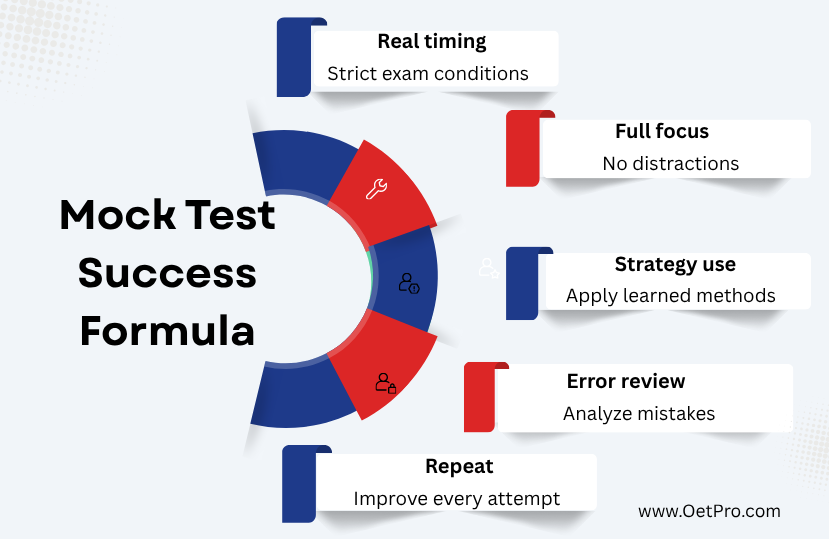
To simulate real exam conditions:
1. No Pause Rule
Do not stop once speaking begins.
Train flow continuity.
2. No Re-Start Rule
Never restart full sentences after mistakes.
Use correction and continue.
3. Time Pressure Training
Always use strict timing:
- 3 min preparation
- 5 min role play 1
- 5 min role play 2
4. Emotional Pressure Simulation
Imagine:
- Patient is anxious
- Time is limited
- Examiner is observing
This builds real exam mindset. To move from Band B to Band A, you need a clear clinical communication system explained in OET Speaking Mastery: Role Play Strategies for Clinical Communication (Band A Success System)
Pressure Control Techniques (Critical Skill)
1. Slow Thinking = Better Control
Do not rush.
Controlled speech = higher clarity score.
2. Structure Anchoring
Always return to:
- Opening
- Explanation
- Interaction
- Closing
Even if you get confused.
3. Recovery Flow Method
If stuck:
Say:
“Let me explain this more clearly…”
Then continue.
Advanced Mock Mastery (What Separates Average from High Scorers)
At this stage, mock practice is no longer about “doing role plays”.
It becomes a performance refinement system.
High scorers don’t just practice speaking they analyze and upgrade every simulation.
1. Examiner Mindset Simulation (Critical Shift)
During mock tests, stop thinking like a student.
Start thinking like an examiner evaluating yourself.
Ask during practice:
- Is this communication clear and safe?
- Is the patient fully involved?
- Is structure consistent throughout?
- Does this sound like real clinical interaction?
Key Insight
If your speaking does not sound like real healthcare communication, it will not score high even if English is correct.
Mock test performance improves only when supported by strong role play strategies in OET Speaking Mastery: Role Play Strategies for Clinical Communication (Band A Success System)
2. Error Tracking System (Advanced Improvement Tool)
Every mock test must be reviewed using a structured checklist:
A. Structure Errors
- Did I follow logical flow?
- Did I jump between ideas?
B. Interaction Errors
- Did I involve patient enough?
- Did I ask enough questions?
C. Empathy Errors
- Did I acknowledge emotions?
- Did I sound robotic anywhere?
D. Clarity Errors
- Were any sentences confusing?
- Did I over-explain anything?
E. Recovery Errors
- Did I panic after mistakes?
- Did I stop speaking or lose flow?
3. High-Performance Simulation Loop
Top candidates use this cycle:
Step 1 — Perform Mock Test
Full timed role play (3 + 5 + 5 minutes)
Step 2 — Immediate Review
Identify:
- 1 structure issue
- 1 communication issue
- 1 emotional issue
Step 3 — Targeted Re-Run
Repeat only weak parts with correction focus
Step 4 — Final Clean Simulation
Run full test again under pressure
4. Examiner-Level Thinking During Practice
While speaking, constantly evaluate yourself:
Internal Questions:
- Am I guiding this conversation clearly?
- Is the patient understanding me easily?
- Am I controlling structure or losing it?
- Does my response sound natural or memorized?
5. Final Exam Readiness System
Before final exam, your mock training should ensure:
1. Structure Stability
You can maintain flow without losing direction.
2. Interaction Control
You consistently involve patient in conversation.
3. Emotional Balance
You respond naturally to patient feelings.
4. Recovery Confidence
You never stop speaking after mistakes.
5. Time Control Mastery
You can complete responses within 5 minutes comfortably.
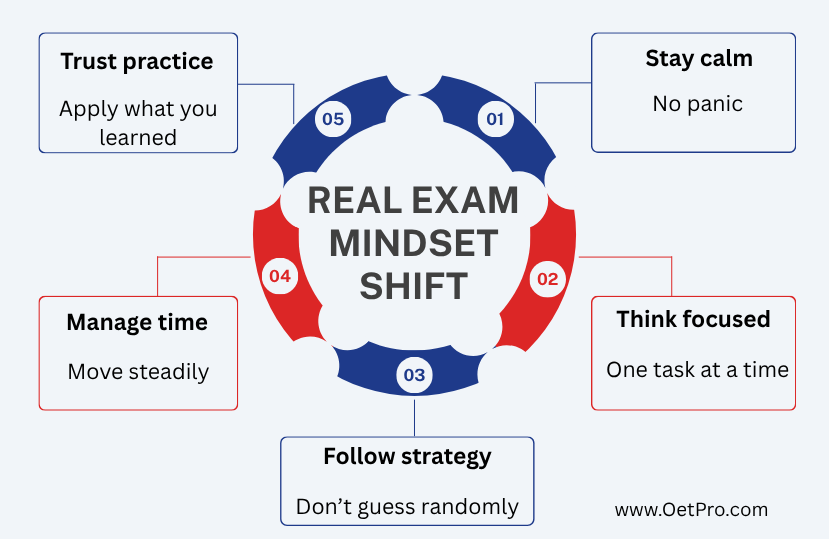
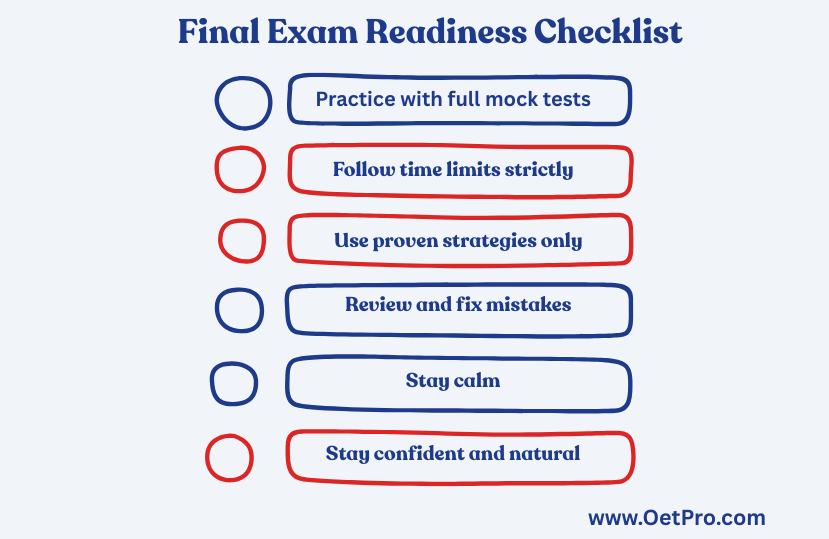
Final Performance Checklist (Exam Day Standard)
Before entering exam:
- I can speak without stopping
- I can recover from mistakes smoothly
- I can maintain structure under pressure
- I can involve patient naturally
- I can stay calm during time pressure
Final Master Insight (Complete System Understanding)
OET Speaking success is not built in the exam.
It is built in mock simulation training that feels identical to the real exam environment.
Final Mindset Shift
Stop thinking:
“I need more practice”
Start thinking:
“I need better simulation quality and performance control”
Summary
OET Speaking mock tests are not simple practice sessions. They are full exam simulation systems designed to train performance under pressure.
This lesson teaches you that success in OET Speaking does not come from memorizing answers, but from repeatedly training your brain to:
- Think under time pressure
- Communicate with structure
- Maintain patient interaction
- Recover from mistakes smoothly
- Perform like a real healthcare professional
When these elements combine, speaking becomes automatic and controlled.
Core Master Principle
You do not pass OET Speaking by knowing English.
You pass OET Speaking by performing correctly under real exam conditions. Build real exam confidence by mastering structured communication techniques in OET Speaking Mastery: Role Play Strategies for Clinical Communication (Band A Success System)
Final Mock Simulation System (Complete Model)
Every high-quality OET mock test must include:
1. Real Exam Timing
- 3 minutes preparation
- 5 minutes role play 1
- 5 minutes role play 2
2. Structured Thinking Phase
Before speaking:
- Identify patient problem
- Define communication goal
- Plan structure mentally
3. Controlled Speaking Phase
During speaking:
- Follow structured flow
- Use simple clear language
- Maintain interaction
- Apply empathy naturally
4. Recovery Phase
If mistakes occur:
- Continue speaking
- Rephrase smoothly
- Do not stop flow
5. Examiner Simulation Mindset
Always evaluate yourself:
- Is this clear?
- Is this structured?
- Is this patient-centered?
Final Examiner Checklist
Before assigning scores, examiners observe:
1. Clarity
- Was communication easy to understand?
- Were instructions clear and simple?
2. Structure
- Was the conversation logically organized?
- Did the candidate guide the flow?
3. Interaction
- Did the candidate involve the patient?
- Was communication one-sided or balanced?
4. Empathy
- Did the candidate respond to patient emotions?
- Was reassurance appropriate and natural?
5. Stability Under Pressure
- Did the candidate maintain flow under time pressure?
- Did they recover smoothly from mistakes?
Common Final Mistakes in Mock Practice
Even advanced candidates make these errors:
1. Treating Mock Tests Like Practice Only
No pressure simulation = false confidence
2. Ignoring Time Limits
Speaking without strict timing reduces exam readiness
3. No Review System
Practicing without analyzing mistakes leads to repetition
4. Memorizing Instead of Simulating
Scripts break under real exam conditions
5. No Interaction Focus
Speaking continuously without patient engagement
7-Day Final Exam Readiness Plan
This plan converts mock training into exam performance readiness.
Day 1–2: Structured Mock Practice
- Full timed role plays
- Focus on clarity and structure
- Avoid memorization
Day 3–4: Interaction Strengthening
- Add questions every 30–40 seconds
- Focus on patient involvement
- Improve empathy responses
Day 5: Error Recovery Training
- Simulate mistakes intentionally
- Practice smooth correction
- Maintain flow without stopping
Day 6: Full Exam Simulation
- Strict timing
- No stopping allowed
- Real pressure environment
Day 7: Final Performance Review
- Identify weak areas
- Fix structure gaps
- Improve confidence
Frequently Asked Questions
1. Do mock tests really improve OET Speaking score?
Yes. If done under real exam conditions with review, they directly improve performance control and structure.
2. How many mock tests should I do?
Quality matters more than quantity.
Even 5–10 high-quality simulations are enough if properly reviewed.
3. What is the biggest mistake in mock practice?
Practicing without time pressure or without analyzing mistakes.
4. Should I memorize answers for mock tests?
No. Focus on structure and communication flow, not scripts.
5. How do I know I’m ready for the exam?
You are ready when you can:
- Speak without stopping
- Maintain structure under pressure
- Recover smoothly from mistakes
- Keep patient interaction consistent
Final Performance Mindset
To succeed in OET Speaking, shift your mindset from:
“I must prepare answers”
To:
“I must train performance under exam conditions” To convert mock test practice into a Band A result, integrate it with OET Speaking Mastery: Role Play Strategies for Clinical Communication (Band A Success System)