
OET Speaking Mistakes: Common Errors, Score Loss Reasons & Recovery Strategy for Grade B/A
Introduction
In OET Speaking, most candidates do not lose marks because they “don’t know English”. They lose marks because they repeat the same predictable communication mistakes.
The problem is not ability. The problem is awareness of errors during real-time speaking.
Many candidates only realize their mistakes after the exam is over. By then, the score is already fixed.
This lesson is designed to change that.
You will learn not only what mistakes happen, but how to detect and recover from them during the exam itself. Once you understand common speaking mistakes, the next step is applying a structured improvement system in OET Speaking Mastery: Role Play Strategies for Clinical Communication (Band A Success System)
OET Speaking is not about perfect performance. It is about controlled recovery and consistent communication quality.
Learning Objectives
By the end of this lesson, you will be able to:
- Identify the most common OET Speaking mistakes
- Understand why candidates lose marks repeatedly
- Learn real-time correction strategies during speaking
- Recover from mistakes without losing fluency
- Improve communication consistency under pressure
- Build awareness of examiner-sensitive errors
Overview of OET Speaking Mistake System
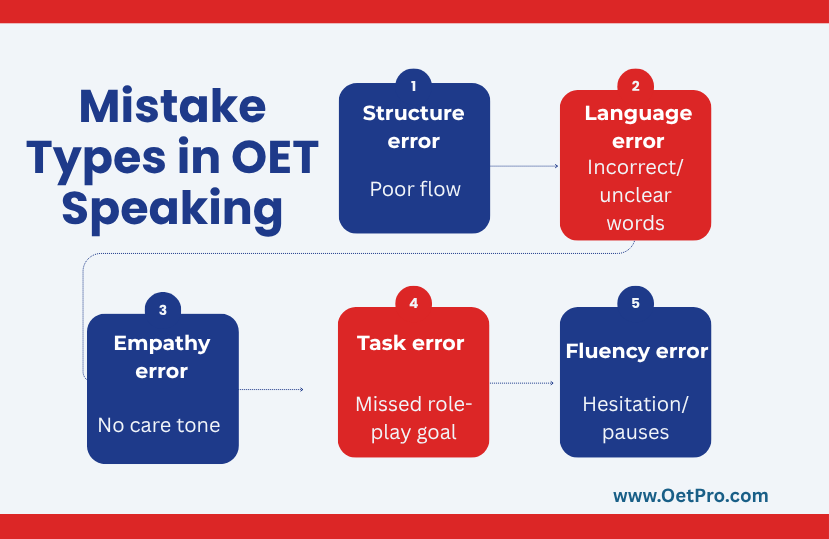
Most speaking errors in OET fall into five predictable categories:
These categories affect your score more than grammar mistakes:
- Structural mistakes
- Communication breakdown mistakes
- Emotional communication mistakes
- Language clarity mistakes
- Interaction mistakes
Each of these directly affects your clinical communication score, which is the most important scoring area.
Key Insight
Most candidates do not make random mistakes.
They repeat the same 5–6 mistake patterns.
Once you identify them, your score improves quickly.
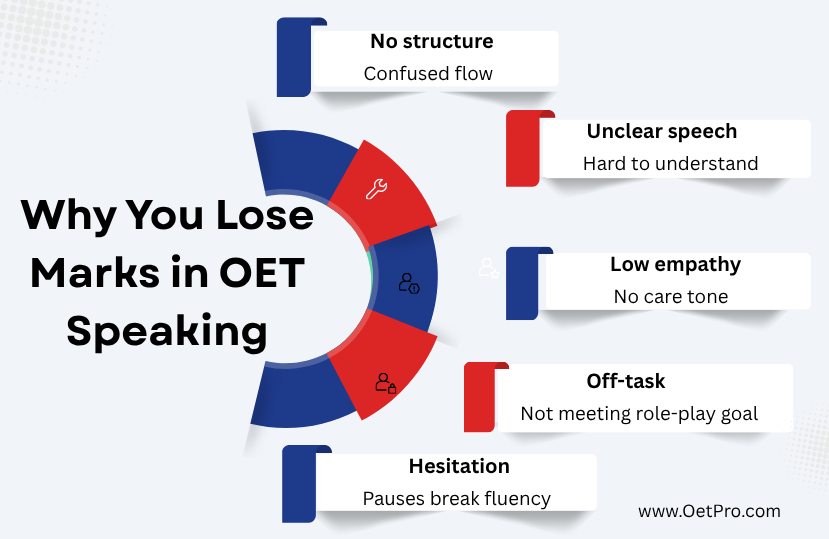
Why Candidates Keep Losing Marks
Even well-prepared candidates struggle because:
- They focus only on memorizing phrases
- They ignore real communication flow
- They do not check patient understanding
- They speak without structure
- They panic when they make small mistakes
The biggest issue is not mistakes themselves it is failure to recover from them.
- To stop losing marks in real exams, you need a clear communication framework explained in OET Speaking Mastery: Role Play Strategies for Clinical Communication (Band A Success System)
Common OET Speaking Mistakes (Core System)
1. Lack of Structure Mistake
Candidates speak without a clear flow.
This leads to:
- Confusion
- Repetition
- Weak communication clarity
Correct approach:
Always follow:
- Opening -> Explanation -> Interaction -> Closing
2. Over-Explaining Mistake
Candidates give too much information at once.
This results in:
- Patient confusion
- Loss of clarity score
- Reduced interaction
Fix:
Break information into small steps.
3. No Emotional Response Mistake
Candidates ignore patient feelings like:
- Fear
- Anxiety
- Confusion
This reduces empathy score significantly.
Fix:
Acknowledge emotions naturally:
“I understand this might be worrying for you.”
4. Monologue Speaking Mistake
Candidates talk continuously without interaction.
This is one of the biggest score reducers.
Fix:
Pause and involve patient:
- “Does that make sense?”
- “Are you following me?”
5. Panic Recovery Mistake
When candidates make a small mistake, they:
- Stop speaking
- Repeat themselves
- Lose confidence
Fix:
Continue naturally without highlighting error.
Score Recovery Concept (Critical Skill)
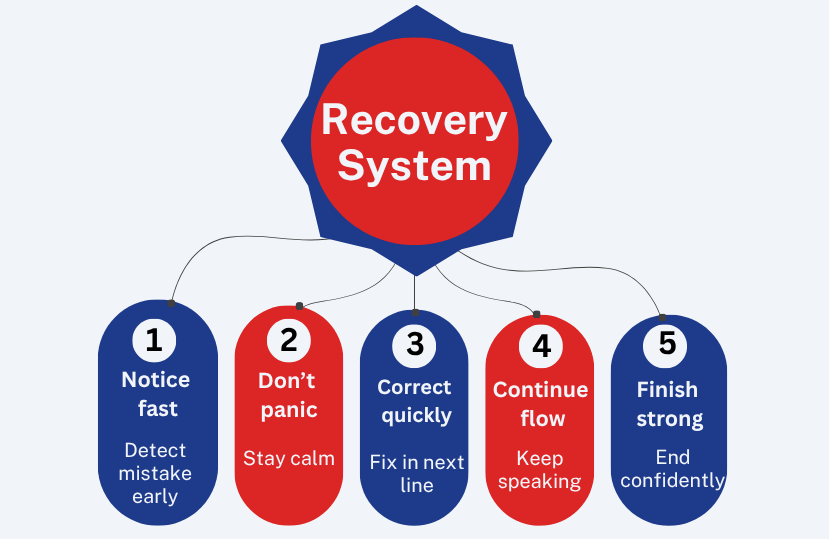
OET Speaking is not about avoiding mistakes completely.
It is about:
Recovering smoothly without breaking communication flow. Every speaking error can be fixed through structured role play practice using OET Speaking Mastery: Role Play Strategies for Clinical Communication (Band A Success System)
Recovery Techniques
1. Self-Correction Without Stopping
If you make a small error:
- Continue immediately
- Do not restart sentence
- Do not explain mistake
Example:
“I recommend you take this medicine daily… I mean, it should be taken once a day regularly.”
2. Bridge Phrases (Flow Repair Tool)
Use phrases to recover structure:
- “Let me explain this more clearly…”
- “What I mean is…”
- “To clarify…”
3. Re-Engagement Strategy
If conversation feels one-sided:
- Ask a question
- Check understanding
- Invite response
Example:
“Have you experienced this before?”
4. Emotional Reset Technique
If you lose confidence:
- Slow down
- Use empathy phrase
- Return to structure
Example:
“I understand this might be a lot of information. Let’s go step by step.”
Real-Time Recovery System (Core Exam Skill)
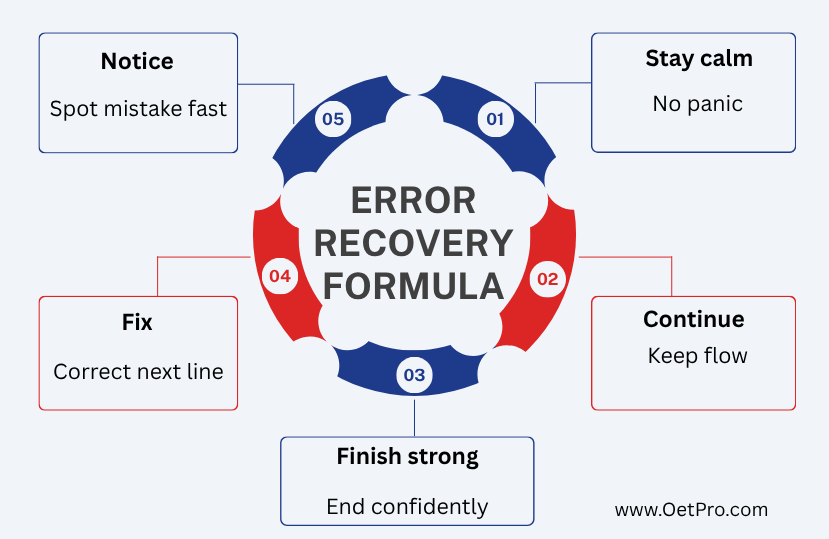
In OET Speaking, mistakes are not the real problem. The real problem is how you behave after making a mistake.
Examiners do not stop scoring when you make an error. They continue evaluating your communication flow, control, and recovery ability.
This is why high scorers are not “mistake-free candidates” they are smooth recovery candidates.
Golden Rule of OET Speaking Recovery
Never stop the communication flow.
Even if you make a mistake:
- Continue speaking
- Adjust silently
- Reframe naturally
Stopping is more damaging than the mistake itself.
Real-Time Correction Techniques
1. Natural Self-Correction (Invisible Fix Method)
If you make a small language or word mistake, correct it smoothly without breaking flow.
Example:
“I suggest you take this tablet twice a day… I mean, two times daily after meals.”
Key rule:
- Do NOT restart sentence
- Do NOT apologize
- Do NOT highlight error
2. Rephrasing Technique (Soft Repair)
If a sentence feels unclear, re-express it immediately in simpler form.
Example:
“This condition is related to metabolic issues… basically, your body is having difficulty processing sugar properly.”
This improves:
- Clarity
- Understanding
- Communication score
3. Pause-Control Strategy
Controlled pauses are powerful tools.
Use pauses to:
- Think
- Structure
- Reduce errors
Good pause usage:
“Let me explain this step by step…”
Avoid:
- Long silence
- Panic hesitation
4. Recovery Through Structure Reset
If you feel lost, restart structure mentally:
- Opening idea
- Main point
- Simple explanation
Example:
“Let me go over this again clearly. First, your condition is… second, what we will do is…”
This brings control back immediately.
- To convert examiner feedback into performance improvement, use the clinical communication system in OET Speaking Mastery: Role Play Strategies for Clinical Communication (Band A Success System)
5. Patient Re-Engagement Fix
If conversation becomes one-sided or awkward:
Bring patient back in.
Examples:
- “Does that make sense?”
- “Are you comfortable with this so far?”
- “Do you have any concerns?”
This restores interaction score instantly.
Examiner Behavior Analysis (What They Notice During Mistakes)
Examiners are trained to observe patterns, not individual errors.
They focus on:
- Does the candidate recover smoothly?
- Does communication remain clear after the mistake?
- Does interaction continue naturally?
- Does confidence return quickly?
Important Insight
A candidate who makes a mistake but recovers well, often scores higher than a candidate who makes no mistakes but communicates rigidly.
- Many candidates stay at Band B because they lack structured communication practice bridge this gap with OET Speaking Mastery: Role Play Strategies for Clinical Communication (Band A Success System)
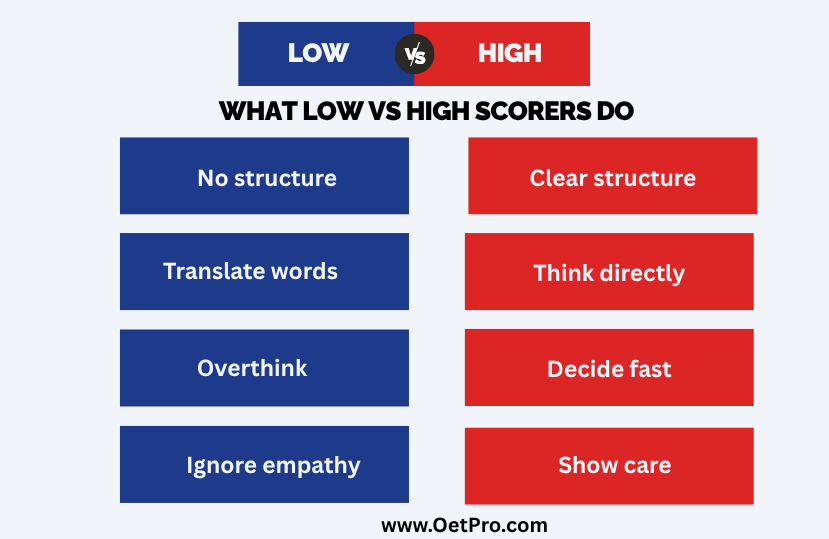
What Low-Scoring Candidates Do
These behaviors immediately reduce scores:
- Stopping after mistake
- Repeating entire sentence
- Apologizing repeatedly
- Losing structure after error
- Going silent for too long
These signal loss of communication control.
What High-Scoring Candidates Do
High performers:
- Continue speaking smoothly
- Fix errors invisibly
- Maintain patient interaction
- Stay calm under pressure
- Return to structured flow quickly
Real Exam Simulation (Recovery Example)
Scenario: Explaining medication dosage
Weak Response
“You take this medicine… uh… sorry… I forgot… you take it once… no twice… sorry…”
Problems:
- Loss of flow
- Visible panic
- Repetition
- Loss of examiner confidence
High-Score Response
“You should take this medicine twice a day… I mean, two times daily after meals to get the best effect.”
“Let me explain further. This helps control your symptoms effectively when taken regularly.”
Why This Works:
- Smooth correction
- No interruption in communication
- Structure maintained
- Confidence preserved
Recovery Mindset Shift
Stop thinking:
“I made a mistake, I lost marks”
Start thinking:
“I made a mistake, now I will recover smoothly”
Key Recovery Formula
Mistake + Smooth correction + Continued structure = No score loss.
Mistake Prevention System (Stop Errors Before They Happen)
Recovery is important, but prevention is higher-level skill.
Top candidates don’t just fix mistakes they reduce them before they occur by controlling their speaking system.
Prevention in OET Speaking comes from structured thinking under pressure, not memorized sentences. Recovery from mistakes during role play requires a strong communication structure found in OET Speaking Mastery: Role Play Strategies for Clinical Communication (Band A Success System)
1. Pre-Structure Thinking (Before You Speak)
Before responding, quickly organize your thoughts:
- What is the patient’s main problem?
- What is my purpose right now?
- Am I explaining, advising, or reassuring?
This prevents:
- Random speaking
- Losing structure
- Over-explaining
2. Simple Language Rule (Clarity Filter)
Always filter your sentence before speaking:
If it sounds complex, simplify it.
Example:
“You are experiencing a pathological condition affecting glucose metabolism”
“Your blood sugar is higher than normal”
This reduces:
- Grammar pressure
- Confusion
- Examiner misunderstanding
3. One-Idea Rule (Anti-Confusion System)
Each sentence should contain only one clear idea.
Good:
- “This medication helps control your blood pressure.”
- “It should be taken twice daily.”
Bad:
- Multiple ideas combined in one sentence
This improves:
- Clarity
- Listening comprehension
- Communication score
4. Emotional Check System (Empathy Trigger)
Before explaining anything, ask yourself:
“How is the patient feeling right now?”
Then respond appropriately:
- Fear -> reassurance
- Confusion -> explanation
- Anxiety -> calm tone
Example:
“I understand this might feel worrying, but let me explain it clearly.”
Full Performance Control Strategy (Exam Stability System)
High scores are not built on perfect sentences.
They are built on consistent control throughout the role play.
1. Start Strong (First 30 Seconds Control)
Your opening must establish:
- Calm tone
- Clear role identification
- Patient comfort
Example:
“Good morning, I’m Nurse Priya. I understand you’re feeling unwell, and I’m here to help you.”
2. Maintain Structure (Middle Control Phase)
During explanation:
- Always follow logical flow
- Avoid jumping between ideas
- Use transition phrases
Control phrases:
- “Let me explain step by step…”
- “There are a few important points…”
3. Maintain Interaction (Engagement Control)
Every 30–40 seconds:
- Ask a question
- Check understanding
- Invite response
Example:
“Does that make sense so far?”
4. Emotional Stability (Pressure Control)
Even if you feel nervous:
- Slow down slightly
- Use simple sentences
- Focus on clarity, not speed
Key idea:
Calm communication = higher score perception
5. Strong Closing Control
Never end abruptly.
Closing structure:
- Summary
- Reassurance
- Next steps
Example:
“To summarize, we will manage your condition with medication and monitoring. If you have any concerns, please contact us anytime.”
Examiner-Level Checklist (Final Evaluation Mindset)
Before examiners assign scores, they subconsciously evaluate:
1. Clarity Check
- Was communication easy to follow?
- Was any part confusing?
2. Structure Check
- Did the candidate follow a logical flow?
- Was the conversation organized?
3. Interaction Check
- Did the candidate involve the patient?
- Was it one-sided or interactive?
4. Empathy Check
- Did the candidate acknowledge emotions?
- Did they respond appropriately?
5. Professional Behavior Check
- Did the candidate sound like a healthcare professional?
- Was communication safe and appropriate?
Final Master Insight (Critical Understanding)
OET Speaking success is not about avoiding mistakes completely.
It is about:
Controlled communication under pressure with smooth recovery when needed
Final Mindset Shift
Stop thinking:
“I must not make mistakes”
Start thinking:
“I must stay structured even if mistakes happen”.
Summary
OET Speaking mistakes are not random. They follow predictable patterns that repeat across most candidates.
The key problem is not that candidates “make mistakes”.
The real problem is that they do not control communication after mistakes happen.
This lesson completes your full error-control system:
- How mistakes happen
- How to prevent them
- How to recover instantly
- How to maintain performance stability
Once you understand this system, speaking becomes controlled rather than stressful.
Core Master Principle
In OET Speaking, mistakes are not score killers.
Uncontrolled mistakes are score killers.
This means:
- A small error with smooth recovery = no major impact
- A small error with panic or silence = score reduction
Final Mistake Control System (Full Model)
Every strong OET Speaking performance follows this cycle:
1. Think Before Speaking
- Identify purpose
- Simplify idea
- Structure response
2. Speak Clearly
- One idea per sentence
- Simple language
- Logical flow
3. Monitor Emotion
- Patient anxiety
- Confusion level
- Need for reassurance
4. Recover Smoothly (If needed)
- Rephrase
- Continue flow
- Do not stop speaking
Final Examiner Checklist
Examiners mentally evaluate your performance using these key questions:
1. Clarity Check
- Was the communication easy to understand?
- Did the message stay clear throughout?
2. Structure Check
- Was the conversation logically organized?
- Did the candidate guide the flow?
3. Interaction Check
- Did the candidate involve the patient regularly?
- Was it a two-way conversation?
4. Empathy Check
- Did the candidate respond to emotions?
- Was reassurance provided appropriately?
5. Stability Check
- Did the candidate recover smoothly from errors?
- Did communication remain consistent?
Common Final Mistakes to Avoid
Even after training, candidates often repeat these:
- Panicking after small errors
- Over-explaining information
- Speaking without structure
- Ignoring patient response
- Ending conversation too quickly
Avoiding these alone significantly improves score stability.
7-Day Score Stability Practice Plan
This plan focuses on eliminating mistakes and improving recovery control.
Day 1–2: Awareness Training
- Identify your common mistakes
- Practice structured speaking slowly
- Focus on clarity over speed
Day 3–4: Controlled Speaking Practice
- Use simple sentences only
- Practice one idea per sentence
- Maintain structured flow
Day 5: Interaction Training
- Ask questions regularly
- Check understanding after each explanation
- Improve patient engagement
Day 6: Error Recovery Practice
- Intentionally simulate mistakes
- Practice smooth correction without stopping
- Focus on maintaining flow
Day 7: Full Exam Simulation
- Timed role plays
- No stopping allowed
- Focus on stability under pressure
Frequently Asked Questions
1. Are mistakes very serious in OET Speaking?
No. Small mistakes are normal. What matters is how you continue after the mistake.
2. Can I still get Grade B or A if I make mistakes?
Yes. Many Grade B and A candidates make minor mistakes but maintain strong communication control.
3. What is the most damaging mistake?
Stopping communication flow, panicking, or losing structure after an error.
4. How can I improve quickly?
Focus on:
- Structured speaking
- Simple language
- Patient interaction
- Recovery techniques
5. Should I speak slowly or fast?
Speak at a natural, controlled pace. Clarity is more important than speed.
Final Performance Mindset
To succeed in OET Speaking, you must stop aiming for perfection.
Instead, aim for:
- Controlled communication
- Clear structure
- Patient understanding
- Smooth recovery
This is what examiners reward consistently.