OET Speaking Scoring Criteria: Examiner System, Band B/A Breakdown & How Marks Are Awarded
Introduction
Most OET Speaking candidates focus only on what they say in the role play.
Very few understand how examiners actually give marks.
This is the main reason many students stay stuck at the same score range, even after months of practice.
The truth is simple:
You don’t improve OET Speaking by speaking more.
You improve it by understanding how scoring works.
OET Speaking is not subjective. It follows a structured marking system based on clear communication criteria. Once you understand how marks are awarded, the next step is learning how to apply them effectively in real role plays using OET Speaking Mastery: Role Play Strategies for Clinical Communication (Band A Success System)
If you understand this system, you stop guessing and start performing strategically.
Learning Objectives
By the end of this lesson, you will understand how OET Speaking is evaluated and how to use this knowledge to improve your score.
You will learn how to:
- Understand the OET Speaking scoring system clearly
- Identify what examiners actually look for
- Differentiate between Grade B and Grade A performance
- Improve communication based on scoring criteria
- Avoid hidden scoring mistakes that reduce marks
- Align your speaking with examiner expectations
Overview of OET Speaking Scoring System
OET Speaking is assessed using two major categories:
1. Linguistic Criteria
This evaluates your language ability:
- Fluency
- Pronunciation
- Grammar
- Vocabulary
2. Clinical Communication Criteria (MOST IMPORTANT)
This evaluates how you communicate in a healthcare setting:
- Relationship building
- Understanding patient needs
- Providing clear information
- Interaction quality
- Empathy and patient-centered communication
Key Insight
While both areas matter, clinical communication carries greater importance in real scoring outcomes.
This means:
You can have good English but still lose marks if communication is weak.
But you cannot achieve high scores without strong clinical communication.
How Examiners Think (Hidden Perspective)
Examiners are not listening like teachers.
They are observing like healthcare communication assessors.
They silently evaluate:
- Does this sound like real clinical communication?
- Is the patient being understood properly?
- Is the conversation structured and safe?
- Is the language helping or confusing the patient?
They are not impressed by advanced vocabulary.
They are impressed by effective communication behavior. Knowing examiner expectations is not enough you must convert them into speaking performance skills using OET Speaking Mastery: Role Play Strategies for Clinical Communication (Band A Success System)
Grade Difference: B vs A (Core Understanding)
To improve your score, you must understand the difference between performance levels.
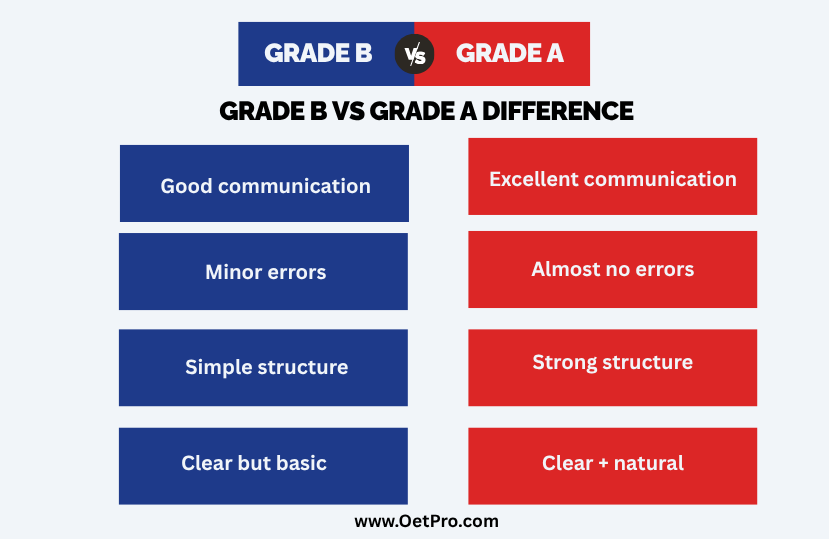
Grade B Performance
A Grade B candidate:
- Communicates clearly
- Uses simple medical language
- Follows structure
- Shows basic empathy
- Handles role play adequately
However:
- May lack consistency in fluency
- May miss deeper emotional communication
- May sound slightly mechanical at times
Grade A Performance
A Grade A candidate:
- Communicates naturally and confidently
- Integrates empathy throughout the conversation
- Controls structure effortlessly
- Adapts language to patient emotions
- Sounds like a real healthcare professional
Key difference:
Grade A is not “better English” it is better communication control.
Why Candidates Lose Marks
Even strong candidates lose marks due to predictable mistakes.
1. Ignoring Clinical Communication Criteria
Candidates focus only on language and ignore interaction quality.
2. Over-Focusing on Grammar
Small grammar issues are less important than unclear communication.
3. Lack of Structure
Unorganized speaking leads to confusion in examiner evaluation.
4. Poor Patient Interaction
No questions, no engagement, no responsiveness.
5. Memorized Responses
Robotic speaking reduces natural communication scoring.
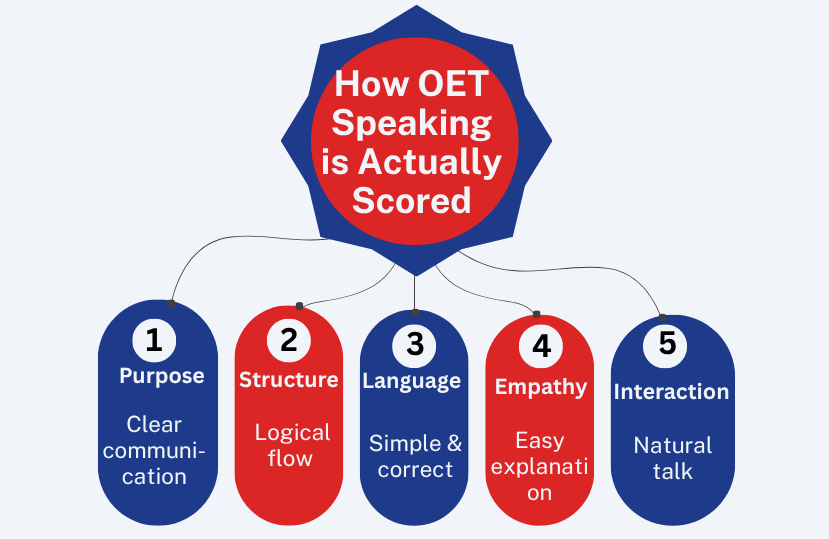
How OET Speaking is Actually Scored (Behind the Curtain)
OET Speaking is not marked by a single “overall impression”.
It is broken into specific assessment areas, and each area contributes to your final performance level.
Examiners are trained to evaluate you using structured observation, not personal opinion.
This is important:
Your score is not based on how “good” you sound overall.
It is based on how consistently you meet each criterion.
The Two Main Scoring Domains (Deep Breakdown)
1. Linguistic Criteria (Language Control)
This includes:
- Fluency (smoothness of speech)
- Pronunciation (clarity of spoken English)
- Grammar (accuracy of structure)
- Vocabulary (appropriateness of words used)
What Examiners Look For Here
They are NOT looking for:
- Perfect grammar
- Advanced vocabulary
- Native-like accent
They ARE looking for:
- Clear understandable speech
- Minimal confusion
- Natural sentence flow
- Ability to express ideas without breaking communication
Key Insight
Even if you make small grammar mistakes, you can still score well if communication remains clear. To bridge the gap between Band B and Band A, apply structured communication techniques explained in OET Speaking Mastery: Role Play Strategies for Clinical Communication (Band A Success System)
But if your speech becomes unclear, even perfect grammar cannot save you.
2. Clinical Communication Criteria (HIGH IMPACT AREA)
This is the most important scoring domain in OET Speaking.
It includes:
- Relationship building
- Understanding patient needs
- Providing relevant information
- Interaction quality
- Empathy and patient-centered communication
What Examiners Look For Here
They evaluate whether you behave like a real healthcare professional.
They observe:
- Do you involve the patient in the conversation?
- Do you respond to emotions appropriately?
- Do you guide the interaction clearly?
- Do you adapt your language to the situation?
Key Insight
This is where most score differences happen.
Two candidates with similar English ability can receive very different scores based on:
- Interaction quality
- Empathy usage
- Structure control
Examiner Evaluation Behavior (How They Think)
Examiners do NOT:
- Count grammar mistakes
- Focus on individual sentences
- Judge vocabulary difficulty
Instead, they:
- Observe communication flow
- Track clarity over time
- Evaluate consistency of behavior
- Judge patient-centered interaction
What Makes an Examiner Give Higher Scores
A candidate is rewarded when they:
- Stay calm and structured
- Communicate clearly under pressure
- Show consistent empathy
- Maintain logical conversation flow
- Keep patient involved
What Reduces Scores
Scores drop when:
- Communication becomes disorganized
- Candidate ignores patient responses
- Speech becomes robotic or memorized
- Information is unclear or too complex
- Interaction is one-sided
The scoring system becomes easier to achieve when you practice structured clinical communication from OET Speaking Mastery: Role Play Strategies for Clinical Communication (Band A Success System)
Grade B vs Grade A (Deep Comparison)
Grade B Performance Pattern
A Grade B candidate typically:
- Communicates clearly most of the time
- Uses appropriate medical language
- Follows basic structure
- Shows some empathy
But:
- May lose structure under pressure
- Interaction may be limited
- Language may become slightly mechanical
Grade A Performance Pattern
A Grade A candidate consistently:
- Controls the conversation naturally
- Uses structured communication without thinking
- Integrates empathy smoothly
- Adapts language instantly
- Maintains strong patient interaction throughout
Critical Difference
Grade B = Correct communication
Grade A = Controlled communication under pressure
If you understand where marks are lost, you can fix them using the role play system in OET Speaking Mastery: Role Play Strategies for Clinical Communication (Band A Success System)
Score Optimization Strategy (Practical Layer)
To improve your score strategically, focus on these 4 areas:
1. Clarity First Rule
Always prioritize:
- Simple sentences
- Clear meaning
- Short explanations
2. Interaction Frequency
High scorers constantly:
- Ask questions
- Check understanding
- Respond to patient emotions
3. Structured Flow Control
Every answer must follow:
- Start (context)
- Explain (information)
- Respond (interaction)
- Close (summary)
4. Emotional Alignment
Always match patient emotion:
- Fear -> reassurance
- Confusion -> clarity
- Anxiety -> calm explanation
Real Examiner Insight (Critical Understanding)
Examiners do not reward “good English”.
They reward:
“Safe, clear, and effective clinical communication”
This means:
- A simple sentence with empathy can score higher than a complex sentence without clarity
- A structured response can outperform fluent but disorganized speech
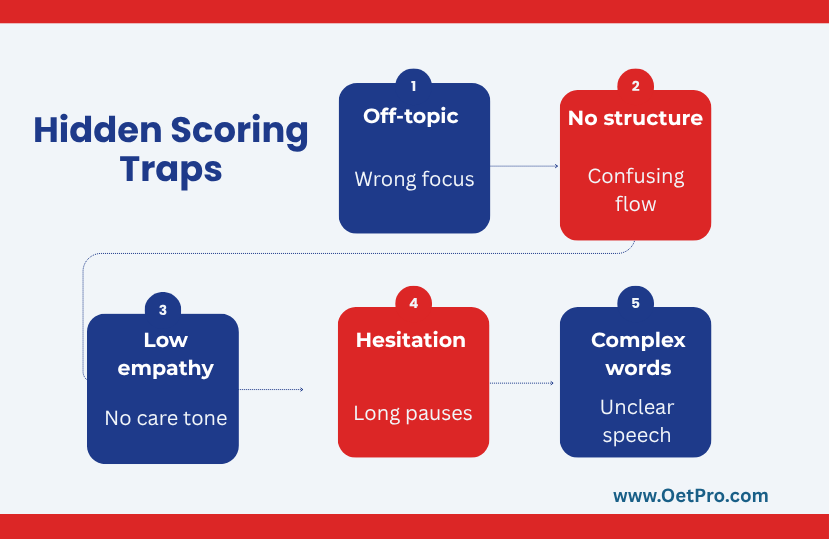
Hidden Scoring Traps (Where Most Candidates Lose Marks)
Many candidates think they lose marks because of grammar or vocabulary. In reality, most score loss happens due to communication behavior mistakes that candidates don’t even notice.
These are the most common hidden traps:
1. “Talking Without Checking Understanding” Trap
Candidates keep speaking without confirming if the patient understands.
This reduces interaction score.
High scoring behavior:
- “Does that make sense so far?”
- “Are you following what I’m saying?”
Low scoring behavior:
- Continuous monologue without pause or interaction
2. “Medical Information Dump” Trap
Candidates explain too much at once.
This causes confusion and reduces clarity score.
Better approach:
- Break information into small parts
- Pause and involve the patient
3. “No Emotional Response” Trap
Candidates ignore patient fear, confusion, or anxiety.
Examiners see this as weak clinical communication.
High scoring behavior:
- “I understand this might be worrying for you.”
4. “Scripted Speech Trap”
When candidates sound memorized:
- Flat tone
- No flexibility
- No adaptation to situation
Examiners reduce communication rating even if language is correct. To align your answers with examiner focus areas, use the structured framework in OET Speaking Mastery: Role Play Strategies for Clinical Communication (Band A Success System)
5. “Ending Too Fast” Trap
Many candidates finish suddenly without closure.
This signals poor clinical control.
High scoring ending:
- Summary + reassurance + next steps
Examiner Psychology (How They Really Evaluate You)
Examiners are trained to observe communication behavior patterns, not just language accuracy.
They subconsciously evaluate:
- Is the candidate acting like a real healthcare professional?
- Is the patient being guided safely through the conversation?
- Is the communication structured and easy to follow?
- Does the interaction feel natural or artificial?
Important Insight
Examiners do NOT track:
- Number of mistakes
- Vocabulary difficulty
- Accent quality
They DO track:
- Communication effectiveness
- Patient involvement
- Emotional handling
- Logical flow
High vs Low Score Simulation
This is where most candidates finally understand the difference.
Scenario: Patient anxious about new medication
LOW SCORE RESPONSE
“I will give you this medicine. It is used for your condition. You may have some side effects. You should take it daily. That is all.”
Problems:
- No empathy
- No interaction
- No structure
- No reassurance
- Sounds robotic
HIGH SCORE RESPONSE
“Good morning, I understand you are a bit worried about starting this medication.”
“Let me explain it in a simple way. This medicine helps control your condition and prevent it from getting worse.”
“I understand side effects can be concerning, but most patients tolerate it very well.”
“Have you heard anything specific that is worrying you?”
“To summarize, we will start the medication carefully and monitor your progress.”
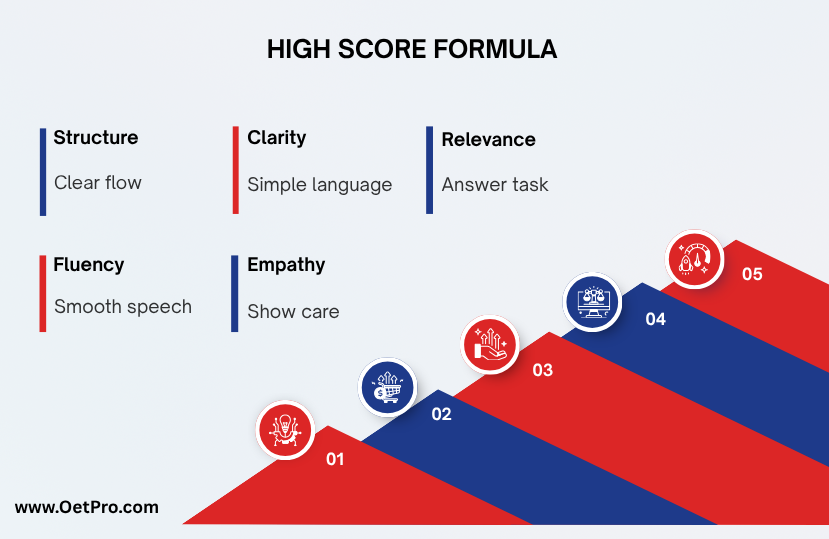
Why This Scores Higher:
- Clear structure
- Empathy included
- Patient interaction present
- Simple explanations
- Professional closure
Key Learning from Comparison
The difference is NOT English level.
The difference is:
Communication design vs random speaking
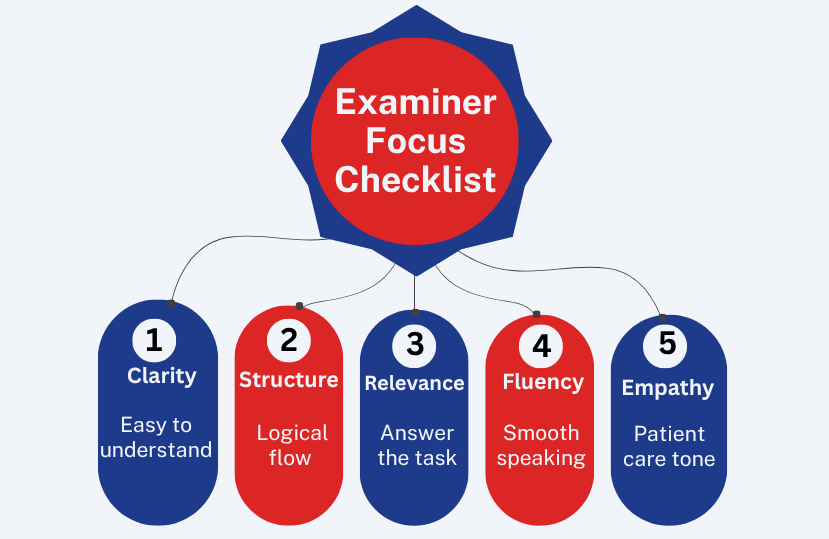
Final Optimization Checklist (Exam Strategy)
Before and during speaking, ensure:
Clarity Control
- Am I speaking in simple, clear sentences?
- Is my message easy to follow?
Interaction Control
- Am I involving the patient regularly?
- Am I checking understanding?
Structure Control
- Am I following a logical flow?
- Am I not jumping randomly between ideas?
Emotion Control
- Am I acknowledging patient feelings?
- Am I reassuring appropriately?
Final Exam Mindset Shift
Stop thinking:
“I must speak perfect English”
Start thinking:
“I must communicate safely and clearly like a healthcare professional”
Summary
OET Speaking is not a language test in the traditional sense. It is a clinical communication performance test where examiners evaluate how effectively you function in a healthcare conversation.
Your score does not depend on how advanced your English sounds. It depends on how safely, clearly, and logically you communicate with the patient.
Once you understand the scoring system, your focus shifts from:
- “What English should I use?”
to
- “Am I communicating like a healthcare professional?”
That shift is what separates average candidates from high scorers.
Final Scoring Model (Simplified System)
Every OET Speaking performance is judged through two layers:
1. Language Layer (Support System)
- Fluency
- Grammar
- Pronunciation
- Vocabulary
2. Communication Layer (Main Scoring Driver)
- Structure
- Interaction
- Empathy
- Clarity
- Patient focus
Key Insight
Communication layer decides your final score more than language layer.
This means:
- Clear communication with simple English > Complex English without structure. To move from understanding scoring to achieving Band A consistently, follow the complete strategy in OET Speaking Mastery: Role Play Strategies for Clinical Communication (Band A Success System)
Final Examiner Checklist (What You Are Really Measured On)
Before examiners assign a score, they mentally check:
1. Clarity Check
- Did I understand the candidate easily?
- Was the message clear or confusing?
2. Structure Check
- Was the conversation logically organized?
- Did it follow a clinical flow?
3. Interaction Check
- Did the candidate involve the patient?
- Was there two-way communication?
4. Empathy Check
- Did the candidate respond to emotions?
- Did they reassure appropriately?
5. Professional Behavior Check
- Did the candidate sound like a healthcare worker?
- Was communication safe and appropriate?
Common Final Mistakes That Reduce Scores
Even strong candidates lose marks due to repeated issues:
1. Over-Focusing on Language Accuracy
Trying to sound perfect instead of being clear.
2. Ignoring Patient Responses
Speaking continuously without interaction.
3. Lack of Logical Flow
Jumping between ideas without structure.
4. Emotional Disconnect
Providing information without empathy.
5. Weak Ending
No summary or unclear closure.
7-Day Score Improvement Plan (Practical System)
This plan converts scoring knowledge into performance improvement.
Day 1–2: Understanding Criteria
- Review scoring system
- Understand difference between B and A
- Identify weak areas
Day 3–4: Structured Speaking Practice
- Practice role plays using fixed flow
- Focus on clarity and structure
- Avoid complex vocabulary
Day 5: Interaction Training
- Practice asking questions every 20–30 seconds
- Focus on patient engagement
- Improve responsiveness
Day 6: Full Simulation Practice
- Timed speaking tests
- No pauses or corrections
- Real exam conditions
Day 7: Review & Correction
- Identify mistakes
- Improve weak communication areas
- Repeat structured practice
Frequently Asked Questions
1. Is grammar the most important part of OET Speaking?
No. Grammar is important but secondary. Communication clarity is more important than grammatical perfection.
2. Can I still get Grade B with simple English?
Yes. Simple, clear, and structured English is enough for Grade B and even Grade A when used correctly.
3. What is the biggest scoring factor?
Clinical communication ability:
- Structure
- Interaction
- Empathy
- Clarity
4. How do examiners decide final scores?
They evaluate overall communication behavior across the role play, not individual sentences.
5. What should I focus on most during preparation?
Focus on:
- Structured communication
- Patient interaction
- Emotional awareness
- Clear explanations
Final Performance Mindset
To succeed in OET Speaking, you must stop thinking like a student and start thinking like a healthcare communicator.
Your goal is not:
- Perfect English
Your goal is:
- Safe communication
- Clear understanding
- Patient reassurance
- Structured delivery
When you achieve this mindset, scoring improves naturally.