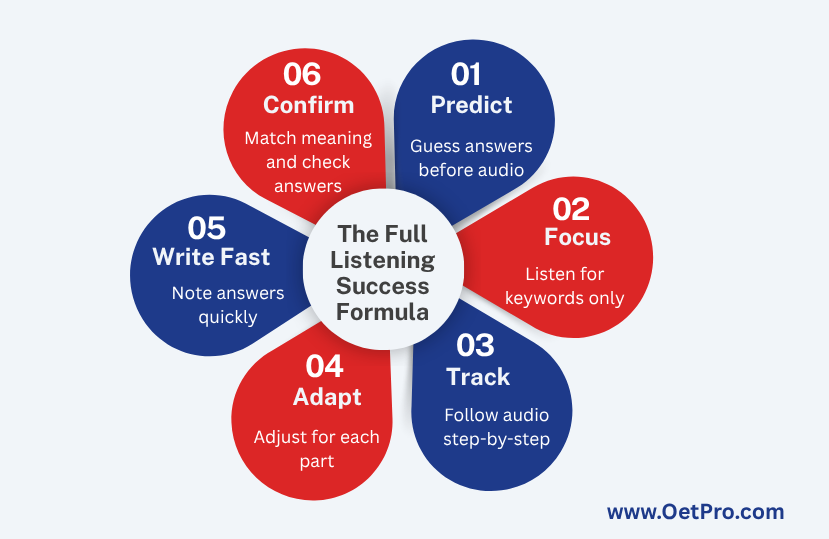
OET Listening Full Strategy (2026): Master Part A, B & C with Integrated High-Score System for Healthcare Professionals
Introduction
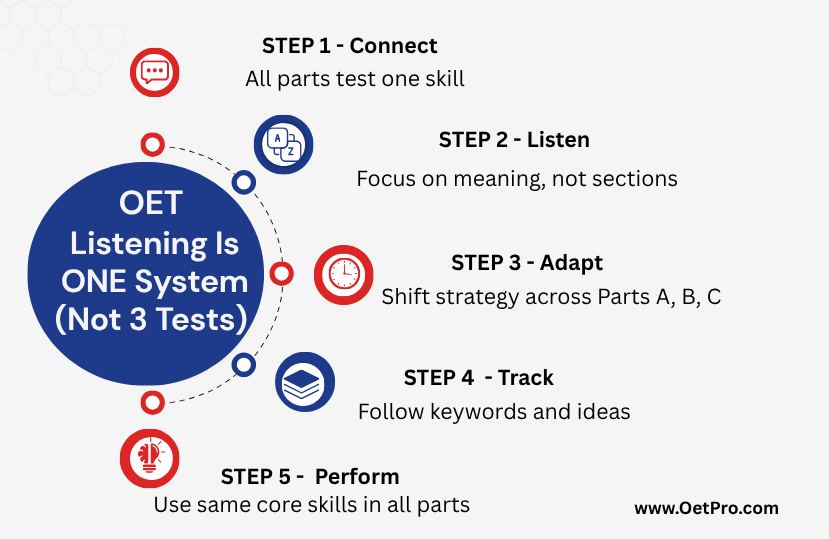
OET Listening is not three separate tests.
It is actually one connected performance system divided into:
- Part A -> Accuracy (notes & details)
- Part B -> Purpose (meaning & workplace logic)
- Part C -> Inference (deep understanding & opinion)
Most candidates fail not because they lack English skills…
but because they treat each part separately.
High scorers treat Listening as one continuous strategy system. An integrated listening strategy helps you combine Part A, B, and C effectively, but your final score depends on how well you understand the complete structure of the OET Listening test. You can understand this full system in OET Listening Mastery: Complete Guide to Part A, B & C for Healthcare Professionals.
Learning Objectives
By the end of this lesson, you will be able to:
- Understand how Part A, B, and C connect
- Manage focus across the full Listening test
- Apply the correct mental strategy for each section
- Avoid switching errors between question types
- Build a consistent high-score performance system
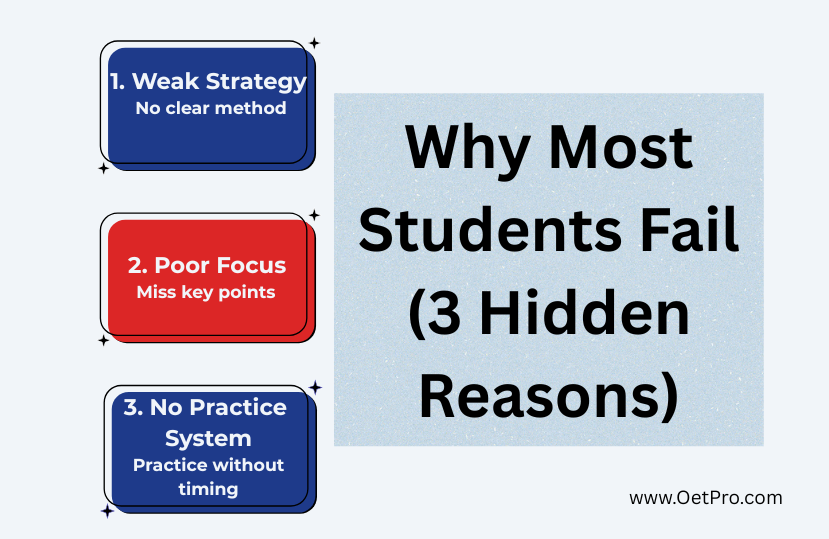
The Big Problem Candidates Face
Most students fail because they:
- Use the same listening style for all parts
- Panic when question type changes
- Lose focus during transitions
- Overthink or underthink sections
Result: inconsistent performance
The Integrated OET Listening System (3-Layer Model)
Layer 1: Part A = “Capture Mode”
You must act like a clinical note-taker
Focus on:
- keywords
- numbers
- symptoms
- medical terms
Rule: Write fast, don’t analyze deeply
Layer 2: Part B = “Meaning Mode”
You must switch to workplace logic thinking
Focus on:
- purpose
- intention
- main idea
Rule: Understand WHY, not WHAT
Layer 3: Part C = “Inference Mode”
You must become an analyst
Focus on:
- opinions
- attitude
- final decision
- hidden meaning
Rule: Read between the lines. While integrating all listening parts is important, it must be built on a strong foundation of individual strategies for Part A, Part B, and Part C. This complete framework is explained in OET Listening Mastery Complete Strategy Guide.
Golden Transition Rule (Most Important Skill)
Between each part, your brain must reset:
Part A -> Part B Transition
- Stop writing notes
- Stop focusing on spelling
- Start thinking meaning
Part B -> Part C Transition
- Stop focusing on short conversations
- Start tracking opinions
- Prepare for inference questions
This “mental switching” is what top scorers do naturally. Achieving high scores requires not only integration but also strong performance in each listening section with clear understanding of exam patterns. You can build these skills using OET Listening Mastery for High Scores (Part A, B & C).
Common Mistake in Full Listening Test
Mistake 1: Same Strategy for All Parts
Using keyword listening everywhere leads to failure.
Mistake 2: Mental Fatigue
Candidates lose focus after Part A -> then Part B suffers.
Mistake 3: Overthinking Part B
Trying to “write” answers instead of understanding meaning.
Mistake 4: Literal Thinking in Part C
Missing inference because everything is taken literally.
Many candidates try to apply integrated strategies without fully understanding how each listening part works individually, which leads to confusion and mistakes. To fix this, refer to OET Listening Mastery Complete Listening Strategy.
Core Success Principle
OET Listening is not one skill it is three different thinking modes.
The Full Listening Flow: How the Exam Really Works
OET Listening is not random.
It follows a fixed psychological flow:
Part A -> High Focus Writing
Part B -> Thinking Mode
Part C -> Deep Analysis Mode
Your performance depends on how smoothly you switch between these states.
Integrated Timing System (Very Important)
You don’t just “listen”.
You manage your energy.
Part A (High Intensity Start)
- Fast attention required
- Writing + listening together
- No room for delay
Strategy:
- Read quickly
- Write immediately
- Do NOT overthink
Part B (Stabilization Phase)
- Slightly calmer pace
- MCQ-based thinking
- Requires focus, not speed
Strategy:
- Read questions early
- Eliminate wrong options
- Focus on meaning
Part C (Mental Endurance Phase)
- Long audio sections
- Heavy cognitive load
- Requires deep understanding
Strategy:
- Track opinions
- Ignore distractions
- Focus on final meaning
Integration becomes effective when you practice all listening sections together while following a structured preparation system for the entire test. Follow the full system in OET Listening Mastery Complete Preparation Strategy.
The SWITCHING TECHNIQUE (Elite Strategy)
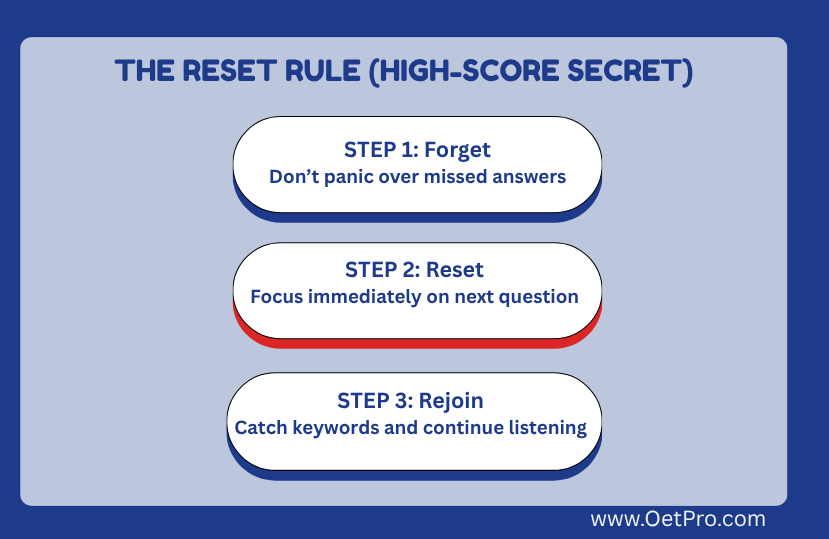
Most candidates fail because they don’t reset their brain between parts.
After Part A -> RESET MODE
You must:
- Stop writing mentally
- Switch from “detail mode” to “meaning mode”
- Prepare for MCQs
After Part B -> RESET MODE
You must:
- Stop focusing on short answers
- Prepare for long conversation thinking
- Activate inference brain
Key Rule:
Each part requires a different thinking system not more effort.
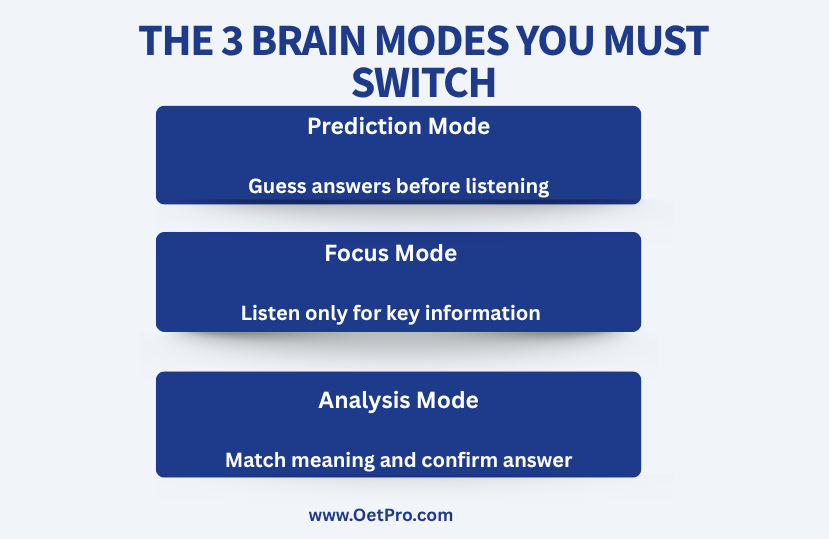
Full Exam Mental Model (Top Scorer System)
Part A Brain Mode = “Scanner”
- Fast extraction
- Keyword focus
- Immediate writing
Part B Brain Mode = “Interpreter”
- Understand purpose
- Identify intention
- Remove distractors
Part C Brain Mode = “Analyst”
- Detect opinion
- Track changes
- Infer meaning
Integrated Practice Simulation
Situation Flow:
You are in a hospital exam simulation:
Part A Example
Patient: “I’ve had chest pain for ___ days.”
You:
- Listen
- Write immediately
- Move on
Part B Example
Hospital staff discussion:
Question: Why is the meeting being held?
You:
- Think purpose
- Ignore extra details
- Select best option
Part C Example
Doctors discussing treatment:
Question: What does the specialist think?
You:
- Track opinion change
- Ignore first idea
- Choose final conclusion
Critical Success Insight
High OET Listening scores come from control, not effort
Control means:
- switching thinking modes
- managing focus
- staying calm under pressure
Final Exam Checklist (Whole Listening Test Control System)
Before you enter the exam hall, your performance depends on one thing:
system control, not language ability
Part A Checklist (Capture Mode)
- Read all notes quickly
- Predict medical context
- Focus on keywords only
- Write immediately while listening
- Never delay answers
- Ignore extra information
Part B Checklist (Meaning Mode)
- Read MCQs before audio
- Identify question purpose
- Eliminate wrong options early
- Focus on speaker intention
- Avoid keyword traps
- Trust meaning over words
Part C Checklist (Inference Mode)
- Track each speaker separately
- Identify opinion shifts
- Listen for “however / but / now”
- Focus on final conclusion
- Do NOT choose first idea
- Think beyond literal meaning
Full Exam Error Correction System
Most students repeat the same mistakes.
To break this cycle, use this system:
Error 1: Keyword Dependency
Problem:
- choosing answers based on similar words
Fix:
- focus on meaning + context
Error 2: Losing Focus in Transition
Problem:
- Part A -> Part B confusion
Fix:
- reset mindset between sections
Error 3: Overthinking MCQs
Problem:
- changing correct answers
Fix:
- trust first logical answer
Error 4: Ignoring Final Opinion
Problem:
- choosing early statement in Part C
Fix:
- always follow final conclusion
High-Score Strategy Formula
OET Listening Success = Focus + Mode Switching + Inference Control
Final Formula Breakdown:
- Part A -> Speed + Accuracy
- Part B -> Purpose + Logic
- Part C -> Inference + Opinion