OET Listening Question Types Explained: MCQ Strategies for Part A, B & C
Introduction
OET Listening is not just about hearing English clearly. It is about understanding question types and choosing the correct answer quickly under pressure.
Many candidates lose marks not because they don’t understand the audio, but because they:
- Misinterpret the question type
- Focus on the wrong information
- Get confused by similar-looking options
The truth is simple:
- If you understand the question types, you can predict the answer style
- If you can predict the answer style, your accuracy improves instantly
OET Listening questions are mainly multiple-choice (MCQs), but each part of the test (Part A, B, and C) uses different thinking patterns. OET Listening question types include MCQs, note completion, and different formats across Part A, Part B, and Part C. To understand the complete Listening test structure, scoring system, and strategies for all sections, read our OET Listening Mastery Guide.
This lesson will break down all question types in a simple and practical way so you can answer faster and more accurately in the exam.
Learning Objectives
By the end of this lesson, you will be able to:
- Understand all major OET Listening question types
- Recognise how question patterns change in Part A, B, and C
- Identify what each question is testing (detail, meaning, opinion, purpose)
- Avoid common traps in MCQ options
- Improve accuracy and speed in answering
- Build confidence in handling unfamiliar questions
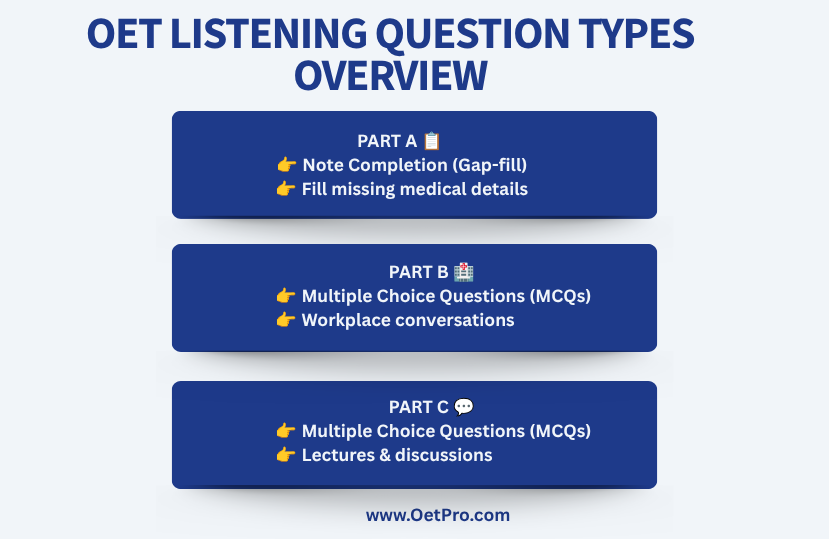
Overview of OET Listening Question Types
OET Listening questions are designed to test different listening skills depending on the section.
Even though all questions are MCQs, they can be grouped into four main types of thinking tasks:
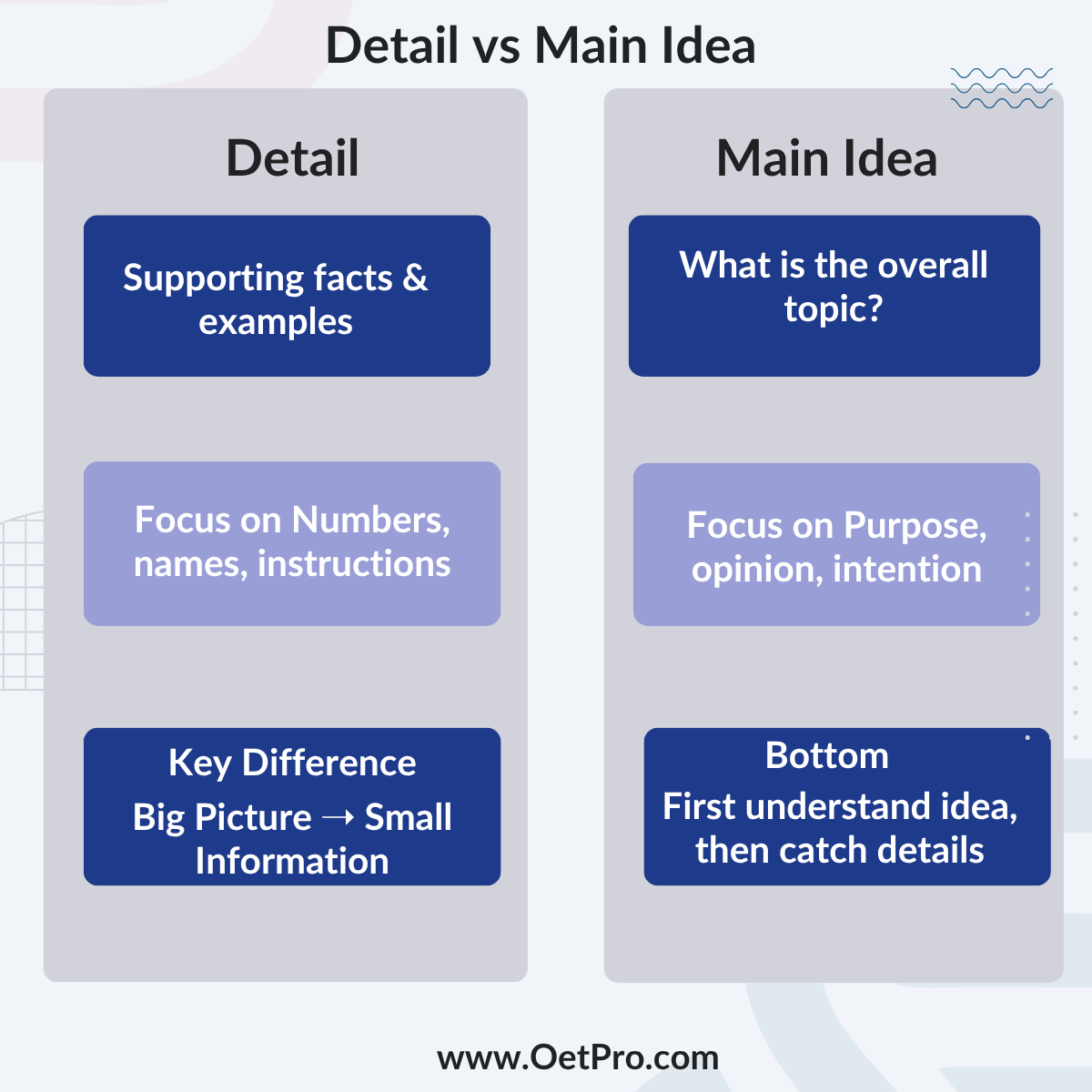
1. Detail-Based Questions
These questions focus on specific information from the audio.
You may need to identify:
- Numbers
- Instructions
- Names or facts
- Specific actions
Common in Part A
2. Main Idea Questions
These test your understanding of the overall meaning of the conversation or lecture.
You are not looking for small details. You are identifying:
- What the speaker is mainly talking about
- The general topic or purpose
Common in Part B and Part C
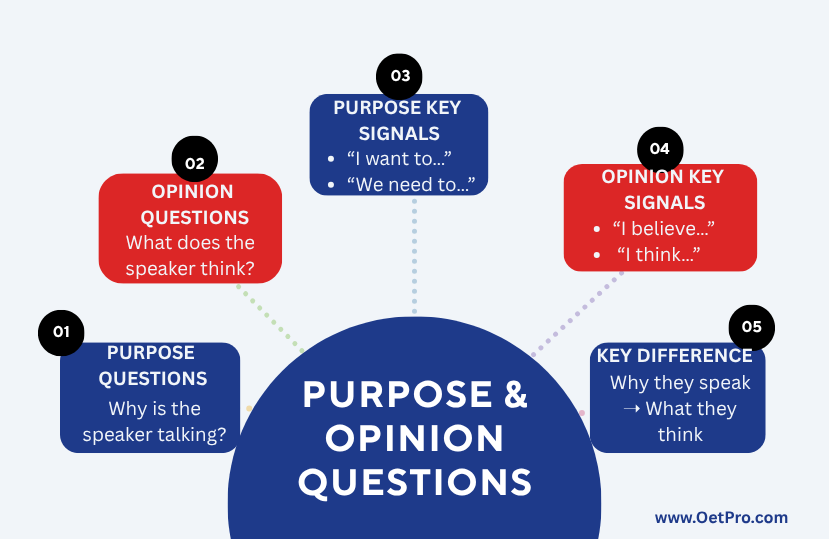
3. Purpose Questions
These ask why the speaker is talking or doing something.
You need to understand intention:
- Why is the nurse speaking?
- Why is the doctor giving this advice?
Common in Part B
4. Opinion / Attitude Questions
These test the speaker’s viewpoint or feeling.
You must identify:
- Agreement or disagreement
- Positive or negative attitude
- Support or concern
Very common in Part C. While understanding question types is important, you also need to know how they appear across all three parts of the OET Listening test. Learn the complete system in our complete OET Listening guide.
Key Insight About Question Types
Most candidates treat all MCQs the same. This is a mistake.
Each question type requires a different listening focus.
For example:
- Detail questions: focus on exact information
- Main idea questions: focus on overall meaning
- Purpose questions: focus on intention
- Opinion questions: focus on attitude
Why Candidates Lose Marks in Listening
Understanding question types solves most scoring problems.
Common issues include:
- Listening for details in main idea questions
- Missing opinion in lecture-based questions
- Confusing purpose with information
- Getting distracted by similar answer options
Simple Truth
OET Listening is not just listening skill.
It is:
Listening + Question recognition + Decision making.
The Question Type Framework (Simple System)
In OET Listening, success depends on one key skill:
Identifying what the question is really asking before you listen carefully
To make this easy, use the 3-Step QRA System
- Q — Question Type Identification
- R — Required Listening Focus
- A — Answer Selection Strategy
STEP 1 — QUESTION TYPE IDENTIFICATION (Q)
Before the audio starts, quickly classify the question.
Ask yourself:
“What am I being tested on?”
4 Main Question Types
1. Detail Questions
- Focus: specific information
- Example: numbers, instructions, facts
2. Main Idea Questions
- Focus: overall meaning
- Example: “What is the conversation mainly about?”
3. Purpose Questions
- Focus: reason or intention
- Example: “Why is the speaker talking?”
4. Opinion Questions
- Focus: attitude or belief
- Example: “What does the speaker think about…?”
STEP 2 — REQUIRED LISTENING FOCUS (R)
Once you know the question type, your listening focus changes.
Detail Questions -> Focus on FACTS
Listen for:
- numbers
- names
- instructions
- specific actions
Ignore opinions or explanations
Main Idea Questions -> Focus on MEANING
Listen for:
- topic
- overall message
- general idea
Ignore small details
Purpose Questions -> Focus on INTENTION
Listen for:
- why speaker is talking
- what action is being done
- goal of communication
Opinion Questions -> Focus on ATTITUDE
Listen for:
- agreement or disagreement
- positive or negative tone
- suggestions or concerns
STEP 3 — ANSWER SELECTION STRATEGY (A)
After listening, use a smart selection method.
Step 1: Eliminate Wrong Options
Remove answers that:
- are too extreme
- do not match topic
- include irrelevant details
Step 2: Match Meaning (Not Words)
Do NOT look for exact words.
Instead ask:
“Does this option match the speaker’s meaning?”
Step 3: Choose Simple Answer
Correct answers are usually:
- clear
- direct
- not overly complicated
These MCQ strategies are essential, but to score high you must also understand how all question types work together in Part A, Part B, and Part C. Explore the full preparation system in our OET Listening Mastery Guide.
Real Exam Example Breakdown
Question Type: Main Idea
Question:
What is the conversation mainly about?
Audio:
A nurse explains medication safety in elderly patients.
Thinking Process:
- Not looking for details
- Focus on overall topic
- Identify general meaning
Correct Answer:
Medication safety in elderly care
Another Example
Question Type: Opinion
Question:
What does the speaker think about the new treatment?
Audio:
Doctor says: “The treatment shows promise, but we need more research.”
Thinking Process:
- Positive + cautious tone
- Not fully approved
Correct Answer:
The treatment is promising but needs more research
Advanced Strategy Tips
1. Identify Question Type in 2 Seconds
Train yourself to instantly recognise:
- Detail
- Idea
- Purpose
- Opinion
2. Don’t Use Same Listening Strategy for All Questions
Each type = different focus
3. Trust Meaning, Not Words
Correct answers often use:
- paraphrased language
- not exact words from audio
4. Avoid Trap Options
Wrong answers often:
- repeat keywords but change meaning
- sound “almost correct”
Common Mistakes in Question Types
Treating all questions the same
This reduces accuracy drastically.
Focusing on details in main idea questions
Leads to wrong answers.
Matching words instead of meaning
Examiners test understanding, not memory.
Ignoring question type before listening
Causes confusion during audio.
These mistakes affect not only MCQs but also other question types across all sections of OET Listening. Learn how to avoid them in our complete Listening guide.
High-Score Candidate Behavior
Successful candidates:
- Identify question type early
- Adjust listening focus instantly
- Think in meaning, not words
- Eliminate wrong options quickly
Key Insight
OET Listening is not just about listening.
It is about:
Understanding what type of thinking is required.
Advanced Question Type Techniques
Now you already know how to identify question types and adjust your listening focus. In this part, we go deeper into exam-level techniques used in OET Listening.
The goal here is simple:
Improve accuracy under pressure
Avoid examiner traps
Make faster decisions
Technique 1 — “TYPE FIRST” RULE
Before listening, always do this:
Identify the question type FIRST, not the keywords
Why this matters
If you focus only on keywords, you may:
- miss the real meaning
- get distracted by similar words
- choose trap answers
Correct thinking order:
- What type of question is this?
- What should I listen for?
- Then listen for keywords
Technique 2 — DISTRACTOR TRAPS
Examiners design wrong answers very carefully.
Common traps:
- Keyword repetition trap
- Partial truth trap
- Extreme meaning trap
- Opposite meaning trap
Example:
Audio:
“The treatment is helpful, but not suitable for all patients.”
Options:
- A: It is fully effective
- B: It is helpful but limited
- C: It is not useful at all
Correct answer: B
Technique 3 — PARAPHRASING SKILL
OET NEVER uses exact same wording in answers.
Example:
Audio:
“The patient should reduce salt intake.”
Option:
“Lower sodium consumption is recommended.”
This is correct even though words are different
Key rule:
Meaning matters more than words
Technique 4 — OPINION SIGNAL DETECTION
For opinion questions, listen for key signals:
Positive signals:
- “I believe…”
- “It is useful…”
- “I agree…”
Negative signals:
- “However…”
- “I’m concerned…”
- “It may not…”
Balanced opinion:
- “It is promising but needs more research”
To achieve a high score, you should practise all question types across Part A, Part B, and Part C—not just MCQs. Follow a complete study plan in our OET Listening Mastery Guide.
Examiner Insights (Cambridge Logic)
Understanding how questions are made gives you a huge advantage.
1. Answers are never obvious
If it feels too obvious, it is often wrong.
2. MCQs test meaning, not memory
You don’t need exact sentences.
You need understanding.
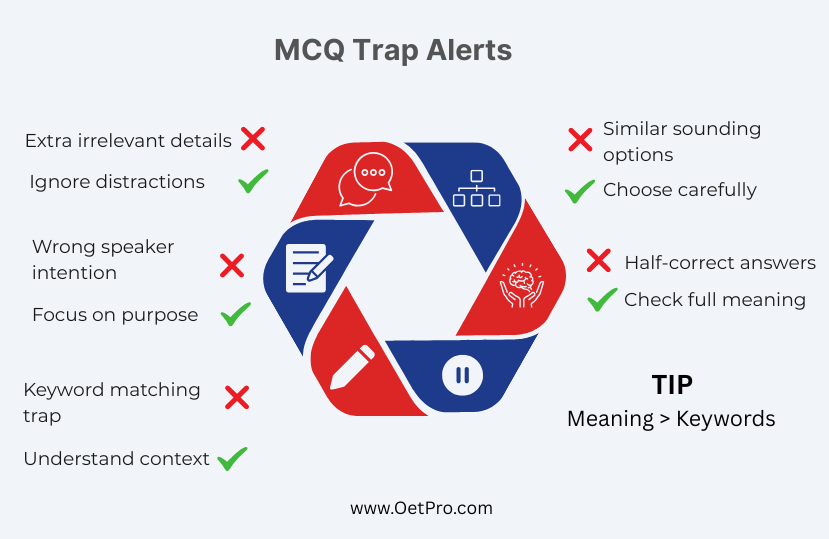
3. Wrong answers are designed to look correct
They often:
- use same topic words
- include partial correct ideas
- mislead with details
4. Correct answers are usually simple
They match overall meaning, not complex wording.
Practice Drills
Drill 1 — Question Type Speed Test
Look at questions and classify in 2 seconds:
- Detail
- Main Idea
- Purpose
- Opinion
Drill 2 — Elimination Practice
For each MCQ:
- remove extreme options
- remove unrelated options
- pick closest meaning
Drill 3 — Paraphrase Training
Take sentences and rewrite meaning in your own words.
Drill 4 — Opinion Detection
Listen to medical audio and identify:
- agreement
- disagreement
- neutral tone
Common Mistakes
Ignoring question type
Leads to wrong listening focus.
Matching words instead of meaning
Biggest cause of wrong MCQs.
Falling for distractors
Examiners design them to confuse you.
Rushing without thinking
Lowers accuracy significantly.
High-Score Candidate Behavior
Top scorers:
- Identify question type instantly
- Focus on meaning, not words
- Ignore traps confidently
- Use elimination method quickly
- Stay calm under pressure
Key Insight
OET Listening success depends on:
Thinking correctly before listening
Not just hearing English.
Summary
OET Listening question types are designed to test different thinking skills, not just listening ability.
If you understand what each question is testing, you can quickly adjust your focus and improve accuracy.
There are four main question types:
- Detail questions: specific information
- Main idea questions: overall meaning
- Purpose questions: reason behind speech
- Opinion questions: speaker attitude
Success in OET Listening comes from:
- Identifying the question type quickly
- Listening with the correct focus
- Selecting answers based on meaning, not words
Final Master Checklist
Use this checklist before your exam.
Question Understanding
- I can identify question types in seconds
- I know what each question is testing
- I adjust my listening based on question type
Listening Strategy
- I focus on meaning, not every word
- I track main idea when required
- I listen for opinion and purpose clearly
MCQ Strategy
- I eliminate extreme options
- I avoid matching exact words only
- I choose answers based on meaning
Exam Control
- I stay calm during long audio
- I do not panic if I miss one sentence
- I move to next question quickly
Frequently Asked Questions (FAQs)
What are OET Listening question types?
OET Listening includes MCQs based on detail, main idea, purpose, and opinion across all three parts.
Which question type is most common?
Main idea and opinion-based questions are very common in Part B and Part C.
How can I improve MCQ accuracy?
By identifying question type first and focusing on meaning instead of keywords.
What is the hardest question type?
Opinion questions are usually hardest because they require understanding tone and attitude.
Can I pass OET Listening without understanding every word?
Yes. You only need to understand meaning, not every word.
7-Day Practice Plan
Day 1–2: Question Type Training
- Practice identifying question types quickly
- Classify sample MCQs
Day 3–4: Listening Focus Training
- Practice detail vs main idea listening
- Focus on switching attention
Day 5: Opinion Detection
- Listen to healthcare conversations
- Identify speaker attitude
Day 6: MCQ Practice
- Solve full listening tests
- Practice elimination method
Day 7: Full Exam Simulation
- Take full listening test
- Review mistakes
- Improve weak areas
Key Success Formula
OET Listening success depends on:
Question Type + Focus + Meaning + Calm Execution
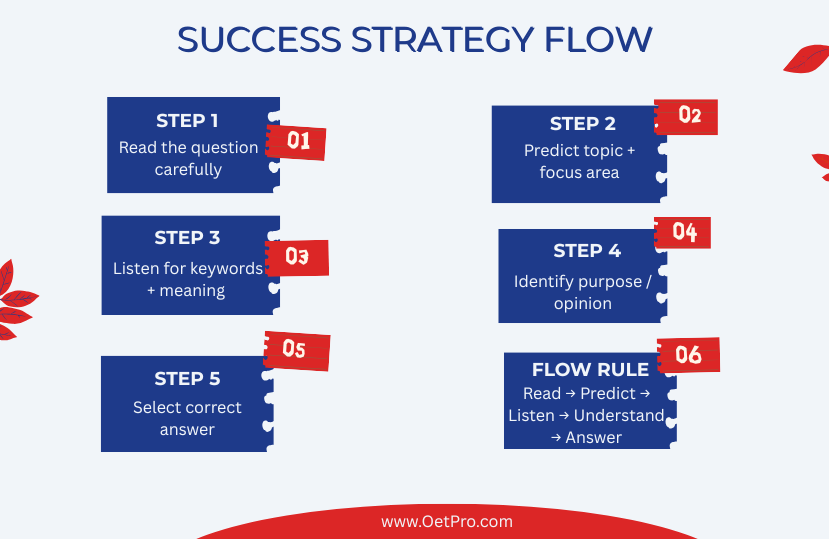
Final Advice
Do not treat all questions the same.
Instead:
- Identify question type first
- Adjust your listening focus
- Choose answers based on meaning
That is the real secret to high scores.