_Complete_Guide_to_Part_A,_B_C1.png)
OET Listening Mastery (2026): Complete Guide to Part A, B & C
Introduction
OET Listening is one of the most scoring yet misunderstood sections of the OET exam.
Many healthcare professionals believe listening is only about understanding English. But in reality, OET Listening is about something more specific understanding healthcare communication with precision.
You are not just listening to conversations. You are identifying key clinical details, understanding patient concerns, and interpreting professional discussions in real medical contexts.
This is why candidates often face a gap. They understand English, but they still lose marks.
The reason is simple. They are not trained in exam-specific listening skills.
This lesson will change that.
You will not just learn what OET Listening is. You will learn how to master it step by step, using a structured system designed for healthcare professionals.
Learning Objectives
By the end of this lesson, you will clearly understand how to approach OET Listening effectively and improve your score.
You will be able to:
- Understand the full structure of OET Listening
- Identify the differences between Part A, Part B, and Part C
- Apply the correct strategy for each part
- Improve listening accuracy and focus
- Avoid common mistakes that reduce scores
OET Listening Overview
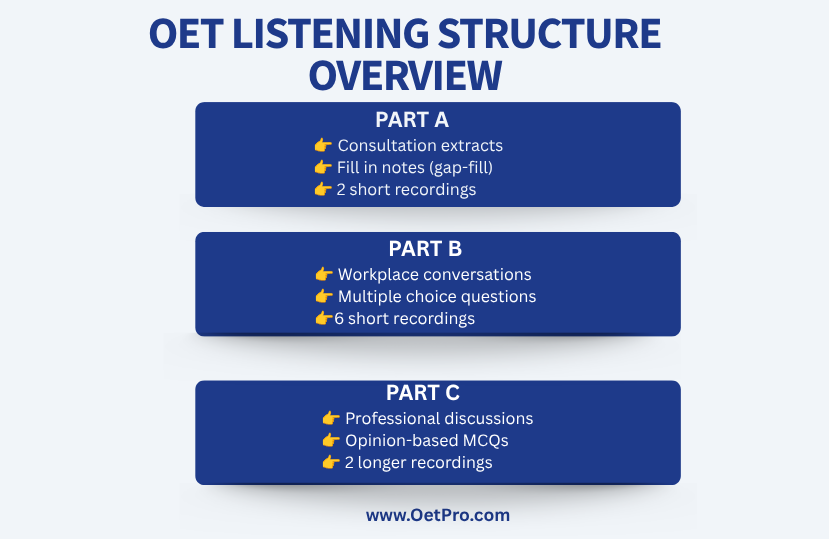
OET Listening consists of three different parts, and each part tests a different type of listening skill.
The Three Parts
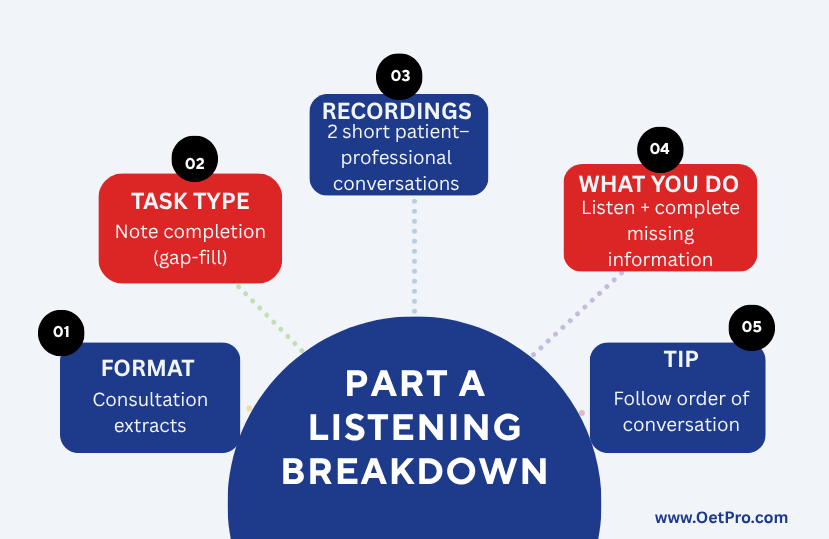
Part A Consultation Extracts – OET Listening Part A Mastery Guide
- You listen to doctor–patient or nurse–patient conversations
- You complete notes based on the consultation
- Focus is on specific details such as symptoms, duration, and treatment
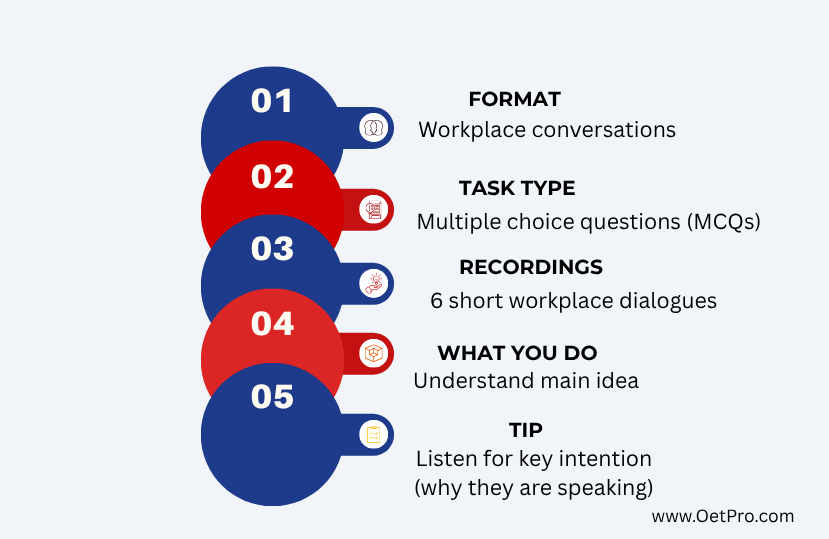
Part B — Workplace Extracts – OET Listening Part B Strategy Guide
- You listen to short healthcare workplace conversations
- Each audio is followed by a multiple-choice question
- Focus is on understanding the main idea or purpose
Part C — Presentations & Interviews – OET Listening Part C Strategy Guide
- You listen to longer discussions, lectures, or interviews
- You answer multiple-choice questions
- Focus is on understanding opinions, attitudes, and deeper meaning
Once you understand all three parts of OET Listening, the next step is to practice them together in full test simulations. Start with our complete Listening practice test guide.
Key Understanding
Each part tests a different skill:
- Part A: Detail accuracy
- Part B: Quick understanding
- Part C: Deep comprehension
You cannot use the same strategy for all three parts.
This is where most candidates go wrong.
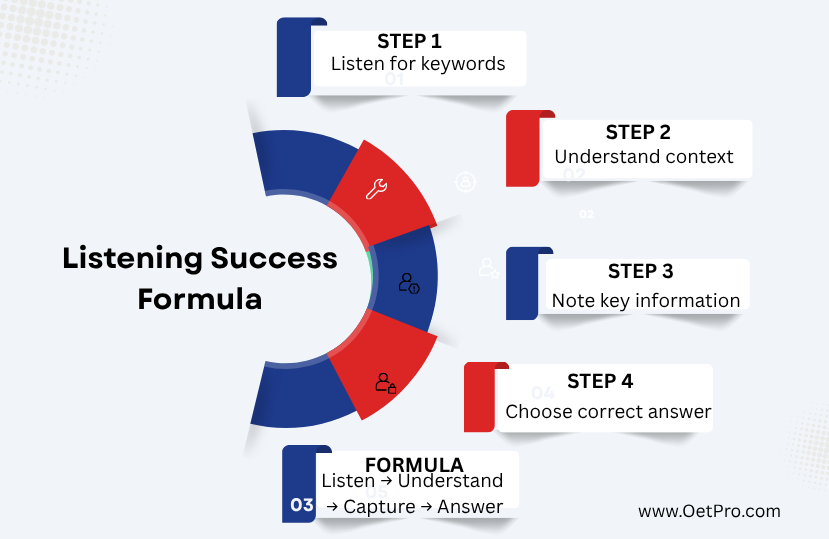
Why OET Listening Feels Difficult
Many candidates say:
“I understand the audio, but I still get answers wrong.” Part C is often the most challenging section because it includes long discussions and lectures with complex ideas. Learn how to handle them effectively in our Part C strategy guide.
This happens because:
- You are trying to understand everything
- Instead of focusing on what the question requires
- You are not trained to filter important information
OET Listening is not about understanding every word.
It is about:
- Identifying relevant information
- Ignoring unnecessary details
- Responding quickly and accurately
Common Mistakes in OET Listening
Understanding mistakes is the first step to improvement.
1. Using the Same Strategy for All Parts
Many candidates treat all sections the same.
But:
- Part A requires writing
- Part B requires quick decisions
- Part C requires deep understanding
Each part needs a different approach.
2. Trying to Understand Every Word
This is one of the biggest problems.
You do not need to understand everything.
You only need to:
- Focus on key ideas
- Identify important details
3. Losing Focus During Audio
OET Listening is fast-paced.
If your attention drops for even a few seconds, you may miss the answer.
This usually happens when:
- You overthink
- You get stuck on one question
- You panic after missing an answer
4. Weak Note-Taking Skills (Part A)
Many candidates:
- Write too slowly
- Try to write full sentences
- Miss the next answer while writing
These skills are especially important in Part A, where you must complete notes accurately while listening. Learn how to master this skill in our Part A detailed guide.
5. Poor Time Awareness
In Part B and Part C:
- You must read, listen, and answer quickly
- Delays lead to missed questions
6. Ignoring Question Focus
Candidates often:
- Hear the correct information
- But choose the wrong answer
Many students understand theory but still lose marks in real exams due to lack of practice under timed conditions. Avoid this with our full Listening practice simulation guide.
Why?
Because they did not understand what the question was asking. These mistakes are very common in Part A, where accuracy is critical. Learn how to avoid them in our OET Listening Part A guide.
These mistakes are very common in Part B, where answer options can be similar and require careful listening. Learn how to avoid them in our Part B strategy guide
These mistakes are very common in Part C because students lose focus during long lectures. Learn how to avoid them in our Part C strategy guide
Many students lose marks because they misunderstand MCQ question types across Part A, B, and C. Learn how to avoid these mistakes in our OET Listening MCQ strategies guide.
Quick Self-Assessment
Ask yourself:
- Do I lose marks even when I understand the audio?
- Do I struggle to keep up with the speaker?
- Do I get confused in Part B or Part C questions?
If yes, you are not alone.
These are common challenges and they can be solved with the right system.
The OET Listening Mastery Framework
To perform consistently well, you need a single system that works across all three parts, with small adjustments for each section.
The most reliable approach is a 3-stage framework:
- Before Listening
- During Listening
- After Listening
This framework keeps your attention structured and prevents panic.
Stage 1 — Before Listening (Preparation Phase)
This is where most candidates lose easy marks. They read passively instead of preparing actively.
Your goal is to predict what you are about to hear.
What You Should Do
- Read the questions or notes quickly
- Identify keywords and focus areas
- Predict the type of answer (detail, idea, opinion)
- Understand the situation (consultation, discussion, lecture)
Why This Matters
Preparation helps you:
- Listen with purpose
- React faster to answers
- Reduce confusion during audio
Stage 2 — During Listening (Performance Phase)
This is the most important stage. You must stay focused and respond in real time.
What You Should Focus On
- Key details (Part A)
- Main idea (Part B)
- Opinion and attitude (Part C)
Core Listening Rules
- Do not try to understand everything
- Focus on the question
- Move forward even if you miss an answer
Stage 3 — After Listening (Quick Review)
You may get a short moment to review.
Use it wisely.
What You Should Check
- Spelling (Part A)
- Completed answers
- Obvious mistakes
Avoid changing answers unless you are confident.
Part-Specific Strategies
Each part requires a slightly different approach.
Part A — Detail Accuracy
Part A is your highest scoring opportunity if handled correctly.
What You Must Do
- Read notes before the audio
- Predict answer types
- Listen for specific details
- Write short, clear answers
To improve your score, it’s important to practise each part separately. Start with Part A, which carries the most marks, using our OET Listening Part A Mastery Guide.
Example
Audio says:
“The patient has had a headache for three days.”
Correct answer:
- three days
OET Listening includes different question types such as MCQs, note completion, and sentence-based questions across Part A, Part B, and Part C. For a complete breakdown of question formats and answering strategies, read our OET Listening Question Types & MCQ Strategies Guide.
Key Focus
- Symptoms
- Duration
- Numbers
- Treatment
What to Avoid
- Writing full sentences
- Missing the next answer while writing
- Overthinking spelling
Part A requires strong note-completion skills and the ability to capture key medical details quickly. For step-by-step strategies, templates, and practice techniques, read our OET Listening Part A Mastery Guide.
Part B Strategy — Quick Understanding
Part B is fast and requires quick thinking.
What You Must Do
- Read the question quickly
- Listen for the main purpose
- Choose the best answer immediately
Example Thinking
If the question asks:
“What is the nurse explaining?”
Focus on:
- The main idea
- Not small details
Key Focus
- Purpose of conversation
- Instructions
- Clarifications
What to Avoid
- Over-analysing options
- Changing answers without reason
- Getting stuck on one question
Part B tests your ability to understand short workplace conversations such as handovers and team discussions. For detailed strategies, question analysis, and practice techniques, read our OET Listening Part B Strategy Guide
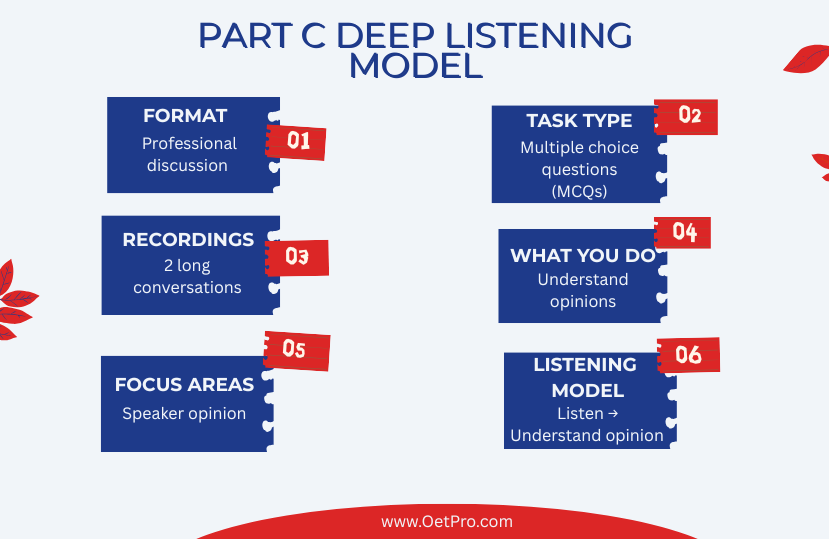
Part C Strategy — Deep Understanding
Part C is the most challenging part because it requires deeper thinking.
What You Must Do
- Read questions carefully before listening
- Identify keywords
- Listen for opinions, tone, and meaning
Example Thinking
If the speaker says:
“I believe this approach is more effective…”
You should identify:
- Opinion
- Reasoning
Key Focus
- Speaker attitude
- Opinions
- Agreement or disagreement
- Main arguments
What to Avoid
- Listening only for keywords
- Ignoring tone and context
- Rushing answers
Part C requires strong listening skills for understanding lectures, speaker opinions, and detailed information. For step-by-step strategies, question patterns, and practice techniques, read our OET Listening Part C Strategy Guide.
Integrated Strategy (All Parts Together)
To master OET Listening, you must combine all strategies.
Your Mental Process
Before Listening:
- What am I listening for?
During Listening:
- Where is the answer?
After Listening:
- Is my answer complete and correct?
Real Exam Scenario
Let’s understand how a high-scoring candidate thinks. Understanding strategies is important, but real success comes from practising full-length Listening tests under exam conditions. Use our OET Listening Practice Simulation Guide for real exam experience.
Situation
Part B question:
“What is the purpose of the conversation?” Practising question types regularly is essential for improving accuracy in OET Listening. Get a full breakdown of MCQs and strategies in our question types guide.
Candidate Thinking
- Ignore unnecessary details
- Focus on why the speaker is talking
- Identify the main intention
These multiple-choice strategies are especially important in Part B, where you must quickly identify the correct answer from short workplace recordings. Learn how to approach these questions effectively in our Part B detailed guide.
Result
Correct answer selected quickly and confidently. To score high in OET Listening, you must understand how each question type works across Part A, Part B, and Part C. Learn detailed MCQ strategies and techniques in our complete question types guide.
Advanced Listening Techniques
At this stage, you already understand the structure and basic strategies. Now the focus shifts to precision, speed, and consistency.
High-scoring candidates are not just good listeners they are trained listeners. They know exactly what to focus on and what to ignore.
Technique 1 — Listen for Meaning, Not Words
Many candidates try to match exact words from the audio to the question. This approach often fails because OET uses paraphrasing.
Instead, focus on:
- The idea behind the sentence
- The context of the conversation
- The intention of the speaker
For example:
- Audio: “It started last Friday”
- Meaning: Duration or starting point
Technique 2 — Anticipation Skill
Top candidates do not wait for answers they expect them.
Before the audio begins, your brain should already be prepared to hear:
- A symptom
- A reason
- A decision
- An opinion
This reduces reaction time and improves accuracy.
Technique 3 — Selective Listening
You do not need to process every word.
Train yourself to:
- Ignore filler phrases
- Focus on keywords
- Capture only relevant information
This is especially important in Part C, where the audio is longer and more complex.
Technique 4 — Staying Aligned with Audio
One of the biggest challenges is losing track of where you are in the audio.
To stay aligned:
- Follow the order of questions
- Move forward even if you miss an answer
- Do not mentally go back
Remember, the audio will not stop.
Technique 5 — Managing Speed
If the audio feels fast, the problem is usually not speed it is processing.
To improve:
- Simplify your thinking
- Avoid overanalysis
- Focus only on the required information
Speed improves naturally with practice. These skills are critical in Part B, where you need to understand the main idea, purpose, and speaker intent in short conversations. Master these skills with our OET Listening Part B Strategy Guide.
Examiner Insights
Understanding how the test is designed gives you a strong advantage.
1. Answers Follow a Logical Order
In most cases:
- The answers appear in sequence
- The structure matches the question flow
This helps you stay organised and avoid confusion.
2. Distractors Are Common
You may hear:
- Extra details
- Similar options
- Misleading information
Your job is to identify:
- What answers the question
- What does not
3. Different Skills Are Tested in Each Part
- Part A: Accuracy of details
- Part B: Quick understanding
- Part C: Depth of interpretation
Examiners expect you to adjust your approach.
4. Understanding Beats Memory
You are not expected to memorise.
You are expected to:
- Understand meaning
- Interpret correctly
- Respond accurately
Essential Vocabulary for Listening
Vocabulary plays an important role, especially in healthcare communication.
Common Patient Language
Patients often use simple expressions:
- “I feel tired”
- “It hurts here”
- “I’ve had this for a few days”
You must understand these clearly.
Clinical Vocabulary
Healthcare professionals may use terms such as:
- diagnosis
- treatment
- medication
- symptoms
Understanding both patient and professional language is essential.
Time and Frequency Expressions
These appear frequently in Part A:
- for two days
- since last week
- twice daily
- every morning
Opinion Indicators (Part C)
These words help you identify opinions:
- I think
- I believe
- In my view
- It seems
Practice Exercises
Practice is essential for improvement, but it must be structured.
Exercise 1 — Detail Listening (Part A)
Listen to a short consultation and identify:
- Symptom
- Duration
- Treatment
Exercise 2 — Main Idea (Part B)
Listen to a short conversation and answer:
- What is the purpose of the conversation?
Exercise 3 — Opinion Detection (Part C)
Listen to a discussion and identify:
- What does the speaker think?
- What is their main argument?
Performance Improvement Strategy
To move from average to high score, focus on consistency.
Daily Practice Plan
- 20 minutes — Part A practice
- 20 minutes — Part B practice
- 20 minutes — Part C practice
Weekly Focus
- Identify weak areas
- Review mistakes
- Repeat difficult questions
Key Habits of High Scorers
- They practise regularly
- They review mistakes carefully
- They stay calm during the test
- They follow a clear strategy
To improve your score in OET Listening, you must practice with full exam simulations that include Part A, Part B, and Part C under real test conditions. Try our OET Listening Practice Mastery (Full Exam Simulation Guide).
Summary
You have now completed a complete system for mastering OET Listening.
This lesson was not just about understanding the exam. It was about learning how to think like a high-scoring candidate.
You learned that OET Listening is not about understanding every word. It is about:
- Identifying relevant information
- Understanding meaning in context
- Applying the right strategy for each part
When you combine structure, focus, and practice, your performance improves naturally.
Final Checklist Before the Exam
Use this checklist to confirm your readiness.
Understanding the Test
- I understand the structure of Part A, Part B, and Part C
- I know what each part is testing
- I can adjust my strategy for each section
Listening Skills
- I focus on meaning, not just words
- I can identify key details quickly
- I understand opinions and tone in Part C
Exam Strategy
- I read questions before listening
- I stay focused during the audio
- I move forward even if I miss an answer
Accuracy & Performance
- I avoid overthinking
- I do not try to understand everything
- I stay calm under time pressure
Frequently Asked Questions (FAQs)
Is OET Listening difficult?
OET Listening can feel challenging at first, especially Part C. However, with the right strategy and regular practice, it becomes manageable and predictable.
How can I improve my OET Listening score?
You can improve by:
- Practising all three parts regularly
- Focusing on weak areas
- Learning to identify key information
- Reviewing mistakes carefully
Which part is the easiest?
Many candidates find Part A easier because it focuses on clear details. However, this depends on your preparation and strengths.
Which part is the most difficult?
Part C is usually considered the most difficult because it requires deeper understanding, including opinions and attitudes.
Do I need to understand every word?
No. You only need to understand the important information related to the question.
Practice Plan
Consistency is the key to improvement.
Daily Practice Plan
- Part A: 20 minutes (focus on accuracy)
- Part B: 20 minutes (focus on speed)
- Part C: 20 minutes (focus on understanding)
Weekly Plan
- Take one full listening test
- Analyse mistakes carefully
- Identify weak areas
- Repeat difficult questions
Monthly Goal
- Track improvement in each part
- Focus on your weakest section
- Build confidence and consistency
Final Performance Advice
Before your exam, remember:
- Stay calm and focused
- Trust your preparation
- Follow your strategy
- Keep moving forward
You do not need perfection. You need consistency and control.
Conclusion
OET Listening is one of the most improvable sections of the exam.
With the right system, you can:
- Improve your accuracy
- Reduce mistakes
- Increase confidence
This lesson gives you everything you need to succeed.
Now, your job is simple.
Practice consistently and apply what you have learned.
Final Call to Action
Start your listening practice today.
Focus on one skill at a time. Improve step by step.
Your OET success is built through consistent effort. Want to master OET Listening Part A? Start with our OET Listening Part A Mastery Guide.