_How_to_Understand_Lectures_Long_Conversations_Easily1.png)
OET Listening Part C Strategy: How to Understand Lectures & Long Conversations Easily
Introduction
OET Listening Part C is the most challenging section of the Listening test for many candidates because it involves long audio passages such as lectures, presentations, or detailed healthcare discussions.
Unlike Part A and Part B, where the focus is short and direct, Part C requires you to stay focused for a longer time while still answering multiple-choice questions based on meaning, attitude, and opinion. OET Listening Part C is only one section of the full Listening test, which also includes Part A (note completion) and Part B (workplace conversations). To understand the complete test format, scoring system, and strategies for all sections, read our OET Listening Mastery Guide
Many candidates struggle not because the English is difficult, but because:
- They lose focus during long audio
- They try to understand every single word
- They cannot track the speaker’s main idea
However, Part C becomes much easier when you stop treating it like a memory test and start treating it like a guided listening system.
Your goal is not to understand everything.
Your goal is to understand the main ideas, opinions, and purpose.
This lesson will give you a clear system to handle long audio confidently and improve your accuracy in Part C.
Learning Objectives
By the end of this lesson, you will be able to:
- Understand the structure of OET Listening Part C
- Identify what examiners test in long audio passages
- Follow lectures without losing focus
- Recognise opinions, attitudes, and key ideas
- Answer MCQs more accurately and confidently
- Avoid common mistakes that reduce scores
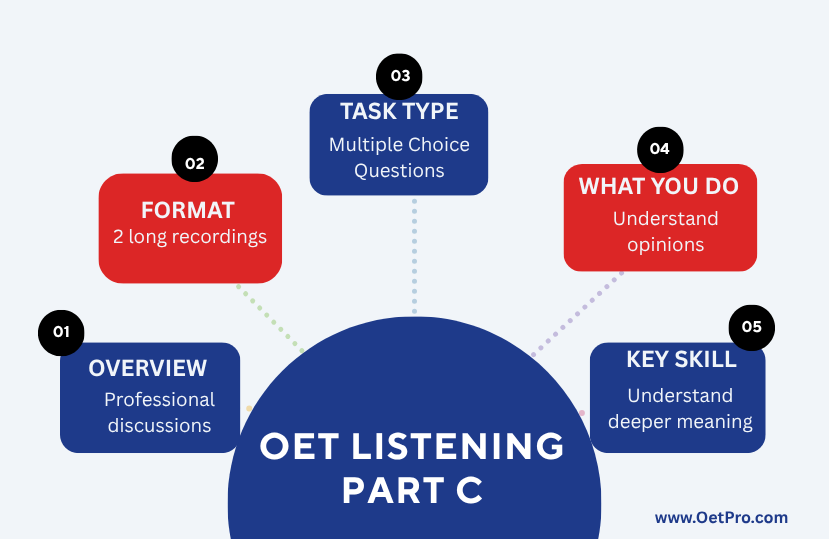
Overview of OET Listening Part C
OET Listening Part C consists of longer audio extracts, usually in the form of:
- Healthcare lectures
- Professional presentations
- Extended discussions between medical staff
- Training or informational talks
These passages are more detailed compared to Part A and B. While Part C focuses on lectures and long conversations, the OET Listening test also includes Part A and Part B, each requiring different skills. Learn how all sections work together in our complete OET Listening guide
What You Will Hear
In Part C, you may hear:
- A doctor explaining a medical condition
- A lecture on patient care techniques
- A discussion about healthcare procedures
- A presentation on research or treatment methods
The language is more formal and structured compared to earlier parts.
What You Need to Do
For each audio passage, you must:
- Listen carefully to a longer recording
- Answer multiple-choice questions (MCQs)
- Focus on meaning, opinion, and attitude
Key Skill Tested
Part C mainly tests your ability to:
- Understand main ideas in long speech
- Identify speaker opinions and attitudes
- Follow structured information over time
- Stay focused during extended listening
Important Rule
You are NOT expected to understand every word.
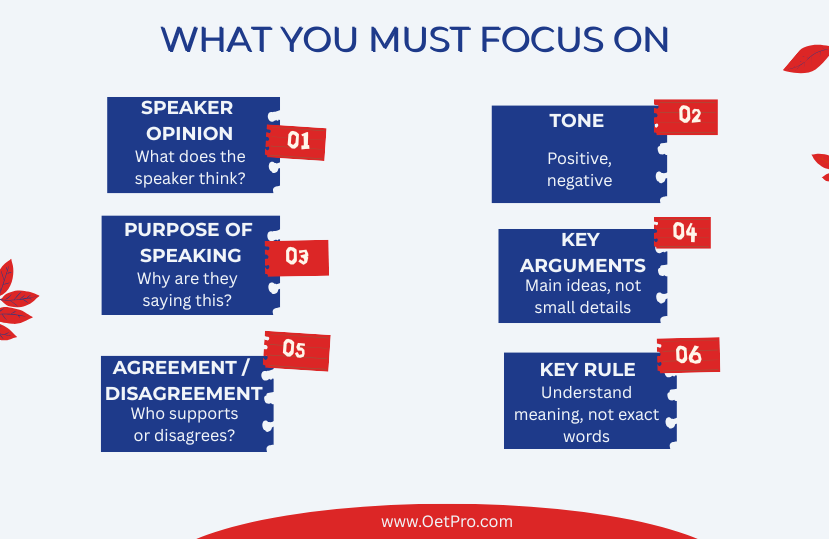
Instead, focus on:
- Overall meaning
- Key arguments
- Speaker’s intention
Why Candidates Find Part C Difficult
Part C feels difficult mainly because of mental pressure and concentration issues, not language complexity.
Common Challenges
- Losing focus in long audio
Candidates stop concentrating after a few minutes. - Trying to understand every word
This slows down thinking and creates confusion. - Missing main idea while focusing on details
Small details distract from the overall message. - Difficulty understanding opinion vs fact
Candidates confuse what the speaker thinks with what is stated. - Stress during MCQ selection
Multiple options look similar, causing hesitation.
Key Insight
Part C is not a test of memory.
It is a test of:
Sustained attention + meaning recognition.
Part C is challenging, but to achieve a high score you must also perform well in Part A and Part B. Learn a complete preparation strategy in our OET Listening Mastery Guide.
Common Types of Questions in Part C
Understanding question types improves accuracy and speed.
1. Main Idea Questions
These ask what the speaker is mainly discussing.
- What is the lecture mainly about?
- What is the topic of discussion?
2. Opinion Questions
These focus on the speaker’s viewpoint.
- What does the speaker think about…?
- What is the speaker’s opinion on…?
3. Purpose Questions
These test why something is being said.
- Why is the speaker giving this information?
4. Detail with Meaning Questions
These combine detail with interpretation.
- What does the speaker suggest about…?
The Part C Success Framework
OET Listening Part C becomes much easier when you stop trying to “remember everything” and instead follow a structured listening system.
The goal is simple:
Stay focused on meaning, direction, and opinion while the audio continues.
To achieve this, use the L.A.S System
- L — Listen for structure
- A — Absorb main ideas
- S — Select answers smartly
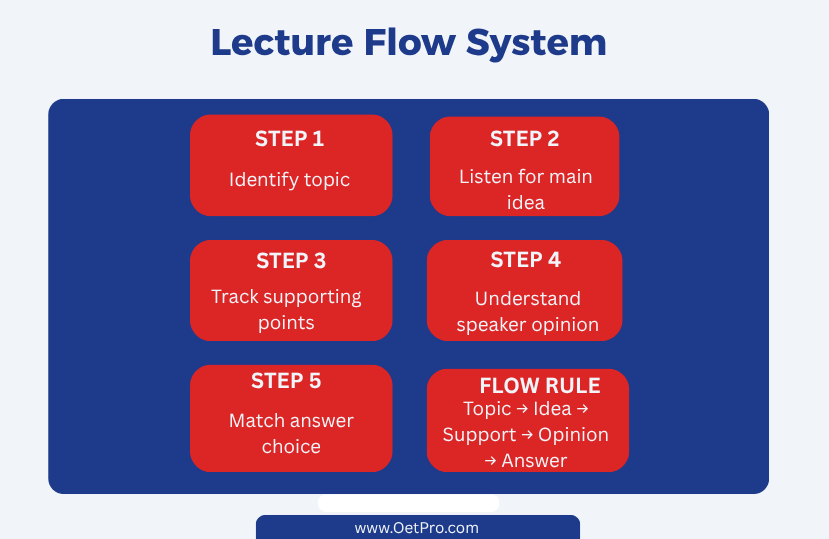
STEP 1 — LISTEN FOR STRUCTURE
Before and during the audio, your brain should identify the flow of information.
Part C audio is not random it is structured like a lecture.
What to look for
- Introduction of topic
- Explanation of key points
- Examples or evidence
- Final conclusion or opinion
Example
If the speaker starts with:
“Today we will discuss patient hydration in elderly care…”
You already know:
- Topic = hydration in elderly care
- Direction = educational lecture
This helps your brain stay focused.
STEP 2 — ABSORB MAIN IDEAS
During the audio, do NOT try to understand every sentence.
Instead, focus on:
- Main idea of each section
- Speaker’s opinion
- Key arguments
What NOT to focus on
- Small details
- Rare medical terms
- Full sentence meaning
What TO focus on
- What is the speaker explaining?
- What is the speaker trying to prove?
- What is the conclusion?
Example
Audio:
“Although hydration is important, overhydration can also cause complications in elderly patients…”
Main idea:
- Balance is important in hydration care
STEP 3 — SELECT ANSWERS SMARTLY
After listening, you must quickly choose the correct MCQ option.
What you should do
- Match answer with main idea
- Eliminate extreme or unrelated options
- Trust your understanding of meaning
Golden Rule
The correct answer is usually simple and direct
Full Strategy Flow
Before Audio
- Read questions
- Identify keywords
- Predict topic
During Audio
- Follow structure
- Focus on meaning
- Track speaker opinion
After Audio
- Select best match
- Avoid overthinking
- Move forward
To succeed in OET Listening, it’s important to prepare all three parts together, not just Part C. Follow a structured study plan in our OET Listening Mastery Guide.
Real Exam Example
Question:
What is the speaker’s main opinion about patient hydration?
Audio:
“Hydration is essential, but excessive fluid intake may lead to complications in elderly patients…”
Thinking Process:
- Main idea = balance needed
- Not extreme hydration
- Not ignoring hydration
Correct Answer:
Balanced hydration is important for elderly patients
Advanced Part C Techniques
1. Follow Lecture Flow
Always track the structure:
- Start: Topic introduction
- Middle: Explanation
- End: Conclusion
This prevents losing focus.
2. Opinion Tracking
Ask during listening:
“Does the speaker agree, disagree, or explain?”
This helps MCQ accuracy.
3. Keyword Anchoring
Use keywords from question to stay focused.
Example:
If question mentions “treatment method”
Listen for treatment-related phrases only
4. Ignore Distractors
Examiners include extra information to confuse you.
Do NOT:
- Chase every detail
- Switch focus unnecessarily
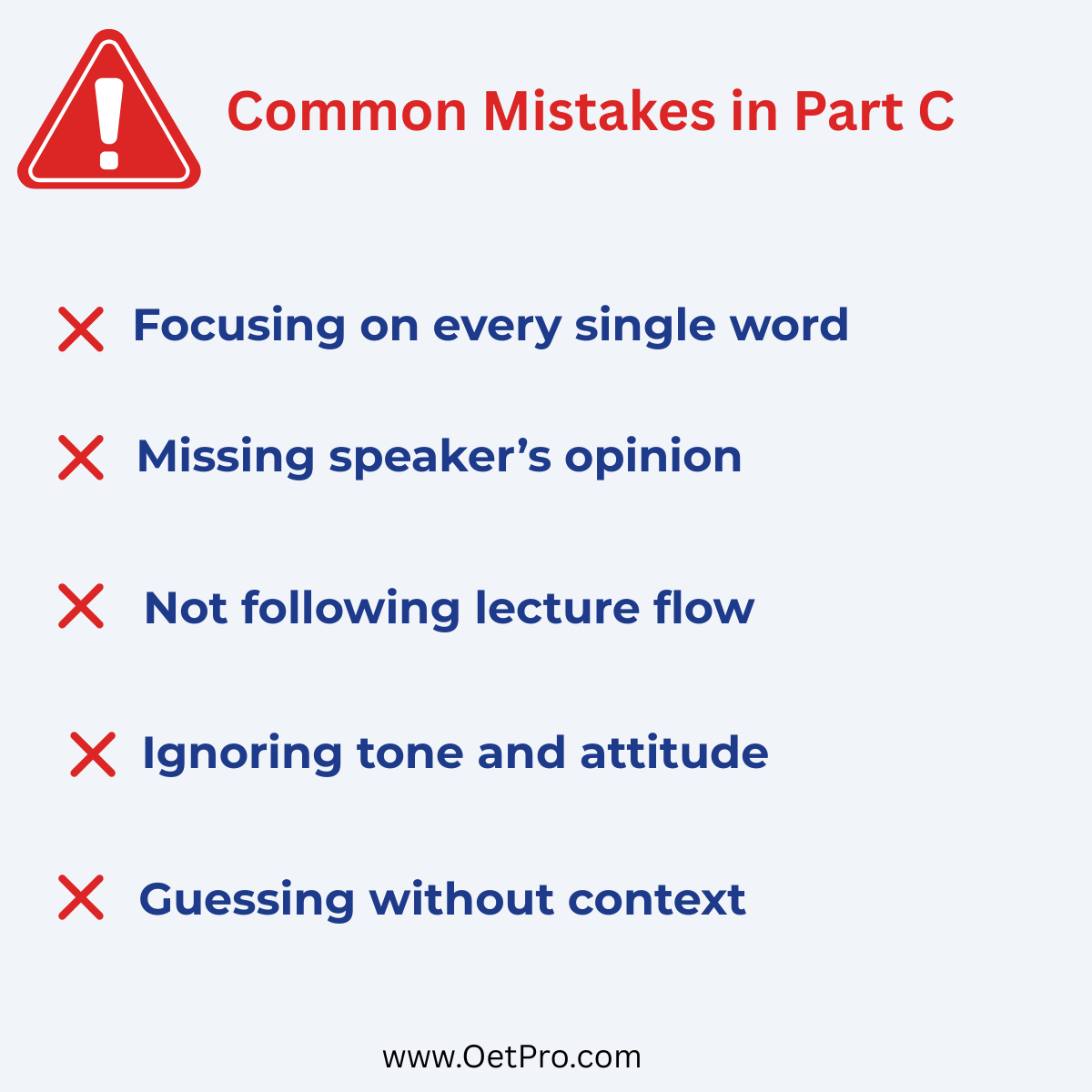
Common Mistakes in Part C
Trying to remember everything
Leads to overload and confusion.
Losing focus mid-audio
Causes missed answers.
Confusing opinion with fact
Speaker opinion is NOT always directly stated.
Overthinking MCQs
Correct answers are usually simple. These mistakes not only affect Part C but also impact performance in Part A and Part B. Learn how to avoid them across the full Listening test in our complete OET Listening guide.
High-Score Candidate Behavior
Top performers in Part C:
- Follow structure of lecture
- Focus on main idea only
- Track speaker opinion
- Stay calm during long audio
- Answer MCQs quickly
Advanced Part C Techniques
OET Listening Part C is not difficult because of language—it is difficult because of attention control and information overload.
Once you understand how examiners design this section, you can predict patterns and answer more confidently.
Technique 1 — Think in “Blocks”, Not Sentences
Part C is a long lecture or discussion. If you try to understand every sentence, you will lose focus quickly.
Instead, divide mentally into information blocks:
- Block 1: Introduction of topic
- Block 2: Explanation or argument
- Block 3: Example or evidence
- Block 4: Conclusion or opinion
This keeps your brain organised.
Technique 2 — Always Track the Speaker’s Opinion
A major focus in Part C is attitude and opinion.
During listening, continuously ask:
“Does the speaker agree, disagree, or explain?”
Common opinion signals:
- “I believe…” ? opinion
- “It is important…” ? emphasis
- “However…” ? contrast
- “Studies suggest…” ? evidence
Technique 3 — Don’t Get Stuck on Unknown Words
Many candidates panic when they hear unfamiliar medical terms.
But in Part C:
Unknown words do NOT matter
Meaning is more important than vocabulary
Focus on:
- Context
- Explanation
- Main idea
Technique 4 — Keyword Tracking Strategy
Use question keywords to guide your listening.
Example:
If the question says:
“What does the speaker say about patient recovery?”
Then you ONLY listen for:
- recovery
- improvement
- healing process
Ignore unrelated information.
Technique 5 — Expect Distractors
Examiners include information that sounds correct but is NOT the answer.
Distractors often:
- Sound medically correct
- Appear early in audio
- Focus on minor details
Correct answer = overall meaning, not isolated sentence
Examiner Insights (What Cambridge Expects)
Understanding examiner logic helps you predict answers.
1. Answers Are Based on Meaning, Not Words
Even if you hear the same words in an option, it may still be wrong.
Examiners test:
Interpretation, not repetition
2. Options Are Designed to Confuse
Wrong answers often:
- Use similar vocabulary
- Include partial truth
- Focus on details instead of main idea
3. Correct Answers Are Usually General
If an option is too specific or narrow, it is often incorrect.
Correct answers are:
- Balanced
- General
- Aligned with main idea
4. Opinion Questions Are High Value
Questions often test:
- agreement
- disagreement
- suggestion
- evaluation
Practice Exercises
Exercise 1 — Block Listening Practice
Listen to any medical lecture and divide it into:
- Introduction
- Explanation
- Example
- Conclusion
Exercise 2 — Opinion Detection
After each sentence, ask:
“Is this fact or opinion?”
Exercise 3 — Keyword Focus Training
Take a question and underline keywords.
Then listen ONLY for those keywords.
Exercise 4 — Elimination Practice
For MCQs:
- Remove extreme options
- Remove unrelated options
- Choose the most balanced answer
Common Mistakes in Part C
Trying to understand every word
This leads to mental overload and loss of focus.
Panicking over unknown vocabulary
Meaning is more important than individual words.
Missing structure of lecture
Without structure, you lose direction quickly.
Overthinking MCQs
Correct answers are usually simple and logical.
High-Score Candidate Behavior
Successful candidates in Part C:
- Follow lecture structure
- Focus on meaning, not words
- Track opinion continuously
- Stay calm during long audio
- Use elimination quickly
Key Insight
Part C is not a memory test.
It is a:
Focus + structure + interpretation test
If you stay calm and follow flow, you will not get lost.
Summary
OET Listening Part C is the most advanced section of the Listening test. It includes long healthcare lectures and discussions where you must understand main ideas, opinions, and overall meaning.
The key challenge is not English it is maintaining focus over a longer audio period.
If you try to understand every word, you will lose direction. Instead, successful candidates focus on:
- Structure
- Main ideas
- Speaker opinion
When you follow this approach, Part C becomes manageable and predictable.
Final Master Checklist
Use this checklist before your exam to ensure full readiness.
Understanding the Task
- I understand Part C is a long lecture or discussion
- I know questions are MCQ-based
- I focus on meaning, not every word
Listening Strategy
- I identify lecture structure (intro -> explanation -> conclusion)
- I track main ideas in each section
- I focus on speaker opinion and attitude
During Exam
- I stay calm during long audio
- I use keywords to guide listening
- I ignore unknown words if meaning is clear
Answering Technique
- I choose answers based on overall meaning
- I eliminate extreme or unrelated options
- I avoid overthinking MCQs
Mindset Control
- I do not panic if I miss a detail
- I stay focused on next question
- I trust structured listening approach
Frequently Asked Questions (FAQs)
What is OET Listening Part C?
Part C is the final section of OET Listening that includes long healthcare lectures or discussions followed by MCQ questions.
Is Part C the hardest part of OET Listening?
It is considered the most challenging due to long audio and concentration requirements, but it becomes easy with structured listening practice.
How many questions are in Part C?
Usually, there are multiple MCQs based on 2 long audio extracts.
What skills are tested in Part C?
- Main idea understanding
- Opinion recognition
- Long audio comprehension
- Focus and attention control
How can I improve my Part C score?
- Practice listening to lectures regularly
- Focus on structure and meaning
- Avoid word-by-word understanding
- Train attention for long audio
7-Day Practice Plan
Day 1–2: Structure Awareness
- Listen to medical lectures
- Identify introduction, body, conclusion
- Practice note mental mapping
Day 3–4: Main Idea Focus
- Listen and summarise each section in 1 line
- Ignore details, focus on meaning
Day 5: Opinion Training
- Identify speaker attitude
- Practice fact vs opinion detection
Day 6: MCQ Practice
- Solve Part C style questions
- Use elimination strategy
Day 7: Full Simulation
- Complete full Listening test
- Review mistakes
- Improve focus and timing
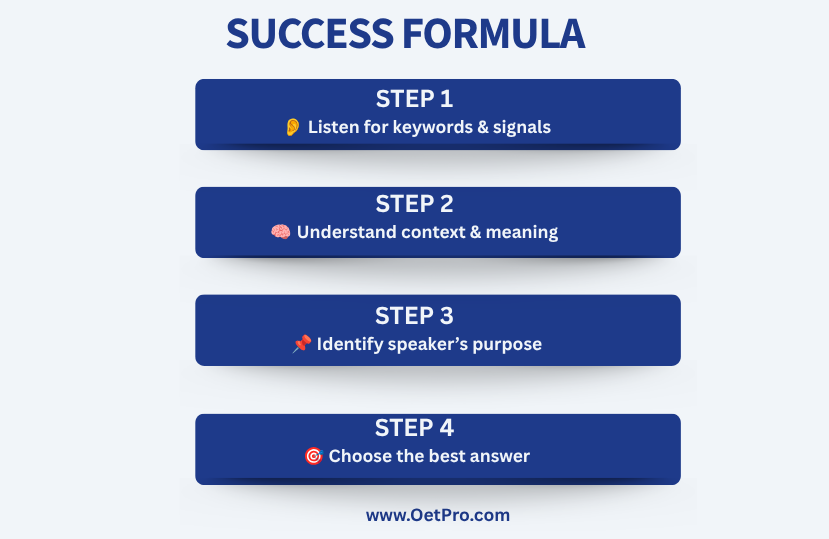
Key Success Formula
OET Listening Part C success depends on:
Structure + Focus + Interpretation + Calm Mindset
Final Advice
Do not try to catch every word.
Instead:
- Follow the flow
- Understand meaning
- Stay calm and structured
That is the real key to scoring high in Part C. Want to master the entire OET Listening test? Start with our OET Listening Mastery Guide.