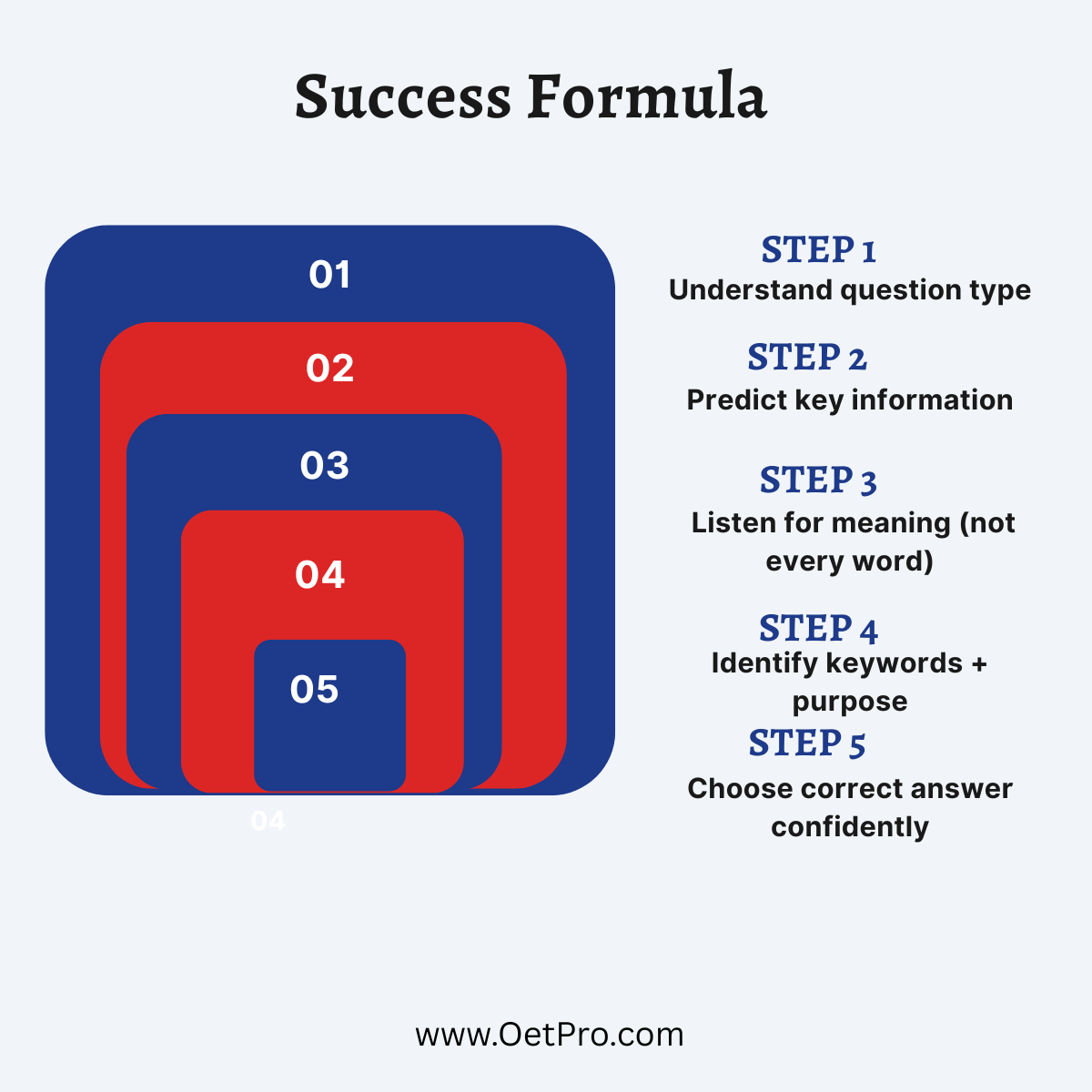
1.png)
OET Listening Practice Mastery (Full Exam Simulation Strategy)
Introduction
Many OET candidates spend hours practicing Listening tests, but their score does not improve. The reason is simple:
They are practicing without a system
They listen to audio, check answers, and move on without understanding what actually went wrong.
OET Listening is not improved by “more practice.” It improves through smart practice with exam simulation + error analysis + question type awareness.
In real OET exams, you will face:
- Fast medical conversations
- Long lectures in Part C
- Tricky MCQ options designed to confuse you
- Time pressure with no pause control
So your practice must feel like the real exam.
This lesson will teach you how to transform normal practice into high-performance exam training so your Listening score improves consistently. OET Listening practice tests are most effective when you first understand the complete Listening test structure, including Part A (note completion), Part B (workplace conversations), and Part C (lectures). For full strategies and exam breakdown, read our OET Listening Mastery Guide.
Learning Objectives
By the end of this lesson, you will be able to:
- Understand how to practice OET Listening like a real exam
- Build a full exam simulation routine
- Improve accuracy in Part A, B, and C
- Identify and fix repeated mistakes
- Train speed and focus under time pressure
- Convert practice into real score improvement
Before attempting full-length OET Listening practice tests, it is important to understand how each section of the exam works. Learn the complete system in our OET Listening Mastery Guide.
Overview of OET Listening Practice Strategy
Most students follow a simple loop:
Listen -> Answer -> Check answers
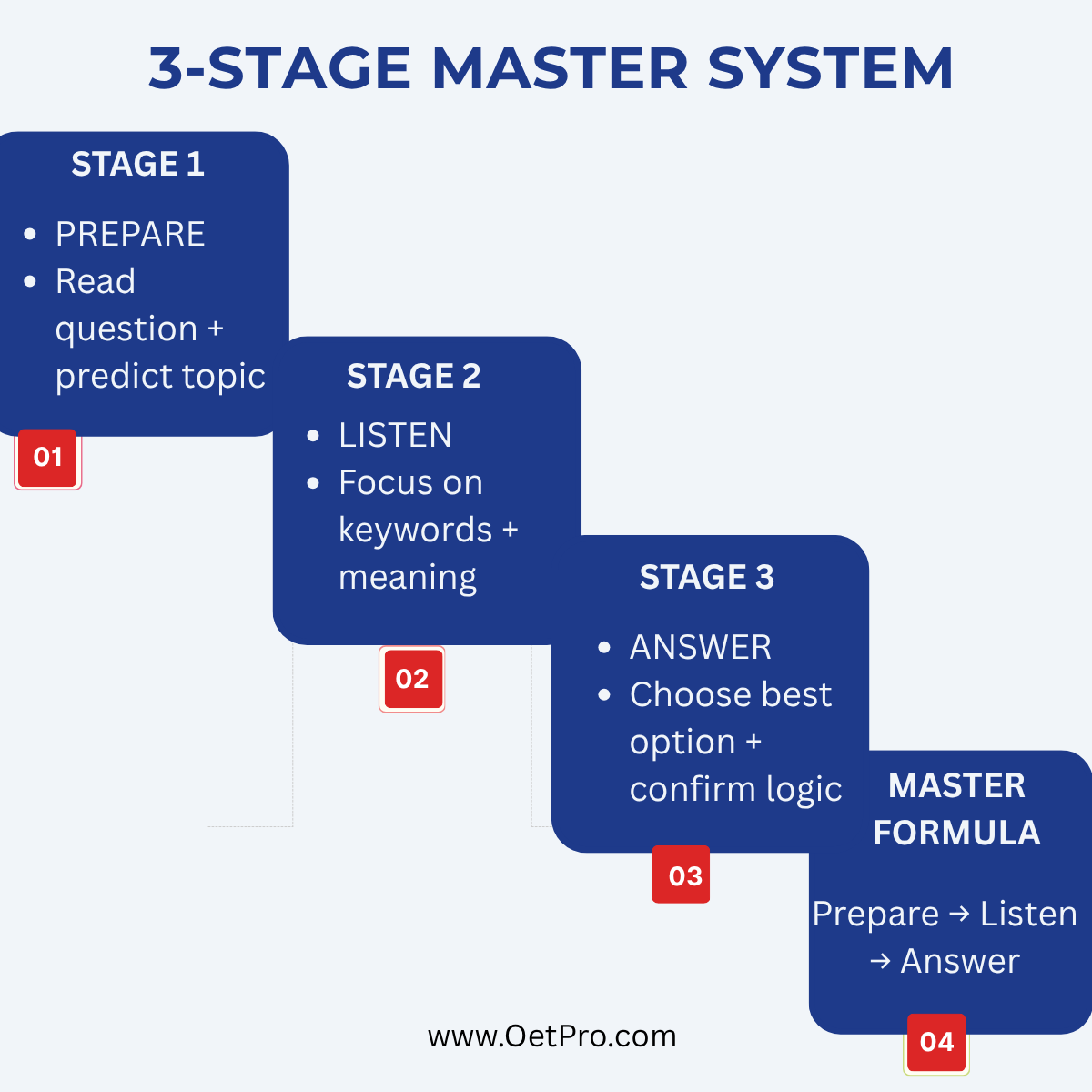
But high-scoring candidates follow a 3-stage mastery cycle:
Stage 1: Simulated Listening
You practice under real exam conditions:
- No pauses
- No replay
- Strict timing
- Real MCQ format
This builds exam pressure control
Stage 2: Deep Review
After the test, you don’t just check answers.
You analyse:
- Why you got it wrong
- What type of question it was
- What you missed (detail / idea / opinion / purpose)
This builds accuracy awareness
Stage 3: Targeted Fixing
You don’t repeat full tests again immediately.
You fix weak areas:
- Specific question types
- Weak listening sections
- Misinterpreted MCQs
This builds score improvement. To get the maximum benefit from practice tests, you should first master all three parts of the Listening exam. Study the full breakdown in our complete OET Listening guide.
Common Mistakes in OET Listening Practice
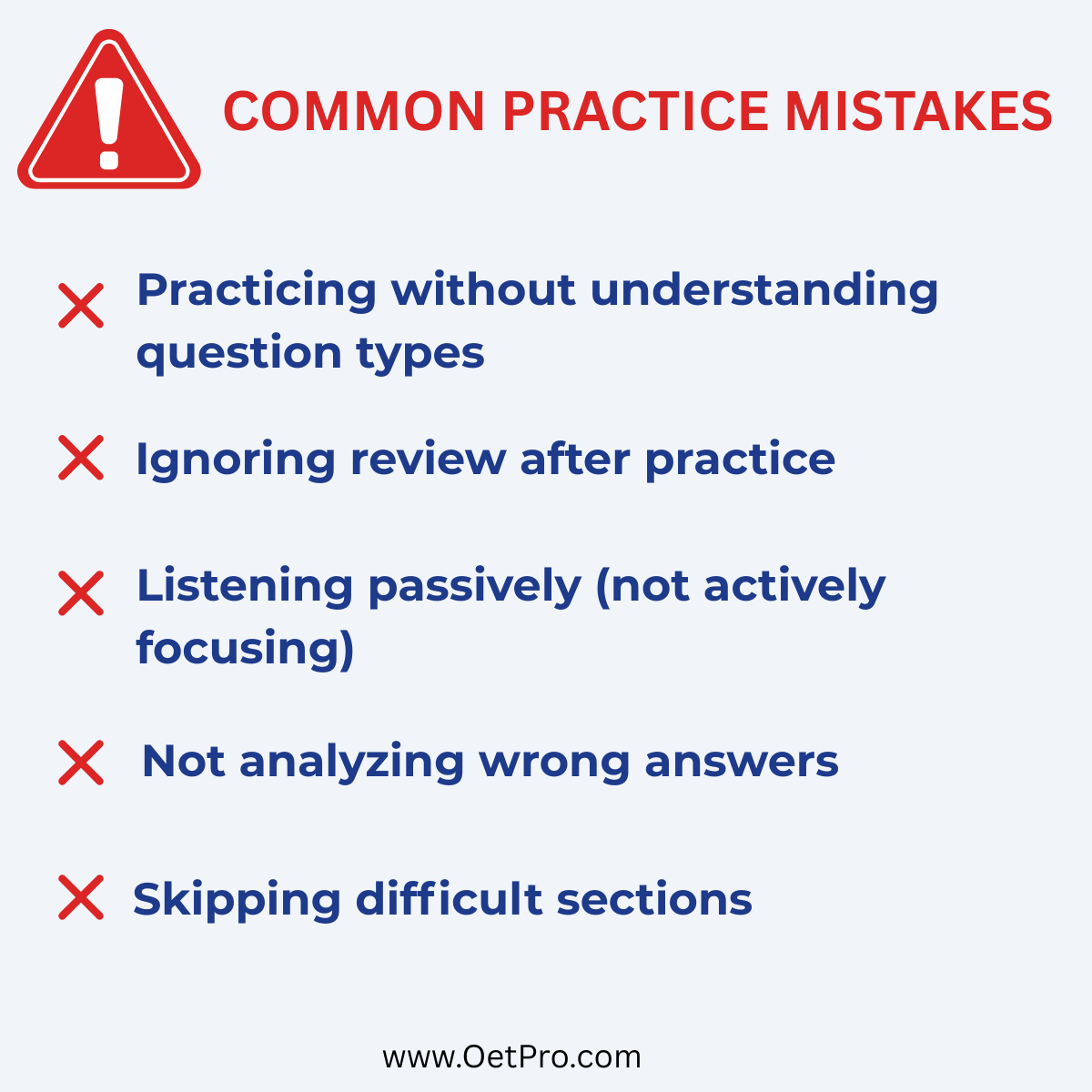
Most candidates stay stuck because of these habits:
Passive Listening Practice
Just listening without analysis or strategy.
Ignoring Mistakes
Checking answers but not understanding errors.
No Time Simulation
Practicing without exam pressure.
Repeating Same Test Without Improvement
Doing tests again without fixing weaknesses.
Focusing Only on Score
Ignoring why mistakes happen.
Many students struggle in practice tests because they have not fully understood the Listening exam structure. Learn the correct approach in our OET Listening Mastery Guide.
Key Insight
OET Listening improvement is not about:
- More tests
- More hours
It is about:
Structured practice + error analysis + focused improvement.
Exam Simulation Framework (Core System)
To improve your OET Listening score, you must stop practicing randomly and start using a full exam simulation system.
This system trains your brain to perform under real exam pressure.
- The goal is not just accuracy
- The goal is real exam performance
The 4-Stage Simulation Method
Stage 1 — Pre-Test Setup (Exam Conditions)
Before you start the test, set the environment exactly like the real OET exam.
You must follow:
- No pause button
- No subtitles or transcripts
- No distractions (mobile silent)
- Timer strictly ON
- One attempt only
Why this matters
Your brain learns to:
- Stay focused under pressure
- Process information in real-time
- Avoid panic during fast audio
Stage 2 — Active Listening During Test
During the test, your focus should NOT be “understanding everything.”
Instead, focus on:
What to track:
- Question type (Detail / Main Idea / Purpose / Opinion)
- Speaker intention
- Key medical terms
- Overall meaning
What NOT to do:
- Don’t stop to think too long
- Don’t replay mentally
- Don’t panic if you miss a sentence
Keep moving forward like the real exam
Stage 3 — Immediate Post-Test Review
After completing the test, DO NOT immediately check answers.
First, ask:
“What felt difficult?”
Then analyse:
Review Checklist:
- Which question types were wrong?
- Did I miss detail or main idea?
- Was it vocabulary confusion?
- Did I lose focus in Part C?
Key Rule:
- Do not just check answers
- Understand WHY you made mistakes
Stage 4 — Targeted Correction Practice
Now you fix your weak areas.
Example Fixing Strategy:
If you got:
Detail Questions wrong
- Practice listening for numbers, instructions, facts
Main Idea questions wrong
- Practice summarising audio in 1 sentence
Opinion questions wrong
- Practice identifying tone (positive/negative)
Purpose questions wrong
- Practice “why is speaker talking?”
This is where score improvement actually happens
Full Simulation Flow (Simple System)
Step-by-step:
- Take full Listening test (timed)
- Do NOT pause or replay
- Finish all sections
- Analyse mistakes deeply
- Identify weak question types
- Practice only weak areas
- Repeat cycle
Why This System Works
Because it trains 3 things:
1. Exam Pressure Handling
You get used to real-time stress.
2. Pattern Recognition
You start seeing question types quickly.
3. Error Awareness
You stop repeating the same mistakes.
Common Practice Mistakes (Avoid These)
Practicing without timing
Leads to fake confidence.
Checking answers immediately
You miss learning opportunity.
Repeating full test without analysis
No improvement happens.
Ignoring weak question types
Score stays stuck.
Key Insight
OET Listening improvement comes from:
Simulation + Review + Targeted Fixing
NOT random practice.
Advanced Score Improvement Strategies
Now that you understand how to simulate full tests, the next step is to improve quality of practice, not just quantity.
This is where most students plateau. They practice a lot—but don’t improve.
Let’s fix that.
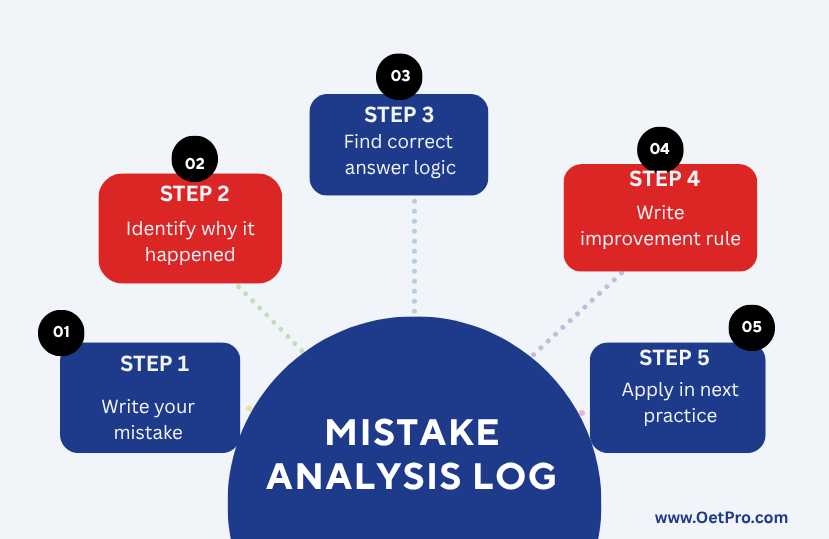
Strategy 1 — Error Pattern Tracking
Every mistake in OET Listening is a clue.
Instead of forgetting it, you must track patterns.
Create a simple mistake log:
- Question type (Detail / Main Idea / Purpose / Opinion)
- Why wrong (misheard / misunderstood / rushed / distracted)
- Correct logic
Example:
- Type: Main Idea
- Error: focused on detail
- Fix: listen for overall topic first
After 5–10 tests, patterns become obvious
Strategy 2 — Listening Focus Training
Each question type needs a different mental focus.
Detail Questions
Focus on:
- numbers
- instructions
- specific facts
Main Idea Questions
Focus on:
- topic
- general meaning
- summary thinking
Purpose Questions
Focus on:
- “Why is speaker talking?”
- intention or goal
Opinion Questions
Focus on:
- tone
- attitude
- agreement or disagreement
Train each separately before full tests
Strategy 3 — Vocabulary Recognition Training
OET Listening often uses paraphrasing, not exact words.
Example:
Audio:
“Patient needs to reduce sodium intake.”
Answer:
“Lower salt consumption recommended.”
Key skill:
Understand meaning, not vocabulary match
Practice method:
- Listen to medical audio
- Write meaning in your own words
- Compare with transcript
Strategy 4 — Examiner Trap Awareness
Examiners design wrong answers using patterns.
Common traps:
1. Keyword Trap
Same word appears, but meaning is wrong
2. Partial Truth Trap
Half correct, but missing key condition
3. Extreme Option Trap
Too strong:
- always
- never
- completely
4. Opposite Meaning Trap
Sounds similar but opposite idea
Awareness reduces mistakes immediately
Strategy 5 — Time Pressure Training
OET Listening is not just skill—it is speed.
Practice rule:
- Answer within limited thinking time
- Do not pause long on any question
- Move forward even if unsure
Goal:
Train fast decision-making
Examiner Insight (Important)
OET Listening is designed to test:
- Understanding under pressure
- Not perfection
- Not full word comprehension
What examiners expect:
? Meaning recognition
? Quick decision making
? Focus on main message
Common Student Mistakes
Overthinking every question
Leads to confusion and loss of time.
Trying to understand every word
Reduces focus on main idea.
Ignoring mistake patterns
Repeats same errors again and again.
Random practice without system
No structured improvement.
High-Score Candidate Behavior
Top candidates always:
- Track mistakes
- Focus on weak question types
- Practice selectively
- Improve step-by-step
- Stay calm under pressure
Key Insight
OET Listening mastery is not:
- More practice
- More tests
It is:
Smart correction + pattern training + focused listening.
Final Summary
OET Listening improvement is not about doing more tests. It is about doing the right kind of practice with analysis and correction.
If you follow a structured system, your score improves steadily across all three parts:
- Part A (Detail accuracy)
- Part B (Purpose understanding)
- Part C (Main idea + opinion handling)
Core Idea to Remember
- Practice without analysis does NOT improve score
- Practice with system + review = real progress
Complete Listening Master System
1. Simulate the Exam
- No pauses
- No repetition
- Strict timing
- Real exam conditions
2. Take the Test Seriously
- Focus on question type
- Listen for meaning
- Stay calm under pressure
3. Analyse Mistakes
Ask:
- What type was wrong?
- Why did I choose wrong answer?
- Was it detail, idea, or opinion issue?
4. Fix Weak Areas
- Practice weak question types
- Re-listen to difficult sections
- Train targeted skills
5. Repeat Cycle
Simulate -> Analyse -> Fix -> Improve
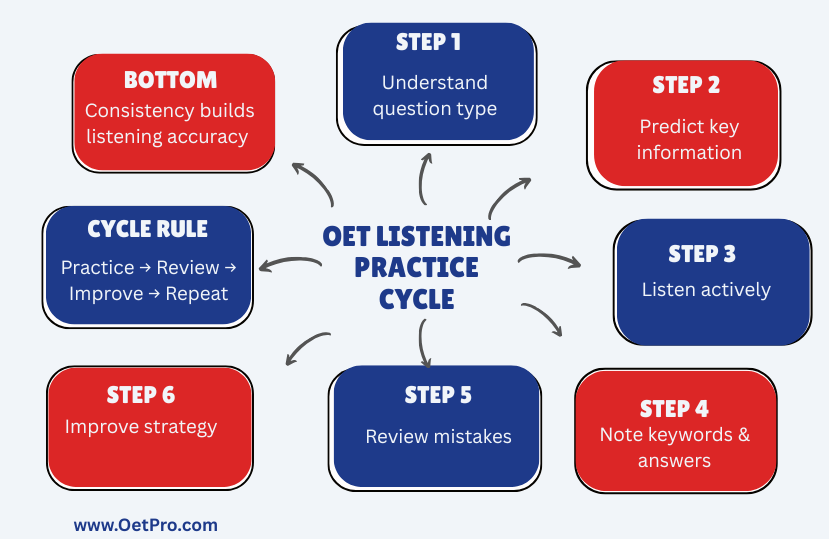
Final Master Checklist
Exam Readiness
- I can handle full Listening test without panic
- I understand all question types
- I can switch focus quickly
Accuracy Control
- I focus on meaning, not words
- I avoid trap answers
- I eliminate wrong options logically
Practice Discipline
- I analyse every mistake
- I track weak areas
- I practice with purpose
7-Day Practice Plan
Day 1–2: Simulation Training
- Full Listening tests
- No pauses
- Real exam timing
Day 3–4: Error Analysis
- Identify weak question types
- Create mistake log
Day 5: Targeted Practice
- Focus only on weak areas
- Detail / main idea / opinion training
Day 6: Mixed Practice
- Combine all question types
- Improve switching ability
Day 7: Full Mock Exam
- Real test simulation
- Final performance check
FAQs
How many practice tests should I do?
Quality matters more than quantity. Even 3–5 full simulated tests with deep analysis is enough if done correctly.
Why is my score not improving?
Because you are likely not analysing mistakes or identifying question types properly.
Should I repeat the same test?
Yes, but only after reviewing mistakes and fixing weak areas.
What is the fastest way to improve Listening?
Structured simulation + mistake tracking + focused correction practice.
Final Advice
OET Listening is not a memory test.
It is a thinking test under time pressure.
To succeed:
- Think correctly
- Listen strategically
- Practice with system
To improve your performance in practice tests, focus first on understanding each Listening section clearly. Follow our OET Listening Mastery Guide for complete preparation.