_How_to_Answer_Workplace_Conversations_Correctly1.png)
OET Listening Part B Strategy (2026): How to Answer Workplace Conversations Correctly
Introduction
OET Listening Part B is often underestimated, but in reality, it is one of the most time-sensitive and decision-based sections of the exam. Many healthcare professionals lose marks here not because they lack English skills, but because they overthink simple questions or fail to identify the main idea quickly.
Unlike Part A, which focuses on detailed information, Part B is about understanding the overall meaning of a short conversation. You are not required to remember specific details like numbers or symptoms. Instead, you must quickly understand what is happening and choose the correct answer. OET Listening Part B is just one section of the full Listening test, which also includes Part A and Part C. To understand the complete test format, scoring system, and strategies for all sections, read our OET Listening Mastery Guide.
In this section, the real challenge is not the audio it is your ability to:
- Think clearly under time pressure
- Identify the purpose of the conversation
- Make fast and confident decisions
This lesson will guide you step by step to develop the right strategy so that you can approach Part B with confidence and accuracy.
Learning Objectives
By the end of this lesson, you will have a clear understanding of how to handle OET Listening Part B effectively.
You will be able to:
- Understand the structure and format of Part B
- Recognise what examiners are testing
- Apply a fast and reliable answering strategy
- Improve both speed and accuracy in multiple-choice questions
- Avoid common mistakes that lead to lost marks
- Build confidence for real exam situations
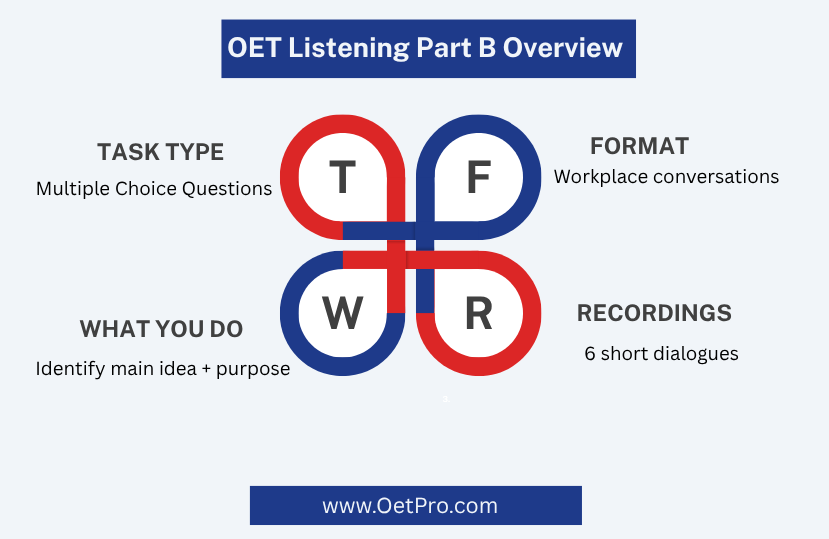
Overview of OET Listening Part B
OET Listening Part B focuses on short workplace conversations that reflect real healthcare situations. These are practical, everyday interactions that healthcare professionals experience in clinical environments.
You will typically hear:
- A nurse giving instructions to a patient
- A doctor explaining a procedure or condition
- Staff discussing a patient’s case
- A healthcare professional providing advice or clarification
Each audio clip is short and focused. After listening, you must answer one multiple-choice question. While Part B focuses on short workplace conversations, the OET Listening test also includes Part A (note completion) and Part C (longer presentations). Learn how all sections work together in our complete OET Listening guide.
What You Need to Do
For each question, you are required to:
- Listen carefully to the short conversation
- Understand the main idea or purpose
- Select the correct answer from the given options (usually A, B, or C)
Key Skill Tested
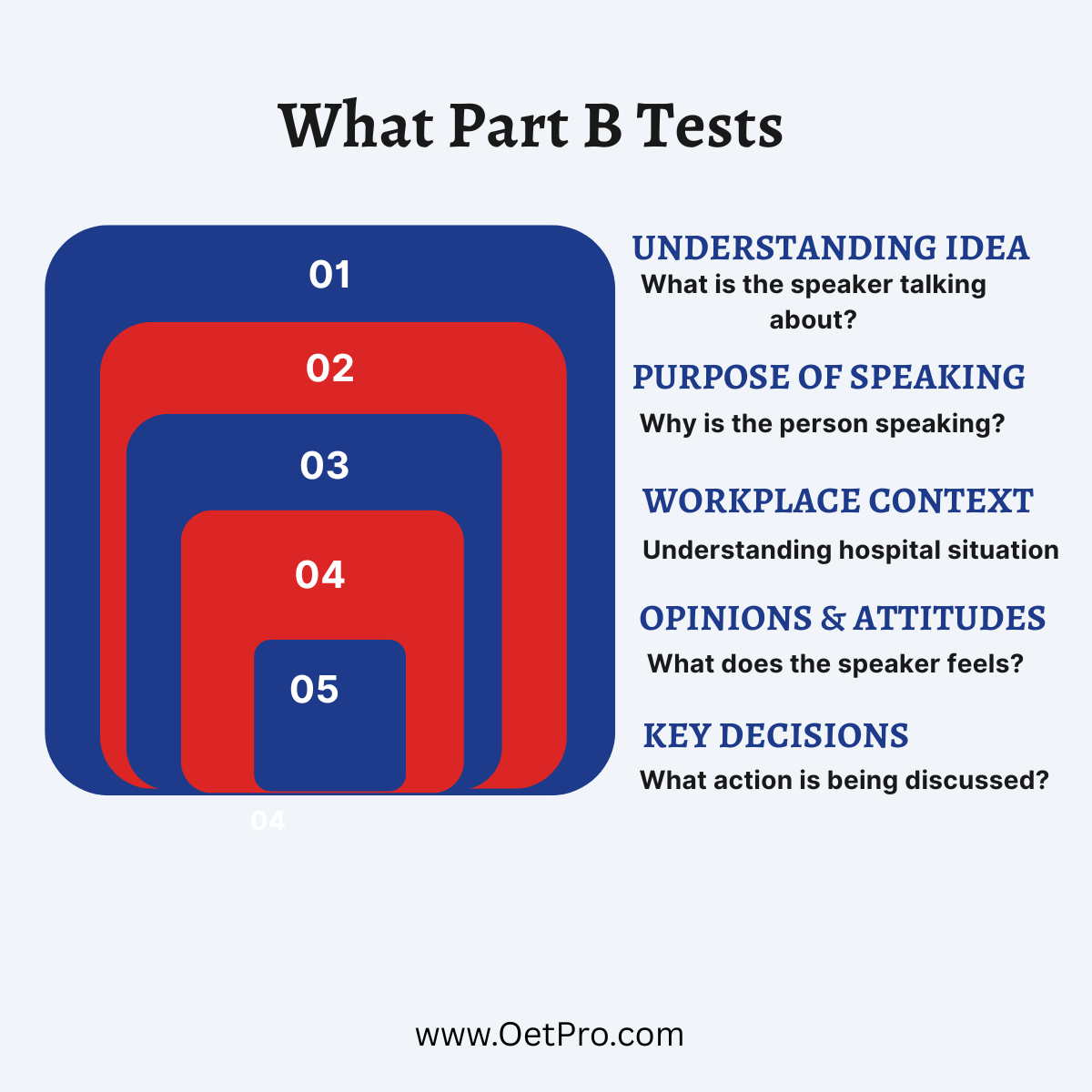
Part B is designed to test your ability to:
- Understand the main idea of a conversation
- Identify the purpose or intention of the speaker
- Make quick and accurate decisions under time pressure
Important Rule
You do not need to remember every detail in the audio. Instead, your focus should be on:
- The overall meaning of the conversation
- What the speaker is trying to do or explain
In simple terms, Part B is about understanding “what is happening”, not “what exactly was said.”
Why Candidates Find Part B Difficult
Many candidates struggle with Part B, not because of language difficulty, but because of incorrect approach and thinking habits.
Common Problems
- Overthinking simple questions
Candidates try to analyse too deeply and confuse themselves. - Focusing on details instead of meaning
Unlike Part A, details are not the priority here. - Changing answers due to doubt
First answers are often correct, but candidates second-guess themselves. - Losing time due to slow thinking
Each question requires a quick response, and hesitation leads to mistakes. - Misunderstanding the question
Even if the audio is clear, misunderstanding the question leads to the wrong choice.
Common Types of Questions in Part B
Understanding the question types helps you respond faster and more accurately.
1. Purpose-Based Questions
These ask why the speaker is talking.
- What is the nurse explaining?
- Why is the doctor speaking?
2. Action-Based Questions
These focus on what will happen next.
- What will the patient do next?
- What is the instruction given?
3. Situation-Based Questions
These ask about the overall context.
- What is happening in the conversation?
4. Clarification Questions
These focus on explanation or confirmation.
- What is being clarified or explained?
Advanced Part B Techniques
At this stage, you already understand the basic strategy for Part B. Now the focus is on refining your thinking speed, improving accuracy, and avoiding traps that cause unnecessary mistakes.
Part B is not about difficult English. It is about clear thinking under time pressure. High-scoring candidates train themselves to recognise patterns quickly and respond without hesitation.
Technique 1 — Focus on Purpose, Not Words
In Part B, many candidates try to remember exact sentences. This approach creates confusion and slows down decision-making.
Instead, you should train yourself to focus on:
- Why the speaker is talking
- What the main message is
- What action or instruction is being given
For example, if a nurse says, “Make sure you take this tablet after meals,” the key idea is not the sentence itself but the purpose—giving instructions about medication.
Technique 2 — One Question, One Idea
Each Part B question is designed around one central idea. If you try to capture multiple ideas, you will lose clarity.
You should always ask yourself:
“What is the single most important message in this conversation?”
This habit helps you avoid confusion and choose the correct option quickly.
Technique 3 — Control Your Thinking Speed
Part B is fast, but many candidates slow themselves down by over-analysing.
To improve speed:
- Trust your first understanding
- Avoid rethinking simple answers
- Move forward confidently
Remember, hesitation often leads to wrong answers not lack of knowledge.
Technique 4 — Use the Elimination Method
When you are unsure, do not panic. Use elimination.
You can:
- Remove options that clearly do not match the audio
- Compare the remaining answers
- Choose the option closest to the main idea
This method increases accuracy without wasting time.
Technique 5 — Stay in the Flow
Part B requires continuous focus. If you get distracted or stuck on one question, it affects your performance in the next ones.
To maintain flow:
- Accept that you may miss one question
- Do not think about previous answers
- Stay fully present for the next audio
Examiner Insights (What You Must Know)
Understanding how examiners design Part B questions gives you a strong advantage.
1. Questions Are Meaning-Based
Examiners are not testing memory. They are testing your ability to:
- Understand the situation
- Identify the purpose
- Interpret communication correctly
2. Distractors Are Carefully Designed
You may hear information that sounds correct but does not answer the question.
These distractors often:
- Include small details from the audio
- Sound similar to correct answers
- Mislead candidates who focus on words instead of meaning
3. Answers Are Usually Clear
In most cases, the correct answer is:
- Simple
- Direct
- Closely linked to the main idea
If an option feels too complicated, it is often incorrect.
4. Timing Is Intentional
Part B is designed to test how quickly you can:
- Read
- Listen
- Decide
This is why overthinking is one of the biggest mistakes.
The Part B Mastery Framework
OET Listening Part B is all about fast thinking and correct decision-making.
To handle this effectively, you need a simple, repeatable system.
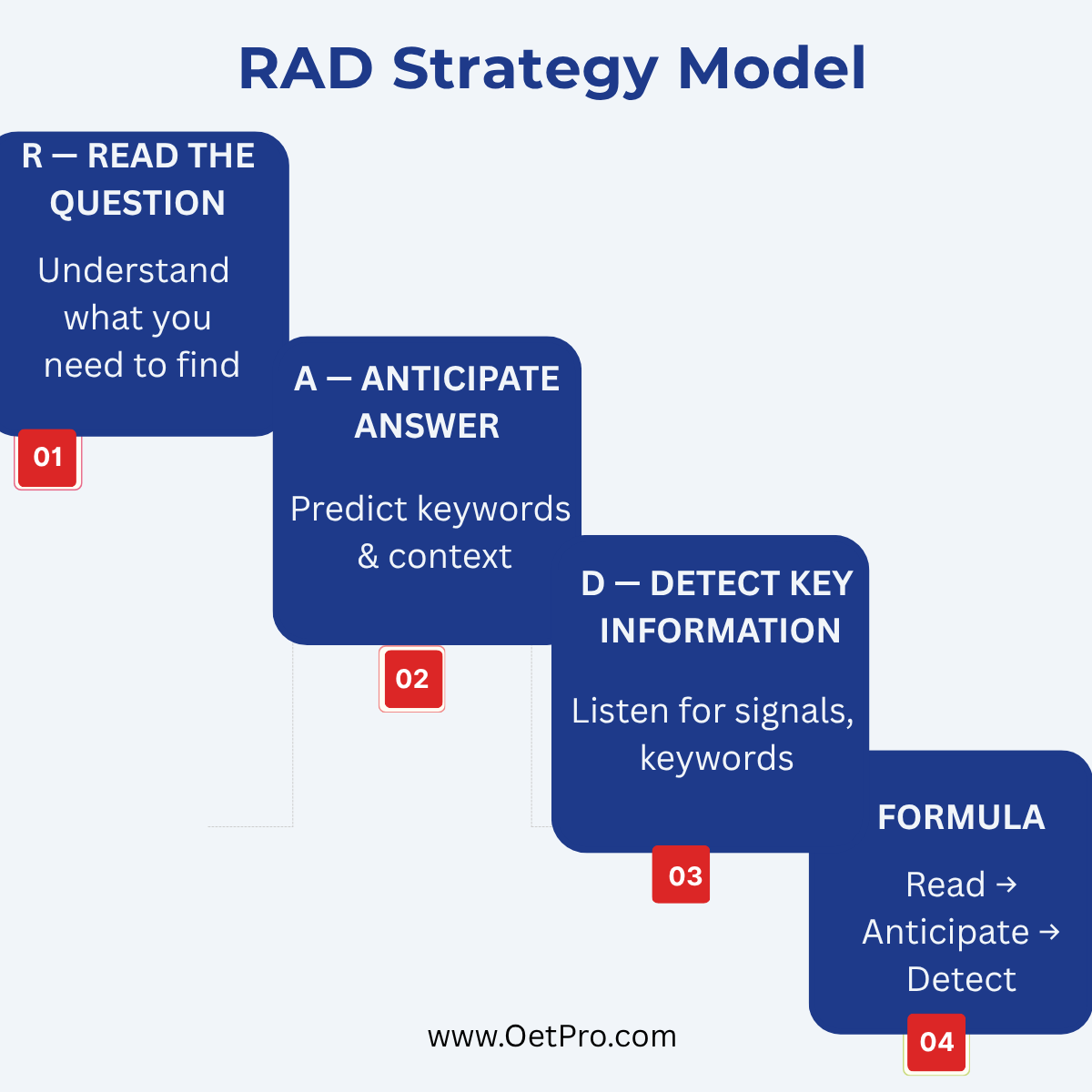
The R.A.D System
- R — Read the Question
- A — Analyse the Main Idea
- D — Decide Immediately
This system helps you avoid overthinking and respond with clarity.
STEP 1 — READ (Before Audio Starts)
Before the audio begins, you get a short moment to read the question.
This is your preparation stage.
What You Should Do
- Read the question quickly
- Identify keywords (purpose, action, situation)
- Understand what the question is asking
Example
Question:
What is the nurse explaining?
You should think:
“I need to understand the purpose of the conversation.”
Why This Step Matters
- It gives your listening a clear direction
- It helps you focus only on relevant information
- It improves speed during answering
STEP 2 — ANALYSE (During Listening)
Now the audio starts.
Your goal is NOT to understand every sentence.
Your goal is to:
Identify the main idea quickly
What to Focus On
During listening, pay attention to:
- Why the speaker is talking
- What the main message is
- What action is being described
Example
Audio:
“You should take this medication twice a day after meals.”
Main idea:
Instruction about medication
Key Rule
- Ignore extra details
- Focus on meaning
- Stay calm and follow the flow
STEP 3 — DECIDE (After Listening)
As soon as the audio ends, you must select your answer.
What You Should Do
- Choose the option that matches the main idea
- Do not overanalyse
- Do not change your answer without strong reason
Golden Rule
Your first instinct is often correct
Full Strategy Flow
Before Audio
- Read question
- Identify focus
During Audio
- Listen for main idea
- Ignore unnecessary details
After Audio
- Choose answer immediately
- Move to next question
Real Exam Example
Question:
What is the doctor doing?
Audio:
“I’m going to refer you to a specialist for further tests.”
Thinking Process
- Speaker is giving a referral
- Main idea = next step in treatment
Correct Answer
Referring the patient to a specialist
Advanced Part B Techniques
Now let’s move to high-level strategies.
1. Main Idea Detection
Train yourself to answer one question:
“Why is this person speaking?”
This solves most Part B questions.
2. Elimination Method
If you are unsure:
- Remove clearly wrong options
- Compare remaining answers
- Choose the closest meaning
3. Avoid Detail Trap
Sometimes options include small details from audio.
But correct answer focuses on:
Main purpose, not details
4. Stay Fast, Stay Calm
Part B requires quick transitions.
- Do not slow down
- Do not panic
- Keep moving forward
Common Mistakes to Avoid
Overthinking
Trying to analyse too deeply leads to confusion.
Changing Answers
Your first answer is usually correct.
Focusing on Details
Details are secondary. Meaning is primary.
Misreading Questions
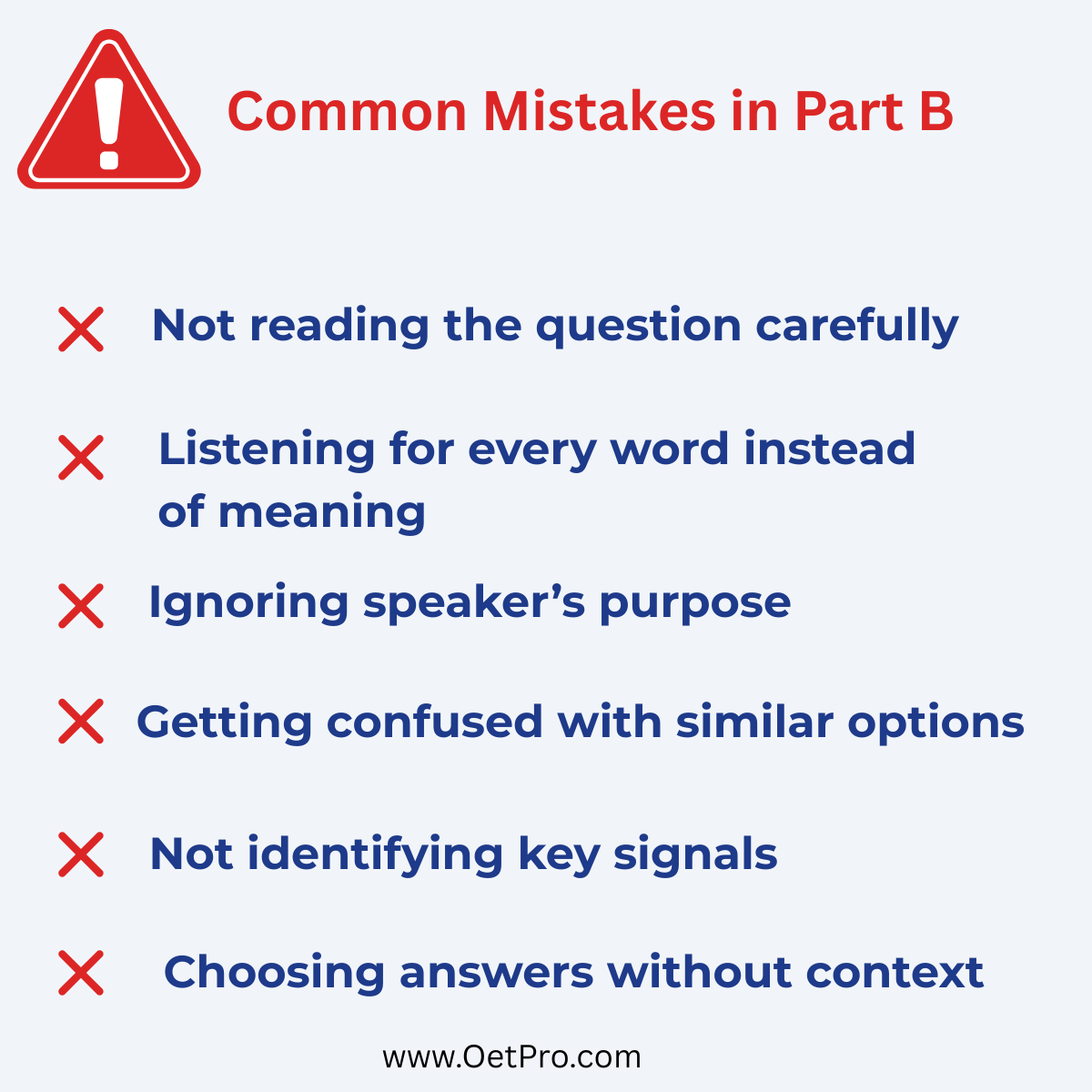
If you misunderstand the question, you will choose the wrong answer. These mistakes not only affect Part B but can also impact your performance in Part A and Part C. Learn how to avoid them across the full Listening test in our complete OET Listening guide.
Vocabulary Patterns in Part B
Although vocabulary is not the main focus, recognising common expressions can improve speed and understanding.
Instruction Language
- “You should…”
- “Make sure you…”
- “Don’t forget to…”
These indicate guidance or instructions.
Explanation Language
- “This means…”
- “What happens is…”
- “The reason is…”
These signal clarification or explanation.
Action Language
- “We will arrange…”
- “I’ll refer you…”
- “You need to…”
These indicate next steps or decisions.
Practice Exercises
To improve Part B performance, your practice must be focused and structured.
Exercise 1 — Main Idea Identification
Listen to short conversations and answer:
- What is the speaker trying to do?
- What is the purpose of the conversation?
Exercise 2 — Quick Decision Training
Practice answering questions immediately after audio.
- Do not pause
- Do not overthink
- Trust your first answer
Exercise 3 — Elimination Practice
Take multiple-choice questions and:
- Remove wrong options first
- Compare remaining answers
- Choose the best match
To achieve a high score in OET Listening, you should practise all three parts, not just Part B. Follow a structured preparation plan in our OET Listening Mastery Guide.
Common Mistakes to Avoid
Overthinking Simple Questions
Many answers are straightforward. Complicating them leads to mistakes.
Focusing on Details
Part B is about meaning, not small details.
Changing Correct Answers
Doubt often causes candidates to switch from correct to incorrect answers.
Losing Focus Between Questions
Each audio is independent. Losing focus affects performance immediately.
High-Score Candidate Behavior
Candidates who perform well in Part B usually:
- Read questions quickly and clearly
- Focus on the main idea
- Answer without hesitation
- Stay calm and consistent
- Maintain a steady rhythm throughout the section
Summary
OET Listening Part B is a fast decision-making section that tests your ability to understand the main idea of short workplace conversations in healthcare settings.
Unlike Part A, you are not focusing on details. And unlike Part C, you are not analysing deep opinions. Instead, Part B is about one core skill:
Understanding purpose and meaning quickly
When you simplify your thinking and avoid overanalysis, Part B becomes much easier to handle.
The winning approach is:
- Read the question quickly
- Identify the main idea
- Choose the answer immediately
Final Master Checklist (Before Exam)
Use this checklist to ensure you are fully prepared for Part B.
Understanding the Task
- I understand Part B is based on short workplace conversations
- I know I must identify the main idea or purpose
- I understand there is one MCQ per audio
Strategy Application
- I read the question before listening
- I focus on meaning, not exact words
- I avoid overthinking answer choices
During Listening
- I identify the main purpose quickly
- I ignore unnecessary details
- I stay focused throughout the audio
Answering Technique
- I choose answers confidently
- I do not change answers without strong reason
- I trust my first understanding
Mindset Control
- I stay calm under pressure
- I accept uncertainty and move forward
- I avoid getting stuck on one question
Frequently Asked Questions (FAQs)
What is OET Listening Part B?
Part B consists of short workplace conversations in healthcare settings where you must answer a multiple-choice question based on the main idea or purpose of the audio.
How is Part B different from Part A?
Part A focuses on detailed note completion, while Part B focuses on understanding the main idea or purpose of short conversations.
What skills are tested in Part B?
Part B tests your ability to:
- Understand meaning quickly
- Identify purpose of communication
- Make fast decisions under pressure
Is Part B difficult?
Part B is not difficult if you avoid overthinking. Most mistakes happen due to confusion, not language difficulty.
How can I improve my Part B score?
You can improve by:
- Practising main idea identification
- Avoiding overanalysis
- Training quick decision-making skills
- Using elimination strategy in MCQs
These MCQ strategies are essential for Part B, but similar skills are also required in other parts of the OET Listening test. Learn a complete approach in our OET Listening Mastery Guide.
Practice Plan (7-Day Improvement System)
Day 1–2: Understanding Question Types
- Practice sample Part B questions
- Focus on identifying purpose
- Do not worry about timing
Day 3–4: Main Idea Training
- Listen to short conversations
- Summarise the main idea in one sentence
- Avoid details
Day 5: Timed Practice
- Simulate exam conditions
- Answer quickly without pausing
- Build speed and confidence
Day 6: Error Correction
- Review incorrect answers
- Identify overthinking patterns
- Fix weak areas
Day 7: Full Mock Test
- Complete full Part B section
- Analyse performance
- Improve decision speed
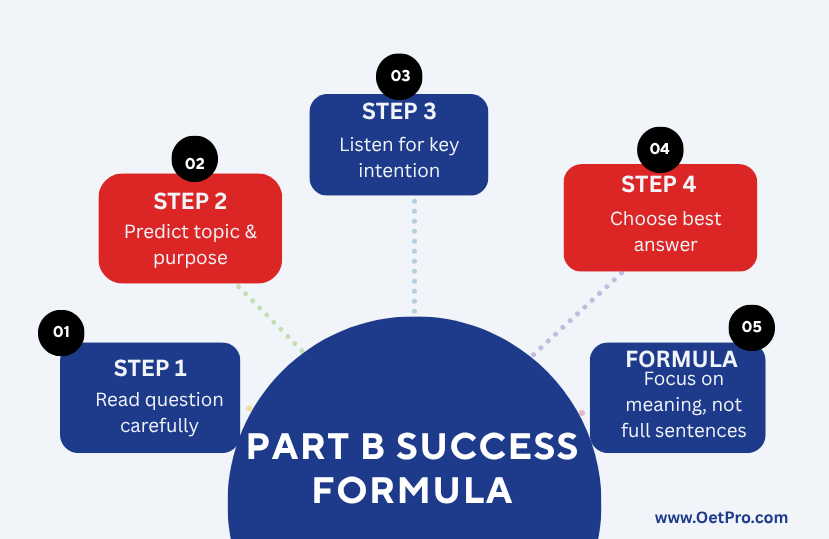
Key Success Formula
OET Listening Part B success depends on:
Main Idea + Fast Thinking + Confidence + No Overthinking
Final Advice
Do not complicate Part B.
If you simplify your thinking:
- Focus on purpose
- Trust your first instinct
- Avoid unnecessary analysis
You will see immediate improvement in accuracy.