_Complete_Strategy_for_Note_Completion_High_Score_(1)1.png)
OET Listening Part A Mastery (2026): Complete Strategy for Note Completion & High Score
Introduction
OET Listening Part A is one of the most important sections in the entire OET Listening test. It is also the section where many candidates lose easy marks.
The reason is simple.
Part A is not just about listening it is about listening + writing at the same time under pressure.
You will hear a healthcare consultation, usually between a doctor or nurse and a patient. While listening, you must complete a set of notes with missing information. OET Listening includes three parts: Part A, Part B, and Part C and Part A is just one section of the test. To understand the complete listening format, scoring, and strategies, read our OET Listening Mastery Guide.
Most candidates struggle because they try to understand everything in the audio. But in reality, success in Part A depends on something very specific:
Identifying key clinical details quickly and accurately
This lesson will give you a clear, structured system to master OET Listening Part A and improve your score significantly.
Learning Objectives
By the end of this lesson, you will be able to:
- Understand the format of OET Listening Part A
- Identify what type of information is tested
- Apply a step-by-step note completion strategy
- Improve spelling accuracy and speed
- Avoid common mistakes that lead to lost marks
- Develop confidence in real exam conditions
Overview of OET Listening Part A
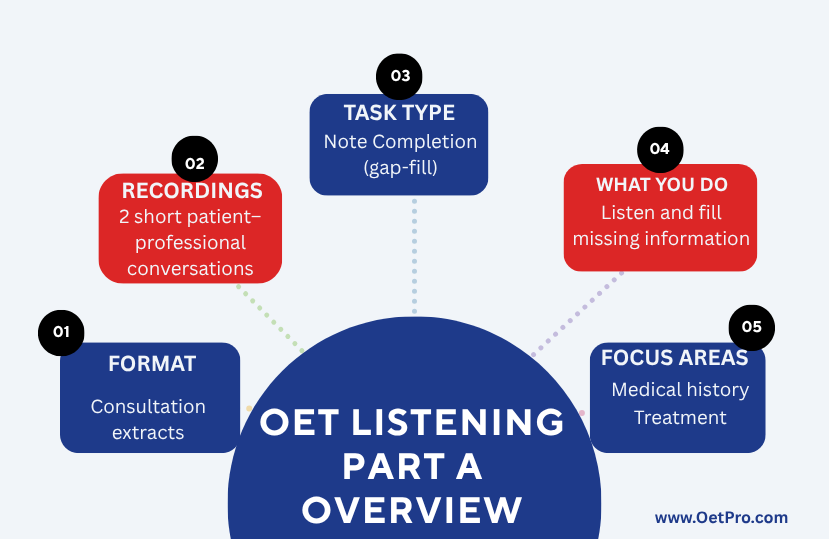
OET Listening Part A is designed to test your ability to understand real-life medical consultations and extract key information.
What You Will Hear
You will typically hear:
- Doctor–patient consultations
- Nurse–patient interviews
- Case history discussions
What You Need to Do
You must complete short notes based on the conversation.
These notes usually include missing information such as:
- Symptoms
- Duration of illness
- Medical history
- Treatments or medication
- Lifestyle or personal details
Key Skill Tested
Part A tests your ability to:
- Listen for specific details
- Write answers quickly and accurately
- Follow the conversation in real time
Important Rule
You do NOT need to understand every word.
You only need to capture:
Relevant clinical information. While Part A focuses on note completion in patient consultations, the OET Listening test also includes Parts B and C, which require different strategies. Learn how all sections work together in our complete OET Listening guide.
Why Candidates Lose Marks in Part A
Many students think they are “bad at listening,” but the real issue is usually strategic.
Let’s look at the most common problems.
1. Trying to Understand Everything
Candidates often try to translate every sentence in their mind.
This leads to:
- Slow thinking
- Missed answers
- Loss of focus
2. Writing Too Much
Some candidates write full sentences instead of short answers.
But in Part A:
Answers should be short, precise, and keyword-based
3. Poor Spelling
Even if the answer is correct, spelling mistakes can lead to lost marks.
Common errors include:
- Medical terms
- Drug names
- Time expressions
4. Losing Track of Audio
The audio moves forward quickly. If you get stuck on one question, you may miss the next answer.
5. Not Reading Questions Properly
Many candidates fail because they:
- Don’t preview notes
- Don’t identify keywords before listening
- Don’t understand what type of answer is needed
Common Types of Information in Part A
To perform well, you must recognise what examiners usually test.
1. Symptoms
- pain
- headache
- fever
- nausea
- dizziness
2. Duration / Time
- for 3 days
- since last week
- two months ago
- yesterday morning
3. Medical History
- previous illness
- surgeries
- allergies
4. Treatment / Medication
- tablets
- injections
- therapy
- dosage instructions
5. Lifestyle Information
- smoking habits
- diet
- exercise
- sleep patterns
Key Understanding
OET Listening Part A is not a memory test.
It is a targeted information extraction task.
If you train your brain to focus only on:
- What the question asks
- What type of answer is needed
- Where the information appears
Your accuracy will improve significantly.
The Part A Mastery Framework
OET Listening Part A is not about “better listening.”
It is about controlled listening with a writing system.
High scorers follow a simple but powerful framework:
P.E.S System
- P — Predict
- E — Extract
- S — Synthesize (Write Short Answers)
.png "What_You_Must_Listen_For_(OET_Listening_Part_A).png")
This system helps you stay focused while managing audio speed and note completion at the same time.
STEP 1 — PREDICT (Before Audio Starts)
Most candidates ignore this step, but it is where easy marks are won.
Before the recording begins, you must quickly analyse the notes.
What to do in Prediction Phase
- Read all incomplete notes quickly
- Identify keywords (symptoms, time, treatment)
- Understand the situation (consultation type)
- Guess what type of word is missing
Example
Note:
Patient has been experiencing ______ for 3 days.
You can predict:
- symptom word (pain, fever, cough)
Why Prediction Matters
It helps you:
- Stay mentally prepared
- Recognise answers faster
- Reduce panic during audio
STEP 2 — EXTRACT (During Listening)
This is the most important stage.
You must focus only on relevant information, not full sentences.
What to Focus On
During audio, listen for:
- Direct answers
- Clinical keywords
- Numbers and time
- Clear patient statements
Golden Rule
Do NOT wait for full sentences
Capture answers immediately
Example (Audio)
“I’ve had a severe headache for about three days.”
Correct answer:
- headache
- three days
Common Trap
Candidates wait for the “perfect phrase” and miss the answer.
Instead:
- Write first
- Think later
STEP 3 — SYNTHESIZE (Write Short Answers)
Part A is not writing practice.
It is fast note completion.
Writing Rules
- Use 1–3 words only
- Do not write full sentences
- Be precise, not detailed
Example Transformation
Wrong:
The patient has been suffering from headache for three days
Correct:
headache / three days
Focus Areas
Always prioritise:
- Symptoms
- Duration
- Treatment
- Diagnosis
- Medication
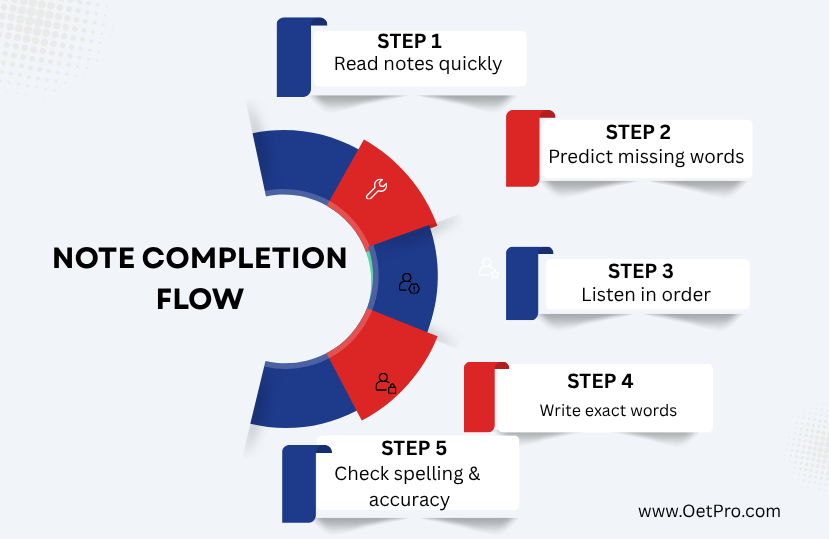
FULL STRATEGY FLOW
Before Audio
- Read notes
- Predict answers
During Audio
- Listen for keywords
- Write immediately
- Stay aligned with flow
After Audio
- Quick check spelling
- Do not change unless necessary
To achieve a high score, it’s important to prepare for all three listening parts, not just Part A. Follow a complete preparation plan in our OET Listening Mastery Guide.
Real Exam Example (Step-by-Step)
Note:
Patient complains of ______ lasting two weeks.
Audio:
“She has been experiencing persistent cough for about two weeks.”
Process:
- Keyword detected ? cough
- Time detected ? two weeks
Final Answer:
- cough
- two weeks
Advanced Part A Techniques
Now we move beyond basics.
1. Keyword Tracking
Train your mind to follow:
- symptom words
- time expressions
- treatment phrases
2. Synonym Awareness
OET often paraphrases:
- “head pain” = headache
- “feeling sick” = nausea
3. Distractor Control
You may hear extra information:
- Ignore background details
- Focus only on relevant medical data
4. Audio Flow Tracking
The audio moves in order.
If you miss one answer:
- DO NOT STOP
- MOVE FORWARD
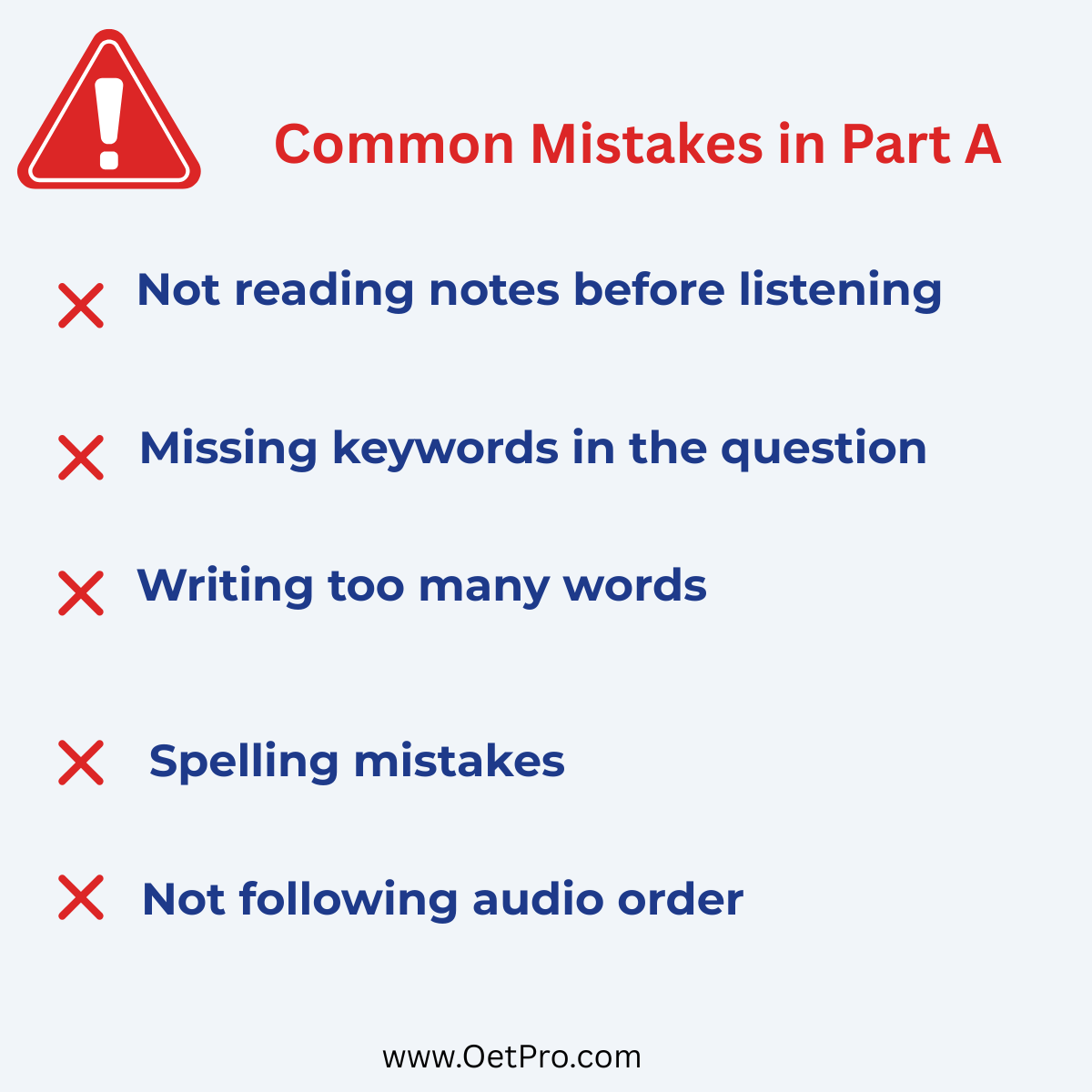
Common Part A Mistakes
Mistake 1 — Writing too much
Full sentences reduce speed and accuracy.
Mistake 2 — Losing focus
One missed answer can affect next 2–3 answers.
Mistake 3 — Spelling errors
Especially in medical terms:
- medication names
- symptoms
- conditions
Mistake 4 — Not predicting
Without prediction, your brain reacts slowly.
High-Score Behavior Pattern
Top candidates always:
- Read before audio
- Write short answers
- Stay calm under pressure
- Follow audio flow
- Ignore unnecessary details
Advanced Part A Techniques
Now that you understand the framework, we move into high-scoring techniques used by top OET candidates.
These are the strategies that separate Grade B candidates from Grade A performers.
Technique 1 — Think in Keywords, Not Sentences
Examiners are not testing your ability to write English sentences.
They are testing your ability to:
- Identify key clinical information
- Extract meaning quickly
- Record it accurately
Example
“I’ve been feeling dizzy since Monday morning.”
Answer:
- dizzy
- Monday morning
Wrong:
I have been feeling dizzy since Monday morning
Technique 2 — Anticipate the Next Answer
In Part A, answers follow a logical order.
Train your brain to:
- Expect the next symptom
- Predict next time reference
- Stay one step ahead
This improves speed dramatically.
Technique 3 — Ignore Non-Essential Speech
Doctors and patients often use extra words like:
- “Well…”
- “You know…”
- “Actually…”
These are NOT important for answers.
Focus only on:
- Medical information
- Clear facts
- Direct statements
Technique 4 — Stay in Audio Flow
One of the biggest mistakes is getting stuck.
If you miss an answer:
- DO NOT GO BACK
- MOVE FORWARD IMMEDIATELY
Because:
- Audio continues
- Next answers are coming
Technique 5 — Smart Spelling Strategy
Spelling matters in Part A.
But you should NOT overthink during listening.
Best approach:
- Write quickly first
- Check spelling later (if time allows)
Examiner Insights (What They Expect)
Understanding examiner mindset gives you a major advantage.
1. Answers Are Direct
Most answers come in:
- Simple words
- Short phrases
- Clear medical terms
They are NOT designed to be complicated.
2. Paraphrasing Is Common
Examiners use synonyms:
- “stomach pain” ? abdominal pain
- “feeling sick” ? nausea
- “doctor visit” ? consultation
You must recognise meaning, not exact words.
3. Order Matters
Answers usually follow the same order as audio.
This helps you:
- Track progress
- Stay organised
- Avoid confusion
4. One Missed Answer Is Not Fatal
Even if you miss one answer:
You can still score high
Because each question is independent.
Essential Vocabulary for Part A
To improve accuracy, you must be familiar with common medical expressions.
Symptoms Vocabulary
- headache
- dizziness
- fatigue
- nausea
- cough
- fever
Time Expressions
- for three days
- since last week
- two months ago
- this morning
Treatment Words
- medication
- antibiotics
- injection
- therapy
- dosage
Lifestyle Terms
- smoking
- diet
- exercise
- sleep
Practice Exercises
To improve Part A performance, structured practice is essential.
Exercise 1 — Symptom Identification
Listen to a consultation and identify:
- main symptom
- duration
- severity
Exercise 2 — Keyword Extraction
From audio, write ONLY keywords:
- no full sentences
- no grammar focus
- only key medical terms
Exercise 3 — Timed Note Completion
Practice under exam conditions:
- 5–7 minute audio
- strict timing
- no pauses
Practising Part A is essential, but you should also develop skills for Parts B and C. Explore a full preparation roadmap in our OET Listening Mastery Guide.
Common Mistakes to Avoid
Mistake 1 — Overwriting
Writing too much slows you down and causes missed answers.
Mistake 2 — Losing Audio Focus
Even 3–5 seconds of distraction can cost multiple marks.
Mistake 3 — Waiting for Perfect Words
If you wait for full clarity, you will miss answers.
Mistake 4 — Ignoring Keywords
Keywords are your “signal system” in Part A.
These mistakes are common in Part A, but similar accuracy issues can affect your performance in Parts B and C as well. Learn how to avoid them across all sections in our complete OET Listening guide.
High-Score Candidate Behavior
Top performers always:
- Predict before audio
- Focus only on keywords
- Write short answers
- Stay calm under pressure
- Move forward continuously
Summary
OET Listening Part A is a high-precision note completion task that tests your ability to extract key clinical information from real healthcare conversations.
Success does not depend on understanding every word. It depends on:
- Identifying important medical details
- Writing short, accurate answers
- Staying focused during fast audio
When you apply a structured system Predict, Extract, and Synthesize you stop reacting randomly and start performing with control.
The goal is simple:
Listen smart, not hard
Final Master Checklist (Before Exam)
Use this checklist to ensure you are fully prepared for Part A.
Understanding the Task
- I understand Part A is note completion
- I know I must listen for specific clinical details
- I understand answers are short (1–3 words)
Listening Strategy
- I read questions before audio
- I predict possible answers
- I focus only on keywords
During Audio Performance
- I write answers immediately
- I follow the audio sequence
- I do not get stuck on one question
Accuracy Control
- I avoid full sentences
- I check spelling if time allows
- I focus on meaning, not exact words
Mindset
- I stay calm under pressure
- I accept that I may miss one answer
- I keep moving forward
Frequently Asked Questions (FAQs)
What is OET Listening Part A?
Part A is a note completion task where you listen to a healthcare consultation and fill in missing information such as symptoms, time, and treatment.
How many questions are in Part A?
Part A usually contains multiple short answers based on one consultation audio.
Is spelling important in Part A?
Yes. Spelling mistakes can lead to lost marks, especially in medical terms and drug names.
Can I write full sentences in Part A?
No. You should write short answers (1–3 words). Full sentences reduce speed and accuracy.
What is the most important skill in Part A?
The most important skill is extracting key information quickly and accurately.
How can I improve my Part A score?
You can improve by:
- Practising note completion daily
- Learning medical vocabulary
- Improving spelling accuracy
- Training your listening speed
Practice Plan (7-Day Improvement System)
Day 1–2: Understanding Format
- Practice sample Part A tests
- Focus on understanding question types
- Do not worry about score
Day 3–4: Keyword Training
- Listen and write only keywords
- Ignore full sentences
- Focus on speed
Day 5: Timed Practice
- Simulate exam conditions
- No pauses
- Strict timing
Day 6: Weak Area Fixing
- Identify mistakes
- Focus on spelling and accuracy
- Repeat difficult questions
Day 7: Full Review Test
- Complete full Part A practice
- Compare results
- Track improvement
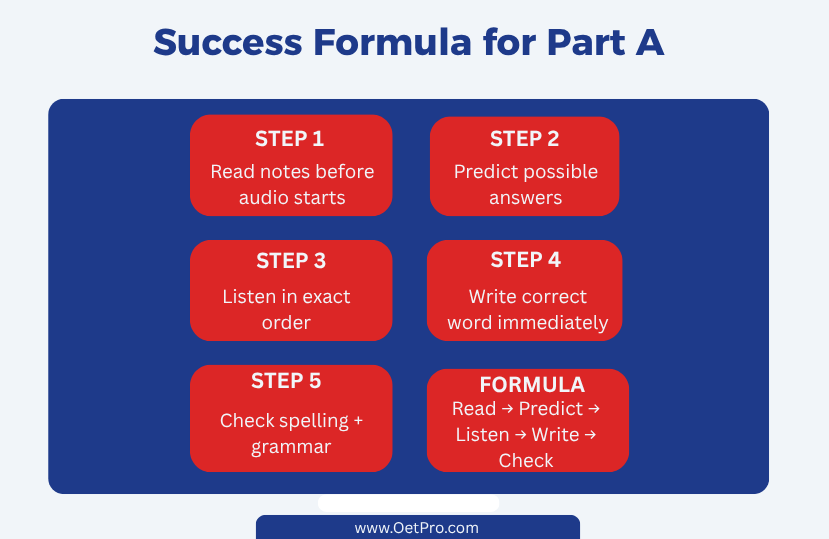
Key Success Formula
OET Listening Part A success =
Prediction + Keyword Focus + Fast Writing + Calm Mindset
Final Advice
Do not try to be perfect in Part A.
Instead, aim to be:
- Fast
- Accurate
- Consistent
Small improvements in focus and strategy can significantly increase your score.