OET Listening Speed & Accuracy Optimization (2026): Think Faster and Choose Correct Answers Under Pressure
Introduction
One of the biggest challenges in OET Listening is not understanding the audio, but responding fast enough with correct answers.
Many candidates face this situation:
- They understand the audio clearly
- But hesitate while choosing answers
- Or select the wrong option due to confusion under time pressure
This happens because OET Listening is not only a comprehension test it is a speed + accuracy decision-making test.
Every question requires:
- Fast interpretation of meaning
- Quick elimination of options
- Immediate final decision
If your thinking is slow, even correct understanding becomes useless.
This lesson focuses on building a Speed & Accuracy Optimization System, helping you respond faster without losing correctness.
Learning Objectives
By the end of this lesson, you will be able to:
- Improve decision-making speed in Listening tasks
- Eliminate answer options quickly and accurately
- Reduce hesitation during audio-to-answer transition
- Balance speed and accuracy under exam pressure
- Develop real-time thinking for Part A, B, and C
Overview: Why Speed Matters in OET Listening
OET Listening is structured to test how quickly you can:
- Understand spoken information
- Match it with answer options
- Make correct decisions under pressure
You are not given unlimited thinking time.
Instead:
- Audio flows continuously
- Questions change quickly
- Cognitive load increases gradually
This creates a time-pressure decision environment
Common Mistakes (Speed-Related Problems)
Mistake 1: Overthinking Answers
Candidates:
- Pause too long on one question
- Try to “perfectly understand” every option
Result:
Miss next audio information
Mistake 2: Slow Option Comparison
Students:
- Read all options multiple times
- Delay decision unnecessarily
Result:
Loss of timing rhythm
Mistake 3: Confusing Similar Options
Candidates:
- Get stuck between two similar answers
- Cannot decide quickly
Result:
Random guessing or hesitation
Mistake 4: Waiting for Full Confirmation
Students:
- Avoid making fast decisions
Result:
Miss real-time flow of exam.
Core Teaching Framework: The Speed–Accuracy Balance System
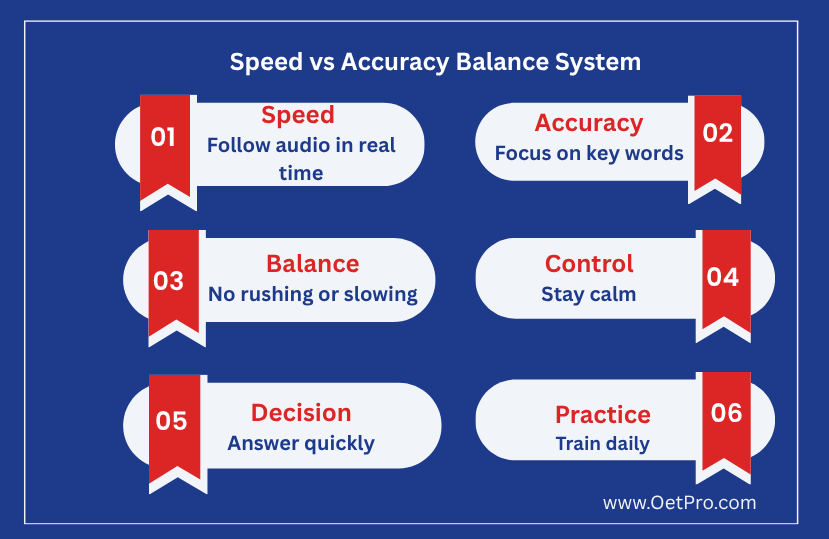
In OET Listening, your success depends on one critical balance:
How fast you think vs how correctly you decide
Most candidates fail because they lean too much in one direction:
- Either they are too slow (accurate but miss timing)
- Or too fast (quick but careless mistakes)
High scorers operate in a controlled balance zone where:
- Thinking is fast
- Decisions are structured
- Accuracy is maintained under pressure
This is called the Speed–Accuracy Balance System.
The Decision Flow Model (Real-Time Thinking System)
Every OET Listening question follows a hidden decision process in your brain.
High scorers train this exact flow:
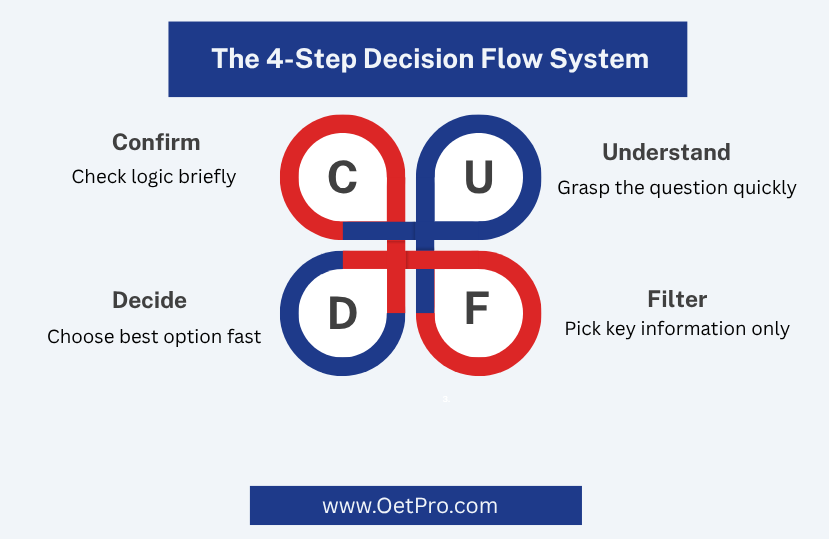
Step 1: Identify Question Type (Instant Recognition)
Before or during audio, your brain must quickly classify:
- Detail question (Part A)
- Purpose question (Part B)
- Inference question (Part C)
This happens in under 2–3 seconds in real exam conditions.
Step 2: Extract Key Signal (Not Full Sentence)
Instead of processing full sentences, focus only on:
- Keywords (symptoms, actions, decisions)
- Signal words (however, but, because, therefore)
- Emotional tone (agreement, concern, uncertainty)
This reduces mental load and increases speed.
Step 3: Option Filtering (Elimination System)
You do NOT directly choose the correct answer first.
You first eliminate wrong ones:
- Remove options not matching meaning
- Remove options with wrong intensity (all vs some)
- Remove options with opposite intent
This makes decision faster and more accurate.
Step 4: Final Selection (Fast Commitment Rule)
Once two options remain:
- Do NOT overthink
- Choose based on overall meaning match
- Commit immediately
Hesitation causes timing loss and focus disruption.
Real-Time Answering Strategy (During Audio Flow)
OET Listening is continuous. You cannot pause mentally.
So you must follow a real-time strategy:
Strategy 1: One Question, One Focus Rule
- Focus only on current question
- Ignore previous missed answers
- Do not multitask thinking
Each question is independent.
Strategy 2: Pre-Listening Prediction
Before audio starts:
- Predict answer type (number, reason, opinion)
- Prepare brain for expected information
This increases processing speed.
Strategy 3: Keyword Anchoring Method
During listening:
- Anchor attention to key words
- Track only relevant information flow
- Ignore filler speech
Prevents overload.
Strategy 4: Rapid Elimination Thinking
While options appear:
- Remove obviously wrong answers first
- Narrow choices quickly
- Avoid reading same option repeatedly
Speed improves automatically.
Why Candidates Fail Speed + Accuracy Balance
Most candidates make predictable mistakes:
- Thinking too long before choosing
- Trying to fully understand every sentence
- Switching attention between questions
- Losing confidence after one mistake
These issues slow down decision flow and reduce accuracy.
Examiner Insight: What the Test Actually Measures
From an exam design perspective:
OET Listening is not just:
- “Did you understand?”
It is also:
- “How fast did you process it correctly?”
- “Did you make correct decisions under time pressure?”
That is why speed is part of scoring performance indirectly.
Advanced Speed Training: Building Automatic Thinking
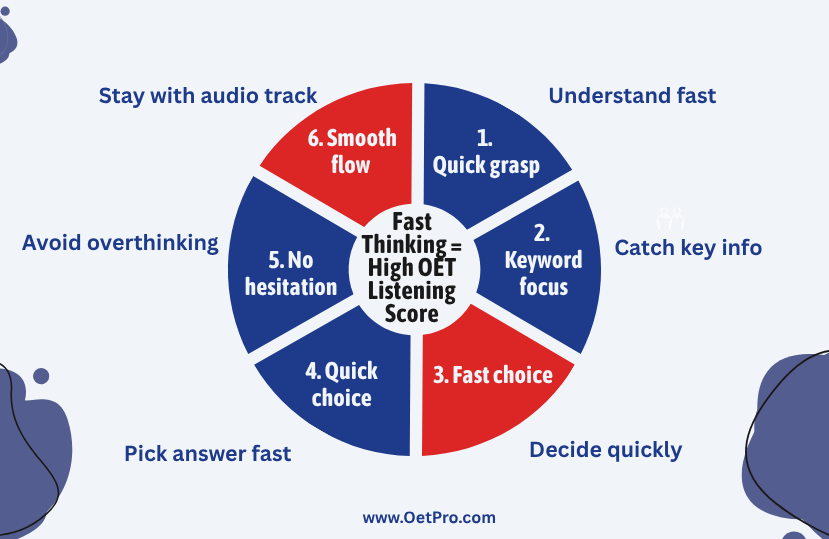
At the advanced level, OET Listening speed is not about “thinking faster consciously.” It is about building automatic response patterns.
High scorers do not stop to think through every option. Instead, their brain instantly:
- Recognizes question type
- Identifies key information
- Eliminates wrong answers
- Selects the best match
This automation is built through repeated speed conditioning drills, not passive practice.
Cognitive Acceleration Techniques (Train Your Brain to Think Faster)
To improve processing speed, you must reduce mental load and train recognition speed.
1. Keyword-to-Meaning Instant Mapping
Train your brain to immediately connect:
- “pain” -> symptom context
- “change” -> treatment adjustment
- “recommend” -> suggestion (not instruction)
- “improve” -> positive outcome
No translation delay = faster decision-making
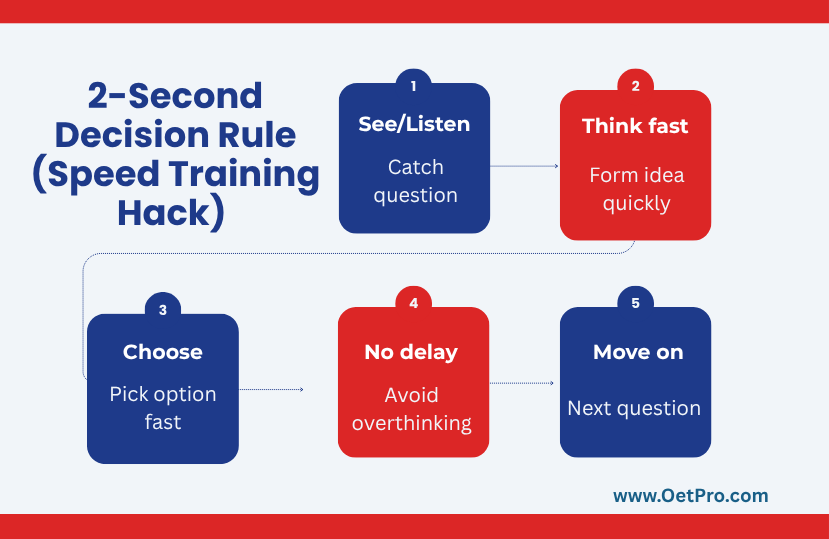
2. 2-Second Decision Rule
During practice:
- Give yourself max 2 seconds per question decision
- Force quick elimination
- Avoid re-reading options repeatedly
This trains real exam speed pressure
3. Micro Listening Drills (Speed Boost Training)
Instead of full tests:
- Listen to 10–20 second clips
- Answer immediately
- Focus only on key meaning
This improves real-time processing speed dramatically
4. Forced Elimination Practice
Before choosing answer:
- Remove 2 clearly wrong options first
- Compare remaining options quickly
- Select based on strongest meaning match
Reduces hesitation time
Exam Pressure Handling System
Speed fails under pressure when the brain becomes emotional instead of logical.
Pressure Problem Pattern
Most candidates:
- Panic after missing one answer
- Slow down mentally
- Lose focus in next questions
- Enter confusion cycle
Pressure Control Solution
Rule 1: No Recovery Thinking
- Do NOT try to recover missed answers
- Move forward immediately
Rule 2: Reset Between Questions
- Each question is a fresh start
- No mental carryover
Rule 3: Neutral Mind Mode
- No panic
- No excitement
- No frustration
Emotional neutrality = stable speed
Real Performance Optimization System
To reach 350+, you must combine speed + accuracy into one system.
Stage 1: Controlled Speed Practice
- Practice answering quickly
- Accept minor mistakes
- Build reaction speed
Stage 2: Accuracy Stabilization
- Review errors
- Fix misunderstanding patterns
- Improve elimination strategy
Stage 3: Integrated Speed-Accuracy Flow
- Full mock tests under real conditions
- Maintain speed without losing accuracy
- Apply elimination system automatically
Why Most Candidates Stay Slow
Common reasons:
- Overthinking every option
- Fear of making mistakes
- Trying to understand every word
- Lack of speed training exposure
Result: slow decision loop.
Summary
OET Listening Speed & Accuracy Optimization is not about rushing through questions. It is about building a structured decision system that works under pressure.
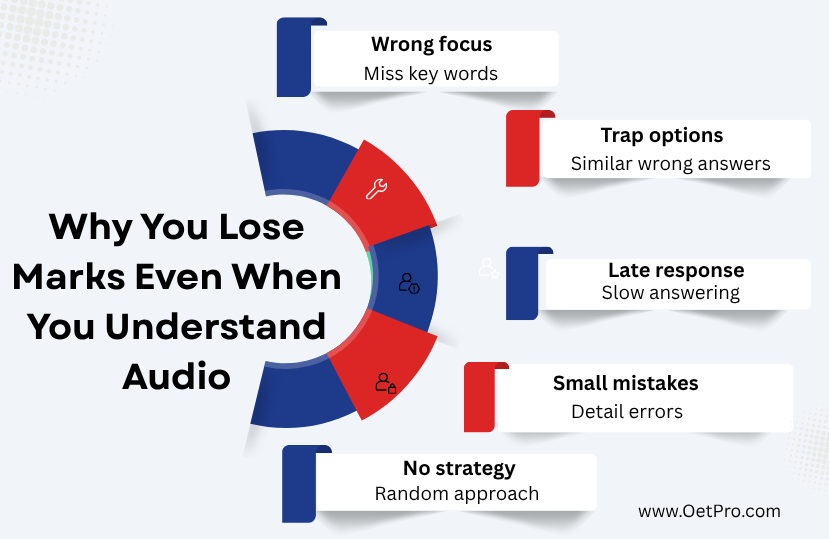
Most candidates already understand the audio, but they lose marks because:
- They think too slowly during decision-making
- They hesitate between similar options
- They fail to eliminate wrong answers quickly
- They lose accuracy when trying to be too careful
High scorers solve this by combining:
- Fast recognition of meaning
- Structured elimination of options
- Controlled decision-making under time pressure
The goal is not just speed or accuracy it is balanced real-time performance.
Final Checklist (Before & During Exam)
Before Exam (Speed Preparation)
- Practice micro listening drills (10–20 sec clips)
- Train elimination-based answering
- Build keyword-to-meaning mapping speed
- Practice 2-second decision rule
During Exam (Real-Time Execution)
- Identify question type instantly
- Focus only on key signals (keywords + tone)
- Eliminate wrong options quickly
- Avoid overthinking after understanding
- Commit to answer without hesitation
Pressure Control Checklist
- Do not revisit missed answers
- Do not pause mentally on one question
- Reset focus after every question
- Maintain neutral emotional state
FAQs
1. Why do I lose time even when I understand audio?
Because understanding is not the issue slow decision-making is the problem.
2. Should I prioritize speed or accuracy?
Neither alone. OET Listening requires balanced speed and accuracy together.
3. How can I improve decision speed?
Use elimination techniques and 2-second decision training during practice.
4. Why do I hesitate between two options?
Because you are comparing too deeply instead of focusing on overall meaning match.
5. Can speed training reduce accuracy?
Not if trained properly. Structured elimination actually improves accuracy over time.
Practice Plan (7-Day Speed & Accuracy System)
Day 1 — Micro Drills
- 10–20 second audio clips
- Instant answering practice
- Focus on speed only
Day 2 — Elimination Training
- Practice removing wrong options first
- Compare remaining answers quickly
Day 3 — Decision Speed Practice
- Apply 2-second rule per question
- No overthinking allowed
Day 4 — Mixed Listening Practice
- Combine Part A, B, C questions
- Apply speed system consistently
Day 5 — Full Mock Test (Speed Focus)
- Attempt full test under real conditions
- Focus on quick decision flow
Day 6 — Error + Speed Analysis
- Identify slow decision points
- Fix hesitation patterns
Day 7 — Final Simulation Test
- Full exam simulation
- Balance speed + accuracy system
Conclusion
OET Listening success is not just about understanding English. It is about how quickly and correctly you process information under pressure.
If you improve:
- Recognition speed
- Elimination ability
- Decision confidence
Your score naturally increases without extra effort.
The difference between average and high scorers is simple:
- Average candidates think carefully but slowly
- High scorers think fast, structured, and confidently