OET Listening Part C (2026): Master Inference, Opinion & Long Healthcare Conversations Strategy
Introduction
OET Listening Part C is the most intellectually demanding section of the listening test.
Here, you will listen to long healthcare discussions between professionals, such as:
- Doctors discussing treatment options
- Nurses reviewing patient cases
- Healthcare teams debating decisions
- Professional meetings and clinical reflections
Unlike Part A and Part B, Part C does NOT test simple facts.
It tests your ability to understand:
meaning, opinion, attitude, and inference
This is where many candidates lose marks not because they don’t understand English, but because they miss hidden meaning.
Learning Objectives
By the end of this lesson, you will be able to:
- Understand the structure of OET Listening Part C
- Identify opinions vs facts in long conversations
- Answer inference-based questions accurately
- Track multiple speakers and viewpoints
- Avoid confusion caused by distractors and changes in opinion
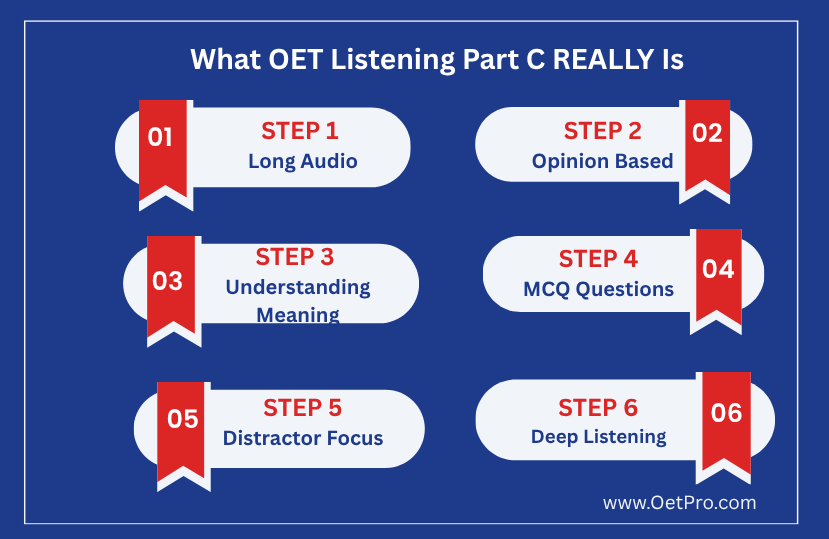
Overview of OET Listening Part C
Part C includes longer recordings with deeper meaning.
Key Features
- 2 long extracts
- 6 questions per extract (12 total)
- Multiple-choice format
- Focus on opinion, attitude, and inference
- Audio played only once
What Makes Part C Difficult
Part C is challenging because:
- Speakers change opinions
- Ideas are indirect (not clearly stated)
- Multiple viewpoints exist
- Information is embedded in long speech
- Distractors are very realistic
You must “read between the lines”.
What You Are Really Tested On
Part C is NOT testing:
- Vocabulary memorization
- Simple facts
- Spelling
It IS testing:
- Understanding speaker attitude
- Identifying agreement/disagreement
- Inferring meaning from context
Recognizing implied information
Common Mistakes in Part C
1. Taking Everything Literally
Candidates assume:
- Everything spoken is true
- Every statement is final
Wrong approach.
Speakers often:
- Change opinions
- Compare options
- Discuss possibilities
2. Ignoring Speaker Attitude
Tone matters more than words:
- hesitation -> uncertainty
- agreement -> approval
- criticism -> concern
- enthusiasm -> preference
3. Confusing Multiple Speakers
You may hear:
- doctor
- nurse
- specialist
Each may have different opinions.
Mixing them = wrong answer
4. Choosing First Heard Idea
Many candidates choose:
- first opinion
instead of - final conclusion
Final idea is usually correct.
5. Overloading Memory
Trying to remember everything leads to confusion.
Focus only on:
- main idea
- speaker opinion
- final decision
Key Insight for Success
Part C is not about hearing it is about interpreting.
You must think like a clinician in discussion:
- What does each speaker believe?
- Do they agree or disagree?
- What is the final conclusion?
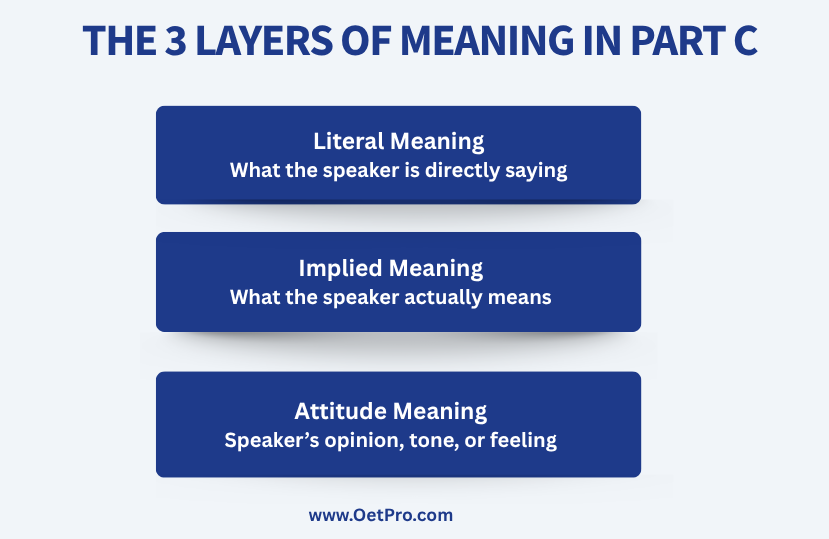
The Core Skill: You Don’t “Hear” Answers You Infer Them
In OET Listening Part C, answers are rarely stated directly.
Instead, they are:
- suggested
- implied
- compared
- modified over time
Your job is to decode meaning, not catch words.
The I.N.F.E.R Framework for Part C
Use this system for every question:
I — Identify Speakers Clearly
First, know WHO is speaking:
- Doctor
- Nurse
- Specialist
- Researcher
Never mix viewpoints.
N — Notice Opinion Words
Look for soft opinion signals:
- “I think…”
- “I feel…”
- “It seems…”
- “We might…”
These indicate belief, not fact
F — Follow Changes in Opinion
Speakers often change their minds:
“At first I thought X… but now I believe Y.”
Final opinion = correct answer
E — Extract Meaning, Not Words
Do NOT focus on keywords.
Focus on:
- intention
- suggestion
- conclusion
Meaning > vocabulary
R — Recognize Inference
Inference means:
What is implied but NOT directly said?
Example:
- “This option may be too risky…”
Inference = not recommended
Speaker Mapping System (Very Important)
When multiple speakers talk:
Track this pattern:
- Speaker A -> Opinion 1
- Speaker B -> Opinion 2
- Speaker C -> Final decision
Always identify:
- agreement
- disagreement
- final conclusion
Real Exam Example 1
Situation
Doctors discussing treatment options.
Question
What does the second doctor think about Option A?
A. It is the best choice
B. It is too risky
C. It should be used immediately
Audio Idea
“I understand why you suggest Option A, but I worry it might have side effects…”
Correct Answer
B. It is too risky
Why?
- “I worry” = concern
- “side effects” = risk
- Not support
Real Exam Example 2
Situation
Nurse and doctor discussing patient care.
Audio Idea
“At first we considered discharge today, but now I think we should observe for another day.”
Correct Answer
Observe for another day
Key Insight
Always choose final decision, not initial thought.
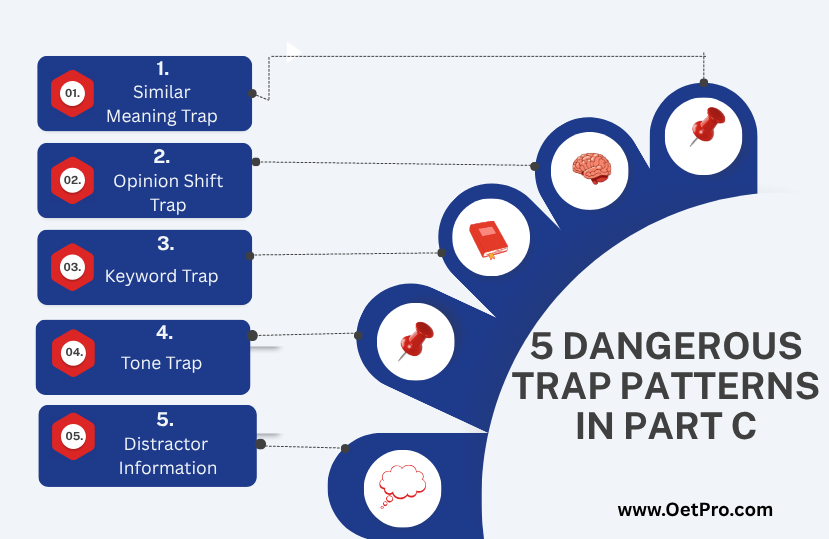
Common Trap Pattern in Part C
Trap 1: Partial Agreement
Speakers say:
- “I agree, but…”
But = contradiction -> important
Trap 2: Old vs New Opinion
Candidates choose:
- first opinion
Instead of: - updated opinion
Trap 3: Emotional Tone
- hesitation = doubt
- enthusiasm = preference
- concern = rejection
Key Strategy for Part C Mastery
Listen for CHANGES, not just statements
You must track:
- how opinions evolve
- what is finally accepted
- what is rejected
Advanced Listening Skills for High Scores
At the OET Listening Part C level, success depends on how you think while listening, not just what you hear.
1. Think in “Clinical Logic”
Instead of translating words, think like a healthcare professional:
- What is the problem?
- What are the options?
- What is the safest decision?
This mindset helps you decode meaning quickly.
2. Track Opinion Shifts
Speakers often change their mind:
- “I initially thought…”
- “However, now I feel…”
Always select the final position, not the first idea.
3. Identify Soft Language Signals
These phrases are important:
- “It might be…” -> uncertainty
- “We could consider…” -> suggestion
- “I’m not convinced…” -> disagreement
- “That seems reasonable…” -> partial agreement
These guide correct answers.
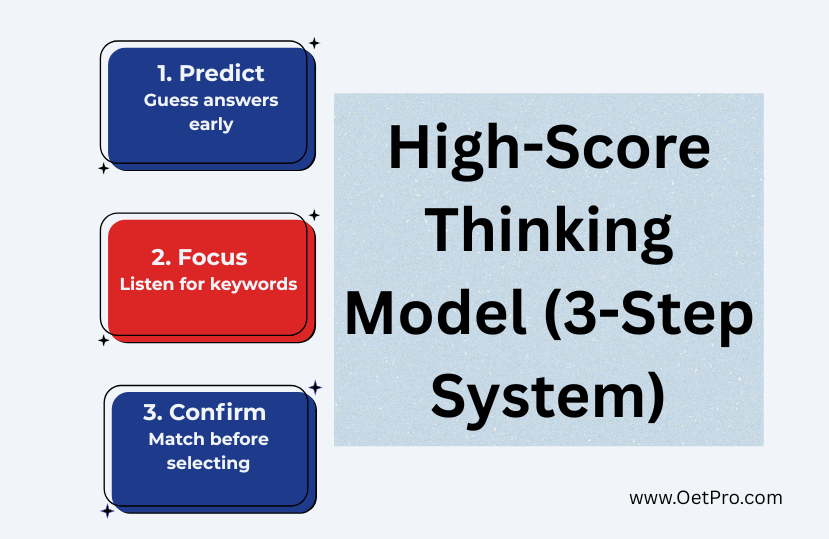
Examiner Insights (How Marks Are Actually Decided)
Understanding examiner logic gives you a major advantage.
1. Answers Are Designed to Be “Close but Wrong”
Most incorrect options:
- sound logical
- include keywords
- match part of audio
But they miss final meaning
2. Inference Is Mandatory
You will NOT hear direct answers.
You must infer:
- intention
- attitude
- conclusion
3. First Impression Is Often Wrong
Candidates often:
- choose first familiar idea
- ignore later clarification
Correct answers often come after a change in speech
4. Context Matters More Than Words
Same word can mean different things:
- “fine” -> acceptable OR minimal concern
- “monitor” -> observe OR delay action
High-Frequency Vocabulary for Part C
Opinion Words
- suggest
- believe
- assume
- doubt
- prefer
- recommend
Decision Words
- conclude
- decide
- agree on
- rule out
- proceed with
Uncertainty Language
- possibly
- might
- could
- not sure
- unclear
Disagreement Signals
- however
- but
- although
- I’m not convinced
- on the other hand
Practice Drill (Inference-Based MCQ)
Situation
Doctors discussing treatment options.
Question
What is the final opinion about Treatment B?
A. It should be started immediately
B. It is not suitable for the patient
C. It is the best long-term option
Audio Idea
“At first I thought Treatment B was ideal, but given the patient’s condition, I’m not so sure anymore.”
Correct Answer
B. It is not suitable for the patient
Why?
- “not so sure anymore” = rejection
- Final shift = negative decision
Common Scoring Mistakes to Avoid
1. Choosing the First Opinion
Wrong: initial statement
Correct: final conclusion
2. Ignoring “However” Statements
“However” often changes everything.
3. Mixing Speakers’ Opinions
Each speaker = separate viewpoint
Do not merge them.
4. Over-Focusing on Keywords
Keywords alone NEVER guarantee correct answers.
Daily 15-Minute Practice Method
Follow this daily:
- Listen to 1 Part C audio
- Identify speaker opinions
- Mark “first vs final opinion”
- Solve MCQs
- Review mistakes
Final Summary: What You Must Master
OET Listening Part C is the highest-level thinking section of the Listening test.
It does NOT test:
- simple facts
- spelling
- direct answers
It DOES test:
- inference
- opinion
- attitude
- final decisions
Success comes from understanding meaning beyond words
Final Exam Checklist
Before Listening
- Identify speakers (doctor, nurse, specialist)
- Read question stem carefully
- Predict topic and possible opinions
During Listening
- Focus on meaning, not vocabulary
- Track opinion changes
- Listen for “however / but / now I think”
- Separate each speaker’s view
After Listening
- Choose final decision, not first idea
- Eliminate partially correct options
- Trust contextual meaning
7-Day Mastery Plan (Part C Focus)
Day 1–2: Foundation
- Understand Part C format
- Learn inference basics
- Practice short discussions
Day 3–4: Skill Building
- Identify opinion vs fact
- Track speaker changes
- Solve MCQs slowly
Day 5: Exam Simulation
- Full Part C practice tests
- Time-based listening
Day 6: Error Correction
- Analyze wrong answers
- Identify trap patterns
Day 7: Final Revision
- Light practice
- Focus on confidence building
Common Mistakes Summary
- Choosing first opinion
- Ignoring “however” statements
- Mixing speakers’ views
- Focusing on keywords only
- Missing final conclusion
FAQs (High-Yield Exam Questions)
1. Is OET Listening Part C the hardest section?
Yes. It is the most advanced section because it tests inference and opinion, not direct answers.
2. How many questions are in Part C?
There are 12 MCQs total (2 long extracts).
3. Do I need to understand every word?
No.
You only need to understand:
- main idea
- speaker attitude
- final decision
4. What is the key to scoring high?
- Tracking opinion changes
- Understanding final conclusion
- Avoiding keyword traps
5. Can I improve quickly?
Yes, if you practice:
- inference questions daily
- workplace discussions
- MCQ elimination techniques
_.png "Speaker_Tracking_System_(Must-Use_Skill)_.png")
Final Conclusion
OET Listening Part C is not about listening harder.
It is about thinking smarter.
Once you learn to:
- detect opinions
- track changes
- understand final decisions
Your score improves significantly.