OET Scoring System & Grade Conversion Explained (2026)
Introduction
Receiving your OET results can be exciting but they can also be confusing if you don't understand how the scoring system works.
Many candidates focus only on whether they achieved a particular grade, without understanding:
- How each skill is assessed
- What the numerical scores mean
- Why different skills can receive different grades
- How to use the score report to improve future performance
Understanding the OET scoring system is essential because it helps you interpret your results accurately and identify the areas that need the most attention.
In this lesson, you'll learn how OET scores are reported, what each grade represents, and how to use your score report to create a smarter preparation plan.
Why Understanding OET Scores Matters
Your OET score is more than just a number.
It provides detailed feedback on your ability to communicate in professional healthcare settings.
Unlike some exams that provide a single overall result, OET reports separate scores for Listening, Reading, Writing, and Speaking. This allows you to identify your strengths and focus your preparation where it is needed most.
For example:
- A nurse may perform strongly in Speaking but need improvement in Writing.
- A pharmacist may achieve excellent Reading results but require additional Listening practice.
Knowing how to interpret these results helps you study more efficiently instead of repeating the same preparation across all four skills.
How the OET Scoring System Works
Each of the four language skills is assessed independently.
You receive:
- One numerical score for Listening
- One numerical score for Reading
- One numerical score for Writing
- One numerical score for Speaking
These scores are reported on a 0–500 scale and are then represented by a corresponding grade.
There is no single combined overall score. Instead, each skill reflects your performance in that specific area of communication.
This approach gives healthcare regulators and employers a clearer picture of your professional English abilities.
Understanding the OET Score Scale
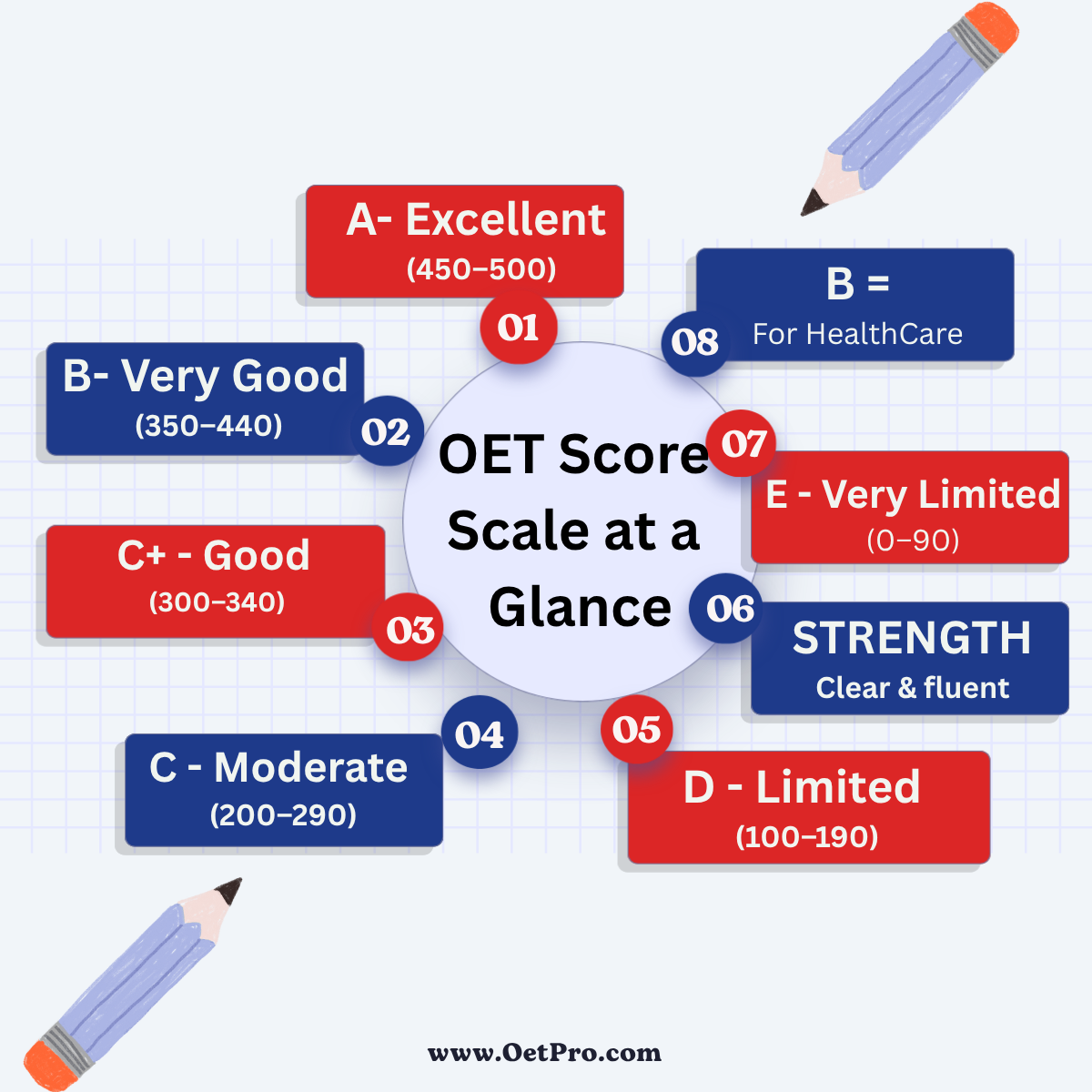
The table below provides a general guide to how numerical scores correspond to grades.
| Score Range | Grade | General Interpretation |
|---|---|---|
| 450–500 | A | Excellent professional English communication |
| 350–440 | B | High standard of professional communication |
| 300–340 | C+ | Good communication with occasional limitations |
| 200–290 | C | Adequate communication in familiar situations |
| 100–190 | D | Limited professional communication |
| 0–90 | E | Very limited communication ability |
Important: Different healthcare regulators, employers, and registration authorities may require different minimum grades. Always check the current requirements of the organisation you are applying to.
Why OET Uses Individual Skill Scores
Healthcare professionals use different communication skills throughout their daily work.
For example:
- Listening is essential when gathering patient information.
- Reading is important for understanding clinical guidelines and reports.
- Writing is required for referral and discharge letters.
- Speaking is necessary for consultations, patient education, and teamwork.
Assessing each skill separately provides a more accurate reflection of real-world professional communication.
Common Misconceptions About OET Scoring
Many candidates misunderstand how OET results are reported.
Let's clarify some common myths.
Myth 1: OET gives one overall score.
Reality: Each of the four language skills receives its own numerical score and grade.
Myth 2: All skills are weighted together.
Reality: Listening, Reading, Writing, and Speaking are assessed independently.
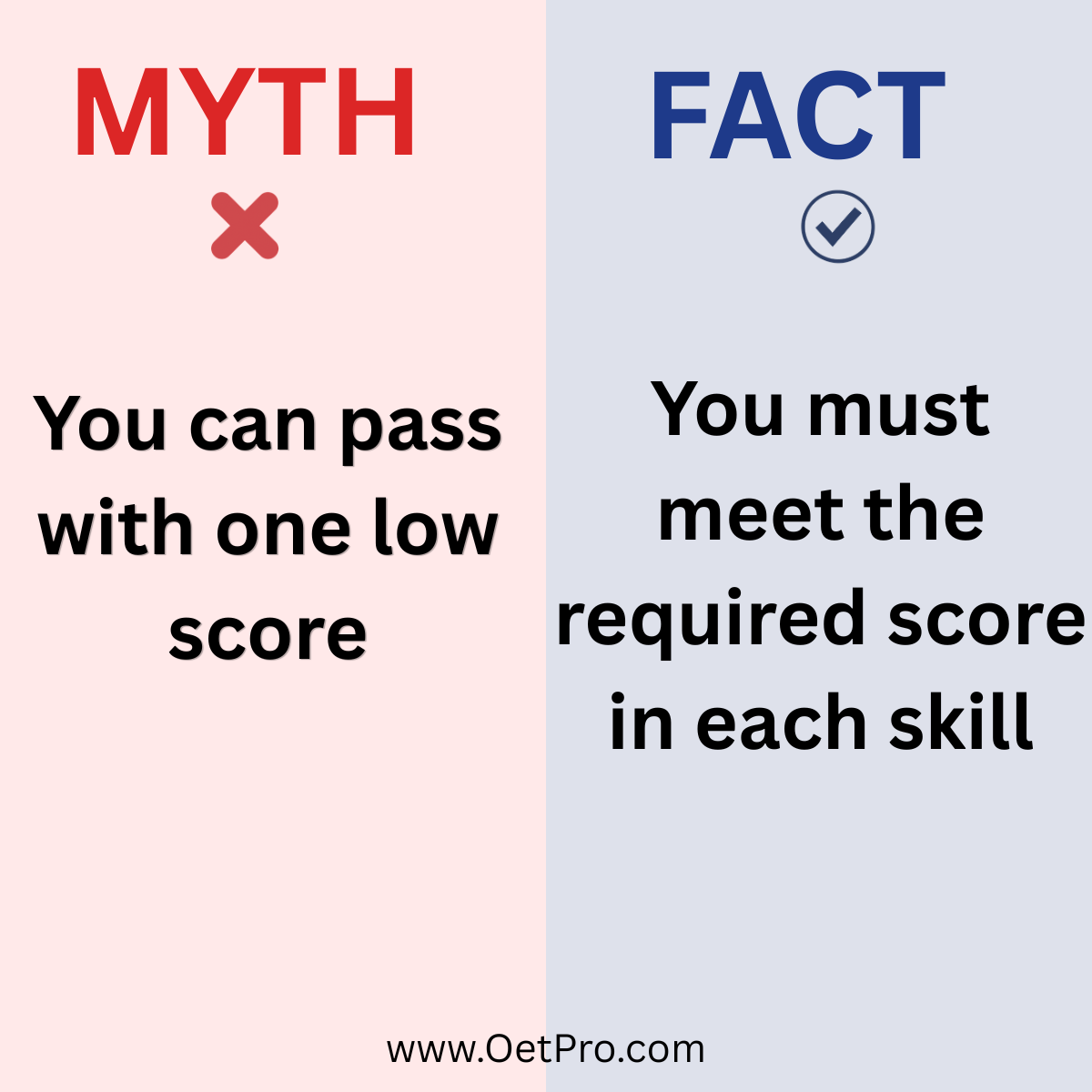
Myth 3: A higher score in one skill can compensate for a lower score in another.
Reality: Many healthcare regulators require candidates to achieve the required grade in each individual skill, not simply an average across all four.
Myth 4: Grade B means perfect English.
Reality: Grade B indicates a high standard of professional English suitable for many healthcare contexts, but it does not imply perfect language use.
Myth 5: Only the numerical score matters.
Reality: Both the numerical score and the corresponding grade help interpret your level of professional communication.
Understanding Your OET Score Report
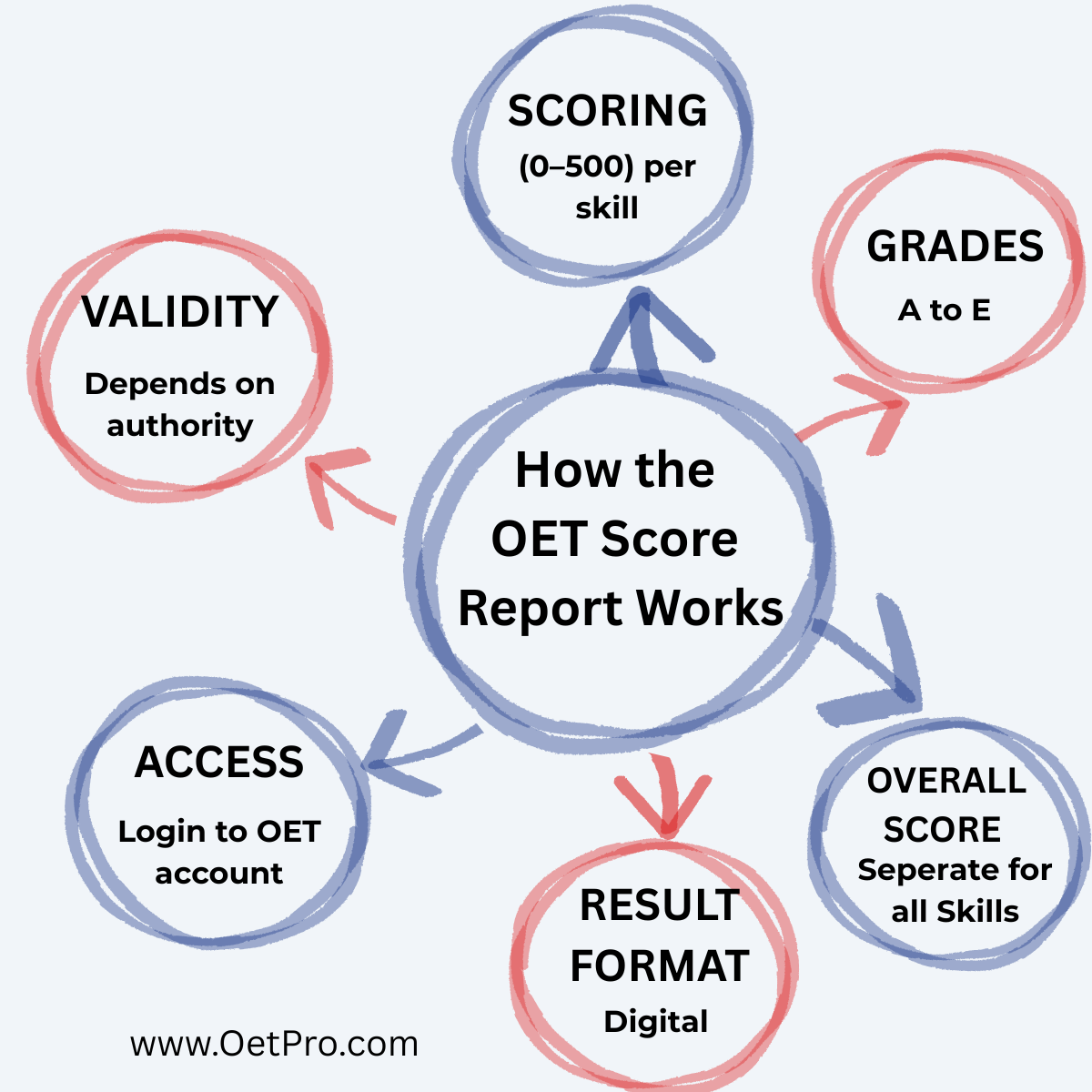
After completing the OET, you'll receive a score report showing your performance in each of the four language skills.
Rather than receiving one overall grade, you'll see four individual results:
- Listening
- Reading
- Writing
- Speaking
Each skill includes:
- A numerical score (0–500)
- A corresponding grade (A to E)
This allows you to identify exactly where your strengths and improvement areas lie.
How OET Scores Are Reported
Your results are reported independently for each language skill.
| Skill | Score Reported Separately? | Why It Matters |
|---|---|---|
| Listening | Measures your ability to understand spoken healthcare communication | |
| Reading | Assesses comprehension of medical and workplace texts | |
| Writing | Evaluates profession-specific written communication | |
| Speaking | Measures effective patient and professional interaction |
Because each skill reflects a different aspect of professional communication, improving one skill does not automatically improve another.
Understanding the Grade Scale
The OET grade scale helps translate your numerical score into an easily understood level of English proficiency.
| Grade | Typical Score Range | General Description |
|---|---|---|
| A | 450–500 | Excellent professional communication with a high degree of fluency and accuracy |
| B | 350–440 | Strong professional communication suitable for many healthcare settings |
| C+ | 300–340 | Good communication with occasional limitations in more demanding situations |
| C | 200–290 | Adequate communication in familiar healthcare contexts |
| D | 100–190 | Limited communication requiring significant improvement |
| E | 0–90 | Very limited ability to communicate effectively in professional settings |
These descriptions are intended as a general guide. Specific organisations may have their own minimum score or grade requirements.
Sample OET Score Report
The example below illustrates how individual skill results might appear.
| Skill | Score | Grade |
|---|---|---|
| Listening | 380 | B |
| Reading | 360 | B |
| Writing | 330 | C+ |
| Speaking | 370 | B |
What This Means
This candidate demonstrates strong Listening, Reading, and Speaking skills.
However, Writing is comparatively weaker, suggesting that future preparation should focus on:
- Selecting relevant case notes
- Organising information logically
- Maintaining an appropriate professional tone
This type of analysis helps create a targeted study plan instead of practising every skill equally.
How Healthcare Regulators Use OET Scores
Healthcare organisations often review each skill individually rather than considering only the highest score.
For example, an employer or registration authority may require candidates to achieve a specified minimum grade in:
- Listening
- Reading
- Writing
- Speaking
Meeting the requirement in three skills may not be sufficient if one skill falls below the required standard.
For this reason, balanced preparation across all four sections is essential.
Understanding Skill Profiles
Your score report tells a story about your communication strengths.
Profile 1: Strong Communicator
| Listening | Reading | Writing | Speaking |
|---|---|---|---|
| B | B | B | B |
A consistent profile suggests balanced communication skills across all areas.
Profile 2: Writing Needs Improvement
| Listening | Reading | Writing | Speaking |
|---|---|---|---|
| B | B | C+ | B |
This candidate should concentrate on letter organisation, relevant information selection, and professional tone.
Profile 3: Speaking Requires More Practice
| Listening | Reading | Writing | Speaking |
|---|---|---|---|
| B | B | B | C+ |
Improvement should focus on:
- Building rapport
- Demonstrating empathy
- Explaining information clearly
- Responding naturally during role-plays
Using Your Results to Plan Your Study
Instead of repeating the same study routine every day, let your score report guide your preparation.
If Listening Is Your Lowest Skill
Focus on:
- Healthcare consultations
- Different English accents
- Note-taking exercises
If Reading Is Your Lowest Skill
Prioritise:
- Timed reading practice
- Skimming and scanning
- Medical vocabulary in context
If Writing Is Your Lowest Skill
Practise:
- Referral and discharge letters
- Selecting relevant case notes
- Paragraph organisation
- Appropriate professional language
If Speaking Is Your Lowest Skill
Work on:
- Role-play practice
- Patient-centred communication
- Active listening
- Confidence under timed conditions
Expert Tip
Avoid comparing your scores with other candidates.
Instead, compare your current performance with your previous results.
Consistent improvement in each skill is a far more effective indicator of progress than focusing only on achieving a particular grade.
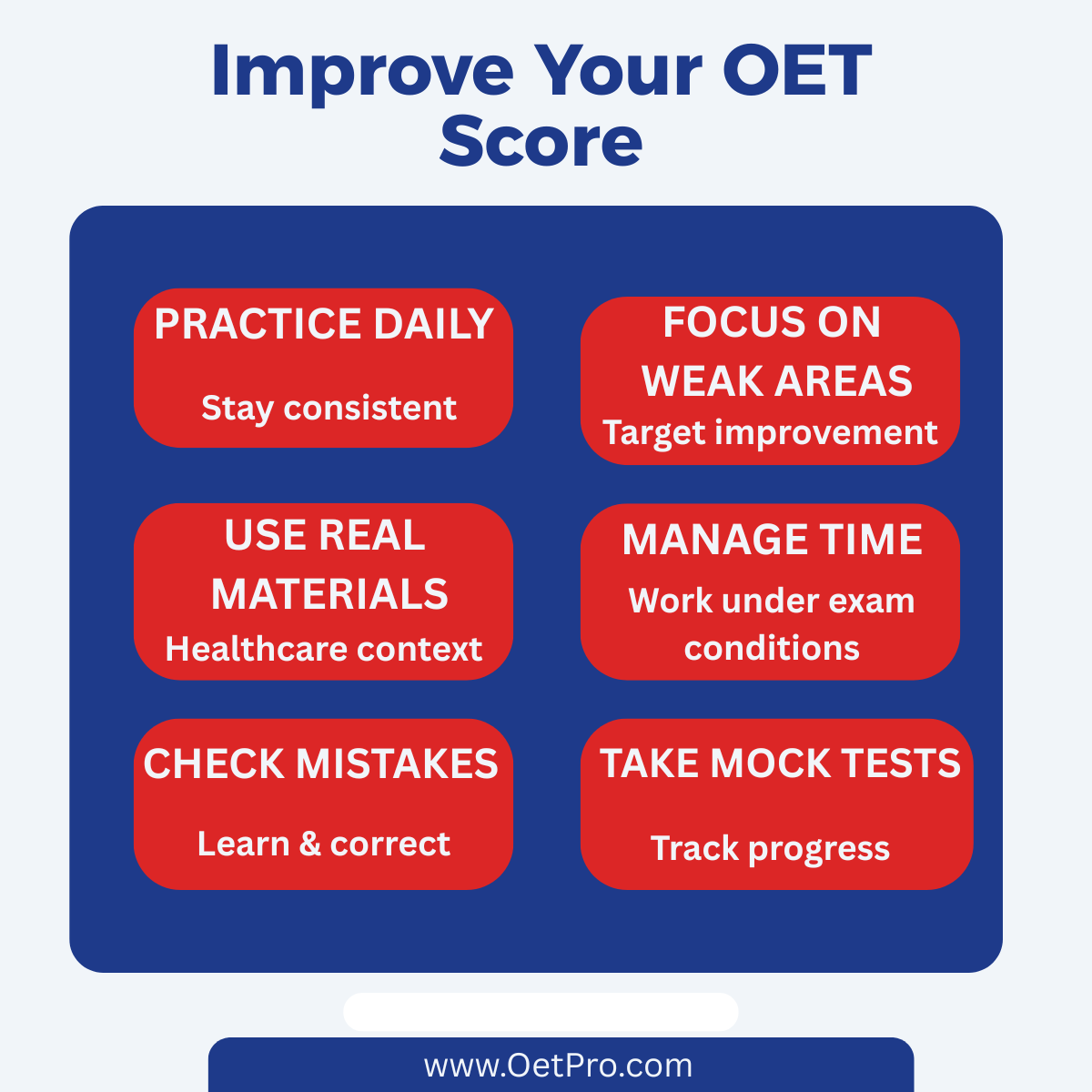
How to Improve Your OET Score
Understanding your score is only the first step. The next step is using that information to improve.
High-scoring candidates don't simply practise more they practise with purpose. They identify weak areas, work on specific communication skills, and regularly review their progress.
Examiner Insights
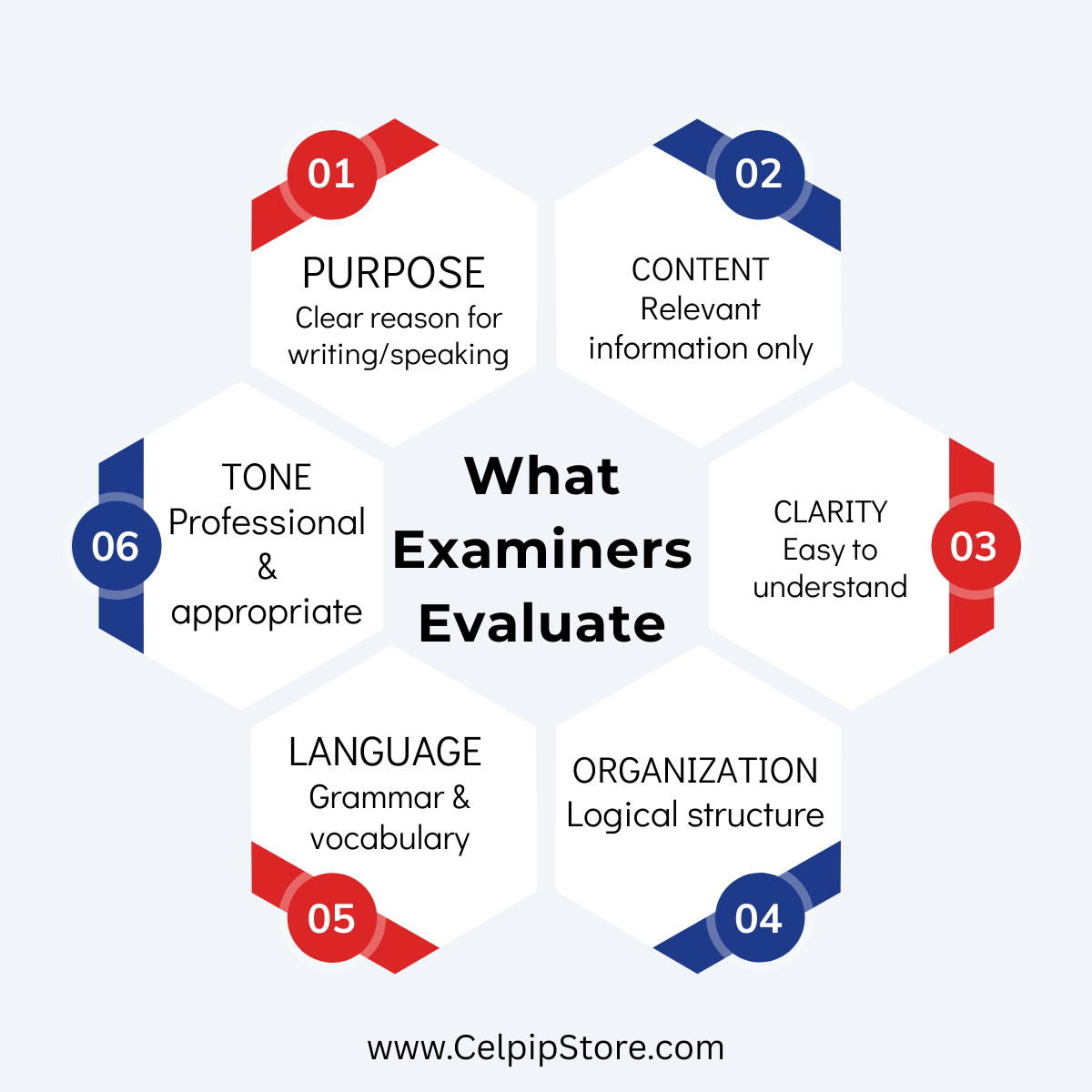
Although each OET section has its own assessment criteria, examiners consistently look for one thing:
Can you communicate effectively in a professional healthcare environment?
Strong candidates demonstrate clear, accurate, and appropriate communication that matches the purpose of the task.
Listening
High-Scoring Candidates
- Focus on the speaker's meaning rather than individual words.
- Identify important clinical details.
- Follow the conversation from beginning to end.
- Recognise attitudes and opinions where relevant.
Common Reasons for Lower Scores
- Missing key information
- Losing concentration
- Focusing on unfamiliar vocabulary instead of the overall message
Reading
High-Scoring Candidates
- Read strategically rather than line by line.
- Locate important information quickly.
- Understand vocabulary from context.
- Manage time effectively across all parts.
Common Reasons for Lower Scores
- Spending too long on difficult questions
- Reading every sentence in detail
- Poor time management
Writing
High-Scoring Candidates
- Identify the purpose of the letter immediately.
- Select only relevant case notes.
- Present information logically.
- Maintain a professional tone throughout.
Common Reasons for Lower Scores
- Including unnecessary information
- Poor organisation
- Unclear purpose
- Inappropriate tone for the intended reader
Speaking
High-Scoring Candidates
- Build rapport with the patient.
- Demonstrate empathy naturally.
- Explain medical information clearly.
- Respond flexibly to the role-play rather than relying on memorised scripts.
Common Reasons for Lower Scores
- Sounding rehearsed
- Speaking too quickly
- Ignoring patient concerns
- Using overly complex language
Practical Score Improvement Strategies
Strategy 1: Analyse Your Score Report
After every practice test, ask yourself:
- Which skill received the lowest score?
- Why did I lose marks?
- Which assessment criteria need improvement?
Targeted reflection leads to more efficient preparation.
Strategy 2: Focus on One Improvement Goal at a Time
Instead of trying to improve everything at once, choose one specific objective.
Examples:
- Improve note-taking in Listening.
- Increase reading speed.
- Write clearer opening paragraphs.
- Practise showing empathy in Speaking.
Small improvements accumulate over time.
Strategy 3: Simulate Real Exam Conditions
Practise under conditions that resemble the actual exam.
- Use official time limits.
- Complete tasks without interruptions.
- Review your performance immediately afterwards.
- Keep a record of recurring mistakes.
Strategy 4: Seek Constructive Feedback
Self-study is valuable, but feedback helps you identify issues you may not notice yourself.
Consider asking a teacher, mentor, or study partner to review:
- Writing organisation
- Speaking clarity
- Tone and professionalism
- Grammar patterns that affect communication
Functional Language That Supports Higher Scores
Strong communication is not about using complicated vocabulary. It is about using language that is clear, appropriate, and effective.
Useful Expressions for Writing
Introducing the Purpose
- I am writing to refer...
- Thank you for reviewing...
- I would appreciate your assessment of...
Presenting Information
- The patient has a history of...
- Recent investigations showed...
- Current treatment includes...
Requesting Follow-up
- Please continue management as appropriate.
- Further assessment is recommended.
- Kindly review the patient at your earliest convenience.
Useful Expressions for Speaking
Showing Empathy
- I understand why you're concerned.
- That sounds difficult.
- Let's work through this together.
Explaining Clearly
- Let me explain what this means.
- Here's what we recommend.
- The next step is...
Checking Understanding
- Does that make sense?
- Is there anything you'd like me to explain again?
- What questions do you have?
Practice Activities
Activity 1: Interpret a Score Report
Review a practice score report and identify:
- Strongest skill
- Weakest skill
- Priority area for improvement
- One action for the next study session
Activity 2: Writing Reflection
After completing a referral letter, ask yourself:
- Did I clearly state the purpose?
- Did I include only relevant information?
- Is the tone appropriate for the reader?
Activity 3: Speaking Self-Assessment
Record a two-minute role-play and evaluate:
- Clarity
- Empathy
- Organisation
- Fluency
- Confidence
Repeat the activity after making improvements.
Activity 4: Weekly Progress Log
At the end of each week, record:
- Practice hours completed
- Mock test results
- Strongest skill
- Weakest skill
- Goal for the following week
Tracking progress over time helps you stay focused and motivated.
Self-Assessment Checklist
Before moving to the next lesson, check that you can confidently answer "Yes" to the following:
- I understand how OET scores are reported.
- I know what each grade represents.
- I can interpret an OET score report.
- I know which skill needs the most improvement.
- I have a clear plan for my next stage of preparation.
If any answer is "No", revisit the relevant section before continuing.
Summary
Understanding the OET scoring system helps you interpret your results accurately and prepare more effectively for future exams.
Unlike tests that provide a single overall score, OET evaluates Listening, Reading, Writing, and Speaking separately. This approach reflects the reality of healthcare communication, where each language skill plays a distinct role in patient care and professional practice.
Your score report is more than a record of your performance it is a roadmap for improvement. By identifying your strongest and weakest skills, you can focus your study time where it will have the greatest impact.
Quick Revision Table
| Concept | Key Point |
|---|---|
| Score Scale | Each skill receives a score from 0–500 |
| Grades | Scores correspond to Grades A–E |
| Overall Score | No combined overall score is awarded |
| Skill Assessment | Listening, Reading, Writing, and Speaking are assessed independently |
| Best Improvement Strategy | Analyse each skill separately and target your weakest areas |
OET Score Interpretation Checklist
Use this checklist after receiving your results.
Understanding Your Results
- I know my score in each skill.
- I understand what my grades represent.
- I can identify my strongest skill.
- I know which skill requires the most improvement.
Planning Your Next Steps
- I have reviewed my performance objectively.
- I have created a study plan based on my weakest skill.
- I am practising under timed conditions.
- I am seeking regular feedback on Writing and Speaking.
Common Score Interpretation Mistakes
- Focusing Only on One Grade
Look at all four skills together to understand your overall communication profile.
- Assuming All Grades Are Equal
Different skills may require different preparation strategies.
- Ignoring Your Weakest Skill
Improving your strongest skill further may have less impact than strengthening your weakest one.
- Studying Without a Plan
Let your score report guide your preparation priorities.
Weekly Improvement Plan
Monday
Review your most recent score report and identify one improvement goal.
Tuesday
Complete a Listening or Reading practice session and note recurring errors.
Wednesday
Write one profession-specific healthcare letter and review it against the assessment criteria.
Thursday
Complete two Speaking role-plays focusing on empathy, clarity, and patient-centred communication.
Friday
Review vocabulary commonly used in healthcare consultations, referrals, and clinical documentation.
Saturday
Take a timed mini mock test and compare your results with previous attempts.
Sunday
Reflect on your progress, update your study log, and set goals for the coming week.
Frequently Asked Questions
Does OET provide one overall score?
No. OET reports separate scores and grades for Listening, Reading, Writing, and Speaking. There is no single combined overall score.
What is the highest OET grade?
The highest grade is Grade A, which represents excellent professional English communication.
Can I receive different grades in different skills?
Yes. It is common for candidates to achieve different grades across the four language skills because each skill is assessed independently.
Which skill should I improve first?
Start with the skill where your score is lowest or where you consistently experience difficulty in practice. A targeted improvement plan is generally more effective than dividing equal time across all skills.
Do employers and regulators consider every skill?
Many healthcare regulators and employers review each language skill separately. Always check the specific requirements of the organisation or registration authority you are applying to.
Conclusion
The OET scoring system is designed to measure how effectively you communicate in professional healthcare settings across four essential language skills.
By understanding how scores and grades are reported, you can interpret your results with confidence, set realistic learning goals, and develop a preparation strategy tailored to your individual needs.
Remember that your score report is not simply an outcome it is a valuable learning tool. Use it to monitor your progress, refine your study plan, and build the communication skills required for success in both the OET exam and your healthcare career.